On this page
The Matsya Avatar
Satyavrata was a rajarshi, a king who had turned his throne into an austerity. He had given up food altogether and lived on water alone, holding his mind on Narayana through every watch of the day. Each morning he waded into the Kritamala river until the cold reached his calves, joined his palms, and poured water for his ancestors, the tarpana a living man owes the dead who made him, offered handful by handful back into the current. The water trembled in his cupped hands, drops threading down between his fingers, and the mantra moved on his lips without a break.
One morning he filled his cupped palms, raised them, and felt something move against his skin.
A fish. A tiny shaphari, no longer than the last joint of his finger, swept into his hands along with the river water, flicking this way and that against the walls of his palms.
He turned his hands to pour it back into the current. A voice came then, so thin that at first he took it for a trick of his own ears.
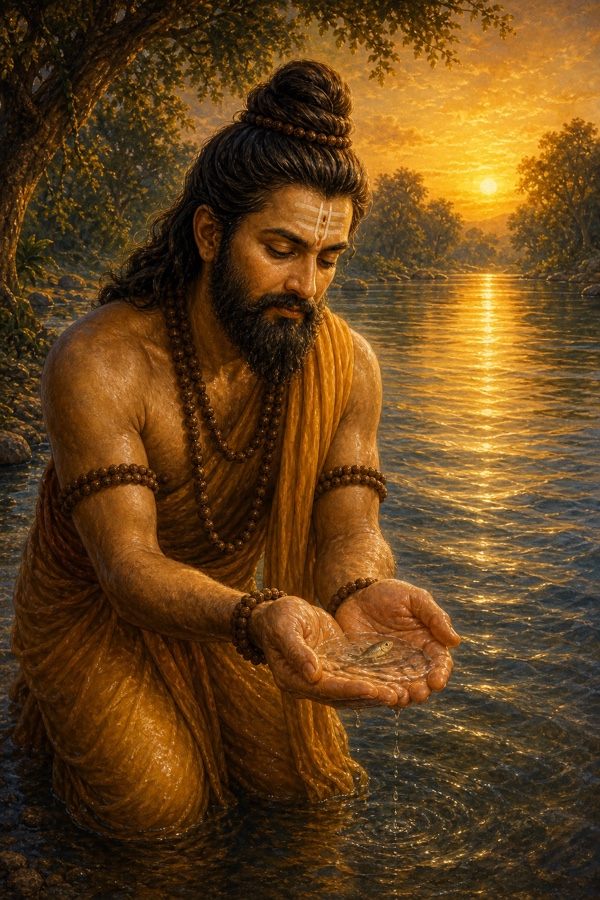
“Rajan, do not throw me back into that water. I am small and helpless, and the creatures of this river kill and swallow their own kind. You are called the friend of the afflicted. Take me with you.”
Satyavrata’s hands went still, the river running past his wrists. Fish do not speak; a lifetime on this bank had taught him that much. But his heart was a plain, straight instrument, and it had never learned to refuse a cry for help. What he could not know was who had come into his palm. When the Vedas, the gods, the righteous, or the helpless stand in danger, the Lord puts on whatever body the rescue requires, and Narayana himself, with an age about to drown, had slipped out of love into the body of a fish, to pour his grace on this one king and draw him toward his own deliverance.
He filled his kamandalu, the ascetic’s water pot he carried everywhere, slid the fish inside, and took it home to his hermitage.
By morning the pot had been outgrown. In a single night the fish had swelled until the kamandalu could no longer close around it; its body lay bent in a cramped curve, and water ran over the rim whenever it stirred.
“Rajan, I cannot live in this pot any longer, even with effort. Find me a wider home, where I can be at ease.”
Satyavrata lifted it out, careful as a man handling a lamp flame, and lowered it into a great earthen water jar.
Two ghadis later, within less than an hour, the fish measured three cubits from nose to tail, and the jar too had run out of room.
“This jar is no longer enough either, Rajan. I have taken refuge in you. Find me a wider water.”
He carried it to a broad pond, and for a little while the pond held. Then the creature swelled into a mahamatsya, a fish of monstrous size, and its body covered the whole water of the pond.
“Rajan, I am a creature of the water, and this pond cannot keep me in any comfort. Protect me. Put me in a water that has no floor.”
So the king of the Dravida country became a fish’s porter. He carried it from lake to lake, each larger than the last, and each time the fish rose to the exact size of the water it was given. When the widest lake in the kingdom had been outgrown, one water remained. Satyavrata released the fish of divine play into the ocean.
Even as it slipped from his hands into the swell, the fish spoke again. “Brave one, this sea is full of alligators and creatures of terrible strength, and they will devour me. Do not leave me here.”
And Satyavrata stopped where he stood, the surf breaking around his shins. Out in the deep the body went on growing. It filled the shallows, then the open water, until as far as sight could travel there was nothing except salt sea, and in the middle of it one shining shape that had begun to touch the horizon.
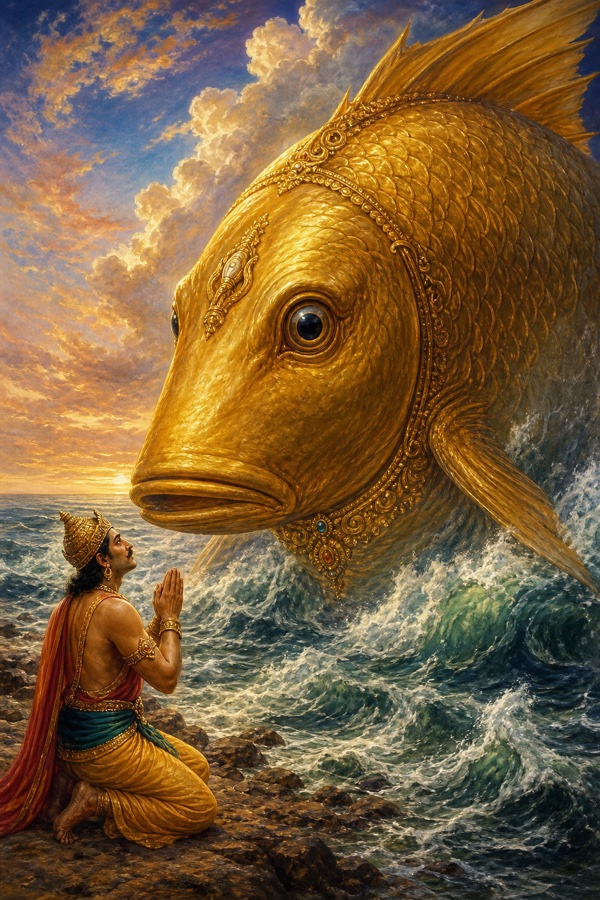
Then Satyavrata knelt on both knees in the wet sand and joined his palms. “Who are you, who bewitch me in the shape of a great fish? In a single day you have grown to fill a lake four hundred kos across. No creature of the water with such power has ever been seen, or even heard of. You can only be Narayana himself, the deathless Lord who wipes out sin, come among the creatures of the deep out of grace toward everything that lives. Creation, its keeping, and its dissolution all turn on you; you are the self and the shelter of those who run to you, and shelter at your feet is the one refuge never given in vain. Every descent you make, you make for the welfare of the world. Lord, tell me why you have taken this form.”
The great fish answered him, and its voice came sweet across the water. “Rajan, I am Shri Hari. Hear how this began. A thousand cycles of the four ages make one day of Brahma, the creator, and when that immense day closes, the maker of worlds grows heavy and lies down, and his night is the dissolution of all he made. As sleep took him, the Vedas slipped from his mouths, the eternal words by which the worlds are built and steered. A demon named Hayagriva, horse-headed and strong, was near, and he seized them and fled down into the deep, even as the seas were making ready to rise. I have put on this body to hunt him through the water and carry the Vedas home. And I have come to you first, carrying a warning.”
“Seven days from today, the three worlds, this earth, the airy world above it, and heaven above that, will go down under the ocean of dissolution. When the waters begin to climb, a boat will come to you, vast and strange, and I will be the one who sent it. Load it with the seeds of every herb and grain, great and small. Bring aboard creatures of every kind, and seat the seven great rishis around you. Then sail out onto a flood without shores. Sun, moon, and stars will disappear; the only light on all that water will be the glow of the rishis themselves.”
“When the gale strikes and the boat begins to reel, I will be there in this same body. Take Vasuki, the king of serpents, for your rope, and lash the boat to my horn. Then I will draw you across the ocean of the dissolution for as long as the night of Brahma lasts. Have no fear of losing me in the dark; I will find you myself. And on that voyage, out of the questions your own heart asks, I will open my glory inside you, the glory whose name is Para Brahma, the supreme truth that outlasts every flood.”
Satyavrata bowed his head to the sand, and when he raised his eyes the sea lay flat and empty to the horizon, as though nothing had ever spoken out of it.
He went home and began to gather a world small enough to carry: grain, the seeds of every herb and plant, creatures of every kind. The seven great rishis gathered to him. Then he spread blades of kusha grass on the ground with their tips pointing east, sat down facing the northeast, fixed his mind on the feet of the Lord who had worn the body of a fish, and waited.
On the seventh day the sky broke. One roll of thunder, long and low, and then the clouds of the dissolution opened and did not close again. The sea forgot the shorelines it had kept since the first morning of the world and came inland. The earth went down by degrees, the mountain peaks slid one after another beneath the surface, and everything that had ever held a name closed into a single sea without floor or edge.
And through the rain, exactly as the Lord had promised, the great boat came riding toward him, vast and steady on the risen water. Satyavrata went aboard with his seeds and his creatures, and the seven rishis took their places around him. The seers looked out at the drowning of the world and said, with great tenderness, “Rajan, hold your mind on the Lord. He alone will carry us through this danger, and he will turn even this to our good.”
On all that water, one boat stayed afloat. Satyavrata’s.
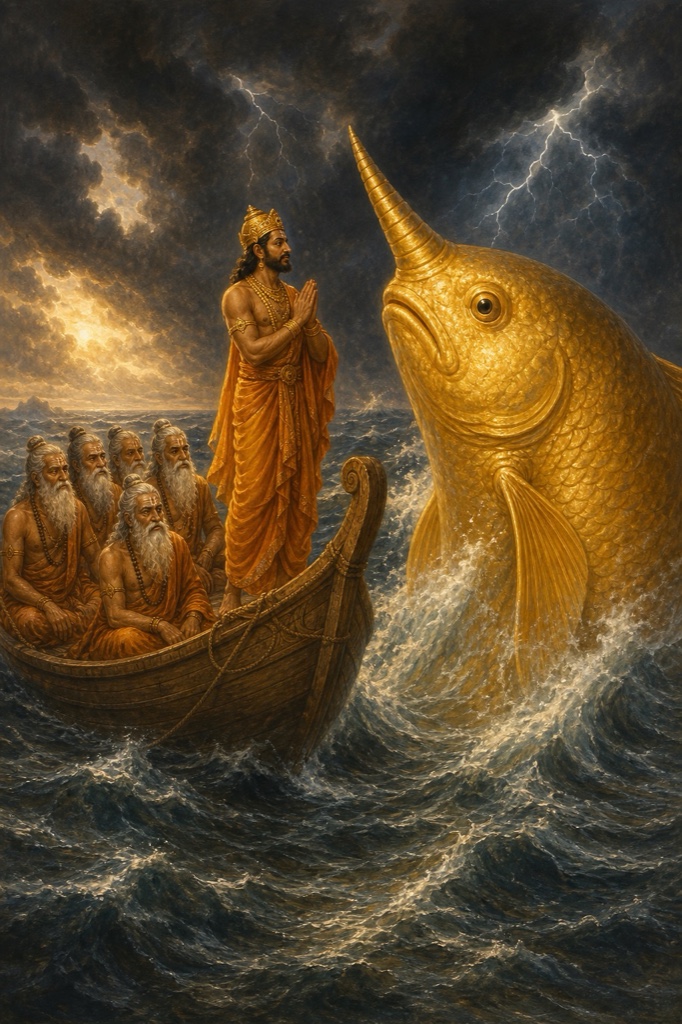
Then the sea split open ahead of them, and a body came up out of it that made the boat a splinter. Four lakh kos it stretched from end to end, blazing like wet gold under the black sky, and on its head rode one great heavy horn.
Matsya.
The enormous shape slowed and drew alongside with the gentleness of something small, and the waves settled into slow, wheeling rings around it.
“Rajan, bind your boat to my horn. Let Vasuki be your rope.”
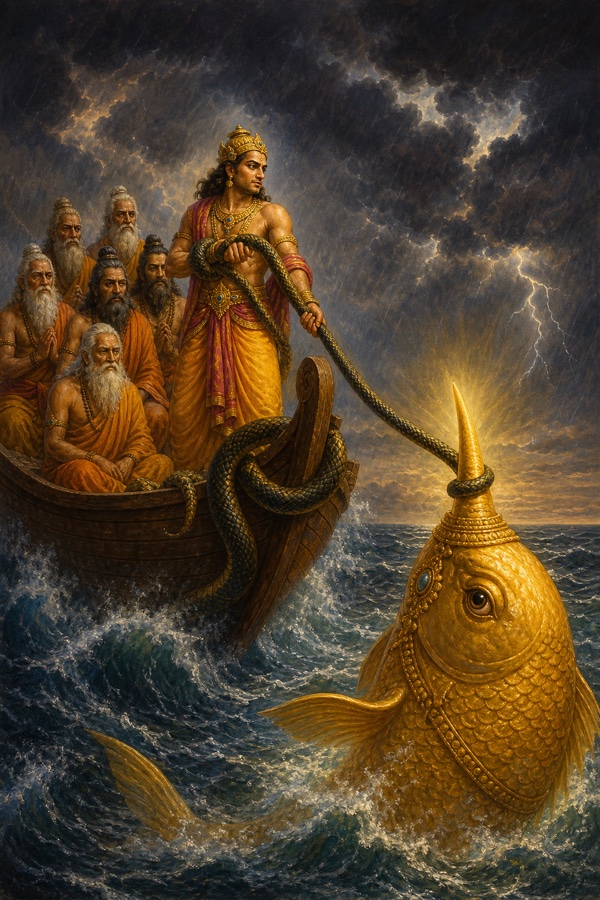
Satyavrata did as the Lord had taught him on the shore seven days before. He drew Vasuki tight like a hawser, made one end fast to the great horn, gripped the other in his fist, and then, with the flood roaring around him and joy standing in his eyes, the king lifted his voice over the water and prayed. “From a beginning no one can date, we have forgotten what we are. We wear these bodies and call them ourselves, and the labor of that one mistake has worn us down through birth after birth; then, by a grace nothing in us ever earned, you let us find you, and the finding ends the wandering. Be our teacher, the highest teacher, and lead us home to freedom. This soul binds itself with the rope of its own karma and strains after a happiness that keeps moving away; let worship of you dissolve the straining itself, and cut the knot it has tied in the heart. Gold and silver hold their dross until fire takes it from them and they come out shining as they always secretly were; so a soul that enters your fire sheds its ignorance and stands up in its own original light. Be for us, then, more than a guru, the undying one behind every guru. All the gods and teachers and well-wishers of the world together cannot show a ten-thousandth part of the grace you show; it is you I take for my refuge. A man without sight cannot guide another who cannot see, and every unawakened teacher is such a guide; you are self-luminous like the sun, you light the very eyes that look for you, and it is you we choose, we who want the truth of the self. The world’s counsel leads into a darkness that is hard to climb out of; your counsel is a wisdom that does not decay, and by it the soul comes easily home to its own joy. Friend who asks nothing back, beloved, the ruler seated in every heart, the self, the teacher, wisdom, and the filling of every real desire: you are all of this to the world, and the world, busy with its wants, walks past you though you stand in its own heart. I have come to you, whom the gods themselves approach for instruction. Cut through the knots in this heart with words of truth, and show me your own self.”
Then Matsya took up the boat and began to swim. Across the heaving middle of the dissolution, through water that had swallowed mountains, one small boat moved steadily behind the Infinite. And as he drew them on through the night of Brahma, the Lord answered the king, question by question, and the answers grew into a teaching: the truth of the self, the discernment that separates spirit from matter, the yoga that joins a soul to its Lord, the sacred rites, the whole of that divine purana the world would afterward call the Matsya Purana, whose first hearers were a king and seven seers on black water. And what he had promised on the shore came true on the sea. The glory whose name is Para Brahma rose in Satyavrata’s own heart, and the king listened to the eternal truth of the self, which is Brahman itself, until not one doubt was left standing in him.
At last the dissolution spent itself. The long night of Brahma wore through, the rains ended, and the water began to fall, uncovering a new earth that steamed and glistened as it rose. Then Matsya turned and looked at Satyavrata.
“Rajan, step down here. This earth is yours now. You are Shraddhadeva, son of the sun god Vivasvan, and in the age now opening you will be Vaivasvata Manu, the seventh Manu, father of the human line to come. Begin the world again from here.”
The Fish had long since run Hayagriva down in the deep, slain him, and taken back the stolen Vedas; and when Brahma woke at the end of that night and sat up to make the worlds again, the Lord laid the eternal words back into his keeping, whole. The age that dawned out of those waters is the one called the Sweta-Varaha Kalpa, the age in which we are living still. Then the vast golden body thinned into the water and was gone, and the sea rocked quietly, as though it had never carried anything at all.
Satyavrata, who was Manu now, stepped down onto the wet new earth. He pressed the seeds into the soil, set the creatures free upon the land, and with the seven rishis beside him began the first morning of a new creation.
A new cycle of the world, and it had begun in a palmful of water that a king chose to hold instead of pouring away.
Literary context
This katha appears in the Eighth Skandha of the Shrimad Bhagavata, Chapter 24. Matsya, who carried Satyavrata, the Vedas, and the seeds of the living world across the night of Brahma, is counted the first of the Lord’s ten avatars. The age that opens after this deluge is the Sweta-Varaha Kalpa, and Satyavrata, reborn as Shraddhadeva, son of the sun, becomes its Vaivasvata Manu, the seventh Manu of the cycle.
Shukadeva gives Parikshit the telling in brief. The Matsya Purana, which the Lord himself spoke on the boat, carries the same knowledge at full length, from the discernment of spirit and matter to devotion and sacred rite. The Bhagavata’s own voice stays compact and turned inward, so that a story of rescue becomes, by its last line, a story of taking refuge.
Why this katha matters now
No cry is too small to be the hinge of everything. Satyavrata could have shaken one frightened voice off his fingers and finished his prayers; he held it instead, and the palm that held it carried a drowning world across the flood. What we hand back today as too little to matter may be the one thing that returns, grown past all measure, to hold us.