On this page
The Mohini Avatar
The sea had been yielding up its wonders one by one. The wish-granting cow, whom the rishis took into their keeping for the milk and ghee of the fire-rites. The moon-white horse Uccaihshravas, which Bali, sovereign of the asuras, claimed for his own while the devas, forewarned by the Lord, let it pass. The great elephant Airavata, four-tusked and white as a snow peak. The Kaustubha gem, which Shri Hari lifted to his own breast. The Parijata tree that graces the gardens of heaven, the apsaras with their playful glances, and then Lakshmi herself, fortune made goddess, who looked down the whole assembly of gods and asuras, chose Vishnu, and by choosing him left the daityas standing dim and slack, as though her face had turned from them in front of everyone. After her came Varuni, the goddess of wine, and the asuras seized her, and the Lord let them. Then, at the very end, when it seemed the ocean of milk had nothing left to give, the water parted around a figure no eye in creation had ever seen. He came up out of the churning dark as a rain cloud, young, his neck ringed like a conch shell, his eyes lit faintly red. Yellow silk lay against a broad chest, polished gem earrings swung at his ears, a garland of fresh flowers crossed his shoulders, and he moved with the unhurried gait of a lion. He had risen out of a single ray of Shri Vishnu himself. In his hands he carried a golden kalasha, and inside that jar was the amrita: the drink that ends old age and ends death. Dhanvantari, later ages would name him, the first physician, the one who gave the world Ayurveda, the science of healing, and who takes his share of every fire-offering to this day.
The devas’ eyes fixed on that kalasha. So did the asuras’.
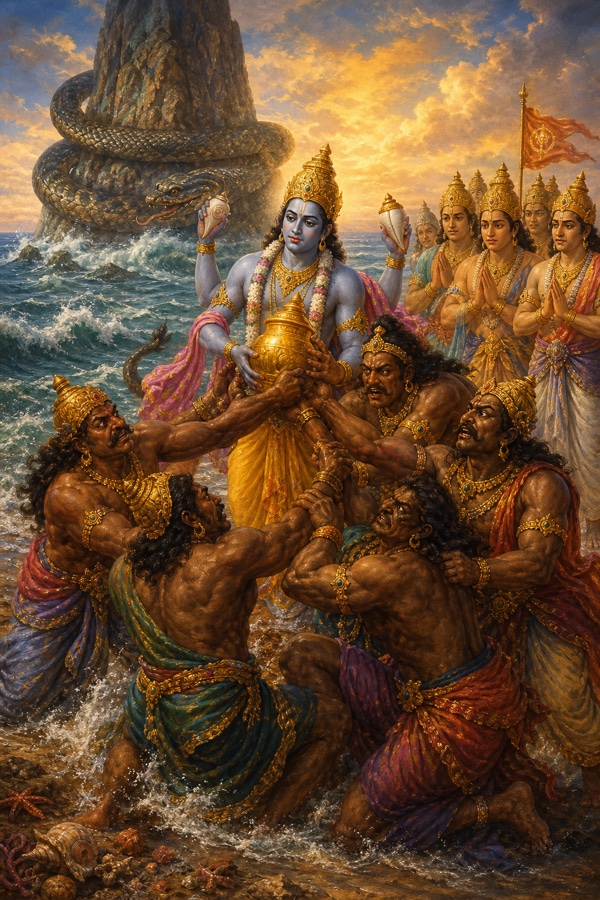
The asuras moved first, and they moved fast. They rushed Dhanvantari, wrenched the golden kalasha out of his hands, and then, having robbed him, turned to robbing one another. One tore it from the first, a third from the second, a fourth from the third, bandits looting bandits over a single treasure.
“The amrita is ours,” every one of them shouted, and every one of them meant himself. “I drink first. I do. Never you.”
The weakest among them got nothing at all, and they began to invoke the oldest law there is. “Every hand that pulled the rope has earned a share of the prize. When a whole people joins in one yajna, the fruit belongs to all who bore the labor; that law is older than any of us. It reaches even the devas, who gripped the same serpent we gripped.” So the weak lectured the strong, envy speaking in the accent of justice, while the jar swung from fist to fist above their heads. And no one listened to a word.
The ground seemed to slide from under the devas. They had churned an ocean for this one prize, and defeat now stood in open view. They joined their palms, closed their eyes, and called on Shri Hari with everything left in them.
“Do not grieve,” came the answer, rising from somewhere deeper than hearing. “I will set them feuding among themselves, and I will send my own deluding power walking into their midst in the shape of a woman. Your purpose is already accomplished.”
Force would play no part in it.
He was the knower of every expedient in the three worlds. He simply turned his form over, the way light changes on water. Where the Lord had been, a woman stood. A woman whose first glance could empty the mind of whatever it had been holding.
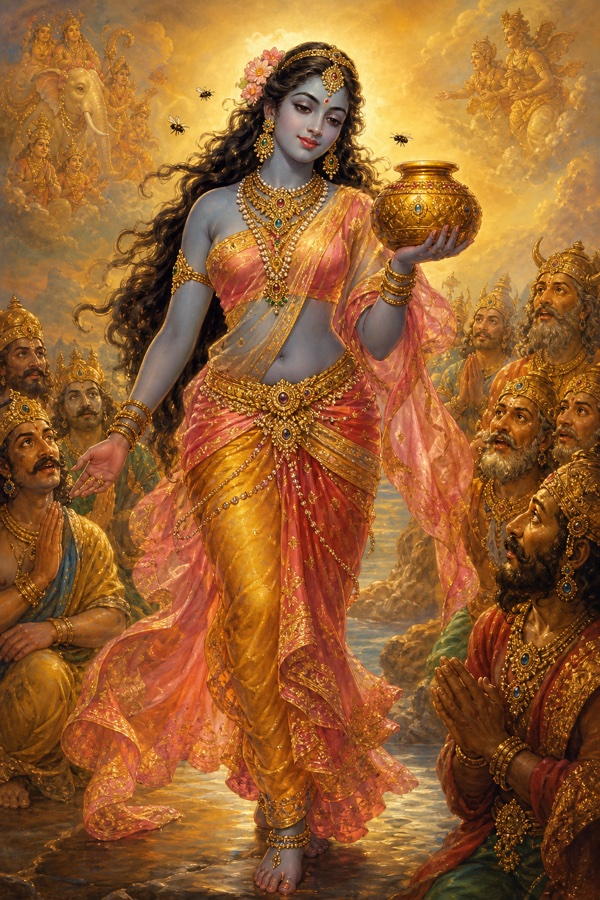
Her skin was the dark blue of an utpala lotus in first bloom. Youth sat new on her, every limb finished so exactly that the eye could find no place to rest and no way to leave. Jeweled earrings flashed at her ears against lovely cheeks and a fine, high nose. A wreath of full-blown jasmine crowned her hair, a necklace lay at her throat, armlets circled her rounded arms, and a jeweled girdle rode her hips above a cloth of spotless white, her waist slender past bearing under the fullness her young age had given her. Anklets chimed at her feet with every winsome step. Black bees, drawn by the fragrance of her breath, hovered close to her mouth, and her eyes went wide at them in a small, startled flutter. Her brows danced. Her smile came and went behind a bashful lowering of lashes, and everywhere it landed among the daitya generals, it kindled fire.
One sidelong glance from those eyes, one shy half-smile, and for a moment the three worlds forgot to turn.
She came down the shore toward the asuras at a walk, the kalasha of amrita carried in her two hands, and there was no hurry anywhere in her.
The asuras forgot the amrita. They forgot the brothers they had been throttling a moment before. Their eyes caught on her and could not come away.
“Who is she?” one whispered.
“What beauty is this,” another managed, “what splendor, what youth.” Then the questions tumbled out of him. “Who are you? Whose daughter are you, and where have you come from? You have set our hearts churning like that sea. What do you mean to do here?”
“One thing we know,” said a third. “No deva has ever touched you, and no daitya. Siddhas, gandharvas, charanas, and the guardians of the sky’s quarters have all failed to touch you. How would mere men have come near you? Surely the creator, in his mercy, sent you to give delight to the senses of every being that breathes. Then give peace to us as well, lady of the slender waist. We are kinsmen, sons of one father, and you find us at war with one another over a single prize.”
Mohini, for that is the name this form would carry ever after, smiled a small smile.
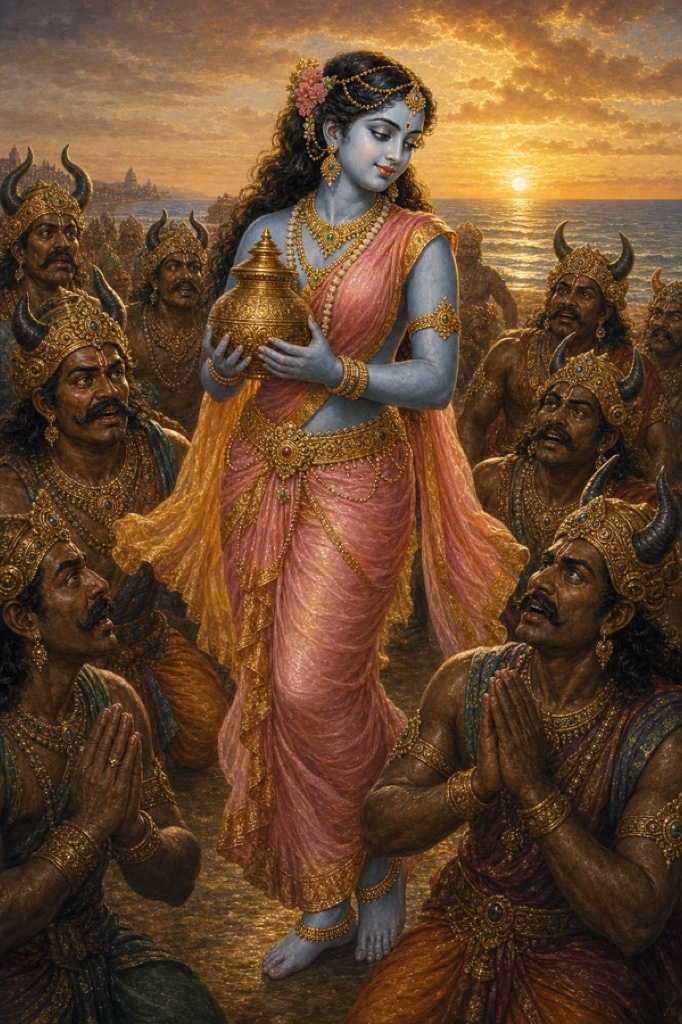
“Why are you tangled up with one another?” Her voice was low and sweet, and it settled the air around it. “Over so small a thing. Give me the jar, and I will divide it among you.”
The asuras bowed their heads as though a queen had spoken. “We are all sons of the maharshi Kashyapa,” they said, “the ancient patriarch whose children fill both sides of every war in heaven. Brothers of one blood. For this amrita we have poured out our strength. Divide it justly, and no quarrel will stand between brothers again.”
Mohini laughed lightly, looked at them from the lovely corners of her eyes, and said a strange thing.
“You are sons of the maharshi Kashyapa, wise by lineage, and I am a woman who wanders where her own wish carries her. No man of sense puts his faith in a free-roaming woman. Trust the friendship of wolves and of wanton women equally: both are forever hunting newer company. And on me you would lay the weighing of justice?”
The barb passed through them and touched nothing. She had all but told them what she meant to do, and if anything their faith only deepened, for what could a face like that have to do with deceit? They laughed with her, a laugh whose floor they never found, and they placed the kalasha of amrita in her two hands.
Mohini received it, and her gentle smile brightened. “One condition, then. Whatever I do with this, right or wrong, you will accept it. On that promise alone will I divide the amrita.”
The great daityas heard the honeyed voice and answered in one breath: “So be it.” Of her true measure they had no inkling at all.
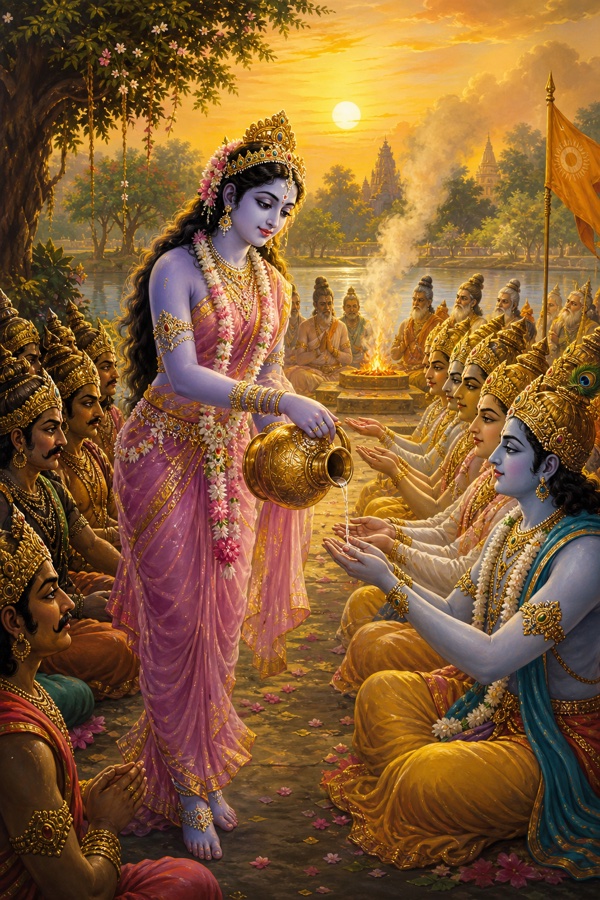
A day of fasting followed. They bathed, fed the sacred fire with offerings, gave gifts to cows, to Brahmins, to every living creature that came near, and had the Brahmins speak blessings over the whole undertaking. They dressed in clothes never worn, put on fresh ornaments, and seated themselves on blades of kusha grass laid with their tips toward the east. And when devas and daityas had taken their places in a hall dim with fragrant smoke, hung with lamps and wreaths of flowers, every face turned toward the sunrise, Mohini came in. She walked slowly, the weight of her hips setting the pace, her eyes swimming as if with some private intoxication, the jar in her hands, her gold anklets announcing each step before she took it. Beneath that form stood the Lord of the universe himself, wearing beauty that answered Lakshmi’s own, and the asuras watched her cross the floor and were lost. She already knew what she would do. To pour deathlessness into the asuras would be to pour milk into serpents: cruelty was their nature, and cruelty made immortal would swallow the worlds. So she seated the two races in separate rows, each amid its own people, kept the daityas soothed with winning words, warm attentions, and glances that promised much, and began to serve the devas, seated at a distance, the nectar that ends old age and death.
She served one deva. Then a second. A third. Drop by counted drop, with a pause between every pour.
The asuras sat and watched the jar empty in the wrong direction, and still they did not rise. They had given their word to accept whatever she did. They had given her their hearts besides, and each of them feared that one wrong move would snap the thread between himself and her. And under it all lay a simpler shame: what kind of warrior squabbles with a woman? Each time their patience thinned, Mohini turned a glance down their row, and the glance held them like a hand laid gently on the chest. “Patience,” she would say, smiling. “Your turn is coming.”
Among the asuras sat one whose eyes kept leaving the woman and returning to the sinking level of the jar. His name was Svarbhanu; later ages would call him Rahu. He was more awake than his brothers.
“She is cheating us,” said a voice inside him, quiet and certain, and it grew louder with every deva who drank.
So he moved. He slipped from his row, changed his shape as smoothly as a thought, and came back wearing the borrowed radiance of a deva. He chose his seat with an infiltrator’s care, in the devas’ own line, between Surya and Chandra, the very lords of the sun and the moon.
The serving reached him. Mohini tipped the kalasha, the amrita touched his palms, and Rahu drank.
But no mask deceives light. Surya and Chandra, seated on either side of him, looked at their sudden neighbor and knew him. They cried out together. “Stop. This is an asura.”
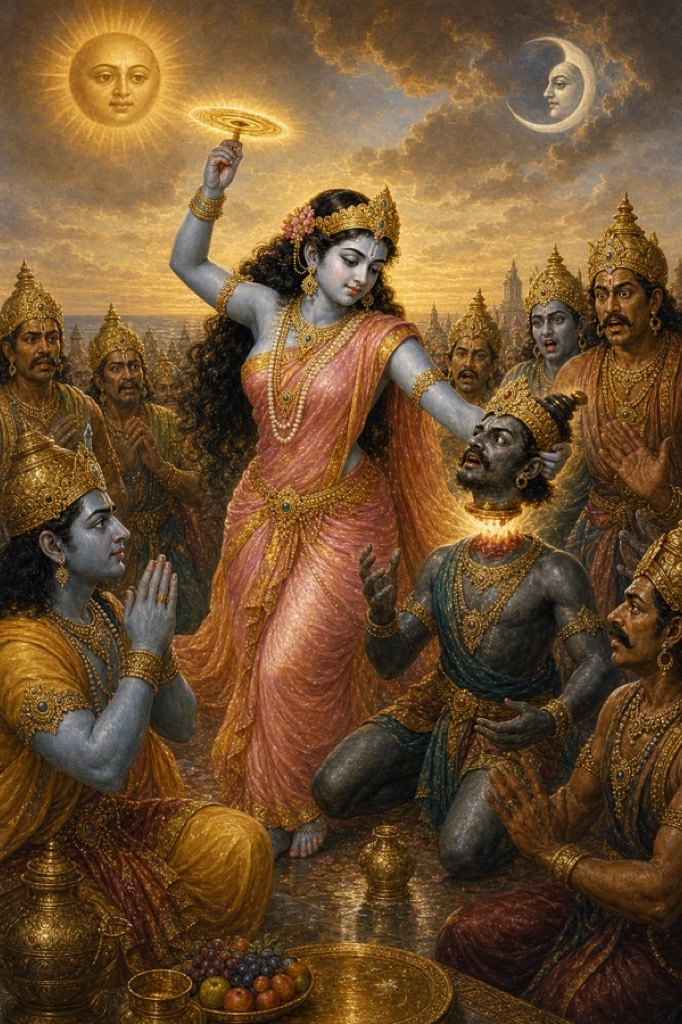
The answer came inside a single heartbeat. In Mohini’s raised hand the Sudarshana chakra appeared, the Lord’s own discus, its rim finer than a razor’s edge, already spinning, and it took Rahu’s head from his shoulders while the nectar was still in his mouth.
Even so, it came one swallow late.
The amrita had touched the head and gone no farther down. The trunk, which the nectar never reached, toppled and lay still. The head did what no severed head had ever done. It lived.
Brahma, the birthless creator, gathered up that deathless head and set it in the sky with the rank of a graha, a power that moves among the planets. It rides there still. And it has never forgiven Surya and Chandra, the two witnesses who tore its secret open.
That is why Rahu returns for them along their bright roads, in an enmity that has never cooled. On the day of the new moon he closes on the sun; on the night of the full moon, on the moon. The shadow that slides across their faces in those hours, swallowing their light piece by piece, is the head at its old theft again. People call it an eclipse.
But he is only a head. There is nothing behind the throat for the light to fall into, and in a little while Surya and Chandra slip out of his grip and burn clean and whole again.
On the shore, meanwhile, the kalasha stood empty. Every drop of the amrita had passed into the devas. The asuras, who had carried that jar off in triumph, closed their hands on nothing at all.
When the size of the trick broke over them, they came up off the grass roaring and threw themselves at the devas. But the devas were deathless now, and a warrior who cannot die fights with a terrible lightness. The asuras were beaten back once more.
And Mohini? The work was done, and the form had no further use. While the asura chiefs stood watching, it dissolved the way mist lifts off morning water, and in its place stood Shri Hari, in his own form, exactly as he had always been.
The devas joined their palms. There were no words left in them, only gratitude.
Then Shri Hari mounted Garuda, the great golden-winged eagle who bears him across the worlds, and with the devas served and the amrita spent, he turned toward his own abode. As he rose he looked back once, and in that glance was the compassion that comes down, yuga after yuga, to save its own.
Literary context
The katha of the Mohini avatar appears in the eighth Skandha of the Shrimad Bhagavata, Chapters 8 and 9. To keep the amrita won from the churning of the ocean out of the asuras’ hands, Shri Hari takes the form of a woman, and the beheading of Rahu, together with the story of the eclipse, belongs to this same episode.
Kerala’s classical dance form Mohiniyattam carries the name of this very Mohini; the dancer’s movement seeks the same play-filled grace the katha describes.
The gist of the katha
When the amrita rose from the churned ocean it came up in Dhanvantari’s hands, and the asuras tore it away and fell to fighting one another for it. Shri Hari took the form of Mohini, bound the asuras in her spell, seated the two races apart, and served the amrita to the devas alone, for deathlessness in cruel hands would have been milk poured into serpents. Rahu’s disguise was cut open in the middle of it, and his severed head still hunts the sun and the moon at every eclipse. A lila woven wholly of maya, with force never drawn, and the devas won it because they had taken hold of the dust of the Lord’s feet; behind every form in the play stands the one same Shri Hari.