On this page
Bhrigu’s Test and the Return of the Brahmin’s Sons
Bhrigu went first to his father. He walked into Brahma’s radiant court, where the maker of worlds sat enthroned on his lotus.
He withheld his bow and every word of praise. He stood before the creator of the universe, his own father, as though the throne were empty. In any court of that age the omission amounted to contempt spoken aloud, and Brahma felt it. Heat climbed into his face until he seemed to burn with his own majestic glow, and anger rose in him. Then he saw that the insult had come from his son, and he forced the anger down by pure reason, quenching the fire of his temper the way water quenches fire, though water itself was born of fire at the beginning of things.
From there Bhrigu climbed to Kailasa, the white mountain in the high Himalaya where Shiva keeps his home. Shankara, the god of gods, saw who had come and rose from his seat in pure delight, for Bhrigu was his brother, and he opened his arms wide for the embrace.
Bhrigu stepped back from the touch. “I will not embrace you,” he said. “You live outside every convention that holds society together, and you flout what the Veda enjoins.”
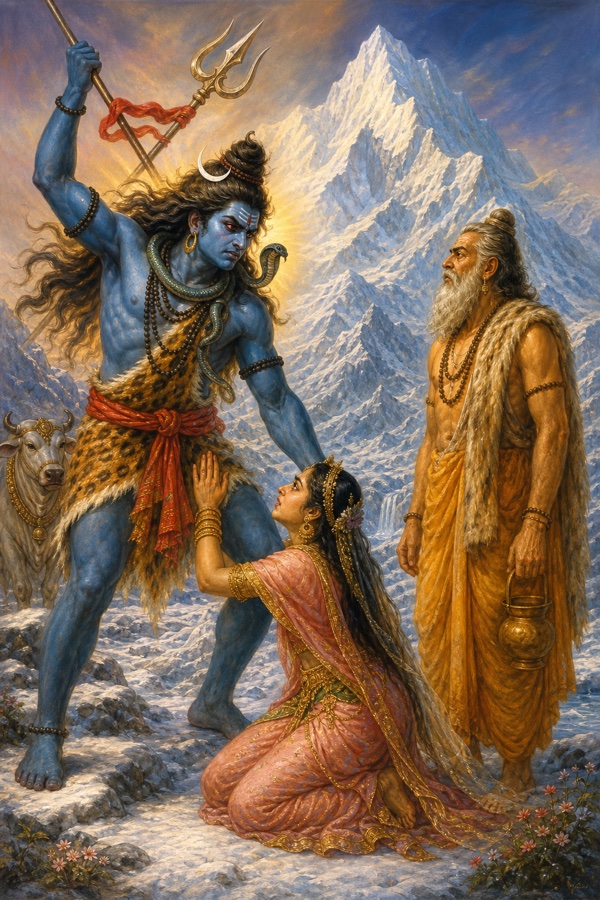
The words struck home, and Shankara’s temper went up like dry timber. His eyes shot fire. He seized his trident and swung it high to run the sage through, and in that instant the goddess threw herself at his feet. Her soft, pleading words drew the wrath out of him a little at a time, until the trident sank and the mountain stood quiet again.
Two courts lay behind him now, and in each of them anger had risen before it was mastered. Bhrigu went on to the third, to Vaikuntha, the realm of light beyond all the worlds where Lord Vishnu dwells.
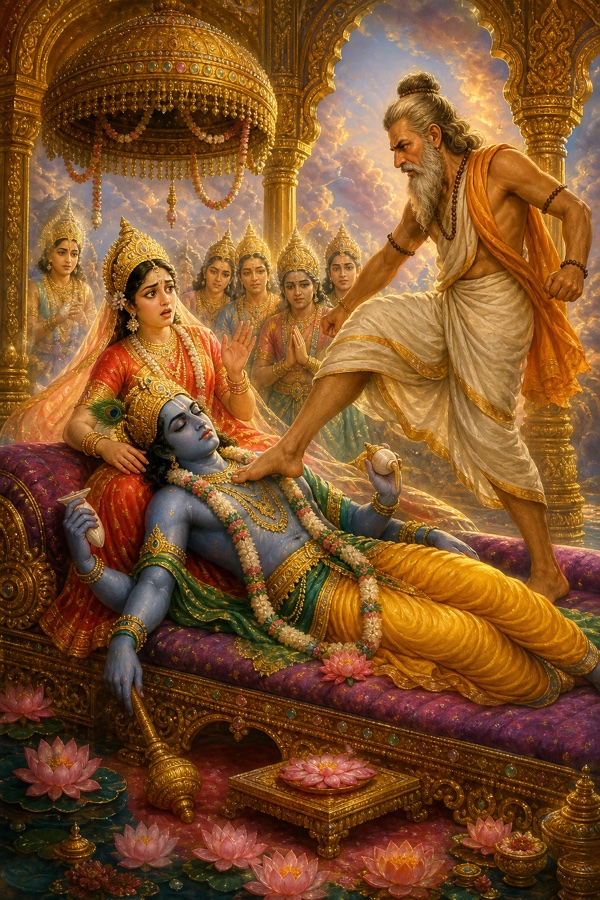
He found Vishnu at rest, his head in the lap of Lakshmi, the goddess of fortune, whose glance decides the wealth of gods and kings. The sage broke into the chamber unannounced, crossed the floor without one word, and drove his foot into the Lord’s chest, a hard kick, square over the heart of the being who upholds the universe.
The Lord remained composed.
Vishnu, who holds those devoted to him dearer than his own body, rose at once, and Lakshmi rose with him. He stepped down from the couch, and the master of the universe bowed his head to the man who had just kicked him.
“You are welcome, sage, most welcome. Sit here and rest a while. We had no word of your coming, and so we failed to receive you at the door as a guest of your stature deserves. Forgive us that fault.”
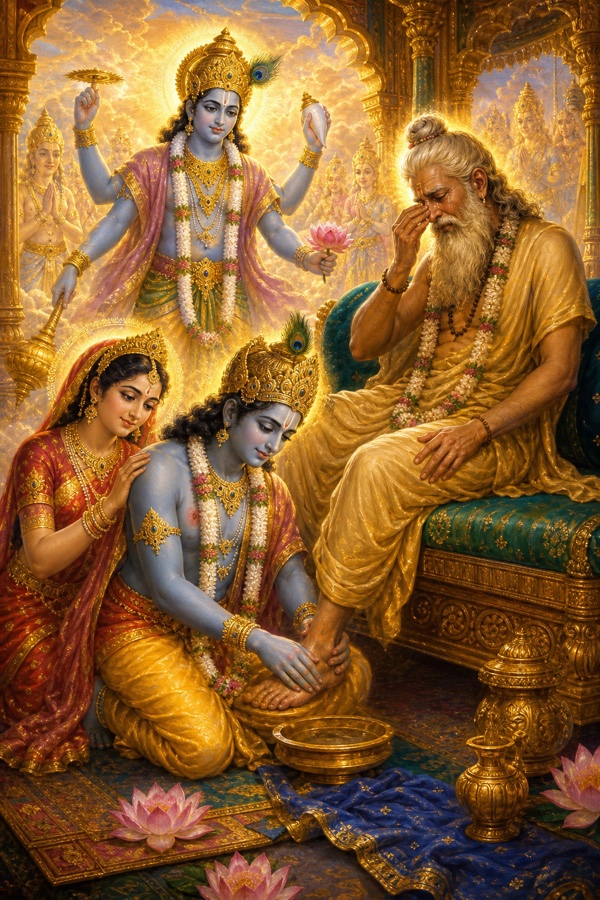
Then he knelt, gathered the sage’s feet into his own hands, and began to press them. “Great one, your feet are so tender. I fear my chest has bruised them.”
He went on, still holding the sage’s feet. “The water that has touched these feet makes even the sacred fords more holy. Sanctify my realm of Vaikuntha with it, and me, and the guardians of the worlds who live within me. Your touch has washed from me every stain I carried. From this day I am the one abode of Lakshmi, for this chest of mine, printed with the mark of your foot, has become her seat for all time.”
Bhrigu listened to the low, deep voice saying these things, the injured one begging pardon of his offender, and something in him gave way. Devotion rose and closed his throat. Tears filled his eyes. The sage who had faced down the creator and the destroyer could no longer bring out a single word.
He traveled back to the Sarasvati, to the assembly of sages who spend their lives expounding the Veda, and laid before them everything he had met in the three courts: the anger mastered, the anger barely stopped, and the kick answered with worship.
Their doubt dissolved as he spoke. Wonder filled the assembly, and from that day they held Vishnu supreme, the fountainhead from which tranquility flows, and fearlessness with it.
Bhrigu had insulted all three gods. The sages gave their verdict to the one who received the insult without heat. The text locates dharma, knowledge, dispassion, sovereign powers, and mind-purifying fame in Vishnu, whom peaceful and even-minded sages hold as their final refuge.
“Sattva, the pure strand of nature, is the very body he loves to wear, and the Brahmin is the deity he favors. Men emptied of craving, serene, fine in their discernment, turn to his worship. His maya, woven of the three strands, has spun up three orders of being, the rakshasa, the asura, and the god, and of the three only the god, formed of sattva, serves as a road to him, for he himself is the end of every road. Understand too, Rajan, that the sages on the Sarasvati staged the whole trial for the sake of ordinary men, to burn out their doubt. And by bowing at the feet their own test had proven highest, they reached the very state they had been debating.”
The second episode turns from Vishnu at rest to Vishnu answering a call for protection.
In Dwarka, Krishna’s fortress city on the western sea, a Brahmin’s wife gave birth to a son. The child came whole and living, and the instant his body touched the ground, he died.
The Brahmin carried the small corpse through the streets to the gate of the royal palace, laid it on the king’s threshold, and wept over it from a breaking heart, loudly, so the whole city could hear the charge he was laying. “There is no doubt of it. My child is dead through some vile act of this kingdom’s ruler, a hater of Brahmins, crooked, greedy, enslaved to his own appetites. Where the king is cruel and cannot govern his senses, the people go poor and eat one sorrow after another.” A kingdom’s calamities were read in that age as the ledger of its king’s conduct, and every soul at the gate knew whose palace stood accused.
His second son died the same way, at the moment of birth, and then his third. Each time the Brahmin walked the same road with the same small weight in his arms, laid it at the palace gate, and cried the same accusation for all Dwarka to hear.
Nine sons he carried to that gate, one after another.
When he came with the ninth, Arjuna happened to be sitting at Krishna’s side. Arjuna, third of the five Pandava brothers, the finest bowman alive and Krishna’s dearest friend, was visiting Dwarka, and he heard the lament with a warrior’s rising blood. “Brahmin, is there no kshatriya in this city of yours who can hold a bow? These Yadavas sit about like priests gathered at a sacrifice. A king in whose realm a Brahmin mourns his stolen wealth, his wife, or his sons wears the costume of a warrior and fills his belly by the role. He is an actor, whatever throne he holds.”
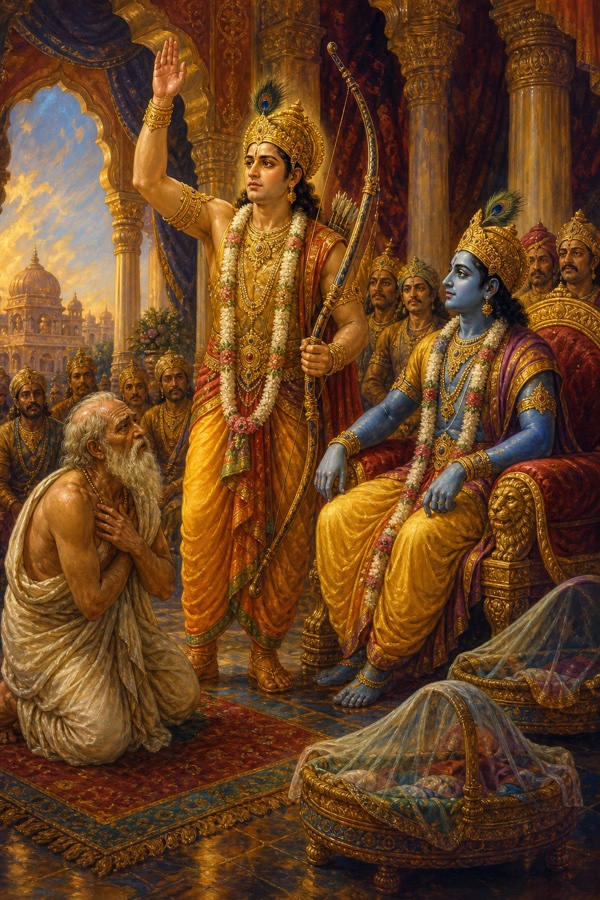
Then Arjuna swore an oath, and he swore it in front of Krishna. “Bhagavan, I will guard the next child born to you. And if I fail to keep my word, I will walk into fire and let it burn the broken promise away, sin and all.” An oath of that kind carried no exit written into it. He had wagered his life on a duel with death.
The Brahmin looked him over and smiled without one grain of belief. “Arjuna. Balarama lives in this city. Krishna himself lives here. Pradyumna, Krishna’s own son and the first of archers, lives here, and Aniruddha his grandson, a warrior without match. When lords of the world of that order could not save my sons, how will you? Even for them the task proved beyond doing. This is a child’s bluster. I do not believe one word of it.”
“You compare me to the wrong men,” Arjuna said. “I am Arjuna, distinct from Balarama, Krishna, and Pradyumna, and the bow in my hand is the Gandiva, whose name is known wherever men string bows. Do not weigh my prowess lightly. It once satisfied the three-eyed Lord Shiva himself. When your next child comes, I will meet Death on his own field, defeat him there, and carry the child back to you.”
The Brahmin went home carrying the first fraction of comfort he had felt through nine bereavements, and something sharper besides: he wanted to see with his own eyes what this outsider’s bow could do.
When his wife’s time drew near, the dread came back over him whole, and he hurried to Arjuna. “It is close now. Keep my child alive.”
Arjuna prepared as a man prepares who knows his enemy can be neither seen nor gripped. He sipped pure water to cleanse himself, bowed to Lord Shankara, and called into memory the celestial weapons he had earned across a lifetime of austerity and war. He strung the Gandiva, charged arrow after arrow with the mantras of every weapon he possessed, and built a fence of them around the room where the birth would come, walling it on every side, floored below and roofed above, until the chamber stood inside a cage of arrows that nothing walking, flying, or creeping should have been able to pass.
The Brahmin’s wife gave birth to her tenth child, a boy, alive. He cried, once, twice, again. And then, while every eye watched and every arrow held its station, the infant rose bodily into the air and vanished through the sky.
The Brahmin turned on Arjuna in front of Krishna himself, grief pouring out of him as scorn. “Look at my folly. I trusted the boast of a eunuch. When Pradyumna could not save my sons, nor Aniruddha, nor Balarama, nor Krishna, who in any world was going to do it? A curse on this Arjuna and his celebrated bow. A curse on his self-praise. The dull fool imagined he could carry back what Providence itself has torn from me.”
Arjuna stood under the abuse, and then he was gone, carried by his yogic power to Samyamani, the city where Yama, lord of death, keeps his court and his ledgers of every life. The child was not among the dead. Weapons in hand, Arjuna went on, through the city of Indra, king of heaven, and the cities of Agni, Nirriti, Soma, Varuna, and Vayu, lords of fire and dissolution, of the moon, the waters, and the wind. He descended to Rasatala, deep beneath the floor of the world, and rose past Indra’s paradise into the high realms above it, Maharloka among them, and searched place after place where no living man travels.
The child was nowhere. The oath stood broken, and one door remained that honor allowed him. Arjuna turned toward the fire.
Krishna caught his arm. “Brother, you will not throw yourself away. Do not despise yourself like this. I will show you the Brahmin’s sons, all of them, this very hour, and the same men who mock you today will themselves raise our spotless name again.”
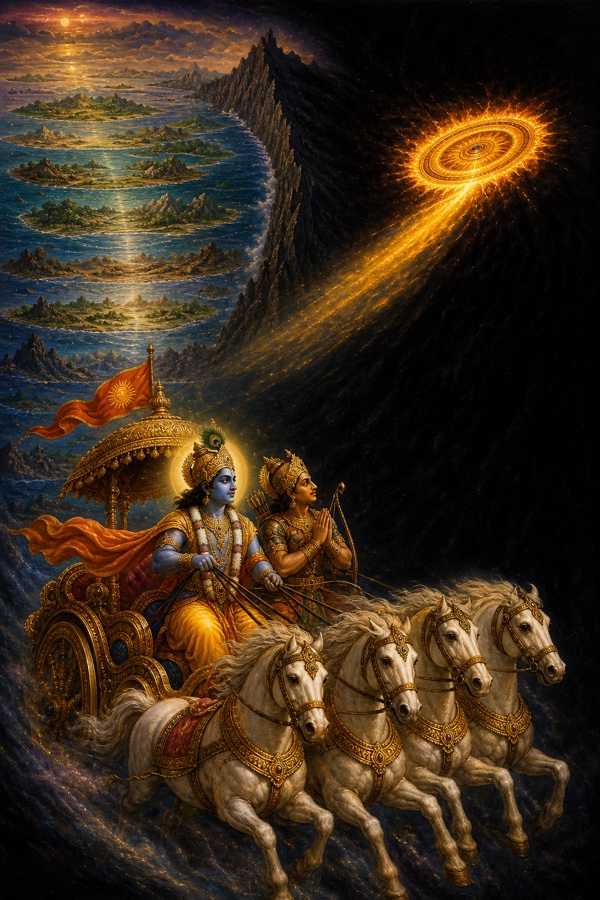
Then the all-powerful Krishna brought Arjuna up onto his own divine chariot and drove west, and west on that road ran farther than any atlas of the living world. They crossed the seven island-continents, each ridged with its seven mountain ranges, and the seven seas that lie between them, and at last the Lokaloka mountain, the colossal wall that rings all the worlds and marks the frontier of the sun’s light. Beyond it they drove into darkness, thick, total, without floor or star.
The dark ran so deep that even the four celestial horses, Shaibya, Sugriva, Meghapushpa, and Balahaka, lost the road and faltered in their traces. Krishna, lord even of the great masters of yoga, watched them stumble and sent his own weapon ahead as a guide: the discus Sudarshana, blazing like a thousand suns fused into one.
Quick as thought the Sudarshana tore into that vast and dreadful darkness, a darkness the Lord himself had made at the founding of things, and split it open on pure light, the way an arrow loosed from Rama’s bowstring once split the massed armies of the rakshasas.
The chariot ran down the lane the discus cut and came out at the far shore of the dark. Beyond it blazed a light with no source and no boundary, supreme, everywhere at once, pervading all it touched. It struck Arjuna’s eyes like a blow, and the man who had faced gods in battle had to shut them.
Past the light the chariot entered water, an ocean above the worlds, beautiful and wild, driven into enormous waves by a hard running wind. And out of that water rose a palace past anything in the fourteen worlds, thousands of pillars of cut jewels blazing rank on rank.
Within it lay Shesha, the serpent of eternity, terrible and marvelous in a single glance: a thousand hoods raised, every hood crowned with jewels, two burning eyes in every head, the body white as the snows of Kailasa, the throats and the tongues a deep blue.
And on the serpent’s coils, taking them for a couch, lay the supreme Person himself, vast past measuring, present in all things. His body was the dark of a rain-heavy cloud. Yellow silk shone on him, joy sat openly on his face, and his large eyes were beautiful. Light from his jeweled crown and earrings ran through his dark curls. He had eight long and shapely arms; the Kaustubha gem burned at his throat; on his chest lay the Srivatsa, the curl marking the seat of Lakshmi, on the same breast a sage’s foot had once printed in Vaikuntha; and a garland of forest flowers hung to his knees.
Around him Arjuna saw the attendants Nanda and Sunanda with the rest of that court, and the Lord’s weapons standing alive in bodily form, the Sudarshana discus among them, and his four powers, Pushti, Shri, Kirti, and Maya, and every fortune that exists, all in attendance on the one being whom Brahma and the guardians of the worlds themselves obey.
Krishna bowed to the endless Lord, bowed, that is, to his own being worn in another form. Arjuna, shaken to the root of himself, bowed after him, and the two stood before the couch with folded hands.
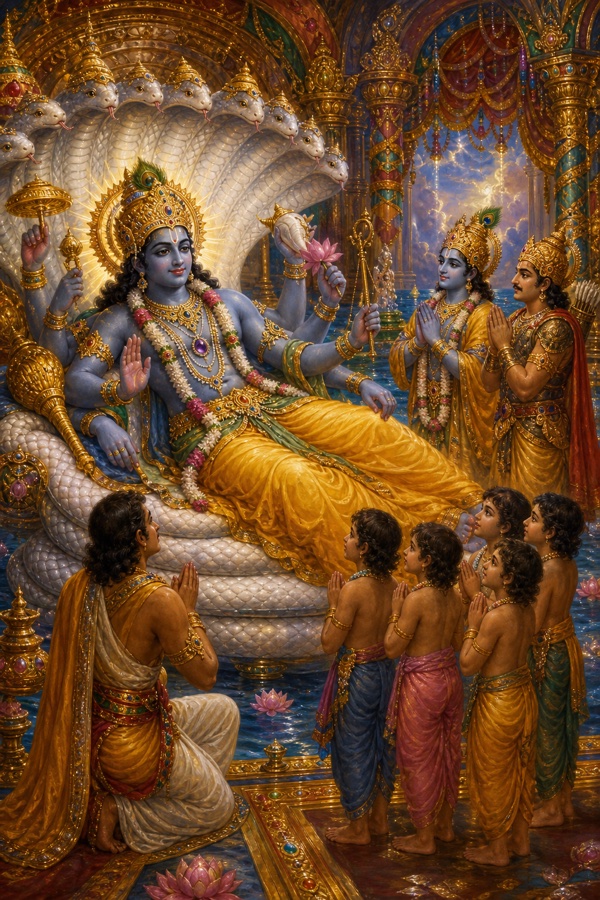
Then the Bhuma-Purusha, master of all the keepers of the worlds, smiled, and his voice came deep and sonorous. “Krishna. Arjuna. I drew the Brahmin’s sons here for one reason only: I wished to look on the two of you. You have gone down into the world as portions of my own being to set dharma on its feet again. Finish that work. Clear away the demon powers that weigh the earth down, and then come back to me, and come soon.”
“For you are the sages Nara and Narayana, the inseparable pair of old. Nothing is left for you to desire, and no being stands above you, and even so you will keep to dharma, because the world holds its shape by the conduct of the great, and men walk by the example you set.”
They received the command as a blessing, bowed to him, and turned back for Dwarka with the Brahmin’s sons gathered onto the chariot, glad past the reach of telling, going home by the same road and the same power that had carried them out.
The boys came home grown, each standing at the age he would have reached had death never touched him, yet each face and form was exactly as it had been at the hour of birth. Krishna and Arjuna gave them, all of them, back into their father’s arms.
Arjuna had stood in the highest abode of Vishnu, and his astonishment refused to settle for the rest of his days. He understood now what he had truly been shown: whatever force, whatever valor moves in any living creature is held on loan, a gift flowing from the grace of Krishna. And Krishna went on living in Dwarka as he had lived, wearing the look of an ordinary man savoring an ordinary world, performing sacrifices on the grandest scale, raining what his people needed on them the way Indra rains on the fields in season, and, by his own hand and by Arjuna’s, emptying the earth of its unrighteous kings until, with Yudhishthira and rulers like him, dharma stood established across the earth.
Literary context
Both episodes belong to the Tenth Skandha of the Shrimad Bhagavata, Discourse 89. In the first part, verses 1 to 20, the sages gathered on the bank of the Sarasvati send Bhrigu to test the forbearance of Brahma, Shiva, and Vishnu, and the test proves Vishnu supreme in sattva, in peace, and in the granting of fearlessness. In the second part, verses 22 to 66, the sons of a Brahmin of Dwarka vanish at birth one after another; Arjuna vows to guard the next and fails; and Krishna carries him on the divine chariot past the Lokaloka mountain to the abode of the Bhuma-Purusha, the one Maha-Vishnu, who had drawn the children to himself only to bring Krishna and Arjuna before him. The children come home grown yet unchanged, and Arjuna learns whose grace his own prowess had carried all along.
Why this katha matters now
Bhrigu walked into three heavens with the same insult and measured the gods by what rose in them afterward. The throne that answered a kick with worship won. Arjuna crossed seven seas and the wall at the edge of light to recover one child, and came home knowing his own strength had been lent to him, all of it. Read together, the two journeys point to a single measure: the highest one is the most at peace, and that peace is what carries every other strength in the world.