The Valmiki Ramayana
Seven kandas, about five hundred sargas, twenty-four thousand shlokas · the first poem of Sanskrit
Every chapter below opens in this English edition.
First, a story
On the bank of the river Tamasa sat a rishi, Valmiki by name. On a tree some way off, a pair of krauncha birds, male and female, lost in love. In that instant a nishada hunter shot the male down with an arrow. Hearing the female’s lament, a pain rose within the rishi, and that very pain broke out, unbidden, into words.
यत् क्रौञ्चमिथुनादेकमवधीः काममोहितम् ॥
O nishada, may you find no standing for endless years, for you have slain one of a krauncha pair lost in love.
This anushtubh meter of thirty-two syllables came out of the rishi’s mouth without any prior design. It is held to be the first true shloka (verse) of Sanskrit. This is why Valmiki is called the adi-kavi, the first poet, and the Ramayana the adi-kavya, the first poem.
A little later Brahma appeared and said, Valmiki, this was no accident; the shloka rose out of your grief. Now tell Rama’s whole story in this very meter. The Ramayana was born of that compassion.
Which Ramayana this is
This is, specifically, Valmiki’s Ramayana. Tulsidas’s Ramcharitmanas and the Adhyatma Ramayana are both treasures in their own place, but Valmiki’s work is the original, the base from which all the later Rama stories flowed.
Tulsidas composed the Ramcharitmanas in Awadhi in the sixteenth century, in the key of bhakti (devotion). When Valmiki composed the Ramayana in Sanskrit is not settled; the estimate is the fifth to fourth century BCE, that is, about two thousand years before Tulsi.
This is why, here and there, the story you heard in childhood will differ a little from Valmiki. The Lakshmana rekha, for instance, belongs to Tulsi’s tradition, not to Valmiki. This continuous telling follows Valmiki’s original throughout.
Seven kandas, thirty-four chapters
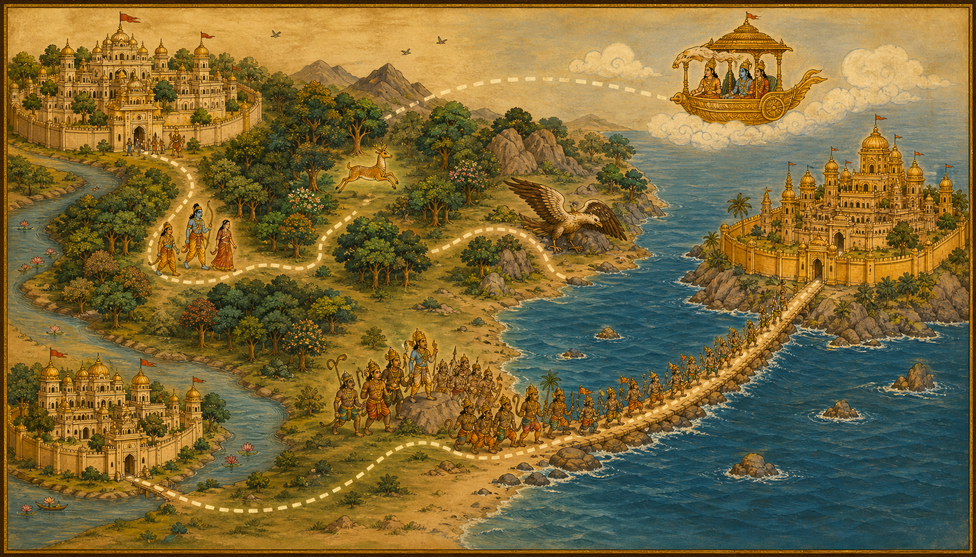
Valmiki’s Ramayana is in seven kandas (books). Each kanda has its own color, its own weight. Below, the chapters of each kanda, in order.
Kanda 1 · Bala Kanda
Rama’s birth, guarding Vishvamitra’s yajna, the slaying of Tadaka, Ahalya’s deliverance, Mithila, and Sita’s svayamvara. The beginning of a prince becoming Rama.
Kanda 2 · Ayodhya Kanda
Preparations for the coronation, Kaikeyi’s two boons, fourteen years of exile, Dasharatha’s death, Bharata’s coming to Chitrakuta, and the sandals. Love and duty face to face.
Preparations for the coronation
Manthara, Kaikeyi, two boons
The death of Dasharatha
Bharata’s arrival, the sandals
Kanda 3 · Aranya Kanda
Panchavati, Shurpanakha, the slaying of Khara and Dushana, Maricha’s golden deer, Sita’s abduction, and Jatayu. Here the story turns.
Dandakaranya, Viradha, Agastya
Jatayu, Kabandha, Shabari
Kanda 4 · Kishkindha Kanda
The meeting with Hanuman, the friendship with Sugriva, the dharma knot of Vali’s killing, Tara’s grief, and the vanaras setting out in search of Sita.
The slaying of Vali
Sampati, the seashore
Kanda 5 · Sundara Kanda
Hanuman’s leap across the sea, the entry into Lanka, the sight of Sita in the Ashoka grove, the ring, the slaying of Aksha, and the burning of Lanka. The best-loved kanda.
Kanda 6 · Yuddha Kanda
Vibhishana’s refuge, the building of the bridge, the siege of Lanka, the deaths of Kumbhakarna and Indrajit, the slaying of Ravana, and the fire as witness.
Vibhishana seeks refuge
The building of the bridge
Kumbhakarna
The slaying of Ravana
Kanda 7 · Uttara Kanda
Ravana’s earlier story, Rama’s reign, Sita’s exile, Lava and Kusha, the ashvamedha, and Rama’s great departure into the Sarayu.
How to read
One way: a kanda a week; the whole Ramayana in seven weeks, with no hurry at all. Another way: only the Sundara Kanda, Hanuman’s journey, complete in itself, which many people recite daily. A third way: with children, twenty minutes in the evening, one episode. This is how it has come down through the generations.
A necessary note. Three more works on lulla.net belong to the Rama story, but they are not Valmiki’s:
· Hanuman Chalisa, Tulsidas’s independent composition, sixteenth century.
· Vibhishana Gita, the dharma-chariot passage from the Lanka Kanda of Tulsi’s Ramcharitmanas.
· Shri Rama Gita, from the Adhyatma Ramayana, Rama’s Vedanta teaching to Lakshmana.
All three are beautiful, but none of the three is Valmiki.
Read alongside
- The Mahabharata, the other epic, vaster and deeper
- The Bhagavad Gita, inside the Mahabharata, yet a foundational text in its own right
- Shri Rama Gita, Rama’s Vedanta teaching to Lakshmana
- Hanuman Chalisa, Tulsi’s forty chaupais
- Vibhishana Gita, the chariot of dharma described