On this page
The Deliverance of Ajamila
In his youth Ajamila was everything a Brahmin’s son is asked to be. He knew the shastras and kept their vows, held his senses in hand, spoke the truth, and stayed clean in habit and heart. The inner sense of the mantras lived in him. He fed the sacred fire its offerings at the appointed hours, served his guru, his guests, and his elders, wished every creature well, claimed nothing for himself, said little, and never went hunting for flaws in another man’s virtues.
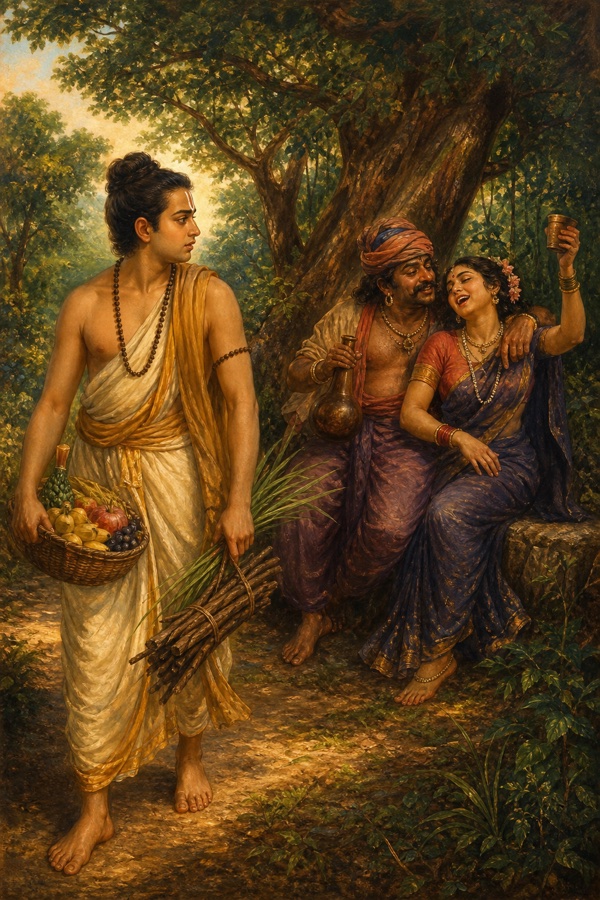
One day, at his father’s bidding, he went out to the forest, and he was walking home with fruit and flowers, firewood for the altar, and kusha grass for the rites when his eyes fell on a couple by the path. A shudra of ruined habits, loud with drink, and with him a serving woman of his own kind. She was as drunk as he was, her eyes swimming, the knot of her garment loosened, laughing and singing to the open road. His arm was around her, and he was pulling her close, teasing her, courting her in the middle of the day for anyone to see.
In that one look something in Ajamila slipped its mooring. The learning was still in him, and he threw all of it against his own mind, reasoning with it, gripping it with every measure of firmness the shastras had taught him, and the mind tore free anyway. Desire had him.
He walked home a different man. The woman circled his thoughts and would not leave them. Within days he had put aside his wedded wife, a Brahmin girl still in the first years of her youth, given to him in marriage for the honor of his line, and he had brought the serving woman under his roof.
Kannauj began to talk. The pandit’s son, the boy who knew the mantras by heart, keeping that woman in his father’s house. The talk ran through every lane, and none of it reached Ajamila at all.
To please her, and then to feed the children she bore him, he let go of every line the shastra had drawn around his life. He poured his father’s whole fortune into her pleasures, and when that was gone he took to the road. He waylaid travelers and bound and robbed them, stripped men at dice with crooked play, took this one’s wealth by fraud and that one’s by plain theft, and when fair and foul means together fell short, he killed helpless creatures for whatever their bodies would bring. By that trade, year over year, he kept her household fed.
The years went by. Ten sons were born in that house.
And the youngest of them all he named “Narayana.”
The text does not explain why he chose that name. Through the child, the name Narayana remained in the household and on Ajamila’s tongue.
The youngest was dearer to him than his own breath. An old man’s last light.
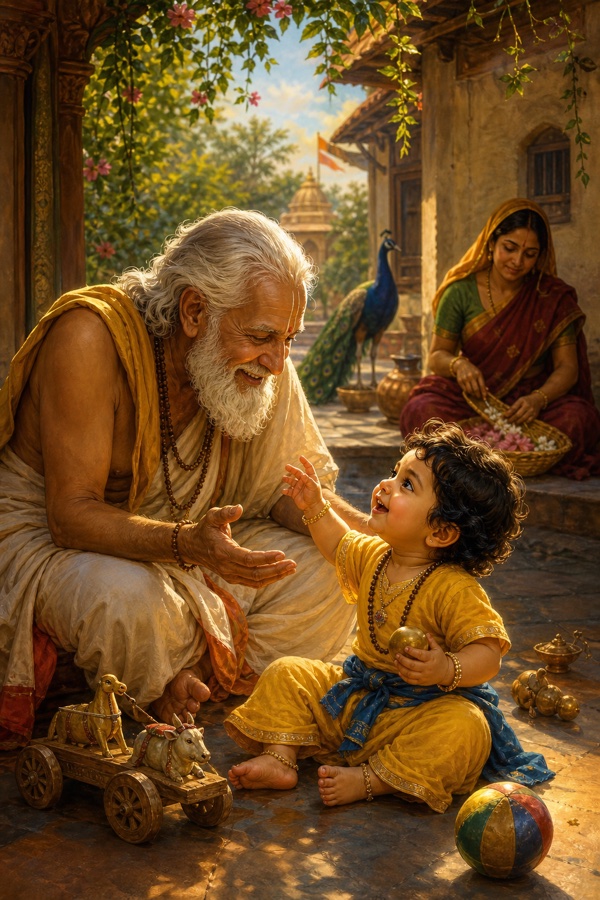
He trailed the boy through the house all day. The lisping half-words undid him; the small games left him laughing at nothing. He would call the child to his own plate and feed him from it before he ate, hold the cup and give him water before he drank, and in all of it, bound hand and heart to the boy, the old man never noticed what had quietly arrived at his door. “Narayana, come here. Narayana, eat this. Narayana, sleep now.” From morning to dark, that one name lived on his tongue.
He had no idea whose name he was calling, day after day, year after year.
Eighty-eight years of his life went by this way.
Then age caught him, and sickness followed it. His breath began to come apart. He lay on his bed counting out his last days, and even there his mind circled the one thing it loved. The boy. Narayana.
And then three figures stood at the foot of the bed. The Yamadutas, servants of Yama, the lord of death who weighs every life when it ends. They had come for him, noose in hand.
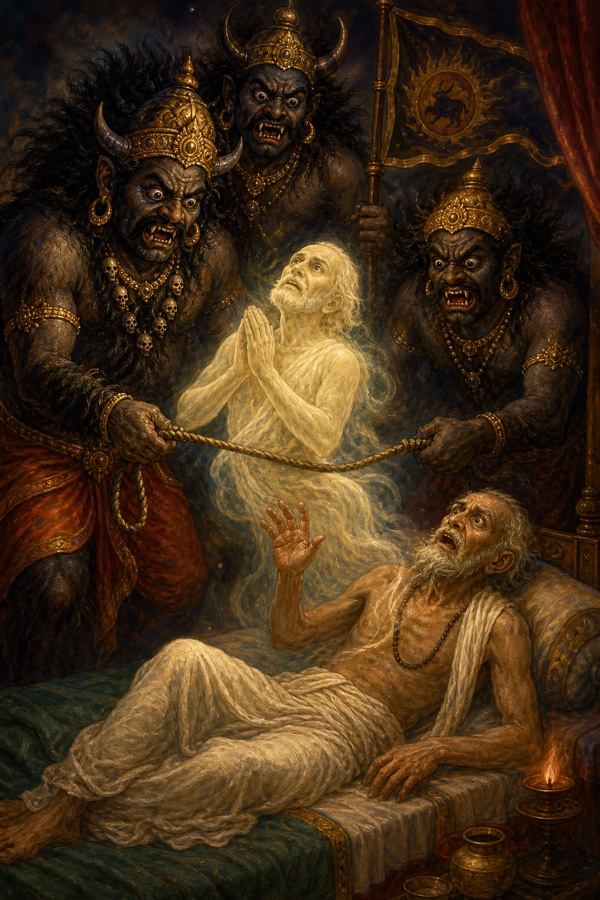
Their mouths were bent and crooked, the hair stood stiff on their bodies, and everything about them was terror. They took hold of the subtle body within him, the fine inner sheath that carries a man out of one life and into the next, and began to drag it from his heart.
Ajamila’s eyes went wide. His throat closed. The breath jammed in his chest and would not move.
In that blind panic his gaze found the doorway. There, a little distance off, his youngest son sat playing in the dust. Narayana.
Terror did the rest. The way a drowning man grabs for anything the river offers, he called out to his son in a long, loud, breaking cry. He was calling the child, only the child, the small face he wanted to see once more before the noose closed.
“Narayana!”
The boy did not hear. He stayed bent over his game.
But something else heard.
For the name he had cried with his last strength was also the name of the Lord himself, Narayana, the one Vishnu, in whom all the worlds rest. And with that single cry a light entered the room that had never been in it before. Four beings stood where no one had stood. They were young and radiant, robed in yellow silk, crowned with diadems, hung with earrings and wreaths of lotus that carried their own glow; their eyes were long and unhurried as lotus petals, and each bore four arms carrying bow and quiver, sword and mace, conch, discus, and lotus. Their brightness drove the dark from the corners of the sickroom and made every lamp in it look like ash. They were the attendants of Bhagavan Narayana, and they had heard a dying man utter their master’s name, and they had come at full speed.
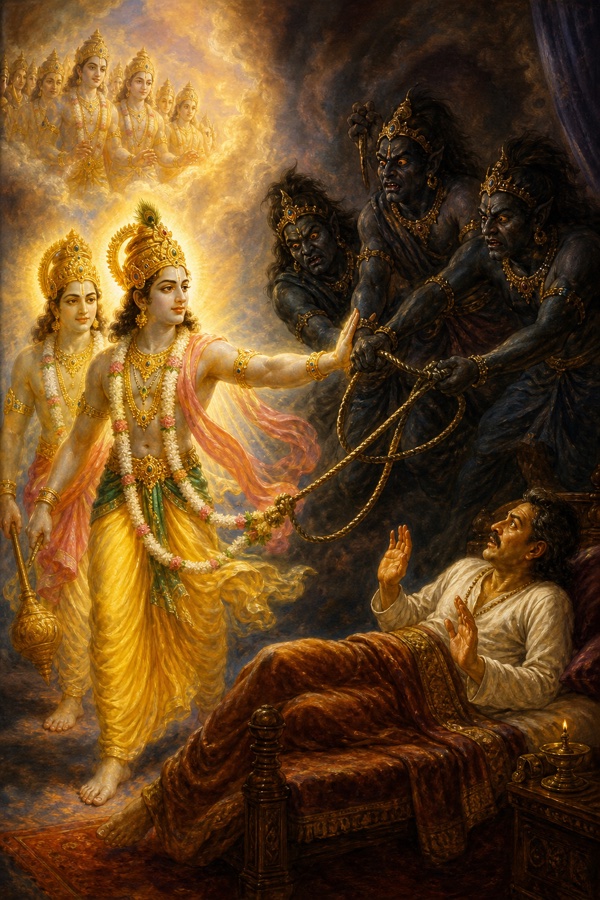
The Vishnudutas crossed the room and seized the noose itself, stopping it by force just as the Yamadutas were tearing the life out of his heart.
“Stop. This man is no longer yours to take.”
The Yamadutas fell back a step, their grip loosening in pure astonishment. In all the ages of their service, no hand had ever interfered with the writ of Yama. “Who are you,” they demanded, “that you obstruct the authority of the lord of justice himself? Whose messengers are you? Where have you come from? Are you gods, or demigods, or Siddhas, the perfected ones who are born already carrying powers other beings spend ages to earn? You shine like no beings we have ever met over a deathbed. Why do you stand in our way?”
The Vishnudutas laughed, and there was no scorn anywhere in the sound, and when they answered, their voices rolled through the room like thunder off distant clouds. “If you truly serve the lord of justice, then answer us this first. What is dharma? Tell us its real character, and the marks by which it is known. Tell us how punishment is measured out, and name its proper object. Does it fall on every soul that acts, or only on some?”
The Yamadutas answered with the doctrine they had been raised on, and it was sound. “Dharma is what the Veda enjoins, and adharma is what the Veda forbids. And the Veda stands apart from every book men have made: it is Bhagavan Narayana himself, risen from him the way breath rises, without labor and without beginning, so that its word is his word. By him every creature was shaped out of the three strands of nature and set moving with its own qualities, its own name, its own work. And nothing any of them does goes unseen. The sun and the fire stand witness, the sky, the air, and the moon, the two twilights and the day and the night between them, the eight directions, the waters and the earth beneath them, Time itself, and over them all Dharma, the god of the reckoning. By the testimony of these, wrong is established as wrong, and by that testimony punishment falls. And it falls on every doer, holy ones, for every embodied being acts; no creature wearing a body can hold still even for an instant, and each one answers for its deed in the same manner and to the same measure as the deed was done. Look at the world and you can read the ledger for yourselves. Some live at ease, some drag through misery, some are handed both, and that difference has no explanation except the deeds each soul carried in with it. A man’s present life tells of his past the way a season in progress tells of the seasons behind it and the seasons to come. And our master reads it all. Yama sits in his city of Samyamani and perceives with his mind alone the whole record of a departed soul, everything it did and everything that waits for it. The soul itself remembers nothing. Like a dreamer who takes the body inside the dream for his only body, it knows the life it is wearing and has lost every life before it, while the subtle frame it rides, spun out of its own past acts, carries it from birth to birth the way a silkworm winds itself deeper into its own cocoon. There is no rest anywhere in that turning, and only one thing ends it: devotion to the Lord. This man was weighed on that scale, and the scale did not waver.”
Then they laid out the record, item by item, and it was the life you have already heard. The Brahmin’s son with the Veda in his mouth and every vow kept. The forest path, the drunken shudra, the woman with the loosened garment. The faithful young wife discarded, the father’s fortune poured out, the decades of robbery, dice, fraud, and the killing of helpless creatures when nothing else would pay. “He has fouled even his food,” they said, “eating for years what a harlot’s hand had touched, and he has performed no atonement for any of it. Our orders are to carry him to Dharmaraja, at whose seat every account is settled, and there punishment itself will purify him. That is the mercy of the rod: what it burns out of a soul, the soul does not carry forward.”
The four heard the whole recital without once interrupting, and when they spoke again the thunder had gone out of their voices, and something like grief had come into them. “What a thing to witness: unrighteousness seated in the very court of the righteous. Those who know dharma best are laying punishment where none has been earned. If the guardians themselves go wrong, if the men who stand as fathers and teachers to the people deal harm to the innocent, where in all the worlds will people turn for shelter? The common man does whatever his betters do; the standard they set is the road he walks. He cannot weigh right and wrong for himself any more than a grazing animal can, so he lays his head in the lap of those above him and sleeps, trusting them completely. How could beings full of compassion, beings the world leans its whole weight upon, betray a trust like that?”
“Now hear what your scale never weighed. This man has already atoned, and his atonement reaches past this one lifetime, past its eighty-eight years, back through the millions of births behind it, because in his final helplessness he spoke the name of Hari. And the Name did more than clear his account; the sound that wipes out sin is the same sound that sets a soul on the road to the highest good. See how little of it he managed. Four syllables, Na-ra-ya-na, meant for a child, flung across a room at a boy playing in the dust: a mere semblance of the Name, and even the semblance was enough. The speaking of the Lord’s name is the one complete atonement there is, complete for every class of sinner you could summon: the thief, the drunkard, the man who betrays his friend, the slayer of a Brahmin, the defiler of his teacher’s bed, the killer of a woman, of a king, of his own parents, of a cow, and any other sinner the darkness has produced. It answers for them all, and here is why. The instant the Name leaves a man’s tongue, the Lord’s own mind turns toward the man who spoke it. He is remembered. From that moment he is held as the Lord’s own.”
“You put your trust in expiation, and the sages did prescribe it with care: heavy penances for heavy sins, light for light, fasting, charity, austerity, muttered prayer, each weighed to its measure. They do their work. The sin is lifted. But they lift it the way a scythe takes a weed, at the stalk, and the root stays in the ground, the seed of the act buried in the heart that did it, and out of that seed the same sin grows again, which is why a man atones and falls and atones and falls until his death. None of those remedies purifies him the way the syllables of Hari’s name purify him, because the Name does what no fast can do: it fills the mind with the one it names. A penance ends and leaves the mind where it found it, still stained, still ready. The Name leaves the Lord’s presence behind in the man who spoke it, and so it changes the mind itself, the very ground the seed needs. Only service at his feet burns the seed along with the sin. Nothing else reaches that deep.”
“And understand how little the Name requires, because this is the heart of it. It asks nothing of the man who says it. Spoken to mean someone else who happens to carry it, spoken in a joke, dropped as the refrain of a song, thrown out even in irreverence, the Name burns sin all the same. Let a man cry out any name of the Lord with no intention at all, because he has fallen, or stumbled, or a snake has struck him, or fever has him raving, or a blow has landed, or a bone has snapped, and from that instant the torments of hell have lost their claim on him. Fire never inquires after the hand that feeds it. Lay fuel on it and it burns, whether the hand belongs to a priest who knows every property of flame or to a child who has never been told what fire is. The strongest medicine cures the man who swallowed it by chance exactly as it cures the man who read the prescription. So the Name worked in this man. He never knew what he was holding, and it saved him all the same.”
“So take your noose off him. He spoke the Lord’s name whole and aloud, and he spoke it dying, at the one hour when no new sin could follow to undo the work. His atonement is finished. Do not drag this man down the road of sinners. He has no place on it now.”
Ajamila lay beneath the halted noose and heard every word. Each sentence dropped into him like a stone into a well, going down and down. In eighty-eight years it had never once occurred to him that the name he had scattered so carelessly through his house, called up stairways and across courtyards, carried a force like this.
The Yamadutas had no answer left. Beaten in open argument by the Lord’s own messengers, they released their hold, gathered their nooses, and went back to Dharmaraja, and they laid the whole affair before their master exactly as it had happened, hiding nothing.
Freed of the noose and freed of fear, Ajamila came back to himself, and it was his oldest self that came back, the one from before the forest path. He bowed his head to the four shining ones, and the tears came, and with them an understanding he had never held before.
The name he had spent years calling toward a child had been, all those years, the name of the same Shri Hari he had walked away from in his youth. Without knowing it, without one flicker of devotion in the act, he had said “Narayana” more times than any man could count. And that blind, accidental repetition had just turned him back from the door of death.
Then his own life rose up in front of him, and remorse took him whole. “What a slave of my senses I have been. I threw away a faithful wife, a girl who had done nothing, and I left my old mother and father, worn thin by austerity, with no one in the world to lean on. I have pressed disgrace into my own line. Men like me fall into the most dreadful of the hells, where the violators of dharma are broken under Yama’s rod. And yet the Lord’s most auspicious name found this tongue of all tongues to rest on, and I have been carried across. Was it a dream, what I saw? Where have they gone, the ones who dragged at my heart with the noose, and where are the four whose beauty stopped it? Whatever wretch I have become, some old forgotten merit must have been waiting in me, that at the end, helpless, I could speak the name of Narayana at all.”
The Lord’s attendants had stayed to watch him. And in the moment he turned to them, gathering himself to speak, they vanished where they stood, and the light of the room went with them.
Ajamila’s sickness left him. He sat up from what was to have been his deathbed.
This time the change went to the bottom. He rose and walked out of the whole edifice of his life, the house, the sons, the woman, every knot of it, and turned toward the place where the Ganga breaks out of the mountains onto the plains, the gateway of the river, the town men now call Haridwar. There, in the Lord’s shrine on the riverbank, he gave himself to the discipline of yoga. He drew his senses back from the world, gathered them into the mind, and fixed the mind on the Lord who is pure consciousness. And the name that had lived on his tongue for a lifetime settled, for the first time, into his heart.
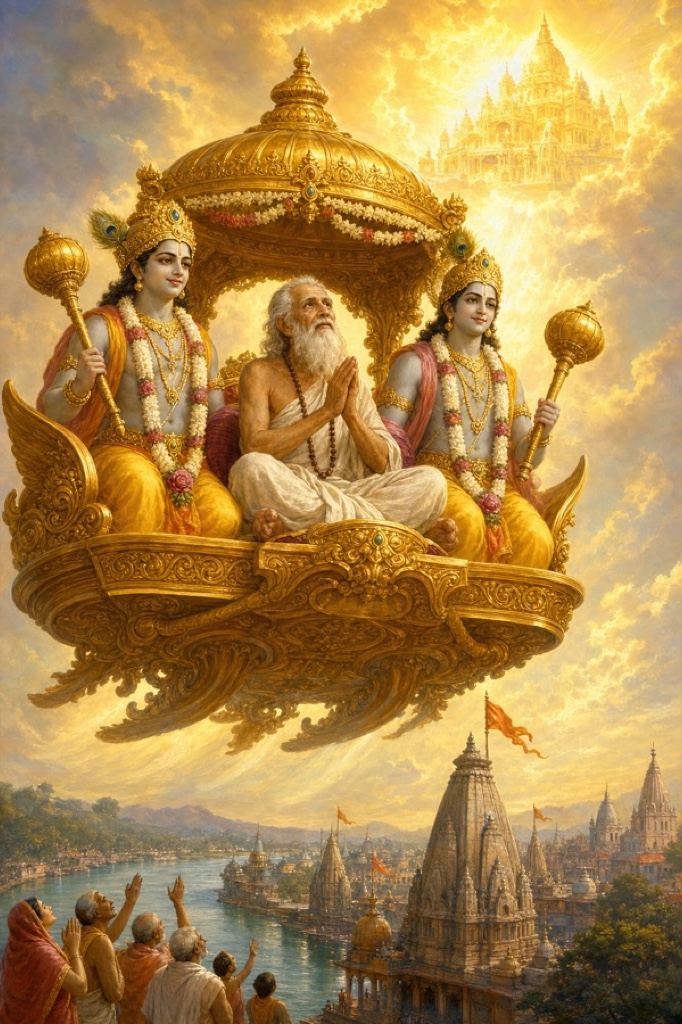
One day on the bank of the river, with his mind held fast and unwavering, he saw them again: the four, standing before him as they had stood in the sickroom, and this time there was no noose anywhere. He knew them, and he bowed. In that instant, on that sacred ground beside the Ganga, he let the body fall. He took on a form like theirs, radiant and golden, and seated among the Lord’s own attendants on a vimana of gold he rose through the sky to Vaikuntha, the abode where nothing ever falls, the home of Bhagavan Lakshmipati, the husband of Sri.
Literary context
The story of Ajamila fills the first two discourses of Skandha 6 of the Shrimad Bhagavata, and it stands as the scripture’s boldest single statement on the power of the Name. Its center of gravity is the debate between the Vishnudutas and the Yamadutas in the second discourse (6.2), where the doctrine that the Name acts by its own force, independent of the speaker’s intent, receives its fullest exposition. The famous shloka ‘sanketyam parihasyam va…’ (6.2.14), that the Name spoken even as a mere pointer or in jest wipes out every sin, belongs to this exchange. The third discourse (6.3) completes the arc: the defeated Yamadutas report to their master, and Yama himself tells them that the Supreme Lord stands above his own authority, that in all creation only twelve beings truly know the dharma the Lord taught, and that his messengers must keep far from anyone who has taken refuge in the Name, for such a soul has passed beyond the reach even of Death.
Ajamila strayed for eighty-eight years, and one name spoken in his last terror carried him across. This story exists for the person who is certain it is already too late. The Name never asks whether you are ready, and it never checks whether you meant it; it answers the moment it is spoken. That is the shelter it holds open.