On this page
The Battle of Hiranyaksha
His story starts far from any battlefield. At the innermost gate of Vaikuntha, the Lord’s own country, stood two doorkeepers, Jaya and Vijaya. One day four sages came to that gate, Sanaka and his three brothers, the oldest beings in creation, wearing by their own choice the bodies of five-year-old children, and the two guards barred their way with their staffs. For that single act of arrogance the boy-sages cursed them to fall, to be born three times in the wombs of asuras before they could come home. The Lord himself, when he arrived at his gate and heard it, would not undo the curse; he gave his doorkeepers only a promise, that they would return to him. And the wombs that received them were prepared by another act of impatience. Diti, a daughter of Daksha, went to her husband, the sage Kashyapa, at the hour of dusk, burning for a son and unwilling to wait. Kashyapa pleaded with her. The hour is wrong, he told her; twilight belongs to Rudra, who rides the failing light on his bull with his host of ghosts around him, his matted hair gray with the dust of cremation grounds, watching everything through his three eyes. Wait a little while. She would not. She caught the sage by his garment like a woman with no shame left to lose, and Kashyapa bowed to what was coming, and gave in.
“When it was done, he did not soften the truth for her. Your mind was impure, he said, the hour was forbidden, my word was crossed, and the gods were slighted; out of those four wrongs will come two cruel and worthless sons, and they will make the three worlds and their guardians weep again and again. And when they turn to killing the helpless and tormenting the great, the Lord of the universe will come down in person and strike them, the way Indra strikes down mountains. Diti heard all of it, and then she asked her one mercy: if they must die, let them die at the Lord’s own hands, and never under the curse of an angry Brahmin. Seeing her remorse, Kashyapa gave her one gentler word to hold: from her elder son would come a grandson so pure that holy men would honor him, and the world would sing his name alongside the Lord’s own. She carried the seed within her for a hundred years, dreading what it would do to the gods, and when the twins were finally born, comets crossed the sky, the earth shook with its mountains, winds tore full-grown trees out of the ground, and she-jackals in the villages screamed fire from their mouths. The two grew like iron given breath, tall as mountains, the crests of their golden crowns brushing the sky, the ground trembling under every footfall. Kashyapa named them: the one who had entered the womb first was Hiranyakashipu, and the one who came out of it first was Hiranyaksha, the fiercer of the two. It was Hiranyaksha who gathered up the earth and carried her down into the waters of Rasatala, the sunless deep below the worlds.”
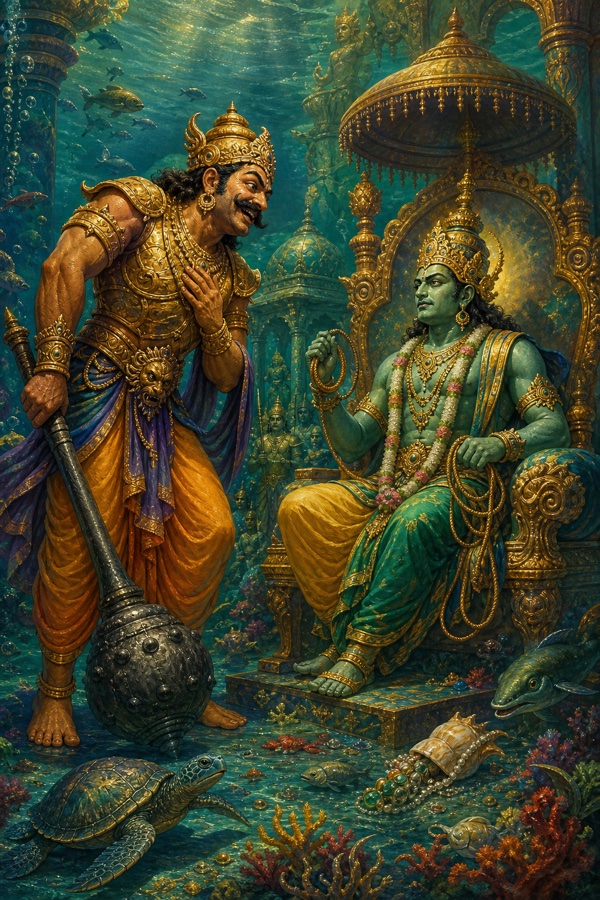
“Hiding the earth quieted nothing in him. A boon he had wrung out of Brahma left him with no death to fear from any created thing, and strength with the fear taken out of it turns into hunger. So he took up his mace, the Vaijayanti garland swinging at his chest, gold anklets ringing at every stride, and climbed into heaven itself to look for someone who would fight him. The gods saw him coming and hid, the way snakes hide from Garuda, and when he found the halls empty and Indra nowhere, he roared his contempt into the silence. Then he threw himself into the deep, thundering ocean for the pure sport of it. Varuna’s creatures fled from his splendor alone, before he had landed a single blow. For years he ranged the waters, beating down the wind-driven waves with his iron mace, until his wandering brought him at last to Vibhavari, the shining capital of Varuna.”
“Varuna was lord of the waters and warden of the deep world below, an old god with an old god’s dignity. Hiranyaksha dropped at his feet in a mockery of homage, grinning up at him. ‘Give me the alms of battle, great lord. You guard an entire sphere; you have broken the pride of warriors beyond counting, beaten every Daitya and Danava in the world, and once performed the Rajasuya, the sacrifice of emperors. Surely you can spare me one fight.’ Varuna felt the anger climb in him, and reason pressed it down. ‘Dear one, we have put war away; age has done that for us. Only one remains who can satisfy a fighter of your skill, the most ancient Person, the one even men like you name with praise. Go and find him. Your pride will leave you the moment you reach him, and you will lie down on his field with dogs for company. He takes his many forms to root out creatures like you, and to shelter the good.’ The demon barely listened. From Narada he learned where Shri Hari was, down in the depths, lifting the earth toward the light, and he went after him at speed.”
“He found the Boar in the deep, bearing the earth upward on the points of his tusks, and the reddish eyes seemed to strip the demon’s own luster from him as they looked. Hiranyaksha laughed. One blow, he thought. This will take one blow.”
“A boar! Against me!”
He settled his grip on the mace, a weight of iron that no other arm alive could have raised off the ground.
“Come on then, fool. Put the earth down. The Maker of the universe gave her into our keeping, to us who hold Rasatala, and you will not slip away with her under my eyes, you vile god dressed in a boar’s skin. Deception is the only strength you have; you kill asuras from inside your tricks, unseen, the pet beast our enemies raised to finish us. When my mace opens your skull, the gods and sages who live on your offerings will stand like trees with their roots cut through. I will dry the tears of my people with your death.”
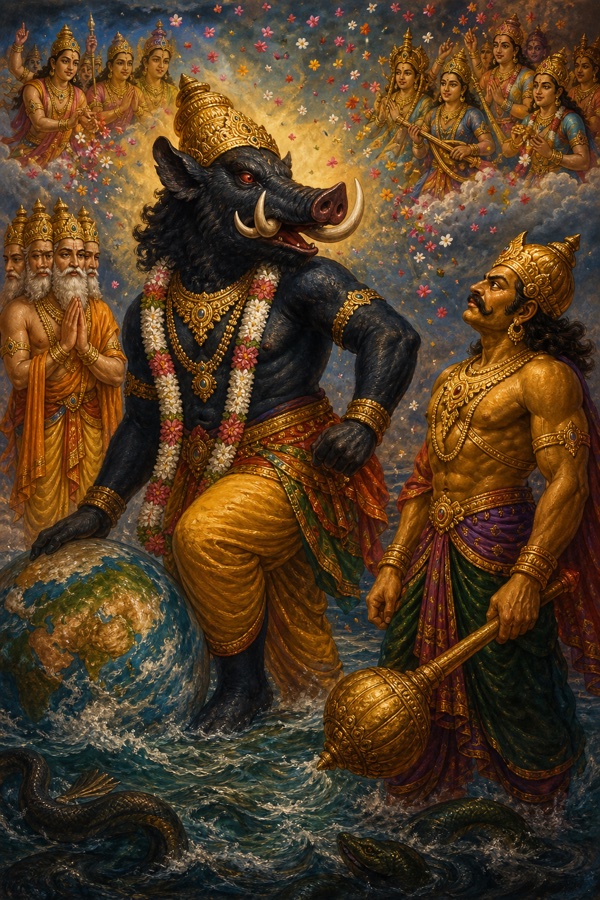
Every word went in like an arrow, and the Lord bore them all without answering, because the Earth was trembling on the points of his tusks, and she came first. He rose through the water carrying her the way a bull elephant brings his mate up out of a crocodile’s reach, and the demon, golden-haired, terrible-tusked, came surging up behind them like the crocodile itself, roaring like thunder, taunting him for running from a challenge. The Lord did not turn until the work was finished. In the demon’s full view he set the earth down on the face of the waters and passed into her his own power, the strength by which she floats to this day. Brahma’s voice rose in praise from above, and the gods poured down flowers.
Only then did he turn to the demon standing close upon him, mace in hand, cased in his strange golden armor, and there was laughter in the Lord’s voice with a terrible anger underneath it. “Wild brutes, yes. We are exactly that, since we roam about hunting for dogs like you. And heroes waste no attention on the bragging of a creature already tied in the ropes of Death. Look at us: your mace so frightened us that we stole the charge of Rasatala’s dwellers, and now we stand here with our shame thrown to the winds, nowhere left to run from so powerful an adversary. So come, captain of foot soldiers. Make good your word and put us down; dry your people’s tears. A man who cannot redeem his boast has no seat among the good.”
Then the war began.
Mace against mace, first. The demon hissed like a serpent teased with a stick, sprang, and swung for the Lord’s chest with everything in his arms. Shri Hari shifted aside by a hand’s breadth, the way a finished yogi steps aside from death, and the blow came down on empty water. Then his own mace answered, catching the demon above the right eye, and Hiranyaksha, a master of the weapon, turned it off his brow with his own. After that neither gave ground. Iron rang on iron until the whole body of water in Rasatala shivered with it, the shock climbing clear to the ocean’s bed above. They circled and hammered, both of them cut, both bleeding, the smell of their own blood driving them wilder, two bulls hooking horns over a single cow, each certain the victory was his.
Brahma came down to watch, ringed by Marici and thousands of seers, and what he saw troubled him: the son of Diti fearless, unbroken, returning the Lord’s blows stroke for stroke. He folded his hands and spoke. “Prabhu, this demon carries a boon he took from me, and it has swollen him past all restraint. He tramples the gods who shelter at your feet, torments Brahmins, cows, every creature that cannot resist him, and walks the spheres hunting for a rival because none exists. Do not play with him, the way a child plays with an angry serpent. He is a conjurer, arrogant, self-willed, wicked to the bone. The dreadful hour of twilight, the hour that ruins the worlds, is nearly upon us, and it will feed his strength. The blessed span called Abhijit opened at midday, and it is almost spent. He has walked to you on his own feet, carrying the death you yourself ordained for him. Show your power, kill him in this duel, and set the worlds at peace.”
The Lord heard the guileless prayer, laughed from the heart, and accepted it with one glance laden with love. Then he sprang, driving his mace at the chin of the demon stalking before him. What happened next startled even the watchers in the sky. Struck by the demon’s mace, the Lord’s weapon slipped from his hand and went down whirling, blazing as it fell, a thing very near a miracle, and for a moment he stood empty-handed. The opening lay wide. Hiranyaksha refused it. He would not strike an unarmed opponent; he held to the law of single combat even now, with everything he wanted standing weaponless in front of him. A cry of alarm went up from the gods and rishis, and the Lord, honoring the fair play of his enemy even as it kindled his fury, called the discus Sudarshana into his hand.
The disc came awake and began to turn. And now the Lord closed at last with the chief of his own doorkeepers, wearing the body of Diti’s son, while from the vimanas overhead, from watchers who had no idea who either of them truly was, strange cries floated down: victory to you, finish him, play with him no longer. The sight of that spinning rim did something final to the demon. He hissed, bit his lips, glared over his tusks as though his stare alone could burn the Lord where he stood, then leapt high and hurled his mace with a scream: “Now you are dead.” The mace came on with the force of a storm, and the Lord knocked it out of the air with his left foot, lightly, while its owner watched. “Pick it up,” he said. “Try again. You want so badly to win.” Hiranyaksha roared and threw it a second time, and this time the Lord did not move at all; he caught it clean out of its flight, the way Garuda closes his talons on a snake. Something in the great daitya went out then. The last heat left his pride, and when the Lord held the mace back out to him, he would not touch it.
He took up a trident instead, a thing that pulsed and fed on the air like open flame, and hurled it at Shri Hari with the whole of his strength, the way a corrupted mind hurls a spell at a blameless Brahmin.
The trident tore across the sky, burning brighter the faster it flew.
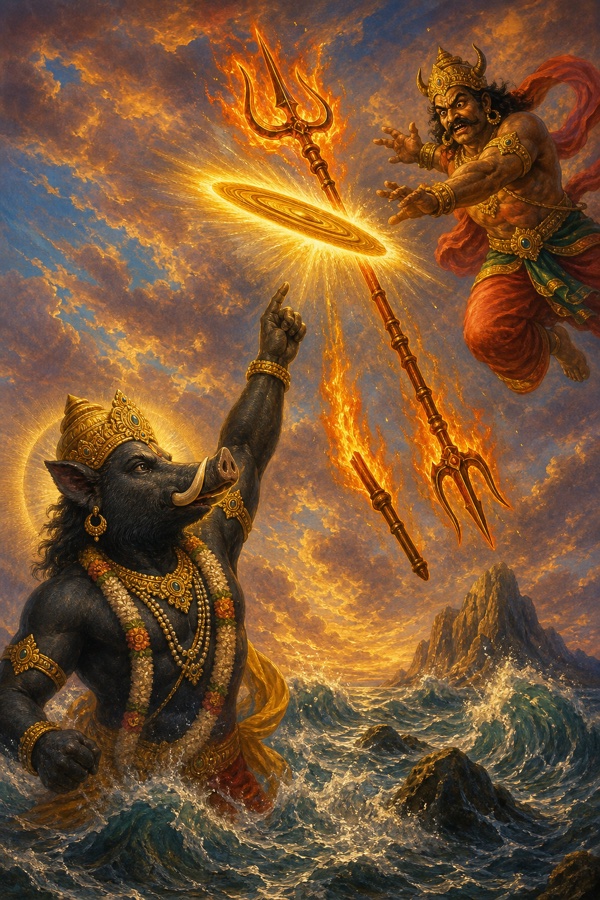
Sudarshana met it midway. The sharp-rimmed disc cut it in two before it could arrive, the way Indra’s thunderbolt once sheared a wing from Garuda, on the day the great bird let the blow land so that Indra’s weapon would keep its honor.
The halves of his trident fell out of the sky, and with them fell the last of the demon’s judgment. He rushed in close and drove his fist, all his mass behind it, into the broad chest where the curl of white hair called Shrivatsa lies over the heart. Then he bellowed once, and vanished from sight.
The blow changed nothing. Varaha stood as an elephant stands when someone strikes it with a wreath of flowers.
Then the great conjurer reached for his deepest art and began to work sorceries against the Lord of Yogamaya himself, the source from which every maya in existence is spun. Those watching felt the alarm of it in their bones and thought the dissolution of the universe had come.
A ferocious wind rose, and the dust it carried buried the world in darkness.
Stones flew in volleys out of every quarter, as if slings by the thousand were working in the dark.
Lightning cracked and flared, banks of cloud swallowed the sun, the moon, and the stars, and out of those clouds rained blood, pus, hair, and bone.
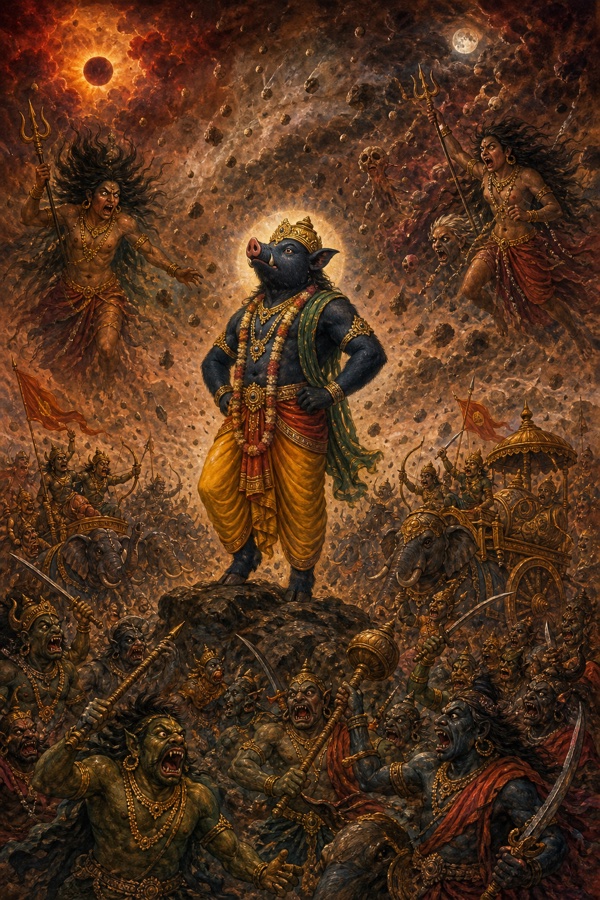
Mountains stood up out of nowhere, pouring down weapons of every kind. Naked demonesses swept past with their hair loose and tridents in their fists, and hordes of yakshas and rakshasas, marauders on foot, on horseback, on elephants, in chariots, filled the dark with a butcher’s clamor: kill, cut them down.
Through the whole of it Varaha stood, the way a mountain stands inside a storm.
Then, to end it, Shri Hari loosed his beloved Sudarshana into the heart of the sorcery, and the entire web of illusion came apart in a single instant, cut through everywhere at once.
In that same instant, far from Rasatala, Diti’s heart lurched in her chest, and blood ran from her breasts. She remembered her husband’s words in the same moment her body did. The death she had begged for her sons, the Lord’s own hands and no Brahmin’s curse, had come for the first of them.
Stripped of his sorceries, Hiranyaksha came back with what remained to him, and what remained was rage. He threw his arms around the Lord to crush the life out of him, locked them with his full strength, and found himself holding nothing. The Lord stood outside the circle of his arms.
So he fell to pounding him with fists harder than thunderbolts. And the Lord answered as Indra once answered Vritra: one open palm, swung flat, at the root of the demon’s ear.
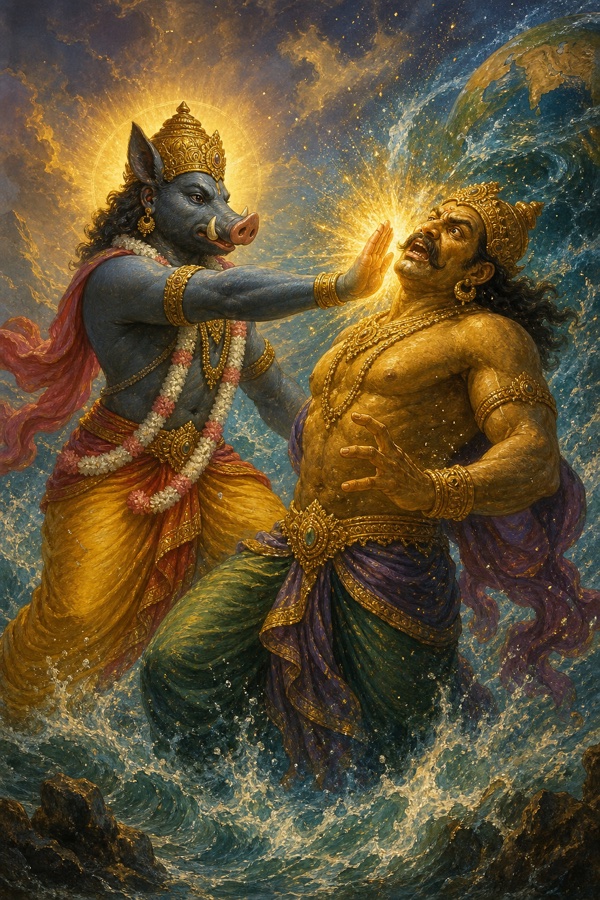
That was the whole of it. The vast body wheeled where it stood, the eyes burst from their sockets, arms and legs and hair broke apart and scattered, and Hiranyaksha came down dead on the water, like an ancient tree torn out by its roots in a gale.
And still the light on him did not go out. He lay there, terrible-tusked, teeth set in his lip, glowing, and Brahma and the gods who had gathered for the battle looked down at him in open admiration. “Who is ever given a death like this? Yogis sit alone for lifetimes, holding the mind by force on that one presence, seeking release from a bondage that was never real, and this crest-jewel of Diti’s sons has left his body struck by the Lord’s own limb, his eyes full of that face to the very end.” And they understood what they were looking at. “These two, Hiranyaksha and Hiranyakashipu, are the Lord’s own attendants, dragged down into demon births by a curse. A few more lives, and they will stand at their own door again.”
The devas folded their hands. “Prabhu, we bow to you again and again. Source of every sacrifice, you have taken on this body of pure sattva to keep the world standing. By good fortune this tormentor of the worlds lies slain, and by devotion to your feet we too are at ease again.”
Then Adi Varaha, the first Boar, who had knocked down Hiranyaksha of the irresistible strength as easily as a plaything, went back to his own realm, where joy runs unbroken, with Brahma and all the rest singing behind him.
Literary context
The battle of Hiranyaksha and Varaha fills Chapters 17 through 19 of the Third Skandha of the Shrimad Bhagavata, where the sage Maitreya recounts it to Vidura. It ends with a single blow, Varaha’s open palm struck at the root of the ear. The Bhagavata traces the brothers’ demonic nature to their conception itself: Diti sought the sage Kashyapa at the forbidden hour of dusk, over his warning, and Kashyapa foretold that the sons of that hour would make the three worlds weep until the Lord came down in person to end them. Diti’s one prayer was that they die by his hands and under no lesser curse.
This katha stands as the gateway to the story of Prahlada and Narasimha, for Hiranyaksha and Hiranyakashipu are the first of the three births of Jaya and Vijaya, the Lord’s own doorkeepers. The full account of their triple fall into asura wombs, and of their release at the Lord’s hands each time, comes in the Seventh Skandha of the Bhagavata.
The philosophical lens
Here the Bhagavata’s teaching of devotion through enmity shows its first and fiercest face. Alongside love, fear, parental tenderness, and friendship, the shastra admits hatred too as a road that ends at the Lord, under one hard condition: the mind must never leave him, even for the space of a single instant. The kathas of Kamsa, of Shishupala, and of Hiranyakashipu each pick up this thread and carry it further.
It is worth saying plainly that this road is for no one to walk on purpose. Shukadeva speaks of it as one speaks of a mystery, never as a practice to take up. The enmity by itself bought Hiranyaksha nothing; his release flowed from the Lord’s causeless compassion, which reaches even an enemy and carries him home. And notice what the gods noticed over the fallen body: the glow that would not fade. The Lord’s own hand had touched him, and his eyes had held that face at the last. A death dealt in anger, coming from those hands, arrives as grace.
One last thing
The earth that Hiranyaksha dragged into the depths, Varaha raised on his tusks and settled back in her place. Nothing that sinks has to stay sunken, so long as someone comes down for it. And the hand that came to do the drowning became, at the end, the door by which she rose.