On this page
Kamsa’s Fear and the Birth of Krishna
⁂
Mathura, in those days, answered to Kamsa. The city was older than any of its kings: Shurasena, chief of the Yadus, had ruled from it long before, and from his day forward it had remained the seat of every Yadava king, a city where, men said, Hari himself was never absent. Kamsa was the eldest son of its king, Ugrasena, lord of the Yadus, the Bhojas, and the Andhakas, a prince who already carried himself as though the whole Shurasena country were his.
Kamsa had a cousin he loved, Devaki, daughter of his uncle Devaka, and she was married in Mathura to Vasudeva, son of Shura, a noble of the Yadu house; to please his cousin, Kamsa himself took the reins of the bridal chariot. When the rites ended, Devaka could not bear to send his daughter away with empty hands. He gave with her a dowry that made the whole city stop and stare: four hundred elephants hung with golden chains, fifteen thousand horses, eighteen hundred chariots, and two hundred young maidservants in full ornament. Conchs, clarionets, clay drums, and kettledrums all sounded at once as the wedding procession formed, and Kamsa himself, glowing with the day, took the reins of the bridal chariot to drive his cousin to her new home, hundreds of gold-plated chariots rolling behind him.
The procession was halfway down the road when the sky spoke.
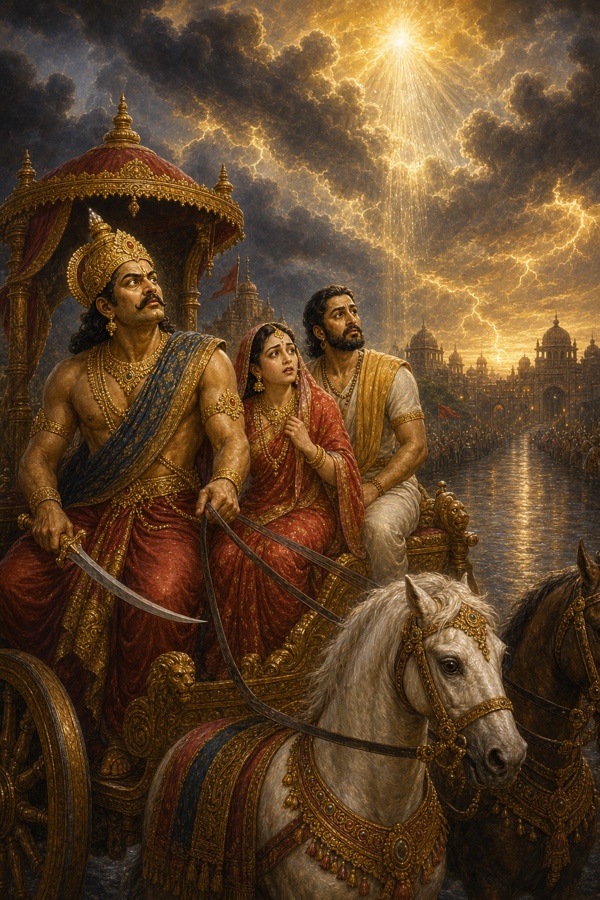
“Kamsa, you fool. This girl you are driving so tenderly to her husband’s house, the eighth child of her womb will kill you.”
The reins slid loose in his fists. For one breath nothing in him moved. Then the coldness turned over and became heat, and the heat had a blade in it.
He seized Devaki by the hair, dragged her from the seat, and raised his sword to take her head on her wedding day.
Vasudeva put himself between the blade and the bride.
“Brother, stop and hear me. You are the pride of the Bhoja house; heroes sing your name in their halls. Will that name now rest on the body of a woman, your own cousin, killed at her own wedding? And think for a moment about the thing you fear. Death is written into every creature on the day it is born; whether it arrives tonight or in a hundred years, it arrives, and no sword held over a bride can move the hour. When the body falls, the one who lived inside it has already stepped across into another, the way a walking man keeps one foot on the ground until the other has found its place, the way a caterpillar at the tip of a grass blade lets go only after it grips the next. The soul carries its destiny from form to form, and the forms tremble while the self stays still, the way the moon shivers in a jar of water while the moon itself hangs quiet in the sky. So harm no one, brother. Whatever a man does to the helpless waits for him up ahead, wearing his own face. And this girl is helpless. She has done nothing. She is your cousin, married this very hour, and you have been kind to the weak all your life. Let her live.”
“Her children are my death.”
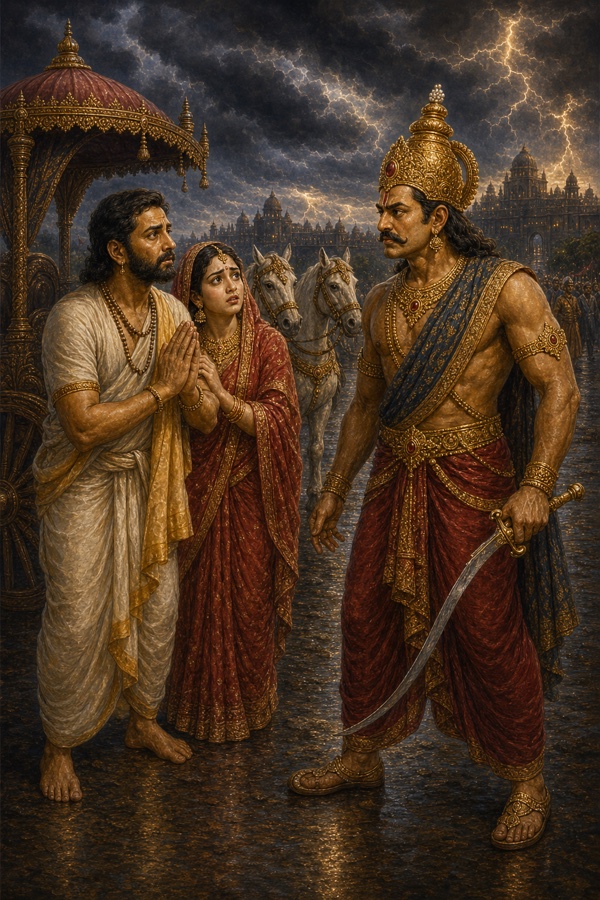
Kamsa’s grip did not soften, and Vasudeva understood that argument had run its course. His mind worked fast, the way a mind works with a sword in front of it. A wise man wards off death for as long as strength and reason hold; if it comes anyway, no blame attaches. Promise him the children, then, and Devaki lives tonight. If sons are born, and if Kamsa still breathes when they are born, the price falls due; and who can read Providence that far ahead? What stands over you may turn aside, and what has turned aside may circle back. A forest fire leaps the tree beside it and burns the one across the ravine, and no man can say why. So Vasudeva looked up at the man he had grown up loving, praised him to his face with an aching heart, and made the offer. “There is no danger to you from her, brother; the voice named her children. Then take the children, and let her live. I give you my word. Every child born of her, I will bring to you with my own hands.”
Kamsa went still. He had known Vasudeva all his life, and in all that life the man had never once broken his word. The offer was real. The offer would hold.
The sword came down to his side. “Agreed. Every child, into my hands.” And the storm passed through him and was gone; he drove the bridal chariot the rest of the way as though nothing on that road had ever happened.
In time Devaki’s first son was born, a boy they named Kirtiman, and Vasudeva did what almost no man alive would have done: he lifted the newborn, carried him through the streets of Mathura, and set him in Kamsa’s hands. What is too heavy for the honest to bear? What do the wise still lack? What can the depraved not stoop to, and what can those who hold to the Lord fail to let go? The plain steadiness of the act stopped Kamsa where he stood. “Take the boy home,” he said. “It was never this one. My death comes from your eighth; the eighth is the one I will watch for.” Vasudeva carried his son back through the same streets and took no comfort at all from the reprieve. He knew the worth of a promise made by a man who could not govern his own mind.
Then, within days, the sage Narada arrived in Mathura, unasked and unannounced, the wanderer who carries word between gods and kings. What he laid before Kamsa moved the ground under the throne. The cowherds of Vraja with Nanda at their head, and their wives; Vasudeva and all the Vrishni clan; Devaki and the women of the Yadava house; the kinsmen and friends of both families down to the last cousin: nearly all of them, Narada said, were gods walking in human skin, sent down to destroy the Daityas whose weight the Earth could no longer bear. And the design reached further still, for out of Devaki’s own body Vishnu himself was coming, and he was coming for Kamsa. Something old and buried rolled over at those words. In a life long finished, Kamsa had been the great demon Kalanemi, and it was Vishnu’s hand that had cut him down then. Now the fear in him went to the root, past the reach of reason, and he saw his death waiting in every unborn child. Kings drunk on their own continuance have murdered fathers, mothers, and brothers to keep a throne; Kamsa found the price easy. The moment the sage departed, he had Devaki and Vasudeva seized, chained hand and foot, and shut behind bars and guards in a cell of his own palace, and he sent for the boy he had spared. The honesty that had once stopped him meant nothing now. He took Kirtiman by the feet and dashed him against the stone. He threw his own father Ugrasena into prison as well, and from then on he ruled the Shurasena country himself.
Year after year the cell heard a birth, and year after year Vasudeva kept his terrible word, and one after another six infant sons died in Kamsa’s hands. His war reached past the prison door too. He gathered demon allies around him, Pralamba and Baka, Chanura and Trinavarta, Mushtika, Arishta, Dvivida, Putana, Keshi, Dhenuka, with Bana and Bhauma behind them and Jarasandha, the emperor of Magadha, whose two daughters he had married, standing surety over it all, and he set them on the Yadus until the clans scattered for their lives into the lands of the Kurus and Panchalas, the Kekayas and Shalvas, the Vidarbhas, Nishadhas, Videhas, and Kosalas. Then came the seventh conception, and this one carried more than a mortal child: a ray of the Lord’s own being, the serpent Ananta whom devotees call Shesha, the endless one on whose coils the worlds are laid. Him the Lord would not surrender. He summoned Yogamaya, his own divine power, the enchantress by whom the whole universe stands bewitched, and gave her his commission. Go to Vraja, he told her. Rohini, another wife of Vasudeva, is hiding from Kamsa among the herds in Nanda’s Gokul. Draw my Shesha out of Devaki’s womb and set him in hers. Then I will be born as Devaki’s eighth, and you, goddess, will be born of Yashoda, the wife of Nanda. And men will never forget you: they will raise temples to you across the earth and call you by name upon name, Durga, Bhadrakali, Vijaya, Vaishnavi, Chandika, Sharada, Ambika, and worship you with incense and offerings as the giver of every wish. So it was done, silently, in a single night. Mathura heard only that Devaki’s seventh had died in the womb, and the city grieved for her. Far away in Gokul that child would be born and grow into Balarama: called Sankarshana, the drawn-across, for the womb he was drawn from; called Rama for the delight of him; called Bala for a strength no one ever found the measure of. But that is a story for another day.
Now only the eighth remained.
What entered the world next did not come the way children come. The Lord passed first into the mind of Vasudeva, whole, with every divine power he possesses, and the chained man began to shine. The guards found they could no longer rest their eyes on him; he burned in that cell like a second sun. From him the glory passed to Devaki through sight alone, mind into mind, the way a master sets a living image whole into the heart of a disciple, and Devaki conceived, and carried the Lord the way the eastern sky carries the rising moon. She began to glow in the dark of her confinement, and it was a shut-in light, a flame closed inside a jar, knowledge sealed up in a scholar who shares it with no one, and still it refused to be hidden. Kamsa saw it. He came every morning to look at his sister, and every morning her face held more of that unbearable brightness, and dread climbed through him rung by rung. Hari has entered her womb, he told himself. The one who is coming for my life is inside her now, the way a lion is inside a cave. And every road out of the fear was closed. Kill the child at its birth? A being who comes for a purpose holds nothing back for being newly born. Kill Devaki now, and the child with her? He circled that thought morning after morning and could never land on it. So he doubled the guard, hung new locks on the gates, stared at the growing curve of her body, and waited, a man watching his own death ripen.
It was the eighth night of the dark fortnight, deep in the rains. All evening the storm had hammered Mathura, and then, toward midnight, the world began to change. The star Rohini stood at the ascendant, and every planet in the sky eased into its gentlest aspect. The quarters cleared as though autumn had arrived months before its time; washed stars crowded the heavens; and below them the earth seemed to remember happiness, towns and villages and herders’ camps stirring with a festivity no one could name. Rivers that had run brown with flood ran suddenly limpid. Ponds opened their lotuses into the dark. The forest edge rang with birds and bees as though it were morning. A breeze came off the Yamuna carrying a sweetness that belonged to no season, cool and clean on the skin, and in the houses of the Brahmins the sacred fires, smothered for years under Kamsa’s persecution, rose into flame on their own, with no hand to tend them. Far overhead, past mortal hearing, kettledrums beat in heaven. Kinnaras and Gandharvas sang; Siddhas and Charanas spoke blessings; Vidyadhara women danced with the nymphs of heaven; sages and gods poured down flowers; and the clouds, holding their rain, rumbled low and soft, like an ocean heard from far inland. In the middle of all of it sat one darkened city, and in the middle of the city, one barred room.
There, at midnight, when the darkness stood thickest and the whole world lay listening, Devaki brought forth her eighth child, the way the eastern horizon brings forth the full moon.
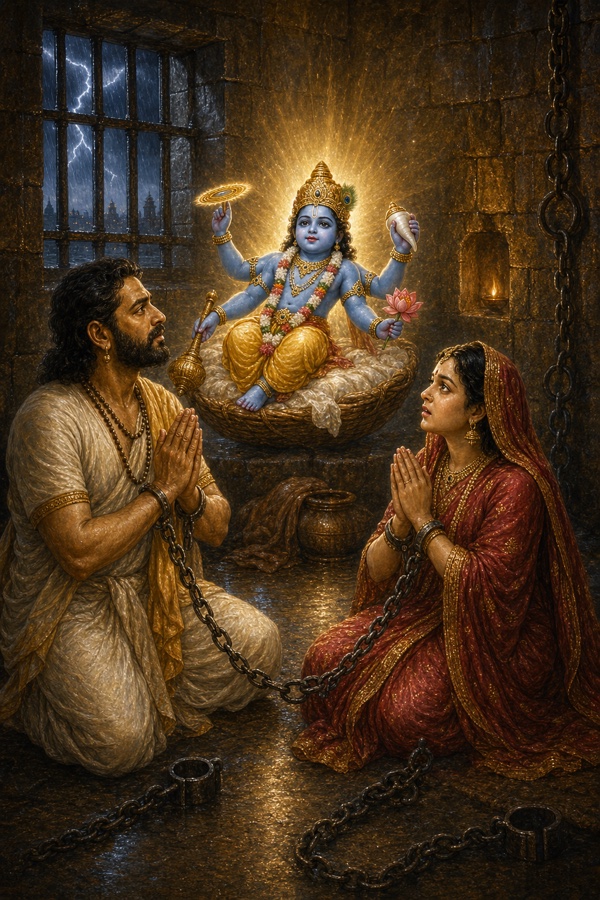
Vasudeva looked at his son and forgot how to breathe. The boy’s eyes were long as lotus petals, and his arms were four, and the four hands held a conch, a discus, a mace, and a lotus. On the small chest gleamed the Srivatsa, the golden curl of hair that marks Vishnu and no one else; at the throat hung the Kaustubha gem, drawing light out of the dark. Silk the color of turmeric wrapped him, and the body itself was dark and lustrous as a cloud swollen with rain. A diadem and earrings set with cat’s-eye stones kindled above the tiny face; a girdle, armlets, and bangles glimmered at every small movement; and the whole cell filled with a radiance that had no lamp behind it. For a moment even the rain fell silent, somewhere far away.
Vasudeva knew what he was seeing: the Supreme Person, the source the Vedas point toward, born as his own son. The fear that had lived in him for eight years let go all at once, and joy came up in its place, joy so large it demanded ceremony. Chained in a cell, owning nothing, he gave away ten thousand cows to the Brahmins in his heart, the royal gift for the birth of a son, and the giving was real where giving matters. Then he bent low over his joined hands, and the words came. You are the Person beyond nature, he said, being itself, awareness itself, bliss itself, the witness seated behind every mind. You spin this universe of three strands out of your own power, and then you seem to step into it, though you were never outside it; there is no inside or outside to you at all, the way the elements that build a thing stand already present within it. The rising of the worlds, their keeping, and their passing all move from you while you remain without desire and without change: a white brilliance when you preserve them, red fire when you kindle them, darkness when you draw them down. And I know why you have come now. You have come to guard the good and to mow down the armies of demons who parade under the name of kings. But Lord, this house is watched. The man out there killed your brothers because a voice told him you were coming; the instant his runners bring him word of your birth, he will stand in that doorway with a sword. Devaki looked at her son, and her long terror finally broke into a smile, and she prayed too. You are the one the Vedas call the unmanifest, she said, the first cause, pure light with no second thing beside it. When Brahma’s own lifetime runs out at the end of two parardhas and the worlds dissolve, when the elements fold back into their causes and the causes fold into you, you alone remain, and for that the wise call you Shesha, the Remainder. Time itself, from the blink of an eye to the turning of the year, is only your power moving. A mortal runs from death through all the worlds and finds no cave and no kingdom where death has not already found the door; and yet the one who reaches your feet rests, and death itself turns and walks away from him.
“And still I am afraid,” she said, and it was the plainest prayer of that whole night. “Kamsa’s guards stand at the wall. Protect us. And this form, Lord, this blazing four-armed form: eyes of flesh must not see it. Draw it in. Be my ordinary child, and let me hide the Lord of the worlds in my arms.” The child answered his mother, and the answer reached back across three lifetimes. In the age of Svayambhuva, the first Manu, he told them, you two were Prishni and Sutapa, a Prajapati and his wife, commanded by Brahma to people the empty earth. Instead you gave yourselves to austerity: rain, wind, blazing sun, frost, and heat borne without shelter, your food withered leaves and then air alone, your breath mastered, your minds washed clean, and twelve thousand celestial years passed over you in that fire. No one has loved me with harder patience. When I stood before you at last, in this same four-armed form, and told you to ask anything of me, the wish that rose in you was for a son like me; liberation itself never crossed your minds, for you had never tasted the world’s pleasures, you were childless, and my own Maya had her hand over your eyes. You asked, and I have kept the asking three times over. I was born to you then as Prishnigarbha. In a second life you were Aditi and the sage Kashyapa, and I came as Upendra, Indra’s younger brother, whom men called Vamana for his dwarf’s form, the small sage who reclaimed the three worlds from the emperor Bali. And this is the third time, mother. I have shown you this form tonight only so you would remember, and know me past all doubting; wrapped in a newborn’s body, I could never have made you believe. Hold me as your son, and know me as Brahman, and love me both ways at once, and when this life closes you will come to me and never again be parted.
“One thing more,” the Lord said, and this was for Vasudeva. “Carry me tonight to Gokul, to the house of Nanda. A daughter has been born there this very hour to his wife Yashoda. Lay me down in her place, and bring the girl back here in your arms.” Vasudeva bowed his head. And then it happened, before their eyes and faster than their eyes could follow: the radiance gathered itself inward, the four arms were two, and in that prison cell lay a small, ordinary, crying newborn with wet lashes and clenched fists.
Vasudeva was ready to go that instant. He was also chained at wrist and ankle, in a barred cell, inside a guarded palace, behind gates sealed with steel.
The answer came from the child in his lap. The irons opened at his wrists and ankles and slid away like things that had lost interest in him. The great locks turned themselves over and hung loose. Door after door, bolted with steel and wound with chain, swung back at his approach the way darkness swings back from sunrise; the gatekeepers’ senses were simply taken from them, and every guard slept where he stood, upright, breathing, gone, with no mantra spoken over him and no spell cast. Yogamaya had moved through the palace ahead of the child, and all Mathura lay under her sleep.
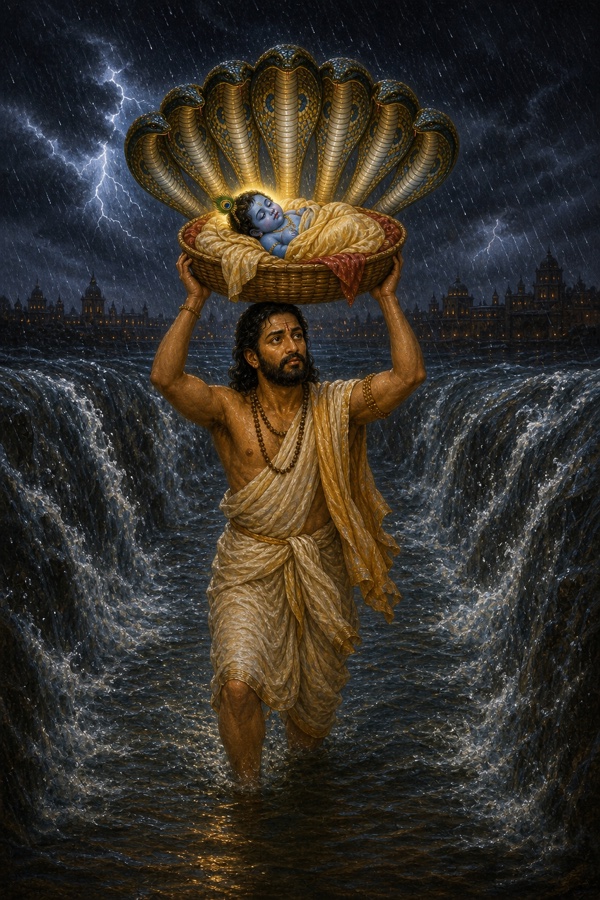
Vasudeva lined a winnowing basket with soft cloth, laid his son inside it, raised it to his head, and stepped out into the rain. The clouds had begun again, low and gentle, rumbling their escort; and up out of the dark behind him rose Shesha, the world-bearing serpent, who spread his hoods over father and child like an umbrella of a thousand ribs and walked the night with them, holding off the water.
Then the road ended at the Yamuna. The river ran monsoon-swollen, deep and fast, torn white with foam and coiled beneath with a hundred whirlpools, while Indra, the king of rain, kept sending fresh bursts down on the country to blind any waking eye. Vasudeva stood at the edge of the flood with the master of that flood balanced on his head, and stepped in. And the Yamuna, who knew what she carried, did what the sea itself had done for Rama in an older age: she gave passage. The waters drew down and apart, standing off on either hand, rising no higher than his thighs while the river roared past at a distance, and he walked the wet lane between them all the way to the far bank.
Gokul lay quiet. Nanda’s house stood open to the night, the whole household spent from a day of festivity and buried fathoms deep in Yogamaya’s sleep. Yashoda lay among them with her newborn daughter at her side. Vasudeva bent over the bed, set the master of all the worlds gently down beside a sleeping woman, gathered her tiny daughter into his arms, and went back out into the rain. Yashoda never stirred. The labor had emptied her, and the goddess had sealed her eyes; when morning came she would know only that she had given birth, and whether to a daughter or to a son, she could not have said.
The Yamuna closed her lane behind him and settled back into her bed. The palace doors let him in and shut themselves after him, gate by gate, exactly as before. He laid the girl beside Devaki, and then he did the strangest, quietest thing of that whole strange night: he bent down and closed the irons around his own ankles with his own hands, and stood as he had stood for eight years, a prisoner, waiting.
And in the stillness, the newborn girl began to cry.
The guards woke to the sound as though it were a war-horn. Word went running through the palace and reached Kamsa in his bed: Maharaj, it has come. The eighth child of Devaki is born.
Kamsa lurched up out of sleep. This was the hour his whole life had bent itself around. He waited for no attendants and no lamp; rain-soaked, hair loose, sword naked in his hand, he crossed the palace on legs that would barely obey him and stood swaying in the door of the cell.
Devaki pressed the infant to her breast and begged as only a mother with six dead sons can beg. “Brother, look at her. A girl. What can a girl be to you? A girl-child must never be killed; she is family to you, blood of your own blood, owed your protection the way a daughter-in-law of your house is owed it. So many babies bright as fire you have taken from me, and I tell myself fate drove your hand. I am your little cousin, and my sons are gone, and I am wretched, and I am asking you for one child. The last one. Leave me the last one.”
There was no pity left in the room. He cursed her for her weeping, wrenched the child out of her hands, caught the small feet in one fist, and swung her down at the stone.
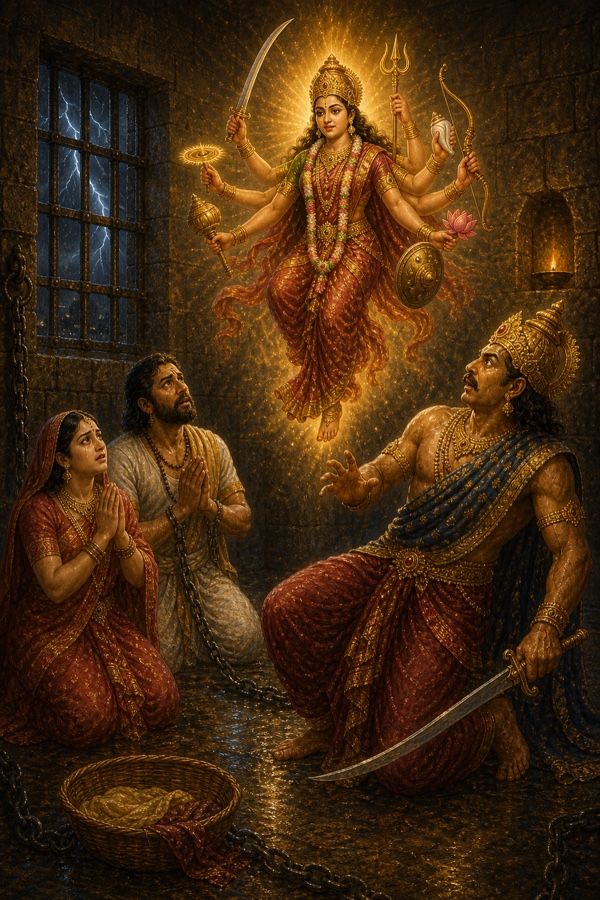
The girl left his grip in the middle of the swing. She rose, going up through the lamplight like a spark returning to its fire, and above their heads she changed. A goddess stood on the air, eight-armed, dressed in garlands and silks and sandal-paste that no loom or garden of this earth ever made, and in her hands the weapons gleamed: bow, trident, arrow, shield, sword, conch, and mace. The unseen filled the room around her; Siddhas and Charanas, Gandharvas and apsaras, Kinnaras and the serpent-folk hymned her from the air and laid their worship at her feet.
She looked down at the man with the sword. “What would my death buy you, fool? The one who ends you is already born. He was your enemy in a life before this one, and he is waiting for you now in some other house, past all your locks. Stop killing helpless children for nothing.” Then she was gone from the air like lightning going home to its cloud, and she did not leave the earth. She settled into it, shrine by shrine, name by name, the same goddess men would come to worship in a hundred places under a hundred names.
Kamsa stood a long time without moving, and then something at the center of him gave way. He struck the fetters from Devaki and Vasudeva with his own hands, and the king of Mathura went down at their feet with his face wet. “Sister. Brother. I have been devouring my own family the way an ogre eats its young. I killed your sons, one after another, with these hands; I threw away pity, I threw away kinship, and I am dead already, a breathing dead man, and I cannot see the bottom of the hells that wait for one like me, a killer on the scale of a slayer of Brahmins. And for what? Even the gods speak falsehood, it seems; I trusted a voice out of the sky, and on the word of heaven I murdered my sister’s children. Do not grieve them past bearing, Devaki. They reaped a harvest sown in older lives; no one stays long, and no one keeps even one place while he stays, and the body was never the self. Bodies rise and fall upon the Self like clay pots forming and crumbling on the earth, and the earth is never altered by the pots. A man who cannot see this keeps watch over two sentences all his life, I am the slayer and I am slain, and both sentences are chains. Forgive me if it can be done. You were always kinder than I deserved, and the good are gentle even to the wretched.” He clasped their feet and wept.
Devaki looked at the man who had killed six of her children, and she forgave him; her anger went out of her with her fear. And Vasudeva, whom nothing in that night had unbalanced, smiled and spoke gently. “It is exactly as you say, brother. The trouble begins with a single belief, the belief that I am this body. Out of it grow mine and not-mine, and out of those grow grief and delight, fear and hatred, greed, delusion, and pride, and a man divided by that eye cannot see the one current underneath, God moving as Time, unmaking beings by the hands of beings.” Kamsa took their leave and walked back through his own palace like a stranger in it.
The night passed, and the morning knew nothing of repentance. Kamsa summoned his counselors, demons of the old enmity against the gods, and laid before them everything the goddess had said. Their answer was simple and it had no bottom. Kill them all, they said. In every town, every village, every herders’ camp, kill every child on either side of its tenth day, and the hidden one dies somewhere in the count. And spend no worry on the gods, they laughed; those are heroes who scatter at the sound of your bowstring, who drop their weapons in the field and loosen their hair and cry out that they are afraid, and you are too honorable to strike a fleeing man, and that honor is all that keeps them alive. Vishnu hides in the hearts of things; Shiva sits in the woods; Indra is a weakling; Brahma has climbed away into austerities. Still, an enemy should never be ignored, for a disease shrugged off in its first days can never be cured once it takes root, and an enemy left to grow will never afterward be dislodged. So strike at the ground the god stands on. Vishnu is the root of the gods, and Vishnu stands wherever dharma is practiced, and dharma is rooted in the Veda, the cow, the Brahmin, austerity, and the rite of sacrifice. Kill the priests, then. Kill the ascetics and the keepers of the fires, and the cows that give the offering. Truth, restraint, reverence, compassion, endurance, worship: all of it is the living body of Hari, and when the body burns, the god has nowhere left to stand. Kamsa was a man already wound in death’s noose, and the counsel fit the fear exactly. He gave the order.
He had the instruments ready. Around his throne stood the demons who had always been his strength, Putana, Baka, Aghasura, and the rest, beings who could put on any shape they pleased, hunger wearing whatever face the hour required. He loosed them across the country against the innocent and the good, and set himself to hunting the one enemy he could not see. And he never once weighed what every wise man knows, that violence done to the great is a debt collected in full: it takes a man’s span of life, his fortune, his fame, his merit, and every blessing he was ever owed, all of it, at the end.
And far away across the Yamuna, in a cowherd’s courtyard in Gokul, Yashoda slept with her new son against her side, knowing nothing of any of it, not the prison, not the prophecy, not the order going out against every infant in the land. She would wake in the morning to a boy. A king’s child born in chains, the master of every world there is, lay in a milkmaid’s arms in the warm dark, wrapped in the smell of milk, home.
⁂
Literary context
This katha comes from Skandha 10 of the Shrimad Bhagavata, Chapters 1 through 4. The Gita Press reading runs in exactly this order: Kamsa’s warning from the sky and the killing of Devaki’s sons (10.1), the Lord’s entry into the womb and the hymns that gather around it (10.2), the midnight birth and the crossing to Gokul (10.3), and Yogamaya’s escape from Kamsa’s hands with her prophecy (10.4).
The night itself is Janmashtami, held as the Krishna-ashtami of Shravana (Bhadrapada in the purnimanta reckoning). From Surdas onward, saint-poets beyond counting have sung this same midnight again and again: the rain, the parting of the Yamuna, and the hood of Sheshanaga spread over the basket.
The philosophical lens
A quiet marvel of this episode is its compression. The whole impossible sequence, the birth, the opening fetters, the parted Yamuna, Sheshanaga’s canopy, the exchange of infants in Gokul, and the return to the locked cell, runs its full course inside a single night. The Bhagavata’s manner of the “one-night katha” reaches its densest form here.
The dance traditions of the south have staged that night over and over. Narayana Tirtha’s Krishna-lila-tarangini binds this same birth and the childhood play that follows it into music and dance, and it is sung and danced in Kuchipudi to this day.
Why this katha matters now
Kamsa’s fear ran so deep that he killed his own sister’s children one by one, and even that could not stop the one he feared. A life that shrinks around its dread, bolting every door and posting a guard on every wall, tightens without knowing it the very gate its own good was coming through. Every chain tied out of fear ends up locked on the hand that tied it.
The same katha elsewhere
- Harivamsha · The Earth’s Cry
Harivamsha: the plea of the Earth and the gods, the prelude to the avatar - Harivamsha · The Birth of Krishna
The birth as told in the Harivamsha, the Mahabharata’s appendix book - Krishna
Character study: the whole arc of Krishna’s story