On this page
The Rasa Lila
He closed his eyes, as though the night he was about to describe still hung somewhere behind them, waiting.
It was the full moon of autumn, and the jasmine, which has no business blooming in autumn, had opened anyway, hedge after white hedge of it, as though someone had arranged the season by hand. Someone had. A year before, in the cold month, the young women of Vraja had gone down to the Yamuna before every dawn and kept a hard vow to the goddess Katyayani, asking her for one thing only, and Krishna had promised them then that the asking would not be wasted. This was the night he had set aside to keep that word. The moon came up the eastern sky red as fresh saffron, the way a traveler home after years away touches saffron to his wife’s face before he touches anything else, and then it climbed and turned to silver, and the whole woodland went pale under it, and the sand along the river lay cool underfoot.
Krishna raised the flute to his lips.
One note went out. Nothing showy in it, no flourish. It simply left, pulling itself farther and farther across the dark water and the dark trees, and it did not come back.
In the houses of Gokul the women were deep in the evening’s work. One leaned into the milking, her cheek against the cow’s warm flank. One had set milk on the fire and stood watching for the boil. One ladled porridge, one served her husband his meal, one sat feeding an infant at her breast, one was rubbing scented oil into her skin, and one bent close to a lamp, darkening her eyes with kohl.
The note found them there.
Hands stopped where they were. The milk rose and ran hissing over the rim. The ladle sank into the pot, the husband sat staring at a half-filled plate, the infant lost the breast, and not one of those women could have said afterward what her hands had been doing when the sound came in at the door.
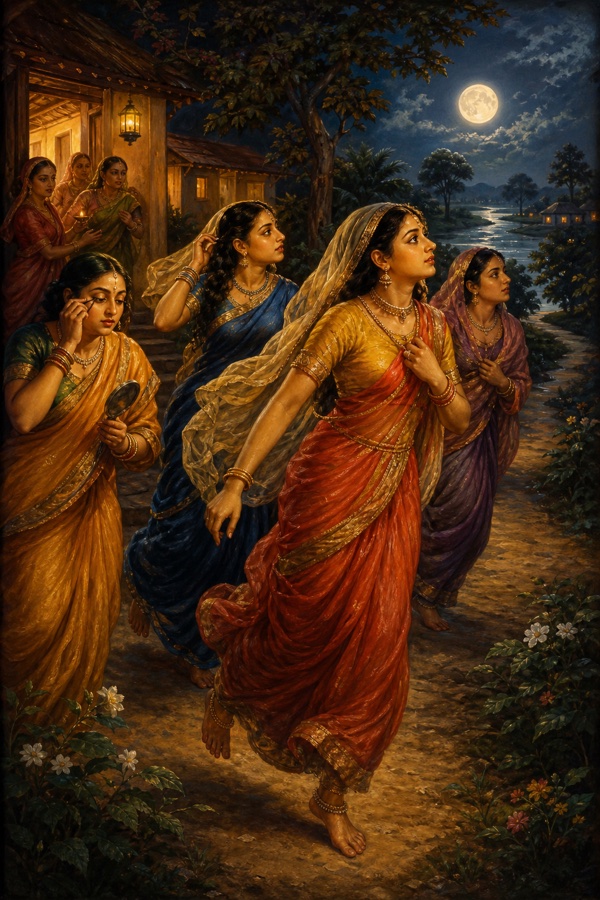
They went exactly as they stood. One with her hair loose down her back, never bound. One with kohl darkening a single eye, the other bare. One had pulled her clothes on crooked and inside out, her ornaments knotted at the wrong places, and she went anyway, running.
Their households tried to hold them.
A husband caught at one in the doorway. “Where, at this hour?” A father called a name into the dark and got no answer. A brother planted himself in a gate and was walked past as though he were the gatepost.
The women said nothing back, because there was nothing in them left over for speech; their feet had stopped taking instructions. And the ones who could not get out at all, bolted in, held fast, closed their eyes where they stood and went to him the only way still open, by thought. What happened to them is the strangest mercy of the whole night. The agony of failing to reach him burned through every sin those women had ever gathered, and the joy of holding him in the mind, embraced, present, real, spent every merit they had ever earned, and with both pans of the scale swept empty, nothing remained in them that could be pulled back into birth. Their bonds parted. Each let the body fall where she stood, softly, a shawl slipping from a shoulder, and was in him. And these were women who had never once studied him or named him as God. Everything they knew of him, they knew as love.
The rest came out onto the bank of the Yamuna, moonlight all over them, breath ragged from running.
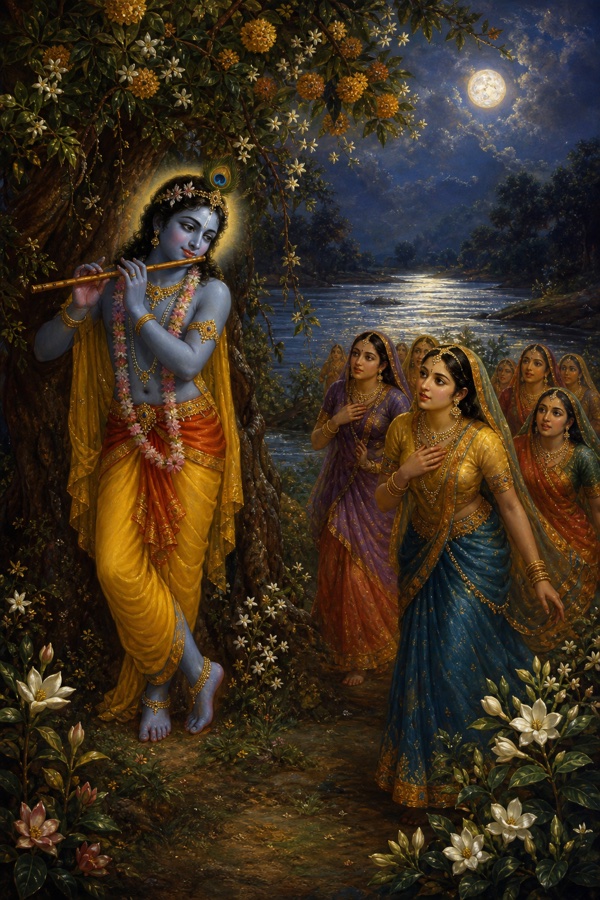
Krishna stood beneath a kadamba tree in full flower, and the flute was still at his lips.
He lowered it. He looked at them, the wives and daughters of his own village standing barefoot in the sand with their kohl half done, and a faint smile came, and then he said the last thing on earth any of them was braced to hear.
“Welcome, fortunate ones, and truly welcome. Tell me how I can serve you. Is all well in Vraja? But tell me also what has brought you out. The night has gone deep, and the creatures that hunt in the dark are moving. Go home. By now your mothers are searching for you, your fathers, your sons, your brothers, your husbands. Do not leave your people standing in doorways, afraid.”
“You have seen the forest now, and it was worth seeing: the full moon on the flowering trees, the new leaves trembling in the breeze off the Yamuna. You have seen it. Now go back and tend what is yours. The calves are lowing for milk, the children are crying to be fed. A woman’s plain dharma is to serve her husband without guile, to care for his people, to raise her children; and a woman who wants the higher worlds does not walk away from her husband, however he has turned out, luckless or worn or dull or ailing or poor, so long as he has not himself fallen from dharma. As for the other road, the road to another man, it closes heaven, and it carries scandal and fear with it wherever it goes.”
He was not finished. “And if it is love for me that brought you, I find no fault in it, for every creature that breathes comes to its delight in me in the end. But hear how that love actually grows. It grows in the one who listens to my story, who looks toward me, who holds me in the mind, who sings of me. It asks nothing of the body’s nearness, nothing of your feet on this sand. So go home.”
The women stood as if struck. Who had played the flute, and who was now preaching the road home?
Their faces went down. They scratched at the sand with their toes, their breath coming so hot with grief it parched their lips, and the tears came anyway, running black with kohl until the color washed from the saffron on their skin. For a while the only sound was the river. Then one of them wiped her eyes with the heel of her hand and spoke, and her voice shook with something close to anger and would not stop, and before she finished, every voice on that bank had joined hers, one grief in many mouths.
“Do not speak to us so cruelly, Govinda. We have put down everything we owned to reach the soles of your feet. Receive us the way Narayana himself receives the ones who come to him wanting nothing further, and do not turn us out. You are the knower of dharma, and you said it yourself a moment ago: a woman’s duty is service, to her husband, to his people, to her children. Then let your own ruling stand, and read it to the end, for you are the Self inside every embodied being, the dearest friend beneath every friendship, the one that all such service was always reaching toward. Water the root, and every branch of the tree drinks. The wise have taken their delight in you since before we were born; what should we do now with husbands and children, who begin in trouble and end in grief? Our minds used to live quietly in our houses; you drew them out with one note and they will not go back in. Our hands have forgotten their work. Our feet will not carry us a single step away from your feet; command them yourself if you doubt it. You lit this fire, with the smile and the sidelong look and that flute; now put it out with what only you have to give, or it will burn these bodies to the ground and we will cross to your feet the way the yogis cross, by remembering and nothing else. From the moment we touched those feet, which the goddess of fortune herself is granted only now and then, no other company in the world has been possible for us. Lakshmi, who lives on your own chest, still comes down beside Tulasi to court the dust of them; the dust is all we are asking. What woman in the three worlds could hear that flute drawn out low across the water, could look once at this form that makes the cows lift their heads and the trees shiver down to their roots, and then walk a straight line home? You were born to take away Vraja’s fear, the way Vishnu, when the gods had lost heaven itself, came in small as a dwarf and won back the three worlds in three strides. Then take away ours. Lay that hand, the one the frightened of every world run under, on our burning hearts. Tell us, Prabhu, where is the justice in calling a woman out of her house with a flute and then quoting the house rules to her at the riverbank?”
Krishna heard her out, and his gaze went slowly from face to face.
What moves in the depth of a person does not turn back because the feet ache or the elders shout. That was the thing he had been sounding for beneath the sermon, and now he had touched it: love without clauses or accounts, with nothing held in reserve for the walk home.
He laughed then, a full and easy laugh, the kind that forgives everyone in earshot. He is the one being in existence who wants for nothing and gains nothing, and out of plain tenderness, tenderness with no hunger anywhere in it, he gave them what they had come for.
And then began what the worlds still call the rasa.
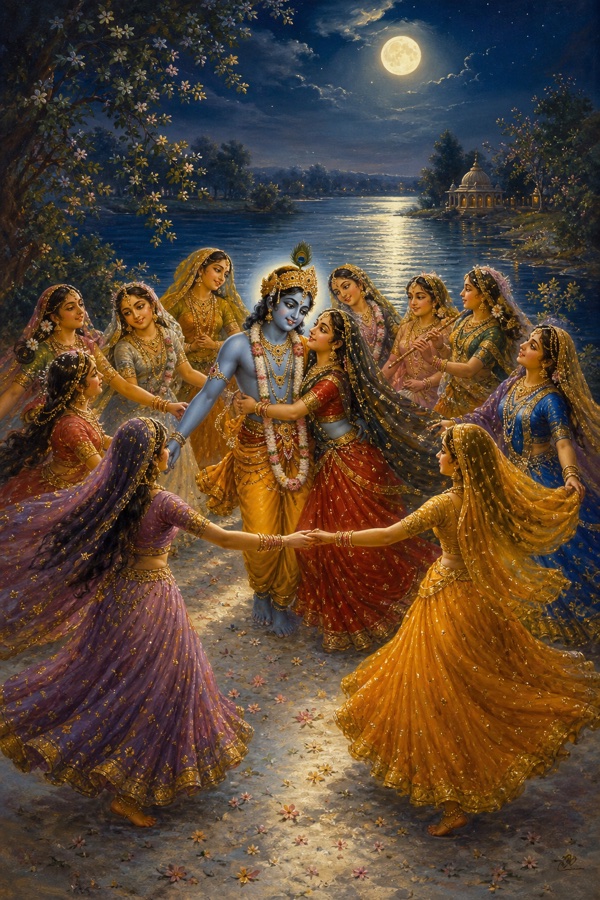
They drew into a ring on the cool silver sand of the Yamuna, with him among them, and the play began.
He moved through them the way the autumn moon moves among its stars. A garland of five colors swung at his throat, and when he laughed, his teeth flashed the white of jasmine. They sang to him and he sang back, louder, whole verses tossed up and returned. He took one by the hand. He drew another inside the circle of his arm. He traded jokes with a third until she doubled over laughing, and on a fourth he rested nothing at all except his eyes.
And every one of them was certain, past argument, past doubt, that the whole of it, the song and the game and the man, was raining down on her alone.
One scolded him. “When do you ever remember us, Mohan?”
Another asked, laughing, “Where did the flute learn this much sweetness in one night?”
And one said nothing at all, sunk in his eyes past the reach of any question.
Whatever he gave, he gave whole. No woman on that sand held a share of him, or a half. Each held all of him, entire, as every jar of water under the one moon holds the entire moon.
So it ran on, flute and turning feet and the wheel of the dance, all of it drawing on a single breath.
Then a thin ripple crossed their minds.
“If he pours himself out on us like this, then surely we stand above every other woman ever born.”
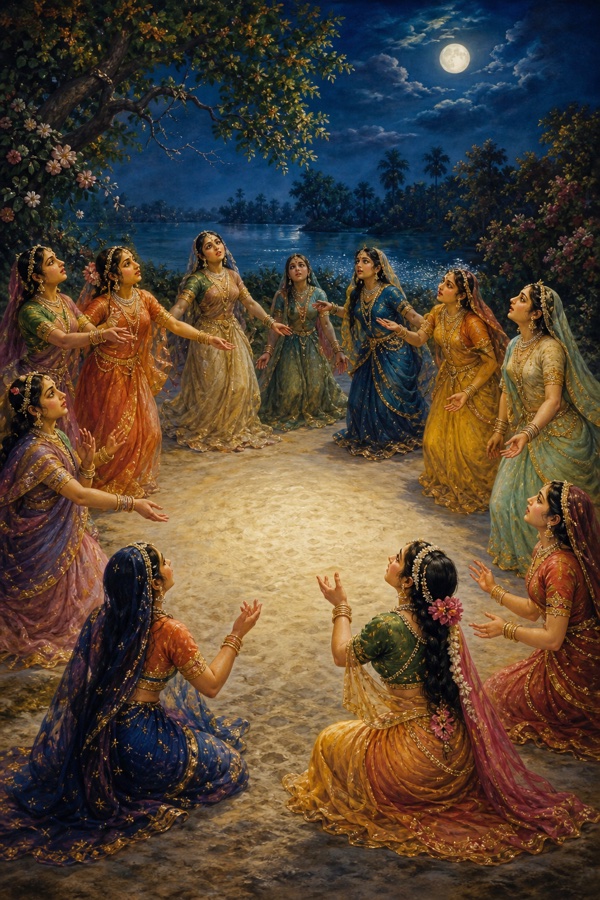
The thought had not even finished forming. He was gone.
Out of the very middle of them, between one heartbeat and the next, the way a lamp goes out in a draft, and the room that had seemed so full of light learns where the light was coming from.
The ring broke. Their hands closed on air still warm from him.
They turned to one another, and it landed on all of them at once: a breath ago every woman there had held him, and now no woman anywhere did.
The weeping did not come first. First came the silence a full courtyard makes in the instant after it empties. Then one cry went up, and another answered it, and soon the whole bank was sobbing, a village of women calling one name into a dark treeline.
They went after him the way elephant cows go after a vanished bull, and because their minds were so full of him there was no room in them left to be anyone else, and so, without deciding to, they began to become him. One threw an arm over her friend’s shoulder and said, “Look at me. I am Krishna. Watch how I walk,” and her walk was his walk. One put her fingers to her lips like a flute and called home cattle that were not there, and the others cried, “Well done! Well done!” One raised her scarf overhead on one straining arm and announced, “Stand under me and fear no storm,” and for that moment she was the boy holding a hill over the whole of Vraja for seven days. One climbed onto another’s shoulders and set her foot down slowly, saying, “Snake, be gone. I was born to punish the wicked,” while the woman beneath her swayed like the great serpent under the dancing feet. One crawled on hands and knees, an infant again, anklets jingling; one played the mother and tied her friend to a mortar with a garland, and the bound one covered her face in a lovely counterfeit of fear. And in between they asked the forest for him, tree by tree. Has he passed this way, the one who steals the mind with a sidelong look? They asked the peepal and the banyan. They asked the ashoka and the champaka. They asked Tulasi, dearest of all green things to him, whether her lord had gone by wearing her at his throat with the bees still following. They asked the jasmine, the mango, the kadamba. They asked the earth herself: what austerity did you once perform, that his feet should walk on you all your life, that your grass stands on end like the hair of a body thrilled? Or is that an older joy, from the day he crossed you in three strides as a dwarf, or the day he was a boar and carried you up out of the flood on his tusks? They asked a doe, mid-graze, her dark eyes shining: friend, has he passed here with his beloved? For the breeze itself had turned informer, carrying the scent of his jasmine garland and, tangled through it, a thread of saffron from a woman’s skin.
Then, on a clean stretch of sand, they found his footprints, and there was no mistaking them, for they carried the marks every soul in Vraja knew: the flag, the lotus, the thunderbolt, the goad, the barley grain, pressed clear as seals. And beside his prints ran a woman’s. The sand gave up the whole story, and they read it aloud to one another while their hearts turned over. He has taken one of us aside. She must have worshiped him in some way the rest of us never found, for look, he has left everyone for her. Here his prints sink deeper: here he carried her. Here hers stop and only his go on: here he lifted her over the sharp grass so it would not cut her soles. Here he rose on his toes: reaching up to break flowers from the high branches for her. And here he sat a long while in one place, for here the master of every world settled onto the night sand with flowers in his hands and dressed one cowherd girl’s braid. And that woman, drawn out of the circle, walking alone with him under the dark trees, had meanwhile begun to think her own quiet thought. He left all of them, it went. All of them. He keeps only me. So when her legs tired she commanded him, sweet and certain of her power: “I cannot walk another step. Carry me where you like.” He smiled and bent his shoulder to her. “Climb up, then.” And her arms closed on the empty dark. She was still crying out into the trees, my lord, my love, where are you, show yourself to your servant, when the others found her. She told them everything, the honor and the fall, both in one night, both out of one pride, and they held her and heard, inside her story, the shape of their own.
They searched as long as the moon gave light, thicket by kadamba thicket, down along the water, behind every bush, inside every shadow. When the moon went down into the trees and the dark closed over the forest, they turned back. By then they had forgotten they had bodies. Home had dropped out of their minds altogether.
Krishna was nowhere.
Worn through, the gopis came back to the sand where the dance had been and sank down on it, and everything still alive in them they began to pour into one song, every voice together, calling him back. That song deserves its own night, Rajan, and it will have one. This story rests here, on the empty bank, where every woman was alone and all of them wept together.
Literary context
This story spans chapters 29 to 33 of the tenth Skandha of the Shrimad Bhagavata, five chapters sung together for centuries as the Rasa Panchadhyayi. The Gita Press text follows Shridhara Swami, the earliest commentator, whose Bhavartha Dipika reads the five chapters as pure bhakti (devotion) and sets every sensual reading aside.
It is worth noticing that Shukadeva names no gopi anywhere in these chapters. The names that later poets and commentators gave to individual gopis belong to those later works and appear nowhere in the Bhagavata itself; chapter 30 points only to one unnamed gopi, drawn apart from the rest, who loses her footing in the intoxication of her own good fortune. The Bhagavata declares the episode fit for hearing and recitation alone, and warns in plain words against imitating it (10.33.30-32, 40).