On this page
Sudama’s Journey
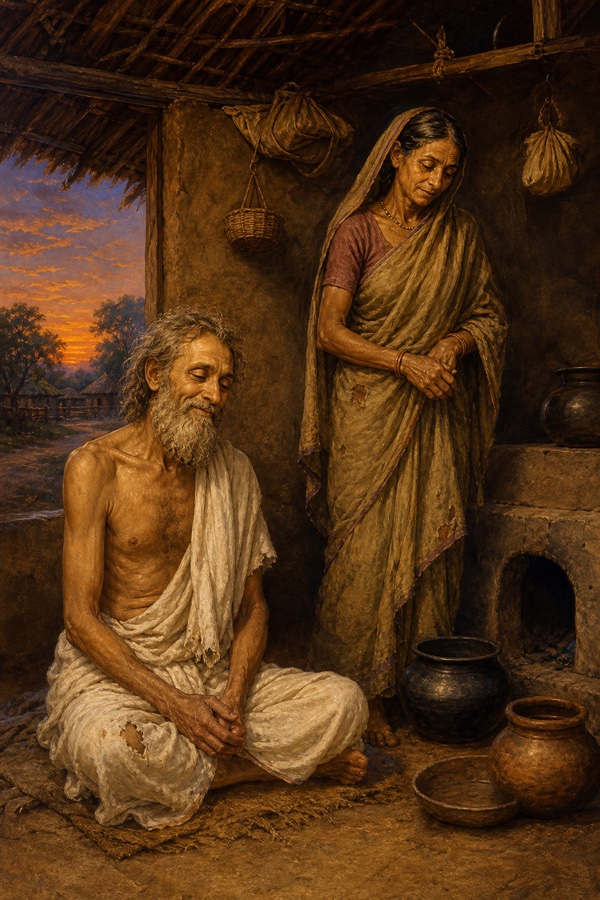
This happened in a small village. There lived this same Brahmin, Sudama. He kept a household, yet he kept it the way a bird keeps a branch: he stored nothing, saved nothing, held on to nothing, and stayed content with whatever reached him unsought. His clothes had worn through to threads, and there was never enough cloth in the house to cover both husband and wife at once. Many a day the hearth stayed cold, the clay pots beside it standing empty and clean because there had been nothing to cook in them. His wife was devoted and true, and hunger had thinned her until the bones showed and her step trembled. They bore it in silence, the two of them, because Sudama did not know how to ask.
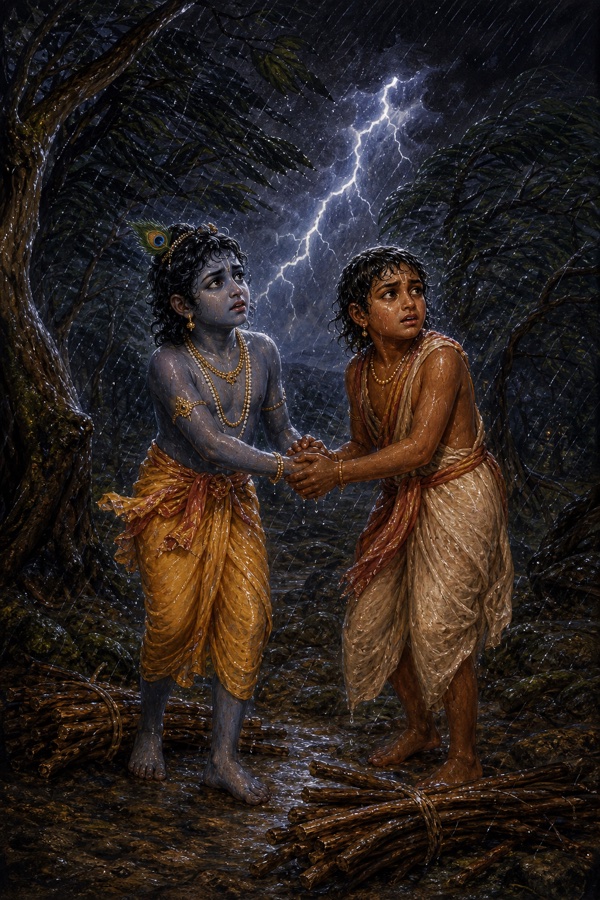
Inside Sudama, one memory of childhood had been kept safe for years, wrapped and put away like a coin sewn into a hem. In Avantipur the sage Sandipani had kept his ashram, and boys came there to live in the guru’s own house, cutting wood, tending the fire, serving the household with their hands while the Vedas passed into them line by line. Krishna and Balarama had studied there, and this same Sudama had sat beside them as their fellow student. One day the guru’s wife sent the two of them into the forest for firewood. A storm broke over them out of season, wind bending the trees to the ground, rain falling in unbroken sheets, thunder rolling overhead without a pause. The sun went down and the dark closed in from every side. Water rose across the forest floor until the land itself disappeared, and there was no telling a pit from a path. Hand in hand, drenched and shivering, lost to every direction, the two boys wandered the forest the whole night through.
When the sun rose, their guru Sandipani came searching and found them, still holding on to each other in the gray first light. The sight of his two disciples in that state filled his heart to the brim. “A wonder, my sons,” he said. “You have borne such hardship for my sake. Every creature holds its own body dearest of all things, yet you two set even that aside and gave your minds to my service. This is what a true disciple does: he lays everything he has, down to his own self, before his guru, and that alone repays the debt. I am pleased with you, jewels of the twice-born. May every wish of yours be fulfilled, and may the Vedas you have learned from me stay bright in you always, serving you in this world and the one that follows.”
That night settled inside them both like a sweet knot in a thread. No one else alive knew what it was worth. Sudama remembered every hour of it.
Years went by. Krishna became lord of the Bhoja, Vrishni, and Andhaka Yadavas and ruler of Dwarka, the golden fortress city that had risen out of the western sea at his word. Sudama stayed on in that same hungry village.
One day his wife came to him trembling, her face wilted with hunger, and spoke softly. “You are a friend of Shri Krishna himself, the husband of Lakshmi, the goddess of fortune. To those who love him he is a tree that grants wishes; whoever comes to his shelter is taken in; and no one on earth is dearer to him than a Brahmin. Go to Dwarka once and see him. He gives his very Self to anyone who so much as holds his feet in mind. Wealth, comfort, the things people beg gods for, those he hands over without a thought, because in his eyes they were never the true prize to begin with. When he learns that you keep a family, and that the family is starving, he will give more than this house could hold. There are nights we go to sleep with nothing.”
Sudama was quiet a long moment. Then he said, “I cannot go there to beg.”
“Then do not beg,” his wife said. “Forget the wealth. Let it never cross your lips. You will stand before Bhagavan Shri Krishna and see him with your own eyes, and that seeing, that darshan, is the greatest gain a human life can hold. Just go and meet him. After that, let it be as he sees fit.”
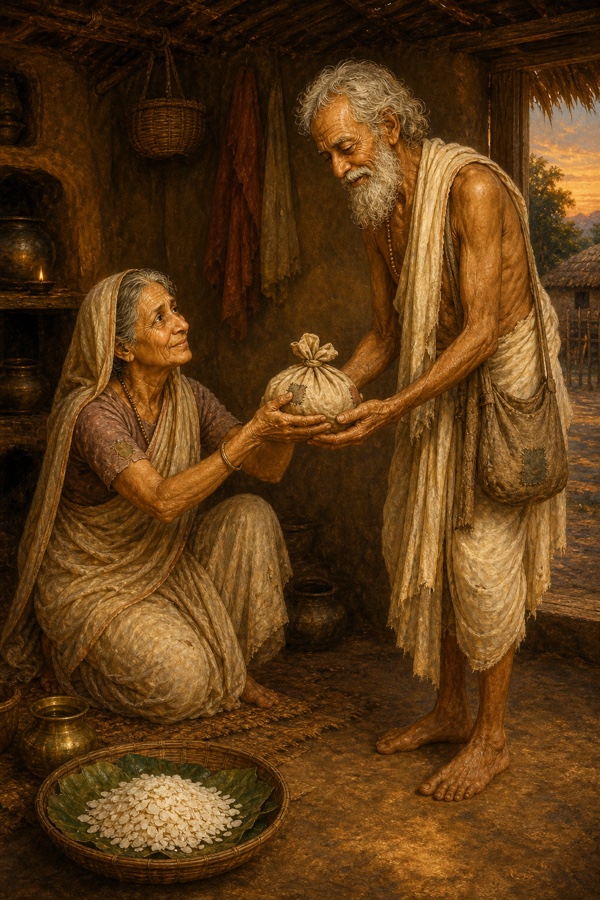
Sudama agreed. “Kalyani, is there anything in the house fit to carry as a gift?” There was nothing. His wife went to the neighboring Brahmins’ homes and begged four handfuls of flattened rice, the parched grain beaten flat that villagers call poha, the cheapest food a poor kitchen knows. She tied it in a torn scrap of old cloth and placed it in her husband’s hands.
“Give him this. How can a man walk in on a friend with empty hands? And what else do we have?”
Sudama tucked the little bundle under his arm and set out. On foot, down the long dust of the road, toward the sea. Dwarka was far.
The whole way, a single thought kept circling in his mind: “How will I ever come into the sight of Bhagavan Shri Krishna?” And a fear walked beside the thought, step for step. Krishna ruled a golden city standing in the middle of the ocean now. What if he simply did not recognize him? And even if they came face to face, what could a man like him find to say?
But his feet did not stop.
He reached Dwarka. The walls blazed like poured gold in the sun. Falling in with a company of Brahmins, he passed three camps of guards and three great ramparts, each gate harder to cross than the last, and came into the quarter where the Andhaka and Vrishni chiefs kept their mansions, streets closed to ordinary men. No one stopped him. No one so much as asked his name. At the heart of it all stood the palace of Bhagavan Shri Krishna, holding within its walls the dwellings of his sixteen thousand and more queens, and Sudama, in his rags, with his little bundle, walked straight in.
He entered one of those palaces, one adorned past all the others. The moment his foot crossed the threshold, Sudama felt himself rising and sinking, rising and sinking, in an ocean of the bliss of Brahman.
At that hour Bhagavan Shri Krishna sat on the bed of his beloved Rukmini, his chief queen, whom the wise of Dwarka knew for Lakshmi herself come to live at his side. He saw the Brahmin from across the long hall, and all at once he was on his feet.
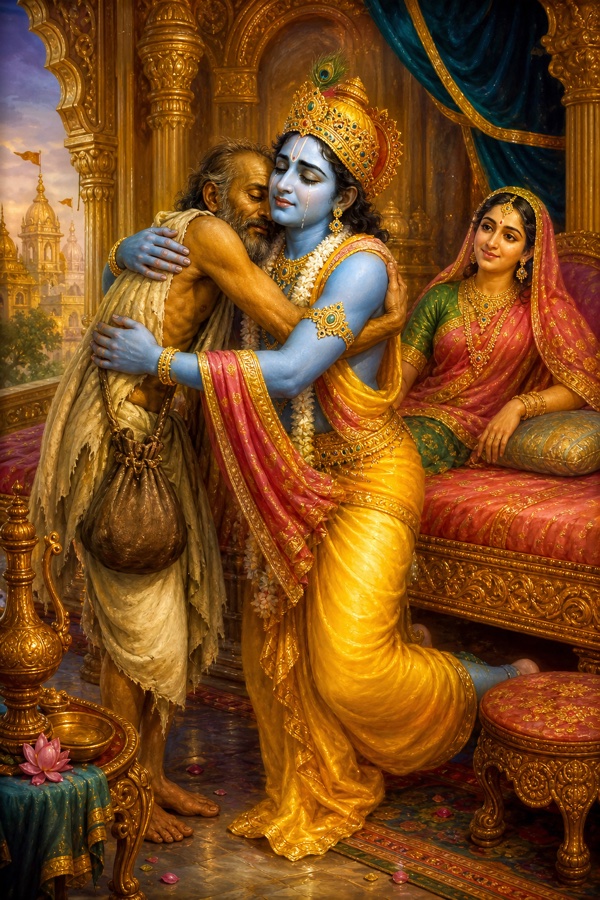
He ran. The lord of the city ran the length of his own hall, and reaching his friend, he caught Sudama in the bind of his arms and held him hard. The touch of that dear body, its bones plain under the worn cloth, flooded him with such happiness that tears rose in his lotus eyes and spilled over.
“Sudama! When did you set out? How did you come, all this way on foot? Could you not have sent a single word ahead? A chariot would have been on your road by morning.”
Sudama could manage nothing in reply. The tears kept coming, and he let them.
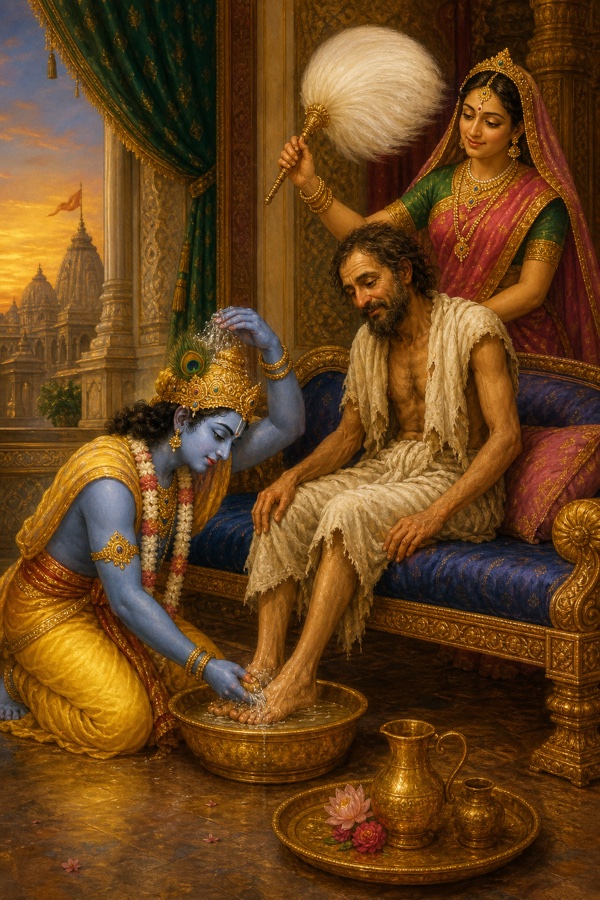
Krishna took his hand and led him within. He seated the ragged traveler on his own bed. Then he did what a host in that land does when a god comes to the door: he brought the articles of worship with his own hands and sat down before his guest. He washed his friend’s blistered feet in a basin, and when he had finished, he lifted that water and sprinkled it over his own head, the head that carried the crown of Dwarka honoring the feet of a beggar. He anointed him with pastes of sandalwood, aloe, and saffron, perfumes fit for an altar. With fragrant incense and rows of lamps he performed his friend’s arati, circling the flame before him as one does before a deity. He offered him betel leaf folded with catechu, lime, areca parings, and cloves, and the gift of a cow, the honor a house reserves for its most sacred guests, and greeted him with sweet words of welcome. Then he sat down close beside him. Rukmini herself, Lakshmi in living form, took up the white chamara whisk that is waved over kings and began to fan the dusty pilgrim with her own hands. The women of the inner palace watched all this and could make no sense of it. They looked at the guest, ill-clad, grimy, so wasted that the veins stood out along his arms, and they whispered to one another: what merit could this beggar have earned, and in what life, that the guru of all three worlds keeps bending lower and lower before him, that he has seated him on his own bed, that he has left Rukmini’s side, Lakshmi’s own side, and gathered this man to his chest the way he embraces Balarama, his elder brother?
Krishna fed him with his own hand. Then, still holding that hand, he let the old years come back. “Tell me,” he said, “after you left the guru’s house, did you marry? Is your wife a match for your heart?” Sudama answered him, and Krishna smiled. “I know you, my friend. You have kept a household all these years and never once let wanting take root in it. I know there is no love of wealth in you. Rare, rare on this earth are the ones who shake off the desires that Maya breeds in every mind and go on doing their given work with nothing pulling at them. I do the same myself, and only to set the world an example.”
His voice turned toward the years they had shared. “Do you remember the guru’s house? That is where the twice-born learns the one thing worth learning and crosses the long dark of not-knowing. Three men stand as gurus over a life. The father who gives the body is the first. After him comes the teacher who lays the sacred thread on a boy’s shoulder and shows him his duty, and that man deserves the honor given to me. Last comes the one who opens the knowledge of the Self and turns a soul toward God, and he is myself, no other. Whoever takes what his guru teaches and lives it crosses the whole ocean of birth and death without strain; that man alone knows where his true good lies. And I tell you, I am the Self seated in every creature, and of all that a person can lay before me, the householder’s fire-rite, the student’s thread and scripture, the ascetic’s long burning, the stillness of the man who has renounced the world, nothing reaches me the way a disciple’s service to his guru does.”
He remembered the night the guru’s wife had sent them out for firewood, and the storm that had swallowed the whole forest, and the flood rising over the land, and the two of them gripping each other’s hands in the black rain until sunrise. “There were many days like that one,” he said. “That was such service. And it is by the guru’s grace alone, friend, that a man reaches perfection and finds the peace past which there is nothing left to want.”
Sudama listened, and somewhere inside the listening he understood, fully, who it was that sat holding his hand. “Lord of gods, teacher of the world,” he said, “what is left for me to gain? I lived in the guru’s house at your side, you whose resolve has never once failed. The four aims of a human life, dharma, prosperity, pleasure, and moksha, all rest inside the Vedas, and the Vedas are your own body. And you walked into a guru’s house and studied them the way any boy studies, in play, only so the world would have its example.”
Bhagavan Shri Krishna knows what moves in every heart, and he knew what was hidden under his friend’s arm. Looking at him with eyes full of affection, half teasing, he asked, “And what have you brought me from home, Sudama? When someone who loves me offers even the smallest thing, it grows vast in my eyes, and a man with no love in him can heap my doorstep with treasure and leave me untouched. A leaf, a flower, a piece of fruit, a palmful of water: let a clean heart bring me any of these, and I take it, and I eat it, and I am glad.”
Sudama’s head went down. The bundle existed, yes, pressed under his arm this whole while. But it was so small, so coarse. Around him rose pillars no king of the earth could buy; beside him sat the goddess of fortune with a whisk in her hand. How could he bring out a beggar’s poha in front of all this? He lowered his face in shame and left the flattened rice where it was.
But the Lord watches every stirring of every heart, and nothing in his friend was hidden from him. He saw it whole: this man has never once worshiped me with an eye on Lakshmi’s riches; even now he has come only because a devoted wife pleaded, and he could not bear to fail her. And a resolve formed in him: I will give this friend of mine a fortune the immortals themselves wait for and do not receive. With that he reached over and pulled the little bundle out from under Sudama’s arm himself. He untied the knot in the rag. Inside, a fistful of flattened rice.
“Ah! This is my favorite of all,” he said, and lifted a handful and ate it with relish. “This much is enough to satisfy me, and through me the whole world.” Then he reached for a second handful.
Just then Rukmini caught his hand, for she was Lakshmi herself, the fortune of the worlds in a woman’s body, and she could not be parted from him. “Vishvatman, enough,” she said, and there was a smile inside the word. “One handful of this rice is enough to please you, and whatever pleases you gives a man every abundance of this world and the next. Eat a second, and you will have handed me away with it.”
The night went by. The good Brahmin slept in the Lord’s own palace in a comfort his body had never known, ate a full meal and then another, and felt he had reached Vaikuntha, the Lord’s own country past the reach of death. Krishna and Sudama talked the old nights back to life. But one thing Sudama never did.
He asked for nothing. Nothing was set in his empty hands, without gold, grain, or a parting gift, and still he asked for nothing.
In the morning Sudama took his leave. Krishna, from whom the whole universe draws its breath, walked beside him down the road a long way, warming him with soft words, and then, before turning back, the master of Dwarka bowed to him. Sudama started for home on foot, abashed at his own heart, that any corner of it had come here wanting anything at all, and rising and sinking in the joy of what his eyes had held. He knew what waited. The same poverty would be standing at the door, open-mouthed. His wife would ask, “What did you bring?” And he would have only one answer.
And yet, though the stomach was empty, something inside had quietly filled.
All along the road he kept talking to himself, and the talk kept turning into wonder. “What joy this is. What a thing I have seen. The Lord of Dwarka holds Brahmins as his own chosen deity, and today I watched that devotion with my own eyes. I, the poorest of the poor, and he, the one shelter Lakshmi herself has ever needed. And still he took me to the chest where the goddess of fortune lives, only because I was born a Brahmin. He sat me on his own queen’s bed as though I were his brother. Rukmini saw the road on me and fanned me with the whisk in her own hand. The God of gods pressed my torn feet and served me the way men serve the gods. Heaven, liberation, every treasure of earth and the regions beneath it, every power there is: all of it follows from the worship of those feet. And into my hands he put nothing. Nothing at all. He looked at me and knew everything: hand this starving man riches and they will climb to his head, and he will grow drunk on them, and he will forget the giver. What mercy, to hold the gift back.” And every few miles the same quiet answer rose in him as well: between friendship and begging runs a line, and that line Sudama had not crossed.
He reached the edge of his village.
And stopped short. His village was simply not there.
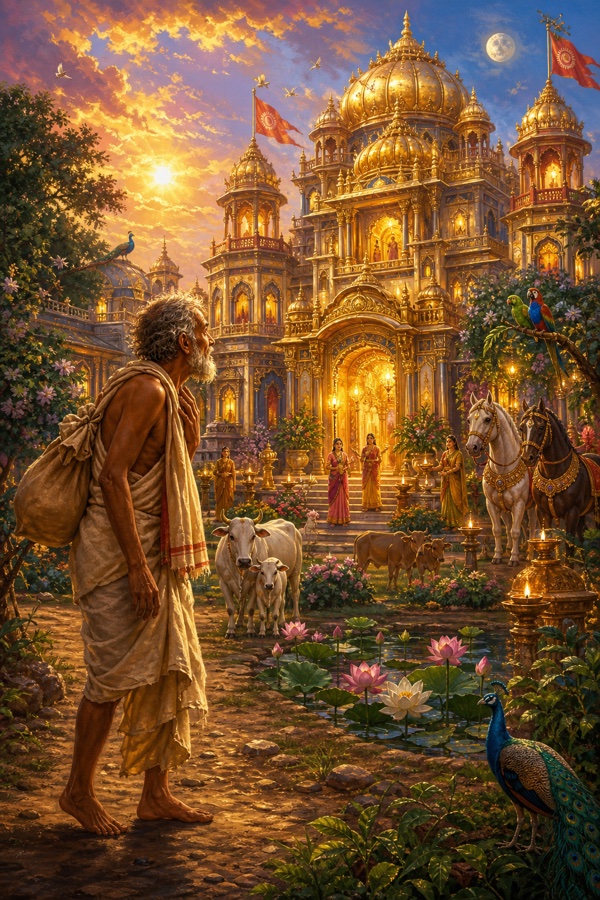
Where his old mud hut had stood, palaces of jeweled stonework now rose seven stories into the sky, blazing like the sun, like fire, like the moon, all three at once. Around them spread gardens and pleasure groves of every design, flocks of many-colored birds calling through the branches, ponds where lilies and lotuses stood open on the water. Beyond lay orchards, cows heavy with milk, horses tethered in gleaming rows. Men and women of an almost godly brightness moved through it all, and a company of them came out toward him with singing and the sound of instruments, as if a king were arriving. And at the doorway of the tallest palace stood his wife. She had heard he was coming and had hurried out like Lakshmi stepping from her own abode: gold at her throat, radiance on her skin, maidservants around her in a ring, her eyes already wet.
He turned and looked behind him. Had he taken some wrong turning and wandered into another man’s village?
The village was the same one. Only, everything that was his had changed.
His wife came to him with tears standing in her eyes, lowered them out of shyness before all those watching faces, and bowed to him; the embrace she could not give him in front of the servants she gave him in her heart, and he felt it land. He followed her inside, into halls that might have been lifted whole from the palace of Indra, the king of heaven: hundreds of pillars of cut gems, bedsteads of ivory plated with gold and spread with sheets as white and soft as the foam of milk, whisks with golden handles, golden seats deep with cushions, strings of pearls hanging from glowing canopies, walls of clear crystal set with emeralds, and women shaped out of precious stone holding jewels in their hands whose light filled the rooms. He took it all in, and he sat down quietly.
She came and sat beside him. “What happened?”
He said only this: “I asked him for nothing. And still he gave everything.”
After that he said no more aloud. But in his own mind he turned it over and over, calmly, the way he had once turned over scripture. I am poor, he thought, and luckless from the day I was born. Where could a fortune like this have come from, if from anywhere except one grace-filled glance of Shri Krishna, the crown jewel of the Yadus? He gives the way a raincloud gives: holding its water back while the farmer stands in the field and watches the sky, then loosing the whole of it in the dark over the sleeping man’s crops, and counting even that as far too little. He pours out abundance, calls it a trifle, and never once names the gift to your face. He took my fistful of rice as if I had brought him a kingdom. Let me have, birth after birth, his friendship, his love, the service of his feet, and the company of the people who love him. Wealth I do not need; he knows better than anyone how riches climb into a man’s head and bring him down. So Sudama lived on among those comforts as gifts of the Lord’s grace, tasting them lightly, his wife beside him, holding to none of it, and day by day his bhakti deepened, until the old knots of ignorance loosened and fell away, and in time he crossed over and reached the Lord’s own abode. And to the end of his days, in his mind’s eye, he kept seeing that fist, once empty, that had filled everything, as if something rested in it still that no scale could weigh.
Literary context
This episode of Sudama comes in the tenth Skandha of the Shrimad Bhagavata, Chapters 10.80-10.81, and stands among the tenderest kathas of sakhya-bhava, the devotion that approaches God as a friend. Between Dwarka’s splendor and the poverty of the man the south remembers as Kuchela, the ragged one, bhakti wipes the ledger of high and low clean. Surdas sings this same figure in the Sursagar, and Narsi Mehta in his padas, and the center never moves: the friend receives without asking, because the giver is Hari himself.
The philosophical eye
One fine touch runs through this katha: every jewel of Dwarka, and later every jewel of the transformed village, reaches the reader through Sudama’s astonished eyes. The opulence never arrives for its own sake; it stays dissolved in the poor friend’s act of looking, and that is why it drenches the heart where it might have stung it.