On this page
Prahlada’s Lessons in the Womb
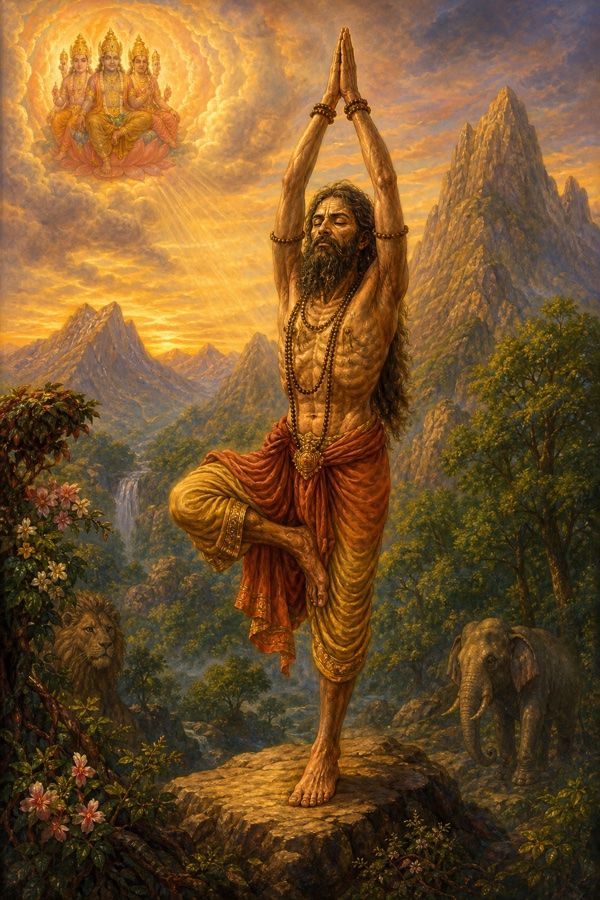
In those days Hiranyakashipu was far away on Mandarachala. The Lord, wearing the form of a great boar, had killed his brother Hiranyaksha, and the daitya king had sworn to collect the price of that death from heaven itself. So he stood on the mountain in a penance built to bend Brahma’s will, balanced on one foot, arms thrown up toward the sky, letting hunger and sun and the slow years grind his body down to sinew, while the heat of that austerity rose off him until the worlds themselves felt it burn. What he demanded was a boon to seal every door death might use: no death indoors and none outside, none by day and none by night, none on the ground and none in the air, none from man or beast, god or demon, weapon or living thing. He gave no thought to what he had left behind. At home, in the womb of his queen Kayadhu, the one being was quietly taking shape who would one day turn all that armor into a single question it could not answer.
Word of it reached the gods, and they read the moment the way soldiers read an open gate. The scourge of the worlds stood rooted on a far mountain, so deep in his own austerity that it seemed to be devouring him where he stood, the way ants devour a serpent. They gathered their army and marched. At the mere sight of that host assembling, the courage drained out of the asura generals. The scramble to stay alive was so complete that they dropped everything a man is bound to guard, wives, sons, friends, elders, houses, herds, the household goods themselves, and scattered in every direction. The royal palace stood open and unguarded. The gods went through it room by room and stripped it bare, and in the middle of the plunder Indra’s gaze stopped on the pregnant queen.
The calculation took him a heartbeat. “The daitya king is far away. What sleeps in this womb is his seed, the seed of the enemy of the gods, and that seed is formidable. I will carry her to Amaravati and keep her under my hand. The moment the child is born, I kill it and let the mother go. One stroke now, and the great thorn of the coming age never grows at all.”
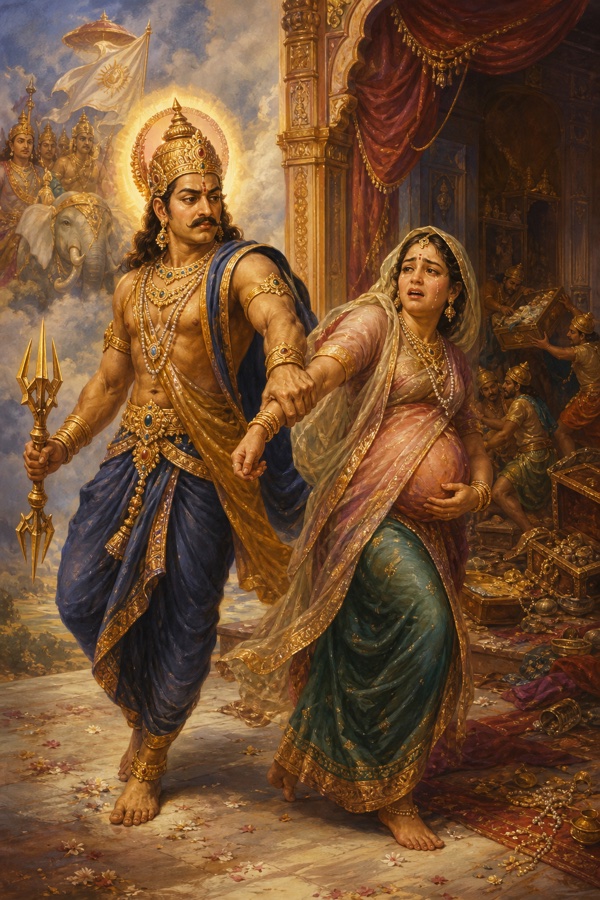
He seized Kayadhu by the wrist and dragged her out onto the road. She shook as she went, weeping, wailing like a kurari, the river hawk whose cry is the sound of something being taken, and again and again her free hand went back to her belly and spread itself flat there, as if a palm’s width of skin could stand between her child and the king of heaven.
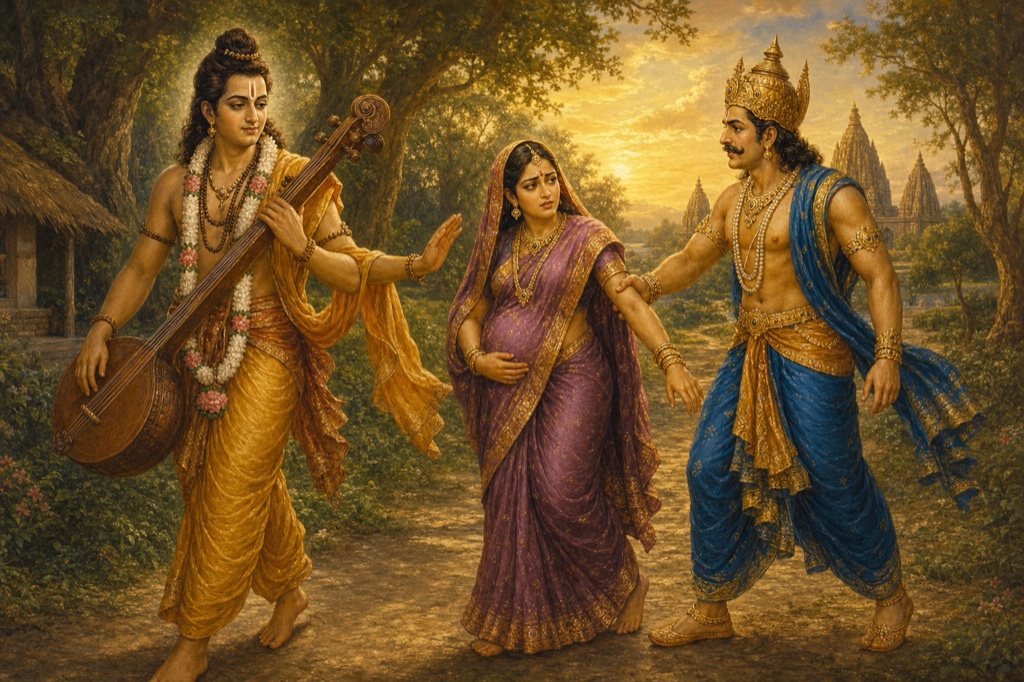
And then, over the weeping, a thread of music. A veena came up the road, its strings ringing softly under a practiced hand, and behind the sound walked Devarshi Narada, the wandering sage who crosses the three worlds carrying little else, and who has a way of arriving, as if by chance, exactly where he is needed.
He took in the scene for one long moment, the weeping woman first, then the god who held her.
“Devaraj, stop. This lady is innocent. She is a chaste and virtuous woman, and she is another man’s wedded wife. Let her go. Let her go.”
Indra stopped walking. His grip stayed where it was. “Devarshi, what she carries is the seed of Hiranyakashipu, the enemy of the gods, and that seed is mighty. She stays with me until the delivery. When the child is born I will finish what I came for, and then she goes free.”
Narada did not raise his voice, and yet Indra’s fingers began, on their own, to loosen. “Devaraj, the one you are calling an enemy’s seed is a great devotee of the Lord, sinless, high by his own qualities, a mighty servant of Vishnu with the strength of the Lord’s own eternal attendants in him. Death will not come to that child from your hands. There is no power in you for it. All you would carry home from this road is the sin.”
The king of the gods stood very still. A moment earlier he had been hauling a trembling woman down a road and calling the work heaven’s defense. The sage’s words held a mirror up to it. Indra honored them and released Kayadhu’s wrist. Then he did something stranger. Filled with sudden reverence for the devotee seated inside the very womb he had come to empty, he walked around the mother in a slow circle of worship, the pradakshina one offers a shrine, and went back to his heaven.
Narada came to the queen. “Daughter, come with me. Stay in my hermitage until your husband returns from his austerities. You will be safe there, and so will the one you are carrying.”
Kayadhu followed the sage.
The hermitage was quiet in a way Kayadhu had never once known. In the palaces of the asuras the air itself stood guard, heavy with the grinding of blades and the wait for someone’s rage to break loose. Here the days were made of prayer and plain work, and nothing anywhere wished her harm. For the first time in her life her breath settled all the way down and stayed. She gave the sage her word, “So be it,” and lived beside him free of fear for as long as her husband’s terrible austerities lasted, and she served him with her whole devotion, tending the fire, the guests, the small daily labor of the ashram. And for the sake of the child, so that it would be born strong and at the right hour, after its father had come home, she carried it on past its season, holding the birth back by the force of her own virtue.
And Narada taught her. For her sake, and for the sake of the listener within her, he opened both halves of the treasure at once: the way of bhagavata-dharma, the life turned wholly toward the Lord, and the pure knowledge that stands beneath it. He began with the oldest confusion there is, the knot that ties the self to the body. Six changes run through everything born, he told her. It comes to be, it exists, it grows, it ripens, it declines, it is destroyed. Watch a tree through the seasons and you will see all six pass through the fruit while the tree stands on. The changes belong to the fruit. The tree outlasts every one of them. So it is with the body and the one who wears it. The atman is eternal, free of decay, unstained, one without a second, the knower behind every act of knowing, the ground everything else rests on, changeless, lit by its own light, all-pervading, touched by nothing, covered by nothing. Hold to those marks of the Self, he said, and the old lie of “I” and “mine,” pasted onto a body and its belongings, comes loose. He taught her to watch the three states every creature moves through, waking, dream, and dreamless sleep, and to look for the one witness standing behind all three, the way you trace the invisible wind by the scents it carries. A goldsmith who knows his craft can take raw ore and lift the gold out of it, clean and entire. A knower of the Self does the same with these bodies: he works through everything the Self is mistaken for, and lifts out what was shining there all along.
Then he gave her the road home. All of this seeing, he said, ripens into one work: burn the very seed of the old restlessness, the ignorance that keeps the wheel of act and consequence turning. That burning is what the wise call yoga. And of the thousands of disciplines that serve it, the Lord himself has singled out one sure and gentle door: live so that love for him grows. Serve your teacher, and lay whatever comes to you at his feet. Keep the company of those who love the Lord. Worship him, revere the stories of his deeds, sing what he has done, hold his feet in your thought, attend on his image with your eyes and your hands. And be kind and open-handed to every creature that draws breath, for Hari himself is seated in each of them. A heart that practices this begins to melt. The lover of the Lord loses his shame the way a fire loses its smoke. He sings with an open throat, his voice breaks, his hair stands on end, he laughs, he weeps, he falls suddenly still, he cries out “O Hari, O Lord of the universe, O Narayana” like a man possessed, and in that crying his bonds slip off him and the old ignorance burns away. Mukunda is won by that love alone. High birth does no work here, nor learning, nor charity, austerity, sacrifice, purity, or vows. Without love, all of it together is empty show. And the door is barred to no one. Daityas have crossed by it, and yakshas, women of the house, cowherds, the humblest workers, birds, beasts, even lives sunk deep in sin. Why strain after wealth and worlds that rot while you hold them, he asked her, when the one you are seeking sits inside your own heart, nearer to you than the space within it, your own Self and oldest friend? Worship him there.
As he taught, the sage’s gaze kept returning to the mother, resting on her a beat longer than teaching required, the look of a man who knows his truest student is in the room and has simply not been born yet.
And Kayadhu listened. A queen of the daitya line, raised among curses and armories and grudges older than her grandfathers, sat in a hermitage hearing the name of Hari from a rishi’s mouth, and her lashes were wet before she knew it. She could not have named the feeling that had come down into her. It fit her like something she had owned since childhood, and she had never met it before.
But beneath all of it, quieter than all of it, there was one more listener.
In that dark, blood-warm world drummed through with heartbeats, where no eyes had opened yet and the fingers were still unfinished, a small being lay curled on itself. Of the world outside it could see nothing at all. But it could hear.
Narada’s voice would rise, travel down through the mother’s body, and arrive at the walls of that small sealed world. The child did not yet own anything that could properly be called an ear. Every word arrived anyway.
When the mother’s mind caught on some word of Hari and went still, the being within her sank into the same stillness. In those hours she forgot that she was an asura’s wife, forgot the war outside, forgot the husband grinding his body away on a far mountain. She was only a listener then. So was the one inside her.
And as the first drop of rain falls on cracked summer earth and the earth takes it in without a sound, so that small being drew every sentence into itself. The deathless Self. The long road of love. Nobody knew that inside that sealed world a school had opened, and that its one student was keeping every syllable safe.
The months went by. Then, far away, the terrible austerity ended. Hiranyakashipu had what he had starved for, Brahma’s boon, every door of death sealed, as he believed, forever. He came home to a looted palace and a missing queen, followed her trail, and arrived at last at Narada’s hermitage, where he gathered up Kayadhu and took her back.
The sage blessed her and let her go with affection. And then time did to the mother what time does. Season by season the words she had heard in the hermitage faded in her, softening, blurring, sinking out of reach. But Narada had set one particular grace upon that teaching, and by his grace it stayed whole in the child in the womb, every word in its place, exactly as it had been spoken. The mother forgot. The one within did not.
Kayadhu came back to the palace of the asuras, and in time the child was born, and he was given a name that is built out of gladness itself: Prahlada.
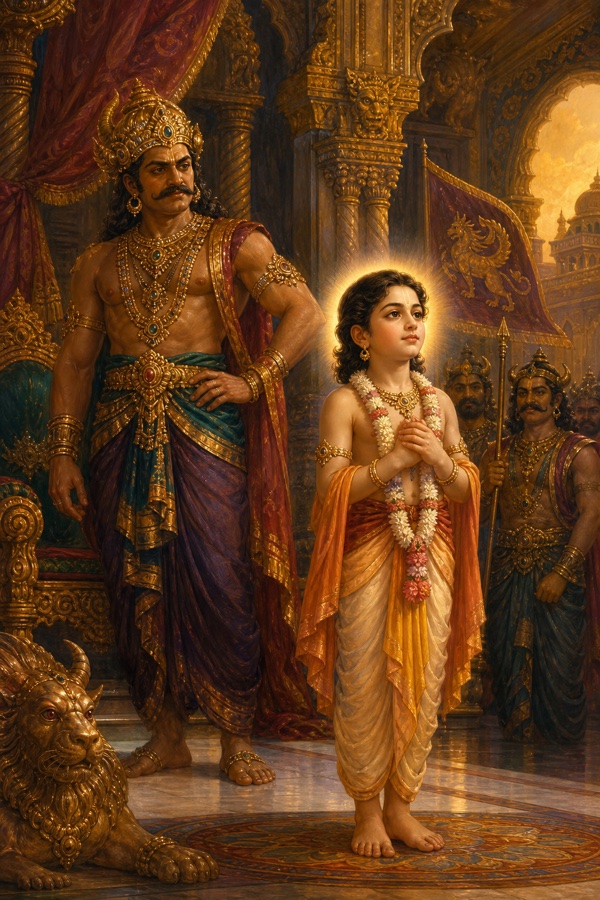
For Hiranyakashipu the boy was a triumph to set beside the boon: a son, the lamp of the daitya house, the future of the line. Except that the son he had imagined never quite appeared. This child kept drifting off somewhere behind his own eyes, lost to the room around him, and every so often, taught by no one, he would murmur “Narayana,” softly, the way a boy repeats under his breath the lesson of a classroom so old and so far away that nobody else remembers it exists.
Literary context
This episode comes in the seventh Skandha of the Shrimad Bhagavata, Chapter 7, where Prahlada, pressed by his daitya schoolmates to explain his devotion, tells them where it began. While Hiranyakashipu performs tapas on Mandarachala, Indra seizes the pregnant Kayadhu; Narada stops him on the road and shelters the queen in his hermitage, and there the unborn Prahlada, hearing Narada teach the deathless atman and the path of bhakti, becomes a devotee of Hari before his birth.
Prahlada’s own testimony, that his mother forgot the teaching with the passage of time while he kept it whole through the sage’s grace, comes at 7.7.15-17. Of the nine forms of bhakti the first is shravana, listening (7.5.23-24), and this katha stands as the root illustration of what listening alone can do. The text of Gita Press, Gorakhpur has been followed.
That voice, that ear
A Devarshi’s voice rises on a road, and then in a hermitage, telling the story of Hari, and inside a mother a small being drinks it down in silence. Outside there is plunder and war and a king buying invincibility with his own flesh. Inside, one ear stays open. And who is to say that this other king on the bank of the Ganga, listening his way through his last days, is not sitting in that same classroom still.