On this page
The Deliverance of Yamalarjuna
That day Yashoda, having knotted her son to the mortar at last, went back to the work of the house, the boiled-over milk, the broken pot of curds, all the morning’s wreckage still waiting for her. She was tired, and her mind kept straying elsewhere. She had left the child in the courtyard with an easy heart. He was tied now. He would go nowhere.
Lala, the darling of the whole house, sat a while where she had left him, studying the mortar that held him. Then, unhurried, he got to his feet.
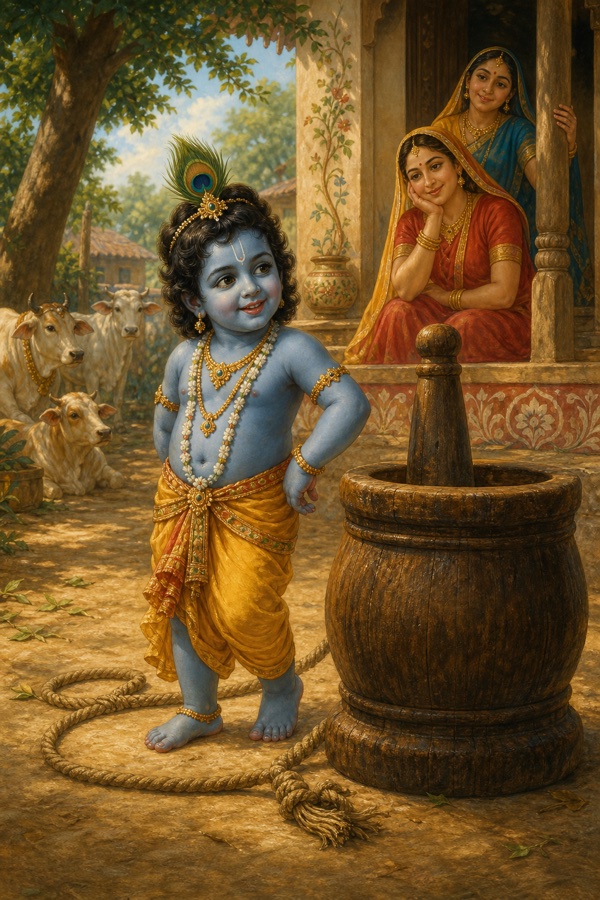
The mortar was solid wood and heavy, and he was this small. But for the one before whom mountains weigh light, what is a block of wood? He leaned into the rope and pulled, and the dragged mortar ground a long furrow across the courtyard earth behind him.
The fun of it showed plainly on his face. He crossed the courtyard at a toddler’s stagger and made for the garden behind the house, the mortar bumping and tumbling along at the end of its rope.
In that garden stood two towering arjuna trees, and they were twins, which is why people called them Yamalarjuna, the paired arjunas. They had risen from the same patch of ground, so close together that their barks touched.
Between the two trunks there was just space enough for a small child to slip through. For a mortar there was no space at all.
Kanha squeezed into the narrow gap. The mortar, following on its rope, swung sideways and jammed fast between the trunks.
He gave one pull.
Under the ground, the roots of both trees shuddered.
A second pull.
The roots cracked.
A third.
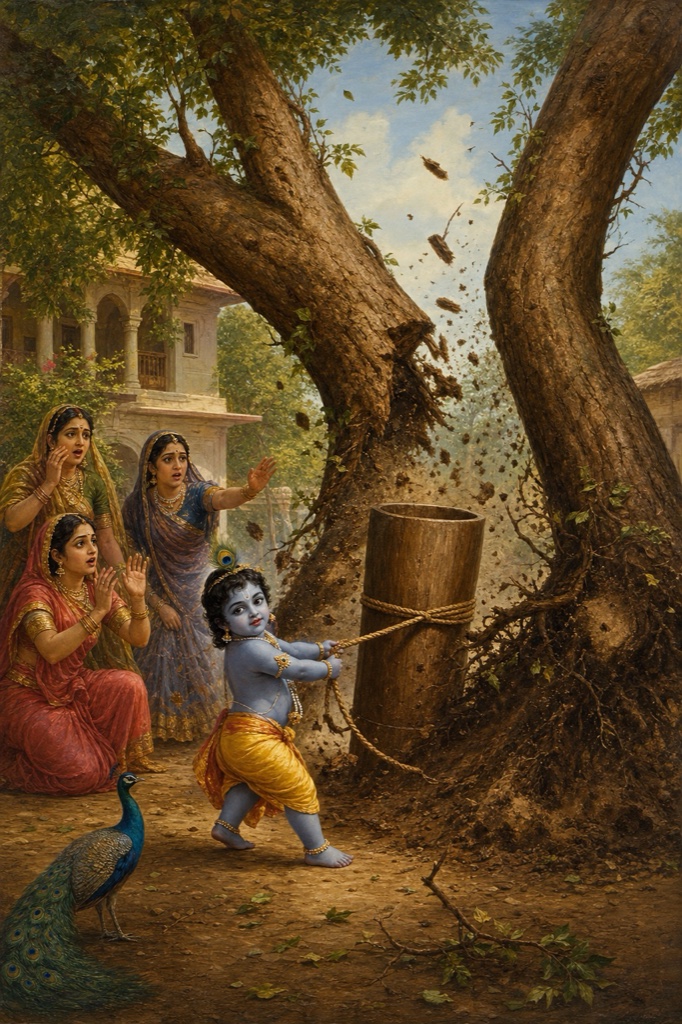
Both trees tore up from the root with a crash that all of Gokul heard and came down together, and everything in them shook as they fell, trunk and bough, branch and twig, down to the last leaf.
And out of the fallen trunks rose two lights.
Two perfected beings stepped clear of the ruined wood, blazing the way fire blazes when it has hidden long inside timber and is suddenly let out, so radiant that the quarters of the sky brightened around them. Nothing of pride was left anywhere on them. Palms joined, the two fell at Kanha’s little feet.
“Prabhu! At last you have freed us from this bondage.”
Little Kanha watched them a while, then softly smiled.
Who were these two?
Nalakubara and Manigriva. They were the sons of Kubera, guardian of the world’s wealth, the lord of treasures himself, and they were counted besides among the attendants of Bhagavan Rudra, the god the world worships as Shiva, whose seat is the mountain Kailasa. Riches from their father, rank at the side of a god: few beings anywhere carried a double fortune like theirs.
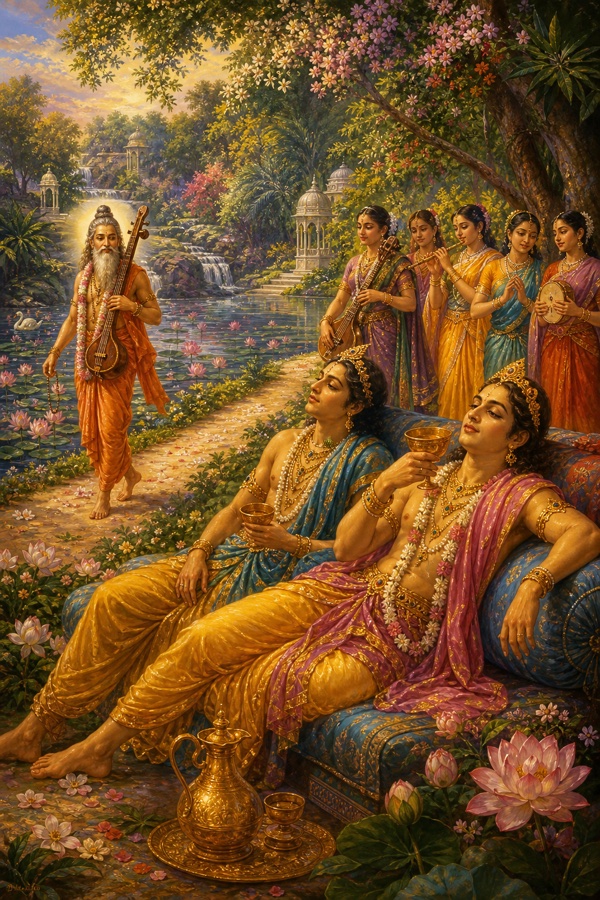
It had happened long ago. The pride of that double fortune had climbed into both brothers’ heads and stayed there. One day, in a lovely grove on Kailasa, on the bank of the Mandakini, which is the Ganga as she flows through the country of the gods, they drank a wine called Varuni until it owned them, and their eyes rolled with the intoxication. A crowd of young women sang and played instruments around them, and the brothers went down into the river among the blooming lotuses and sported there with them, the way a pair of bull elephants plays in the water with their mates.
Down that same path came the devarshi Narada, the wandering sage who moves at will through all the worlds and misses nothing in any of them.
The apsaras saw him first. They shrank back in an instant and snatched up their garments, for a sage’s curse can unmake a celestial, and they knew it.
The two princes stood exactly as they were, naked in the open water, and felt nothing. Shrimada, the intoxication that riches pour, had blinded them long before the wine finished the work. They had no sense left of their own bareness and no shame left to feel it with.
Narada looked at them for a long moment. When he spoke, his voice held compassion and nothing else, because grace toward these two was the whole of his intent, and the sentence he was about to pass was the shape the grace would take.
“Of all the prides that swell a man given to pleasure,” he said, “none eats his reason like the pride of wealth. Pride of blood, pride of learning, these blind a man slowly. Riches blind him at a stroke, because riches never travel alone: women follow them, and dice, and wine. A man drunk on wealth comes to believe his own body will never age and never die, and out of that single delusion every cruelty flows. He turns merciless. He kills living creatures to pamper a body that men call a god while it walks, and call a worm, or dung, or a handful of ash once it stops. And whose body is it, even now? The master who feeds it has a claim. The father and mother who made it have a claim. So do the grandfather, the king who commands its labor, the buyer who pays its price, and the dog that will one day eat it, and no claim is better than another. Only a fool watches this common property rise out of the unmanifest and sink back into it, and still spills blood to keep it comfortable. For blindness like that, one medicine works: poverty. A poor man looks at every other creature and sees himself. The foot a thorn has pierced never wishes the thorn on another foot, and yours have never bled. A poor man’s hunger thins his senses until violence dies out of him on its own. The hardship he never chose becomes his austerity. The pure of heart, who look on all beings with one eye, sit with him, and in their company his last cravings dissolve and he is clean. None of that has ever come near the two of you. Your fortune has climbed so high that shame itself has walked out of you. And what use do saints, who want only the feet of Shri Hari, have for the wealth-proud? So I will take this pride from you now, slaves that you are to your women and your wine. You could not recognize your own nakedness, so stand as the thing your dullness has made of you already. Be trees: rooted to one spot, unbending, bare to every eye, until you have learned what you refused to learn as princes. And my grace goes with the sentence. Your knowledge of yourselves will stay awake inside the wood, and your remembrance will hold, so that you never fall this way again. When a hundred years of the gods have run out, you will stand in the presence of Lord Vasudeva himself, and there, with a supreme love kindled at his feet, you will rise and go home to your own world.”
The change took them between one breath and the next. On Kailasa two princes were gone, and behind what would one day be the courtyard of Nanda’s house in Gokul, two arjuna trees stood rooted, and began to wait.
For the severity was only the outer face. The sage’s heart stayed tender under it, and he had built his mercy into the punishment itself: through the whole of the long tree-sleep their knowledge of themselves would never gutter out, their remembrance would stay fastened on Shri Hari, and the road that ended at the feet of the Lord was written into the last line of the curse. Then Narada walked on toward the hermitage of the sage Narayana, and the two new trees stood in the dark of their own wood, remembering.
Then a hundred years of the gods went by. And the day arrived.
Kanha freed them with no mantra and no rite. And he had not wandered to those two trees by chance. Narada was dear to him beyond almost any being, and the child dragging that mortar knew the sage’s sentence down to its final clause. He had said it to himself as he crossed the courtyard: the devarshi is most beloved of me, and what Narada foretold, I will now perform. One pull, and a bondage a hundred divine years old broke.
Nalakubara and Manigriva bowed again and again to the tiny figure roped to the mortar.
“Prabhu, we know you now. You are Krishna, the enchanter of all, master of every yoga, the primordial Person who was before the beginning. This universe, all of it that can be seen and all of it that cannot, is a form of you. You are the one controller seated inside every creature that breathes: of its body, its breath, its senses, and its very sense of I. You are Time, which swallows everything. You are the imperishable Lord, Vishnu himself. You are prakriti in her subtlest state, the unmanifest weave of sattva, rajas, and tamas out of which every world is spun, and you are the great principle that first stirs from that weave, and you are also the Purusha who watches it all, the witness seated in every body, the knower of everything that ails each body and each mind. No creature shut inside a frame woven of those three strands can grasp you through them, for you were there before the frame was made. How would the made perceive its maker? We bow to you, Vasudeva, the infinite, the origin, whose glory hides behind the very energies that borrow their light from you. You have no body, and yet your descents into bodies are known through feats of valor that nothing born has ever matched. And this time you have come down whole, the source of every partial descent in one small form, for the flourishing and the liberation of the entire creation. Krishna, son of Vasudeva, we salute you. We are servants of your servant Rudra: give us leave to go. That our eyes fell on you at all is the grace of the devarshi Narada. And grant us only this. Let our speech spend itself on your excellences, our ears live in your stories, our hands do your work, our minds rest in the thought of your feet, our heads bow to this world that is your dwelling, and our eyes seek out your saints, for they are your walking forms.”
Bhagavan laughed. He was still, at that moment, a baby tied by a cord around his middle to a grinding mortar, and the two radiant beings towering over the wreckage were asking his leave to depart. “I knew it all already,” he said in his lisping child’s speech. “I knew what the kind sage did for you the day your fortune blinded you, how he folded grace inside a curse and prescribed your fall as the medicine for it. This is the law of it: once a heart has stood in the company of the equal-eyed, of those whose minds have entered me, bondage cannot hold that heart any longer, any more than darkness can hold a room the sun has entered. Go home now, Nalakubara, and you, Manigriva. You have known me as the highest object of your love, and the undivided devotion you asked for, the devotion that ends rebirth, is already burning in you. Give yourselves over to me and go.”
The two bowed their heads once more and walked the slow reverent circle around Bhagavan that pilgrims walk around a shrine, keeping him always on their right. Then they set off toward the north, on the road to their own world.
At that same moment the crash of the falling trees reached the house, and Yashoda came running.
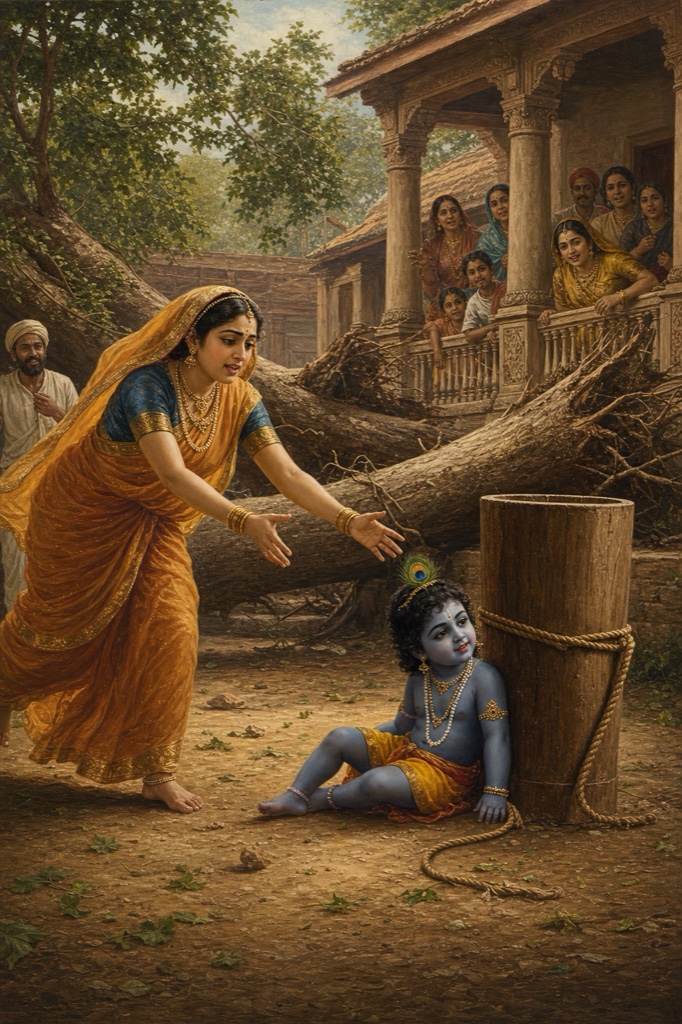
The sight stopped her where she stood. Two enormous trees lay torn out of the earth, their roots naked to the sky, and between the trunks, still tied to the mortar, her Lala sat playing in the dirt as though nothing whatever had happened.
For one moment her breath would not come.
“Kanhaiya!”
She lunged forward and swept the child into her arms. Her shaking hands went over him, forehead, arms, legs, hunting for the wound that had to be there, the scratch, the bruise.
There was nothing. Two trees had come down on either side of him and had not put one hair of his head out of place.
She never thought to loosen the knot at the mortar. She only held him.
The men of Gokul arrived at a run, Nanda Baba at their head, every one of them braced for the ruin a thunderbolt leaves behind. They found two great trees down and nothing on earth to account for it. Storm, lightning, and axe had left no trace on either trunk. The cause sat in plain sight between the trunks, a baby with a mortar roped to his waist, and their minds simply refused it. They murmured of evil omens instead, and turned the thing over and over, and could not close their hands around it.
The children who had been playing in the garden told them exactly what had happened. He did it, they said, pointing at Kanha. He came in dragging the mortar, and when it stuck sideways between the trees he pulled, and the trees fell, and two shining men came out of them and walked away toward the north. The grown men would not credit a word of it. A child who could barely walk, uprooting two hardwoods that ten of them together could not have rocked? Yet a few of them fell quiet in the middle of their own disbelief, remembering Putana, the poisoner who had come to this same house as a beautiful woman and died with this same infant at her breast, and Trinavarta, the demon who had carried him into the sky inside a whirlwind and shattered on the rocks beneath him, and they were no longer sure of anything at all.
Nanda Baba looked at his son, roped to a mortar in the wreckage of the garden, and laughed. He bent down and worked the knot loose with his own hands. Let the others read omens. His Lala was whole, sitting in the dirt and reaching up for him, and there was no room in a father’s eyes for anything else.
Which was exactly what Shyamasundar wanted. The being the two yakshas had just hailed as Time, as prakriti, as the witness inside every creature, wanted a mother’s lap, a father’s hands at the knot, the dust of Gokul on his skin. Beside these, every other splendor in creation sat pale.
Literary context
This katha comes in the tenth Skandha of the Shrimad Bhagavata, chapters 9 and 10, directly after the Damodara lila, and its closing scene opens chapter 11. The two beings set free are the yakshas Nalakubara and Manigriva, sons of Kubera, whom the devarshi Narada had cursed to stand as arjuna trees. Because they grew as a twinned pair, the trees were called Yamalarjuna.
The philosophical lens
Inside this small lila hides one of the Bhagavata’s large truths. Nalakubara and Manigriva were masters of splendor, and the splendor made them inert, wood standing in a garden, and the touch of a tiny child made them conscious again. Splendor binds. Love unbinds.
This is why the katha belongs to vatsalya and to grace at once. The hand that rips two trees out of the ground is the same hand that catches hold of Yashoda’s anchal at dusk and falls asleep holding it. The Bhagavata shows this over and over: the supreme splendor of Bhagavan is that he lets the ones who love him make him tender.
Why this katha matters now
The deliverance of Yamalarjuna: the child Krishna dragged his mortar between the twin arjuna trees, the trees fell, and the two brothers bound inside them, Nalakubara and Manigriva, walked free. True freedom begins the moment the rope of ahankara snaps.