On this page
The Curse of Jaya and Vijaya
One day four sages came walking toward that realm. Sanaka, Sanandana, Sanatana, and Sanatkumara. Brahma had thought them into being at the dawn of creation, before Marici, before the patriarchs, before anything else that lives, and they are called his mind-born sons because no womb ever carried them. They are the eldest beings in the universe, and to the eye they are boys of five, wandering wherever they please through all the worlds, held by none of it, wearing nothing at all but the open sky.
No film of wanting lay on those four. Objects held no attraction for them, and gates had never slowed them, and fear had no purchase on minds that saw every creature as their own self. They had come for one thing, the sight of Sri Hari, and they walked toward it.
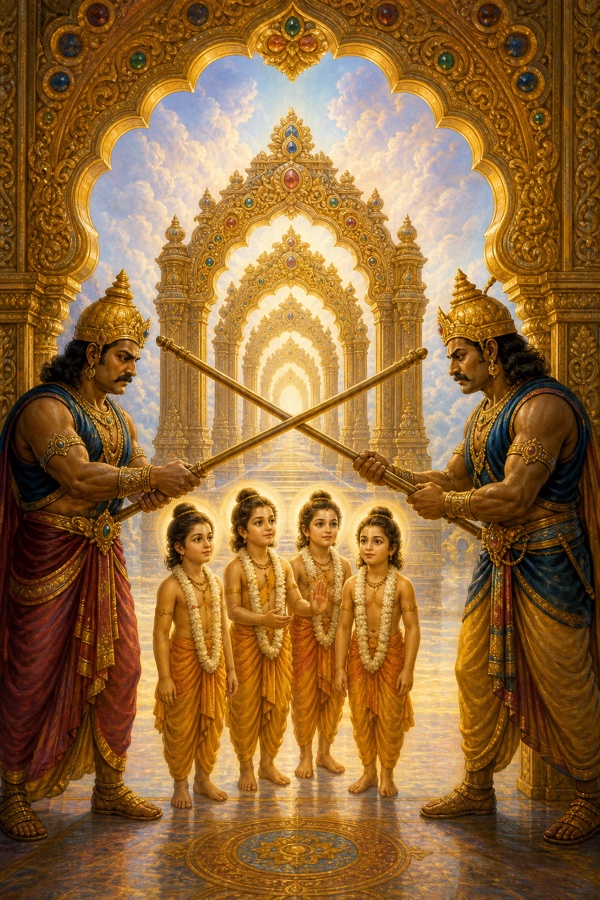
Six entrances they crossed, each hung with doors of gold and diamond, and no one stopped them; they moved through as freely as through open country. At the seventh gate two guards stood waiting, both of one age and one fierce beauty. Four dark arms apiece. Maces held ready. Armlets, earrings, and jeweled diadems catching the light, and around their necks, swinging between those four arms, garlands of forest flowers loud with drunken bees. Their brows were arched, their nostrils flared, their eyes carried a touch of red, and a stranger could have taken them for small images of the Lord they served. When the naked boys came on toward the door as though no door existed, Jaya and Vijaya thrust out their staffs and barred the way.
And they laughed at them. Two guards in the house of Sri Hari looked at the untroubled walk of these children and laughed in their faces, a laughter foreign to their master’s whole nature. “Stop there. This is no way to enter.”
The four looked at one another. Their gaze fell evenly on all things; they had walked every world in existence and no hand had ever been raised against them. But to be turned back at the threshold of the one they loved, with his door in sight, sent a slow red climbing into their eyes. Even in the desireless, a thwarted longing knows the old way to anger.
“Doorkeepers,” they said, “whoever lives in this realm has reached it by long and loving service, and comes in time to look on all things with the Lord’s own even gaze. You two belong to that company. Where did this crookedness enter you? The Lord is peace through and through; he has no quarrel with anything that breathes. The people of this place see no distance between themselves and him who holds the whole universe in the hollow of his body; they rest inside him the way the space in a jar rests inside all space. What danger could ever come in here? If you scent one, the treachery is your own; a deceiver suspects in others what he carries in himself.”
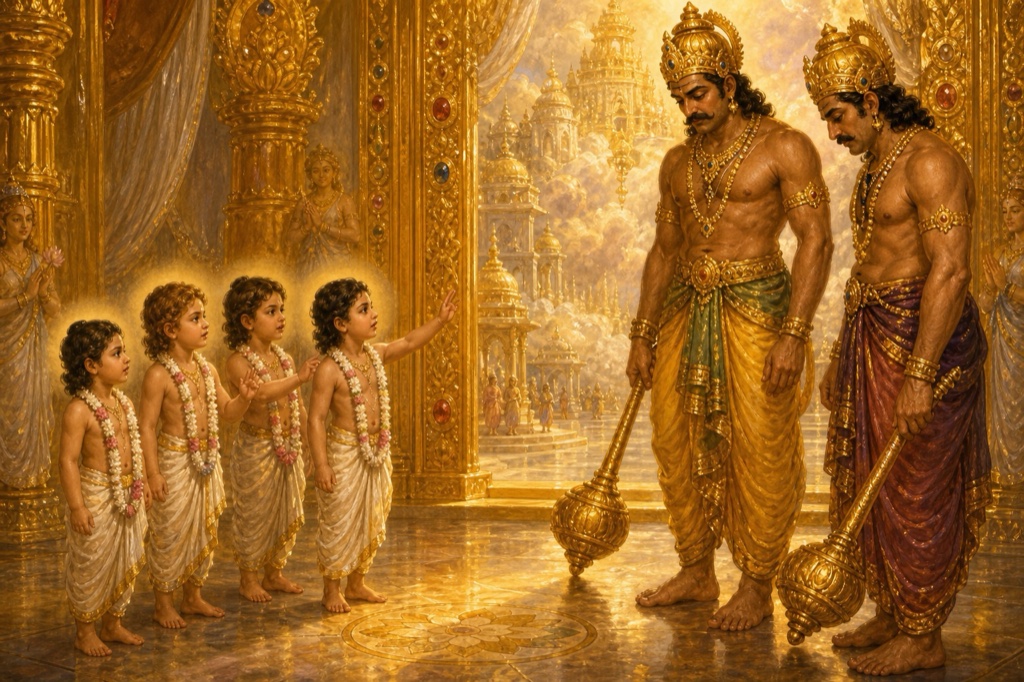
“You wear the Lord’s own likeness, and inside it your minds have gone dull. So, for your own good, we will give your fault the sentence it has earned. Since you see division here, where none exists, go down out of Vaikuntha. Go to the wombs where division is the law of life, into the world where every creature is born fighting the three enemies lodged in its own chest: desire, anger, and greed.”
At that one sentence the guards’ arms dropped.
They knew what had just been spoken. A curse from the lips of Brahmins can be blunted by no weapon ever forged, and the Lord himself stands in deeper awe of his Brahmins than any servant of his has ever stood of him. The two let their staffs fall, went down to the ground, and took hold of the sages’ feet.
“Bhagavan,” they said, and their voices shook, “we are guilty, and the sentence fits the fault. Let it fall. Let it scour out of us the sin of slighting the Lord by slighting you. We ask one mercy only, if any pity stirs in you for two servants who forgot themselves: that down in those dark wombs no delusion take us thick enough to wipe the Lord from our memory.”
And then the gate filled with light, because Sri Hari was walking toward it. He had learned, in that instant, what his own people had done to his guests, and he came himself, on the same feet that renunciants seek through lifetimes of austerity, with Lakshmi beside him. His attendants hurried alongside bearing the honors of his house, the white umbrella held over him like a full moon, the strings of pearls at its rim swaying in the breeze of two white chowries until the moon seemed to be raining nectar.
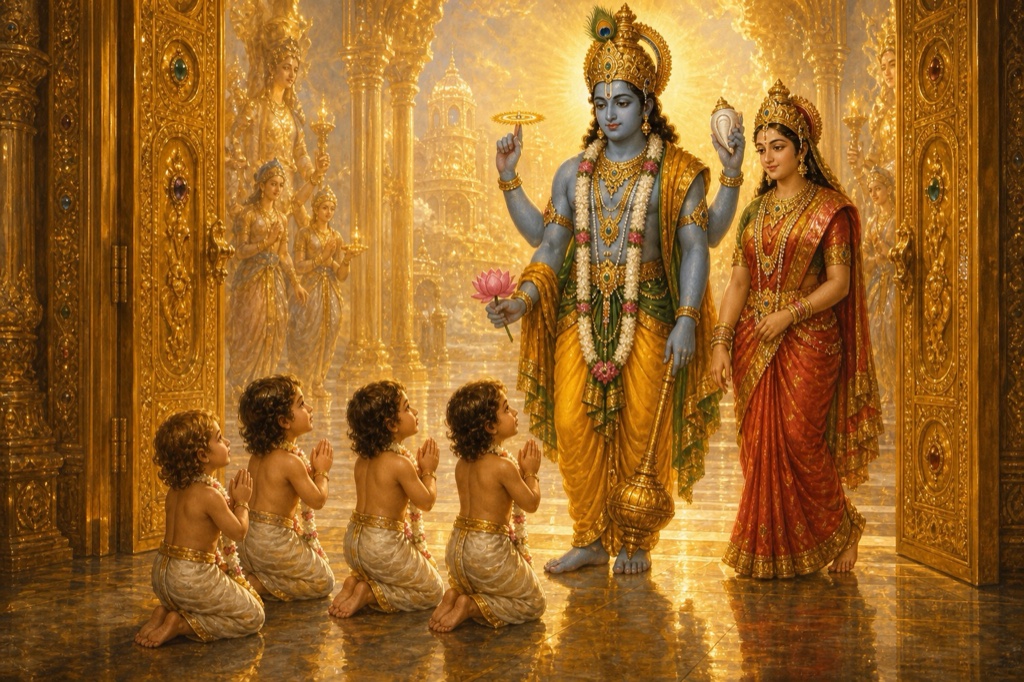
His form undid them. Lakshmi lay along his dark chest as a fine line of gold. Yellow silk wrapped his hips beneath a bright girdle; a garland of forest flowers, trailing its own murmur of bees, hung between his four arms; bracelets ringed his wrists, one hand resting on the shoulder of Garuda, the great eagle who carries him, the other idly turning a lotus. Jeweled pendants blazed at his cheeks, a crown of gems sat on his head, and at his throat burned the Kaustubha jewel. The four sages looked at him and could not stop looking. These were beings who lived sunk in the still joy of Brahman, past the reach of the senses, and yet when the breeze came off him, carrying the honey of tulasi and the dust of his feet, it entered them through the nostrils and set even their minds trembling. They drank in the blue lotus of his face and the jasmine whiteness of his smile, then lowered their eyes to his feet, where the nails shone like set rubies, fastened their minds there, and began to praise him. Today, they said, you stand before our eyes at last, you who hide from the wicked while seated inside their hearts. Our father Brahma told us your secret at the beginning of our lives, and you entered us then through the ears; only now through the eyes. Send us where you will. Let us be born among the fallen, in hell itself, and we will count it no fall, so long as our minds keep their delight in these feet, our words carry the grace of these feet the way tulasi leaves carry it, and our ears stay filled with the telling of you. Those who have once tasted the sweetness of your stories hand back liberation itself without a pang, and the throne of Indra weighs less still.
Sri Hari heard the hymn to its end and said nothing at first. His gaze rested on his two servants, and it was full of pity.
“Best of sages,” he said, “these two are mine. Jaya and Vijaya, my own attendants, and in forgetting my mind they have wronged you badly. I stand with your sentence. The offense was against you, and an offense against you I count as an offense against me, for the Brahmin is my highest deity. When a servant does wrong, the world rightly lays it on the master, and the stain spreads across a good name the way white leprosy spreads across skin. Whatever glory I have, I hold from you. My name is the nectar that purifies whoever dips an ear into it, down to the man who lives on the flesh of dogs, and it was the Brahmins who made that name holy. If this arm of mine ever turned against you, I would cut it off, for all its strength. Because I serve you, the dust of my feet washes away sin; because I serve you, Lakshmi never leaves me, though I ask nothing of her while the great gods keep vows for one sidelong glance. The fire of sacrifice is my own mouth, and still I taste what a Brahmin eats with more relish than any oblation poured into the flame. The Ganga rises from the washing of my feet and makes three worlds holy, and Shiva bears her on his head; I bear on my crown the dust of your feet. Brahmins, cows, and the defenseless are my own body. So I stand before you now as a beggar, asking one alms of you: your goodwill.”
“They failed you only because they could not read my mind. Grant me this one favor, for my sake: let their exile be short. Let them take the low birth their fault has earned, reap it to the last grain, and come home to me soon.”
The sages stood in silence. The serpent of anger had bitten them, and still they could not stop drinking his words, brief words, mantra-like, with a floor too deep to touch; they turned his speech over and over and could not find the intention hidden inside it. At last they answered. “Self-radiant Lord, we cannot follow you. You rule everything that is, and you speak of favors we might do you. You call the Brahmin your deity, when you are the deity of the Brahmins and of the gods of the gods themselves. Lakshmi, whose footdust others carry on their crowned heads, waits at your door for the hours you appoint her. If it pleases you, set these two some other penance. Keep them in your service. Or punish us, who have cursed two innocent servants of yours. Whatever you choose carries our assent already.” And the Lord answered them: the curse was his own act, set moving through their lips. The two would take birth in the wombs of demons, and there, their minds welded to him by anger itself, they would burn through their fault and stand before him again, and soon. The sages walked around him in reverence, bowed, and went out through the shining gates praising his splendor as they went.
Then Sri Hari turned to the two who had kept his door.
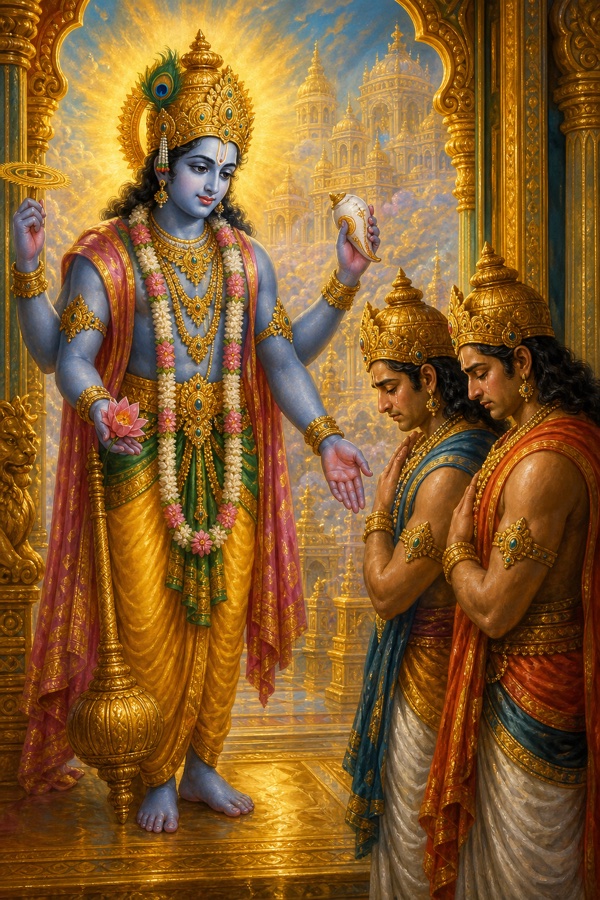
“You must go down into the world of death and be born. Go without fear; all will be well with you. I could annul a Brahmin’s curse. I will not, because this one carries my own assent, and because it is older than today. Long ago, while I lay deep in yoga-sleep, you turned Lakshmi herself away at this door, and her displeasure marked you then; what these sages spoke, she had already set in motion. Enter, then, the wombs of the daityas. And hear the mercy folded inside the sentence: in the very heat of your hatred, your minds will hold me and nothing else, without one break, and that unbroken hold will burn your sin away and carry you home to me, and soon.”
Jaya and Vijaya bowed their heads.
In their eyes was the pain of leaving their master. Under the pain, already taking root, lay the hope of the road back.
So the road was laid.
The luster went out of the two attendants then, and their pride went with it, and they fell. A cry rose from the jeweled vimanas of Vaikuntha as the watchers saw the Lord’s own doorkeepers drop out of the realm of Sri Hari, down and down, into the womb of Diti, where Kashyapa’s stored fire lay waiting for them. “And that,” Brahma told the gods at last, “is the seed you fear. It is those two who ripen in Diti’s womb. It is their glow that has drunk your light, and the Lord himself is moving in all of this. He will act when the hour ripens; our deliberations can add nothing to him.” In time Diti gave birth, and the seed became two brothers, Hiranyakashipu the elder and Hiranyaksha after him, and their coming shook the worlds.
Their deaths came in their season. For Hiranyaksha it was the boar, Varaha, the Lord in his tusked form, who killed him in a duel fought half in the sea. For Hiranyakashipu it was the man-lion, Narasimha, who burst from a palace pillar at twilight and tore him open on his own threshold. Each brother, in his last hour, stood face to face with the very Lord whose door he had once kept, met him as an enemy, and died under his hands with his whole mind fastened on him.
Literary context
This katha sits in the third Skandha of the Shrimad Bhagavata, chapters 15 and 16, inside a frame of its own: Brahma tells it to the gods to explain the darkness spreading from Diti’s hundred-year pregnancy. The four Kumaras, Brahma’s mind-born sons, pass six gates of Vaikuntha unchallenged and are stopped at the seventh by the doorkeepers Jaya and Vijaya, whom they curse down into the world of desire, anger, and greed. The Lord comes to the gate in person, takes the offense on himself, honors the curse and declines to cancel it, and folds a promise inside it: even in demon wombs the two will keep their minds fixed on him through anger itself, and the way back will be short. In their first birth they rise from Diti’s womb as Hiranyakashipu and Hiranyaksha, killed in turn by Narasimha and Varaha.
The arc completes in the seventh Skandha, where Narada answers Yudhishthira’s question at the Rajasuya sacrifice: how could Shishupala, who cursed Krishna to his face, melt into him before the whole court? Narada names the falling doorkeepers and the sages’ final mercy, three births and no more. Ravana and Kumbhakarna fall to Rama; Shishupala and Dantavakra fall to Krishna’s discus; the curse spends itself, and the two return to the Lord’s side. A single curse threads the great demon pairs of three ages onto one line, and the line runs the length of the Bhagavata: even the Lord’s enemies end in him.
The philosophical lens
At the center of this katha stands a plain and unsettling law. Wherever a mind fixes and holds without breaking, there the whole person is slowly carried. The Bhagavata does not argue the point. It shows the two beings who stood nearest the Lord falling out of his house with hatred for their wages, and shows that same hatred grinding them against him so continuously that it did the work of prayer.
The seventh Skandha identifies the same pair in three hostile births and explains that concentrated hostility kept their attention fixed on the Lord. Their return is an exceptional fate ordained within this curse. The Bhagavata directs its hearers toward loving remembrance as the deliberate path.
Why this katha matters now
Jaya and Vijaya, the two doorkeepers of Sri Hari. One misjudgment at the seventh gate of Vaikuntha, the curse of four boy-sages, and three lives as the Lord’s sworn enemies before the road bent home again. Their katha records an exceptional consequence of sustained attention within a fate the Lord himself had ordained. For the listener, its constructive path remains loving remembrance.