On this page
The Varaha Avatar
Manu bowed to the command, and then laid the one difficulty at his father’s feet. “All of this I will do, father, destroyer of sins. But first show me the ground I am to stand on. Give me, and the generations that are to come out of me, a place to live. The earth, the home of every living being, lies drowned in the vast flood, sunk clean out of sight. My lord, some way must be found to raise her.”
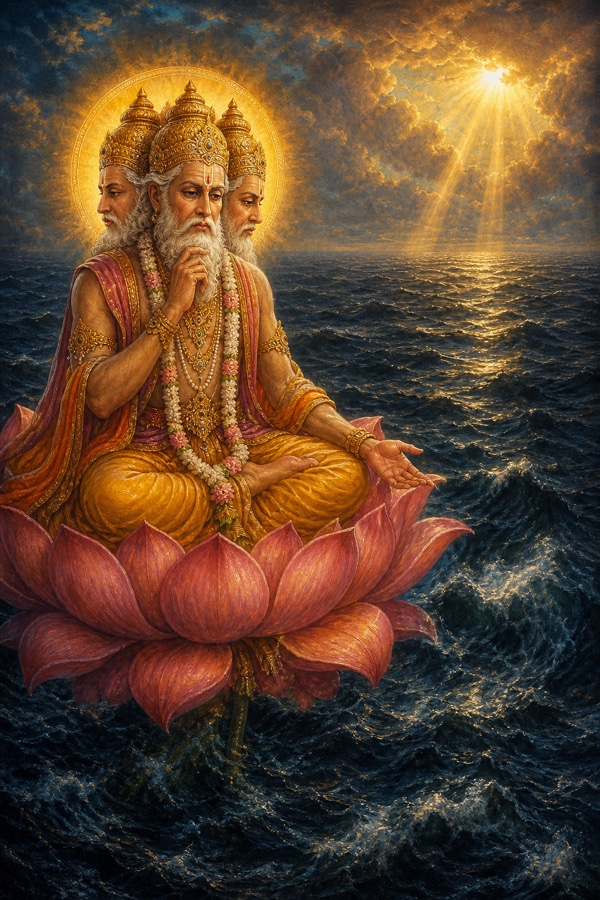
Brahma looked, and saw that it was true. The earth lay deep beneath a single shoreless ocean, exactly as she lies when an age closes and everything made returns to water. Sunlight came down, touched the surface, and stopped there, for beneath the surface nothing remained for light to reach.
And with her, all the rest of creation stood waiting. Without ground there was nowhere for a seed to split, nowhere for a creature to draw its first breath, nowhere for a human foot to come down.
For a long while Brahma turned the problem over in his mind. “Even while I pressed on with the making, the waters kept washing at her, and she slipped down and down to the lowest deep. What is a creator to do whose creation has lost its floor?” At last his thought went where it always went in the end, back to his own origin, to the almighty Shri Hari, out of whose mere thought Brahma himself had sprung. Let the one who had thought the maker into being now think of the way.
And while he was still deliberating, the answer climbed out of his own body.
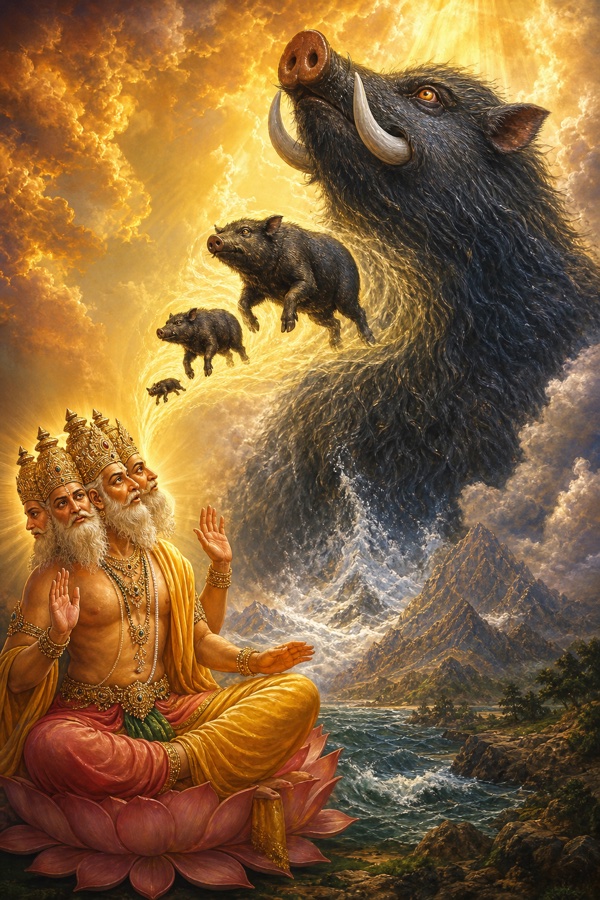
From one of Brahma’s nostrils, without the least warning, slipped a boar. It was tiny, no bigger than the top joint of a thumb, small enough to vanish inside a closed hand.
Brahma stared at it. What was this?
Then, in the open air, it began to grow. In the time it took to watch, the creature stood as big as an elephant, and it kept growing. Around Brahma the first minds of the universe gathered to look: Marichi and the other seers Brahma had brought forth from his own thought to help him people the worlds, the child-sage Sanaka with his three brothers, and Svayambhuva Manu, whose plea had begun it all. Brahma spoke his wonder aloud. “What is this being that has put on the guise of a boar? And it came out of my own nostril. A moment ago it would have sat on a thumbnail, and now it stands like a great rock. Could this be Lord Vishnu himself, playing upon my mind?”
Even as they wondered, the boar went on growing, until it stood against the sky like a mountain that had decided to move. Thick black bristles covered the vast body from snout to tail. Two white tusks curved outward and caught the light. The eyes burned so fiercely that no watcher could hold their gaze, and yet the whole form carried an unaccountable majesty, for this was the Lord of all sacrifice himself, Shri Hari, wearing the bristles and the tusks.
Then he roared. The sound rolled out and set the four quarters of the universe ringing, and it swept the last doubt from the watchers like a wind clearing smoke. Far above, in Janaloka, Tapoloka, and Satyaloka, the three high realms where perfected sages dwell beyond the reach of any flood, the seers heard that roar and answered it with the holy mantras of the three Vedas. The Lord received their chanting as the Veda itself returning home to him, roared a second time for joy, and turned toward the waters for the sake of the gods, playful as a bull elephant making for a river.
Under the coat of stiff bristles his frame was hard as forged iron. He sprang upward first, tail raised, mane shaking, and his hooves tore through the clouds as he climbed. Light traveled wherever his glance traveled. His tusks flashed white and terrible, and yet, passing above Marichi and the sages who stood singing his praise, he turned on them a look of perfect gentleness.
Then he dove into the sea.
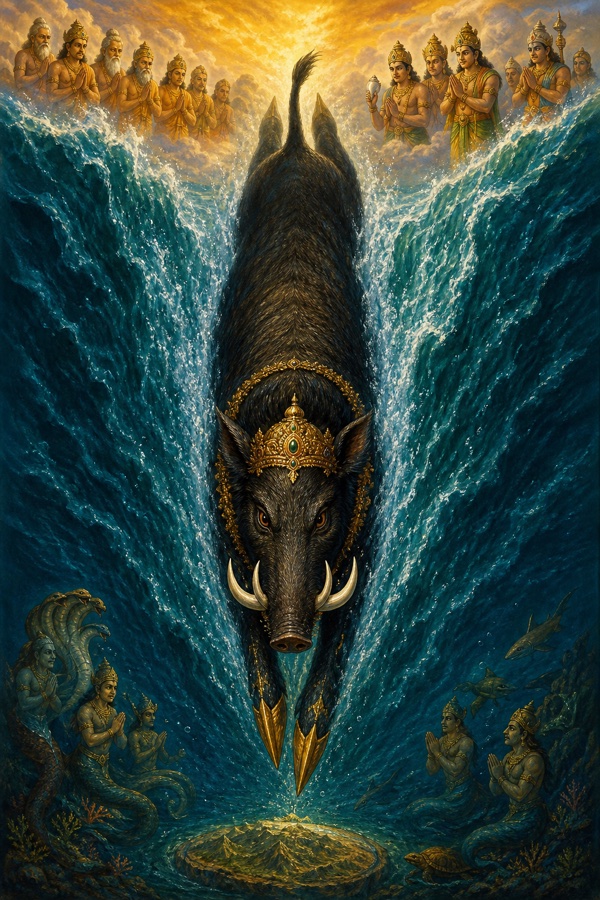
The waters split and stood away on either side. Torn open to its depths by that plunging mountain of a body, the ocean thundered and flung its waves upward like so many arms, and its roar seemed to carry one cry inside it: “Protect me, Lord of sacrifices.”
Down he went, cleaving the deep with hooves keen as arrows, hunting by smell. His nostrils searched the black water for the one scent lying under all others, the scent of earth. And at the far end of that fathomless ocean, in the lowest deep called Rasatala, he found her: the earth, home of every living thing, the same earth he himself had gathered into his own body at the close of the last kalpa, the day of creation before this one, when he drew all things back into himself for the long night of the worlds.
Varaha took the earth up between his two tusks and began to rise.
And there, while he was still deep in the water, something stepped across his path. Hiranyaksha, firstborn of the demon race, son of Diti and elder brother of Hiranyakashipu, a fighter whose strength no power in the three worlds had yet withstood. He saw the earth being carried up and out of his dominion, and rage filled him, and he brought his mace down on the rising body of the boar.
“A pig dares to cross me?” he bellowed in contempt, and struck, and struck again.
Anger rose in Varaha, sudden and sharp as his own discus, the blazing Sudarshana. But the earth still rested in his mouth, and he declined to hurry for a demon. He killed Hiranyaksha the way a lion kills an elephant, in passing, almost at play. The demon’s blood smeared his snout and his temples, and he looked like a great dark tusker that had come up from goring a hillside of red clay.
Then he rose on through the water, the earth steadied on the points of his tusks, carried the way a hand carries the most fragile thing it owns.
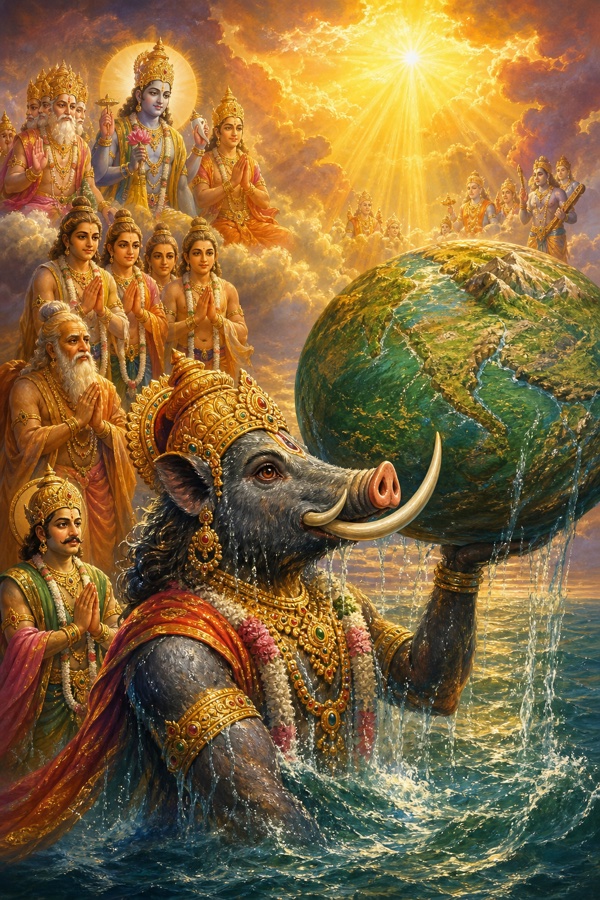
He broke the surface in a burst of spray and set the earth gently down in her own place, resting upon the waters, and the waters bore her. Sunlight traveled all the way down to her soil again. And over the sea, for the first time since the drowning, opened the smell of wet earth.
A shout of joy went up from gods and seers together. Brahma, Marichi and the elder sages, Sanaka and his brothers, and Svayambhuva Manu knew him now past all doubting, and with joined palms they praised him in words that came off their tongues sounding like the Veda itself.
“Victory, victory to you, unconquerable Lord, upholder of every sacrifice,” the sages sang. “We bow to you as you stand shaking the water from a body woven of the three Vedas. We bow to you again, who put on a boar’s shape for the earth’s sake alone, you in whose every bristle-pore the sacrifices lie hidden.”
“For this body of yours is the sacrifice itself, and eyes dulled by sin cannot even take it in. The sacred meters, the Gayatri and the rest, by which every hymn is measured, run through your skin. Your bristles are the kusha grass strewn on the altar floor. The ghee that feeds the flame shines in your eyes. Your four legs move with the work of the four priests who divide every rite among themselves. Your long snout carries the sruk, the great wooden ladle that pours the offering onto the fire, and in your nostrils rides its small companion, the sruva. Your belly is the ida, the dish from which the offering is tasted. The hollows of your ears hold the soma cups; in your mouth lies the vessel of the brahma-priest’s portion, and down your throat go the ladles of pressed soma. And every time your jaws grind, an oblation falls into fire: your chewing is the agnihotra itself.”
“Each descent you make into this world of matter is the consecration with which a great sacrifice opens. Your neck bears the three preparatory rites that lead up to the pressing of the soma. Your two tusks are the offering that begins the rite and the offering that ends it. Your tongue is the Pravargya, the blazing pot-rite that heralds each stage. The fire of the assembly hall and the fire of the home burn as your head, and your breath moves as the bricks move when the altar rises, course laid upon course. The soma is your seed. Your very posture of sitting holds the rites of morning, midday, and evening. The seven substances of your body are the seven great soma sacrifices, the Agnishtoma first among them; the joints of your body are the long sessions that run on for days together, and your sinews are all the rites there are, those with soma and those without. Every mantra spoken, every god invoked, every offering poured, every act of the rite, all of it is you. And you are more still: the wisdom won through dispassion, through devotion, through a mastered mind, and the teacher standing behind every teaching. Again and again we bow.”
“When you shook the water from that Veda-woven body, the drops that flew from your mane came down on us in Janaloka, Tapoloka, and Satyaloka, and washed us cleaner than all our austerities ever had. Whoever sets out to count your deeds to their end has already parted with his reason. Lord, the whole world lies bewildered among the objects of the senses, caught in your own Yogamaya, the veiling power you cast over what you make. Bring it peace.”
Then Brahma himself came forward, his four faces lit with recognition, and joined his palms.
“Who could have done this, Lord, except you? To put on the humblest shape in creation, the one form no proud being would stoop to. To go down through the whole weight of the flood into the dark of Rasatala. To break a demon no army could have broken, and to bring the earth up through all of it so gently that she carries no wound. And for you even this is no marvel, for you are the home of every wonder, and you spun this entire astonishing universe out of your maya. Look at her now. Riding the points of your tusks, the earth with all her mountains shines like a lotus plant lifted, leaves and all, on the tusk of a great elephant climbing out of a lake. And with her resting there, this boar-body of yours, itself the three Vedas standing upright, is a mountain wearing a crown of clouds. Now set her firm, Lord. She is the mother of everything that moves and everything that holds still, and she is your own consort, in whom you have laid the seed of her power to sustain, the way fire waits inside the arani, the kindling-wood from which the priest churns out flame for the rite. Make her steady. Make her a home for every creature, for you are their father. Then we will bow to you, and to her.”
“You have done more than lift the earth, Lord. You have shown every age to come that the greatest rescue may arrive in the humblest form there is.”
Varaha looked at the earth once, a long look. Then the mountain of a body grew still, thinned like mist off morning water, and was gone, and Shri Hari withdrew into his own unseen being.
Literary context
This katha of the Varaha pradurbhava (manifestation) comes in the thirteenth chapter of the third Skandha of the Shrimad Bhagavata, where the sage Maitreya recounts it to Vidura. The earth sinks to Rasatala in the waters of dissolution, and Shri Hari takes the boar form to bring her out; Hiranyaksha bars his way in the water and strikes with his mace, and Bhagavan slays him in sheer lila. The full account of that battle and of Hiranyaksha’s death comes in later chapters, the eighteenth and nineteenth.
In the Gita Press reading this katha stands in the chain of avatar stories in which Jaya and Vijaya, the Lord’s own gatekeepers, take three births as his adversaries; Hiranyaksha and Hiranyakashipu are the first of those births. The same chapter carries the sages’ long praise of the Varaha body as the yajna-purusha, in which each limb of Bhagavan is seen as a limb of the sacrifice.
Why this katha matters now
When the whole world needed saving, Shri Hari picked the one form that is at home in the mud. There is work like that everywhere: done far below notice, in places people would rather never look, and holding up the ground everyone else stands on. The Varaha katha trains the eye to honor it.