On this page
Narakasura
Bhaumasura, whom men also call Narakasura, was the son of Bhumi, a daitya born from the womb of the goddess who is the living Earth. His strength grew until even the devas, the gods who keep the order of the worlds, could not meet his eye.
He robbed heaven the way lesser men rob houses. From Varuna, the ancient god who rules the waters, he wrenched away the royal parasol, the white canopy under which only a sovereign may stand. From the ears of Aditi, mother of the gods themselves, he stripped her shining earrings, gold refined in fire and set with gems. On Mount Meru, the mountain of the gods, he seized Mani-parvata, the celestial site that stood upon it. And then he did a thing that no one before him had dared. He began taking the daughters of kings, by force, from their fathers’ houses, wherever his conquests carried him.
From every kingdom he had carried them off, from every direction of the map. He shut them away in a locked wing of his palace, behind gates and guards, meaning to keep them all under his power the way he kept the parasol and the earrings, as things taken, never to be returned.
Those princesses wept day and night. Far from their own cities, far from their mothers’ laps, inside the walls of a daitya. As the night deepened, one girl’s sob would wake another, and by the coming of dawn all would fall silent again, as if even the tears had run out.
When the cry of the devas grew too loud for heaven to hold, Indra himself came down to Dwarka, Krishna’s island capital on the western sea, and laid before Shri Hari every last deed of Bhaumasura. The gods had lost their jeweled ground on Mount Meru. His own mother had been robbed at the ear. He told it all, and he left the rest in the Lord’s hands.
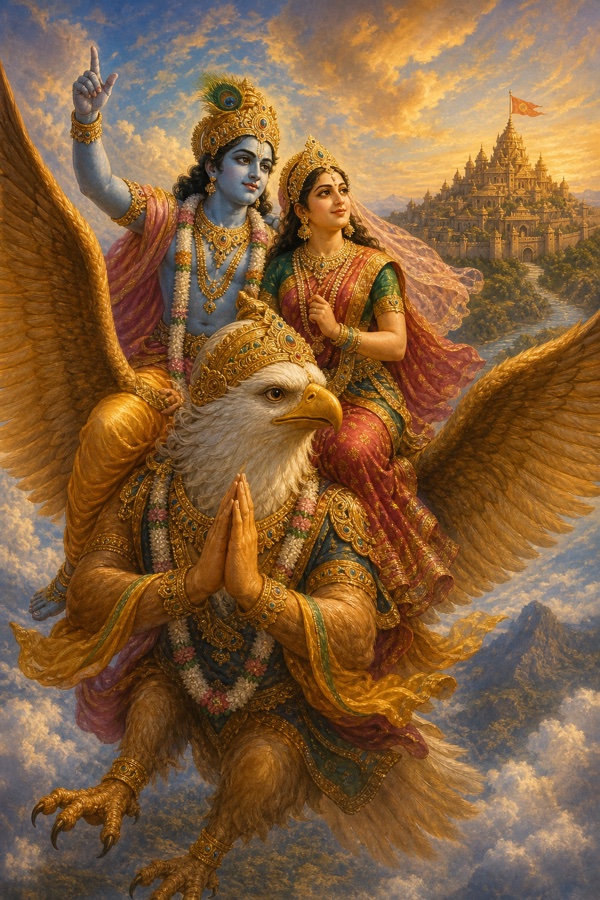
Krishna and Satyabhama mounted Garuda and set off toward Pragjyotishapura.
Pragjyotishapura had been built to make entry unthinkable.
First there was a rampart of mountains ringing it about, then a barrier of massed weapons, then a deep moat full of water, then walls of living fire and of wind, and within all of these, innermost and worst, the strong net of noose-ropes that the daitya Mura had laid, myriad snares waiting in the dark. At every gate stood a guard of daityas.
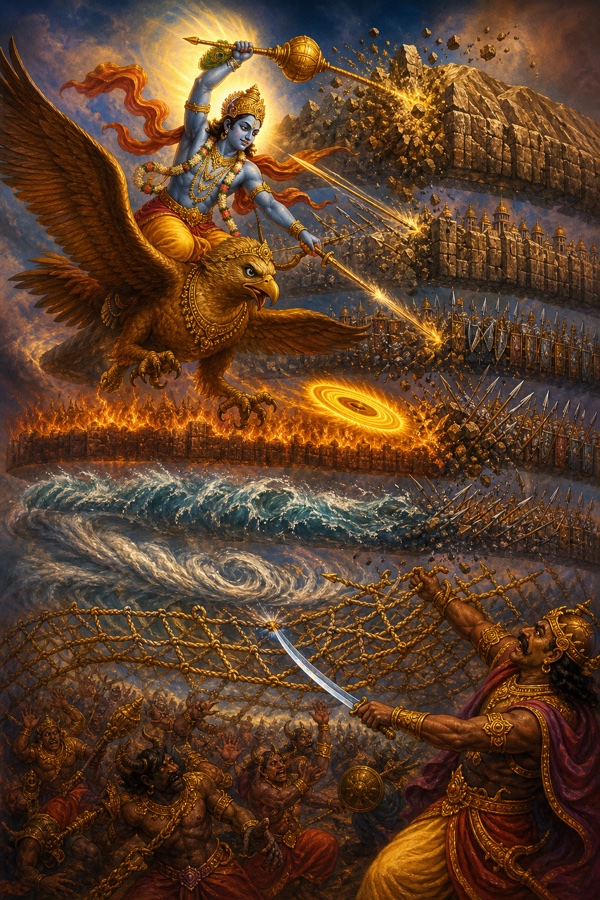
Shri Krishna broke the mountains apart with the blow of his mace and cut the ranks of weapons to pieces with his arrows. Then with his chakra, the spinning discus Sudarshana, he tore down the walls of fire, water, and wind, and he cut Mura’s net of nooses apart, strand by strand, with his sword. The great engines set along the ramparts, and the hearts of the warriors who manned them, he split with the blast of his conch, and he brought the fortress wall of the city to ruin with his heavy mace.
The sound of Bhagavan’s conch Panchajanya rolled over the city like the thunder that cracks at the end of a kalpa, when the worlds themselves are unmade.
That roar reached down through the water of the moat and broke the sleep of the daitya Mura, who until now had lain sleeping in its depths. Five-headed, carrying a fierce splendor like the sun and fire of the day of pralaya, the day of dissolution, he came up out of the water, so terrible that it was not easy even to lift one’s eyes toward him.
He raised his trident and rushed at Shri Hari the way a serpent, forgetting its own nature, strikes at the very eagle that feeds on serpents. It seemed as though he would swallow the three worlds with his five mouths.
He whirled the trident and hurled it at Garuda with all his force, and roared a lion’s roar from all five mouths at once, a sound that spread through earth, sky, patala the netherworld, and the ten directions, the eight points of the compass and the above and the below, until the whole brahmanda rang with it.
Shri Krishna swiftly loosed a pair of arrows that cut the flying trident into three pieces in the air. At the same time he struck many arrows into Mura’s mouths. Then, filled with rage, Mura swung his mace, but Shri Hari, with the blow of his own mace, ground that mace to a thousand splinters in midair.
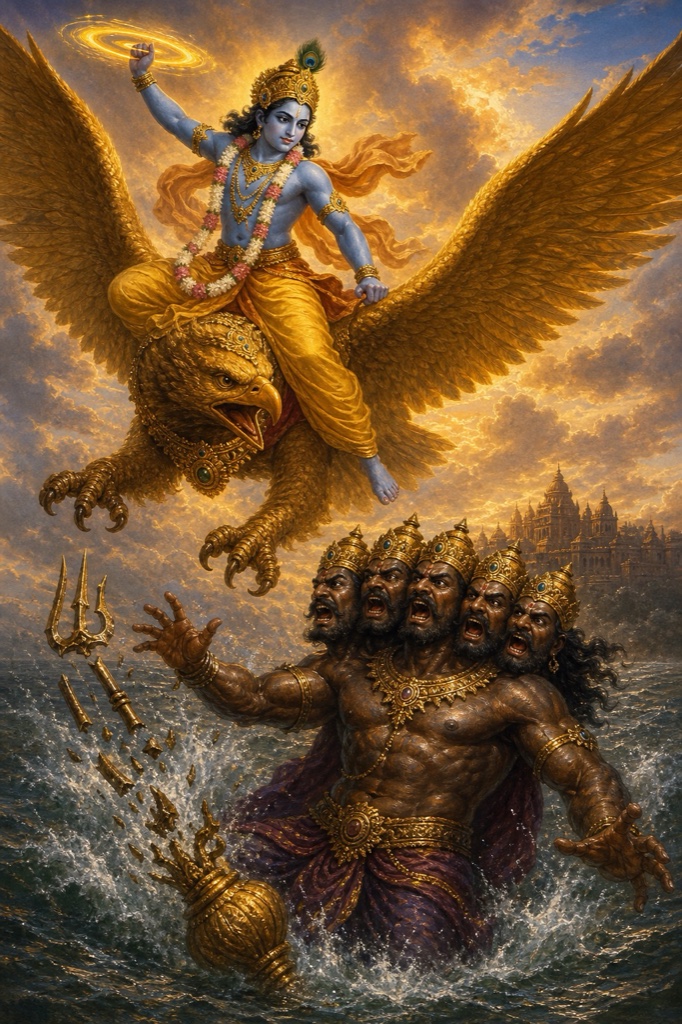
Weaponless now, the daitya spread his arms wide and lunged at Shri Krishna with his bare hands, and Bhagavan, as though at play, took off all five of his heads with one pass of the chakra. The heads cut away, the life fled out of Mura, and he dropped into the water the way a mountain, its peak sheared off by Indra’s vajra, falls into the sea.
Mura had seven sons: Tamra, Antariksha, Shravana, Vibhavasu, Vasu, Nabhasvan, and Aruna. Stricken with grief at their father’s death and burning to avenge him, they armed themselves for battle. Putting the commander named Pitha at their head, at the order of Bhaumasura they came up against Shri Krishna.
In great fury they began to rain down on Bhagavan a storm of fierce weapons, arrows and swords and maces and javelins and spears and pikes. But the power of Bhagavan is unfailing and without end. With his arrows he met that whole descending armory in the air and cut it to pieces as small as sesame seeds. Then he cut away the heads, thighs, arms, feet, and armor of the commander Pitha and the daityas with him, and sent them all to the house of Yama, the lord of death who keeps the account of every life.
From the fortress height Bhaumasura watched his army and his commander pass into the jaws of Kala, of time that devours all things, and an unbearable rage took hold of him. He came out of the city with an army of rutting war-elephants born in the line of Airavata, the four-tusked mount of Indra that rose long ago from the churned ocean of milk. Then he looked up. Shri Krishna was seated on Garuda in the sky with his wife beside him, as beautiful as a dark cloud of the rains beside its lightning, standing bright above the sun itself.
Bhaumasura loosed the weapon called Shataghni, the slayer of hundreds, and all his soldiers together let fly their own weapons in the same instant. But each and every weapon that came, Shri Krishna cut down with three keen arrows apiece. In that same moment the arms, thighs, necks, and torsos of Bhaumasura’s soldiers began to fall away cut through, and the elephants and horses began to die. Garuda struck at the war-elephants with his wings, his beak, and his talons until the survivors turned in their distress and fled back into the city.
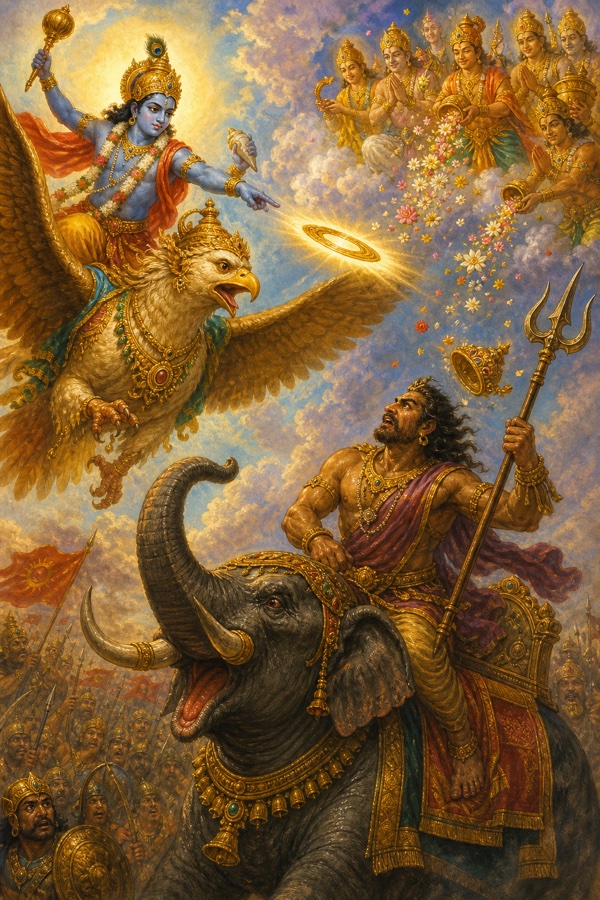
Now Bhaumasura fought on alone. He struck Garuda with the same Shataghni that had once turned back the very thunderbolt of Indra, but Garuda, though pierced by it, did not stir any more than an elephant stirs when a flower garland is tossed against it. Then Bhaumasura raised a trident to kill Shri Krishna. He never threw it. Before the shaft could leave his hand, Bhagavan, with his chakra of an edge keen as a razor, cut off Bhaumasura’s head while the demon still sat upon his elephant.
His shining head, with its earrings and its beautiful crown, fell to the earth. A cry of grief went up from his own people, and in the same breath the seers cried out, “Well done, well done,” and the chiefs of the devas rained flowers upon Bhagavan and began to sing his praises.
Then the mother of the daitya came forward: Bhumi, the goddess Earth herself, standing over the ruin of her son. She placed around Shri Krishna’s neck the vanamala, the garland of forest flowers, along with the jeweled Vaijayanti garland, and she gave back everything her son had stolen: the shining earrings of Mother Aditi, made of refined gold and set with gems, the parasol of Varuna, and Mani-parvata on Mount Meru. Then she bowed low with folded hands, and with a heart full of devotion she praised the one who had struck her child down. “Victory to you, lord of the lords of the gods, bearer of the conch, the discus, and the mace. You dwell within every being and move it from within, and yet you have taken this form because your devotees longed to see you. Yours is the navel from which the first lotus grew, yours the lotus eyes, the lotus feet, the garland of wild flowers on your chest. You are Vasudeva, you are Vishnu, older than the first stirring of creation, its seed and its cause, knowledge itself standing whole. To make the worlds you take on the restless energy of creation, to keep them the mode of light, to dissolve them the darkness that ends all things, and no mode of nature ever clouds you. You are time, you are matter, you are spirit, and you stand apart from all three. Earth, water, fire, air, and sky, the senses and all they seize, the mind, the ego, the whole moving and unmoving creation: all of it is an appearance shimmering in you, who are one without a second.” Then she drew forward a trembling boy. “This is Bhagadatta, my grandson, Naraka’s son. He is afraid. You who lift the fallen the moment they reach your feet, protect him. Lay upon his head the lotus of your palm, the hand that burns away all sin.” Shri Hari laid his hand upon the boy, granted him fearlessness, and left him his father’s kingdom. Bhagadatta remained safe in his kingdom.
After this Shri Krishna entered the palace of Bhaumasura, its halls heavy with everything the daitya had ever taken.
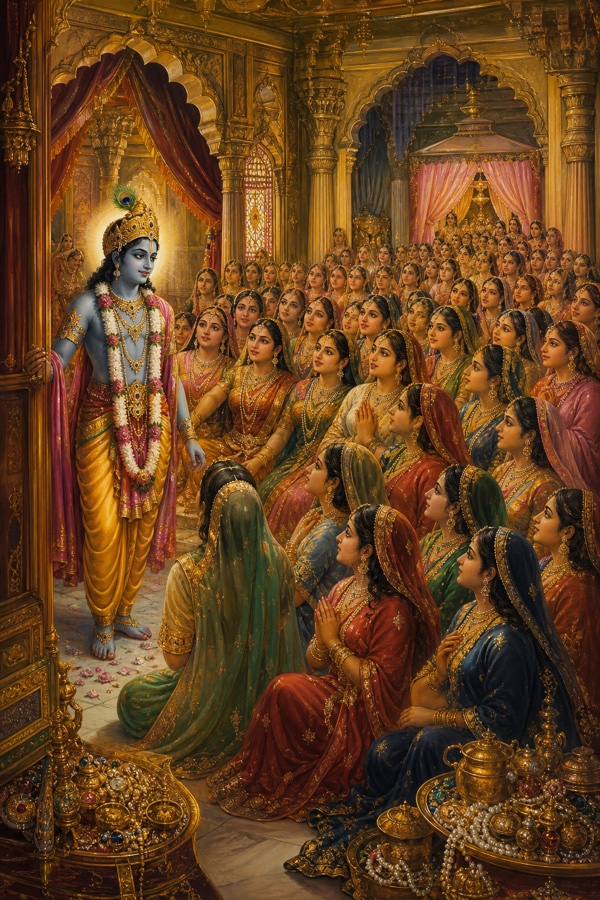
Going in, he saw what the locked wing had been hiding all these years: sixteen thousand one hundred maidens, taken by force wherever the daitya’s conquests had carried him. They were the daughters of kings, and of gods and Siddhas and daityas too, seized from their fathers’ houses and held here as captives, each one once the treasure of some distant court that had long ago stopped hoping for her return.
When those princesses saw the best of men, Shri Krishna, entering the inner apartments, they were enchanted. Understanding it to be Bhagavan’s causeless grace and their own great fortune arriving at last, in their hearts they chose him then and there as their dearest and most beloved husband.
Each one of them resolved within her mind, “May this Shri Krishna be my husband, and may the Creator bring this longing of mine to pass.” Sixteen thousand one hundred hearts made the same silent vow in the same moment, each one certain it spoke alone, and in this way, with love, they laid themselves down as an offering before Bhagavan.
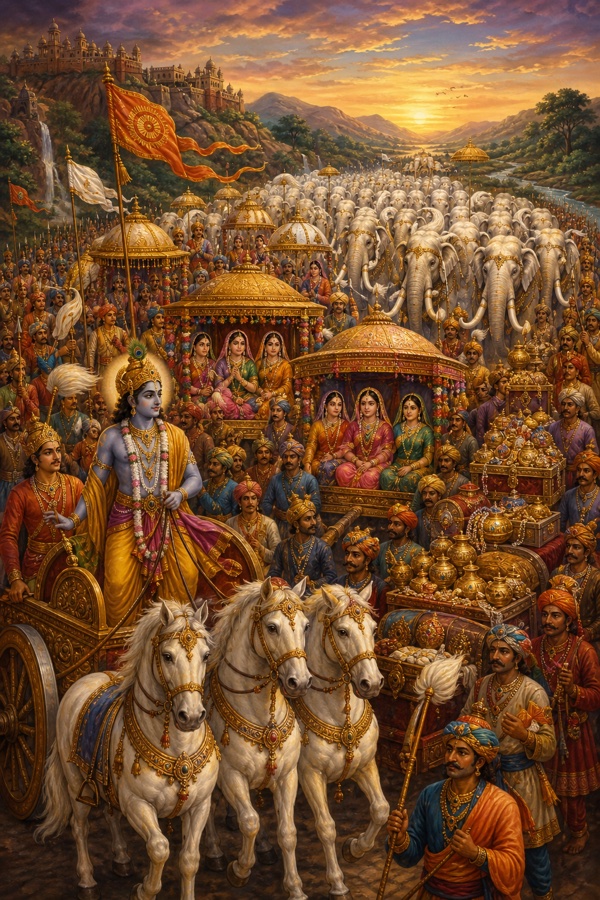
Then Shri Krishna had those princesses bathed and dressed in fine, spotless garments and ornaments, seated them in closed palanquins, curtained as for royal brides, and sent them to Dwarka. Along with them he sent great stores of treasure, chariots, horses, and boundless wealth, and he sent on to Dwarka as well sixty-four swift white elephants with four tusks each, born in the line of Airavata, the elephant of Indra.
Then Shri Krishna rose on Garuda to Amaravati, the city of the immortals above the clouds, to the palace of Indra, king of the devas. There Indra, with his queen Indrani, did worship to him and to Satyabhama, and Bhagavan set back into the ears of Aditi, mother of the gods, the earrings that Naraka had torn from her. Indra bowed so low in his gratitude that the tips of his crown brushed Krishna’s feet. Then, as they were leaving, at the urging of Satyabhama, Krishna pulled up the wish-granting Parijata tree, root and all, and set it upon Garuda. And the same Indra whose crown had just touched those feet came after him in arms, and the devas came with him, to keep one tree from leaving heaven. Shri Krishna defeated them all and bore the tree home to Dwarka. Strange, the wealth of heaven, that it can make even gods forget what they owe. The Parijata he planted in the garden of Satyabhama’s palace, and its fragrance drew the bees down out of heaven after it the whole way, and the beauty of that garden grew very great.
The sixteen thousand one hundred princesses who had been held captive were now queens in Dwarka, and Bhagavan, in a single muhurta, took as many forms as there were brides, one bridegroom in each separate mansion, all of them one Krishna, and wedded them all at once by the full rite the shastras prescribe, and nothing of him was divided or diminished by it. He knew that these women had set their whole heart upon his feet, and for the all-powerful, imperishable Bhagavan, whole and lacking nothing, what is there in this to wonder at?
Each queen’s separate palace was filled with divine things that had no equal anywhere in the world. And in every one of them, at every hour, absorbed in the bliss of his own atman, was her own Shri Krishna, as though there were no other queen in all the world. Though a hundred servant-maids stood ready in each house, the queen herself would go to meet him at her door, seat him, wash his feet with her own hands, offer him betel leaf, press the tiredness from his limbs, fan him, bring him sandal paste and garlands, dress his hair, lay out his bed, and serve his bath and his meals, and her joy at each fresh meeting only deepened, bright with smiling glances, small jokes, and sudden shyness, never once wearing thin. So the imperishable Lord, whose ways even Brahma the creator cannot fathom, moved among these queens, each a portion of Lakshmi, the goddess of fortune who is his own eternal consort, exactly as an ordinary householder moves among his own, keeping every duty of the home.
Literary context
The slaying of Narakasura stands in the tenth Skandha of the Shrimad Bhagavata, chapter 59, whose title is ‘Parijata-harana, Naraka-vadha,’ the carrying off of the Parijata and the slaying of Naraka. Bhaumasura (Narakasura), son of Bhumi, had held sixteen thousand one hundred royal maidens captive; after slaying Mura, the chief guardian of Pragjyotishapura, along with his seven sons and the commander Pitha, Shri Krishna himself killed Narakasura, freed the maidens, and, receiving them as his queens, gave them back their honor. To this too is joined the famous reckoning of Shri Krishna’s sixteen thousand eight queens, counting the eight chief mahishis, though the title of the source chapter gives the number as sixteen thousand one hundred.
The chaturdashi that falls just before Deepavali, called Naraka-chaturdashi, is kept in memory of this very victory.
Why this katha matters now
Narakasura had held sixteen thousand one hundred princesses captive. Slaying the daitya took only a moment; the work that mattered most came after, to give honor and shelter once more to those who, even after being freed, had no place of their own left to go. At the mere darshan of Shri Hari their hearts leaned toward him, and he lifted them all up, giving each the standing of a queen. To take up close to himself the one whom the world forgets is the very nature of Shri Hari’s compassion.
The same katha elsewhere
- Harivamsha · The Slaying of Narakasura
The slaying of Narakasura as the Harivamsha tells it