On this page
Govardhana
Every year in Vrindavan there was a yajna, a great fire-rite, and it belonged to Indra. Indra is the king of heaven and the lord of the clouds, the god whose thunderbolt keeps the demons off the world’s neck. The herdsmen held that he was the one who sent the rain, and that everything they owned hung on that water: the rain fed the grass, the grass raised the cows, and the cows carried their whole life, the milk, the butter, the curd, the entire wealth of a people who measured their fortune in cattle.
Every year the preparations were grand. The elders sat together and worked it through, house by house and herd by herd. Rice, milk, sweets, ghee, all of it gathered and tallied. A great pit was dug for the sacred fire, and Indra was worshiped with everything a village of herdsmen could set before a god.
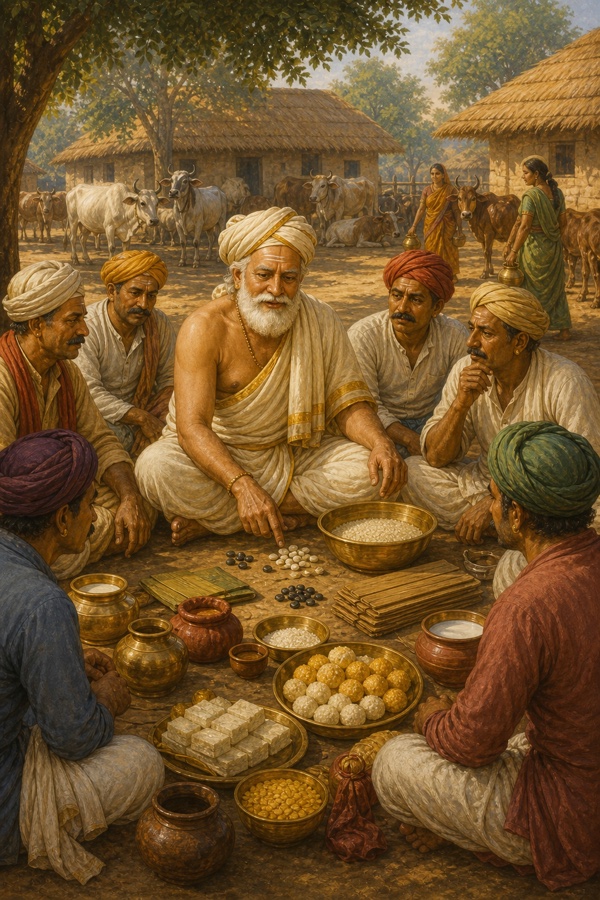
This year too the work was under way. Nanda Baba, the chief of the herdsmen and the man who was raising Krishna as his own, sat outside his house among the elders while the accounts were settled: whose field would send how much grain, how much ghee would be melted, which house owed what to the fire. It was Baba’s way never to let an old custom go without turning it over a hundred times. And yet, each time his eye fell on this one son, the careful old man in him melted somewhere he could not name.
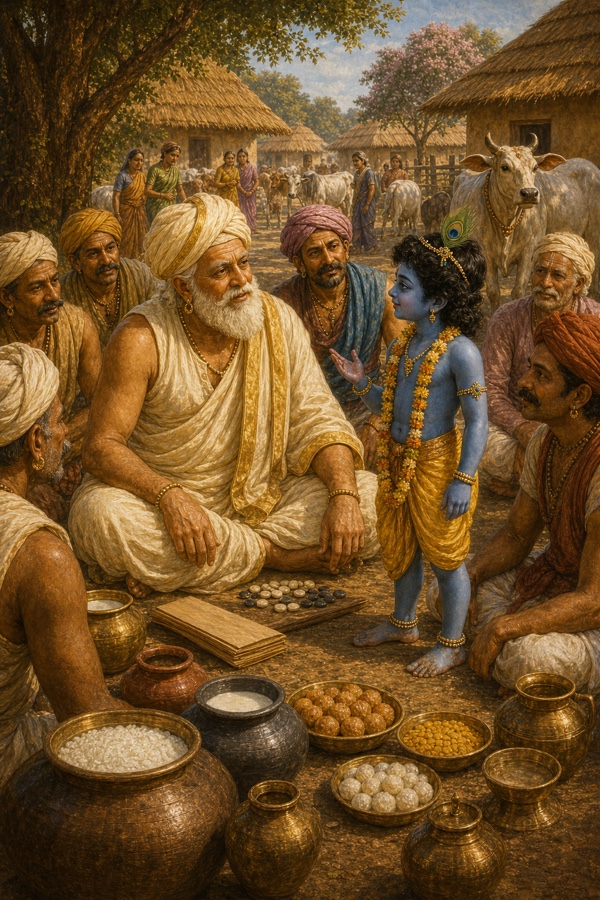
Then Kanha arrived. Kanha is what Braj called Krishna, the small name, the one his mother used. He was seven years old that season, the morning’s wet mud still on his feet, and in his eyes the mischief that hid from no one.
“Baba, what is all this?”
“Son, we are preparing the worship of Indra.”
“Why the worship of Indra, Baba?”
Baba set the account leaf aside. His son had asked, and the question would not be waved off. “Indra is the king of the gods and the master of the rains, son, and the clouds are his own forms, dear to him as his body. They pour down the water that is the life of every creature that breathes. We make our offerings out of the very things his rain gives us, grain and milk and ghee, and we live on what remains once the fire has taken its share. Through that worship a man wins the three things he lives for: the merit of a duty done, the food on his plate, and whatever he manages to hold and keep. This custom has come down our line for generations. And a man who throws over the way of his own people out of appetite, greed, fear, or spite never comes to any good.”
Kanha was quiet a moment. Then he spoke, softly, the way a child says a thing that has been turning in him far longer than the grown-ups suspect. What no one at the accounts could see was how far the question was meant to travel, for the boy had asked it with a throne in mind, and with the pride of the god who sat on it.
“Baba, may I ask one thing? A creature comes into the world by its own actions and leaves by them. Its comfort and its grief, its fear and its safety, all of it reaches it through what it has itself done. Even suppose some lord does sit above us, handing out results. He can only pay out what a creature has already earned. Over one who has done nothing, he holds no power at all. So what is left for Indra to do, in the middle?”
Baba turned it over. “It is not so simple, son. The worship pleases him, and pleased, he sends the rain in fuller measure.”
“But does the rain fall because someone in the sky is pleased, Baba? Or because that is the nature of clouds? Three strands run through everything that exists, and it is the restless one, rajas, that masses the clouds and drives the water down; through that water every creature finds its food. This whole moving world rises, holds a while, and comes apart again, each thing by its own turning. Every being is bound to its own nature and follows it, and gods and demons and men all live inside that law together. By its actions a soul takes one body and then another, high and low; action comes back to us as enemy and friend and stranger; our own work is our teacher and our master, and there is no other. So a man does best to stay with the duty his nature has given him and to honor the work that actually carries him. Worship what feeds you, Baba. Serve one and court another and you come away with nothing from either, like a wife who slips from her own husband to a lover and finds no rest with him.”
“And where do our cows graze, Baba? Kingdom, settled cities, villages, and long ridged fields lie outside our way of life. We have always been people of the wild; the forests and the hills are our home.”
“On the hill of Govardhana.”
“So the cows eat that hill’s grass, drink from its springs, rest in its shade. We are vaishyas, Baba, the order that lives by field and herd and trade, and of the four callings open to us, farming, trade, cattle, and lending at interest, our people have only ever kept cattle. Then the right to our worship belongs to the cows, to the Brahmins, and to Giriraj himself, the king of mountains standing over our pastures. Worship these three. Give them everything that has been gathered here for Indra. If it pleases you, Baba, let it be done this way. The cows will love this worship, and the Brahmins, and the mountain. And so will I.”
The elders looked at one another. The words had come from a child, but they were straight, and they had gone to the root of the custom.
Someone said, “The lala is right.” Someone said, “There is danger in changing an old rite.”
Nanda Baba was silent a long while. Then what happened every time happened again. The careful old man in him melted, and he took his son’s word.
It was settled. This year the worship would belong to the cows, to the Brahmins, and to Giriraj Govardhana.
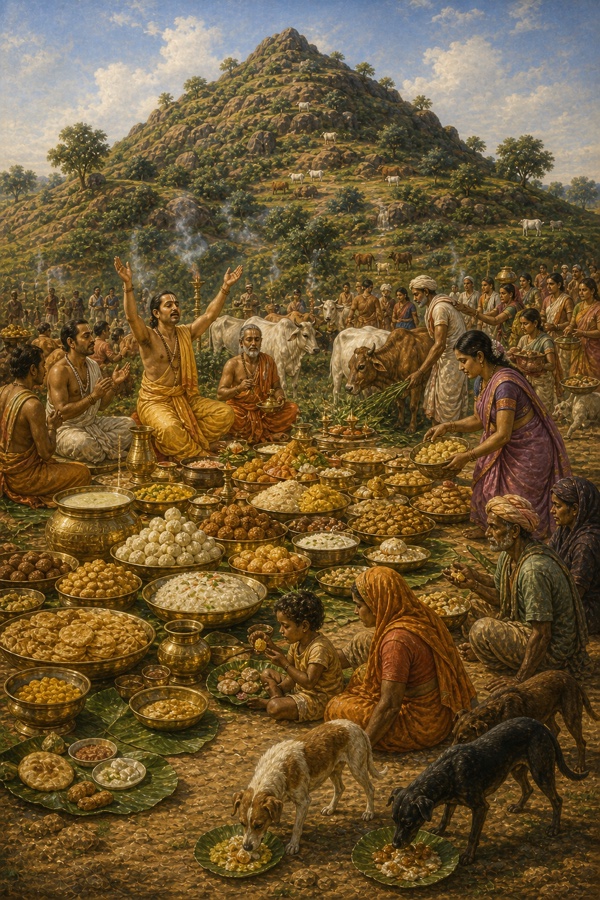
All the milk of Braj was gathered in one place. Kheer thick with sugar, halwa, sweet wheat porridge rich in ghee, fried cakes and breads, down to the plain boiled pulses, dish after dish was made until the courtyards smelled of nothing else. The Brahmins who knew the Vedas fed the sacred fires with due offering and recited the blessings, and were given excellent food, cows, and gifts by the armful. And no one forgot what Kanha had said. Food was carried, each to his measure, to the chandalas, the people every other feast forgot, to the fallen, even to the village dogs, and fresh green grass was heaped before the cows. Then everything was taken to an open slope of Govardhana and offered to Giriraj. The smell of incense spread on the air, and the cowbells did not stop ringing.
Dressed in their best, sandal paste cool on their skin, the cowherds and the gopis, the herdswomen of Braj, climbed onto their bullock carts, and with the cows walking ahead of them and the Brahmins calling out benedictions, they began to circle Giriraj, keeping the hill always to their right, the courtesy Braj paid to anything it held sacred, singing the songs of Kanha’s lilas as they went.
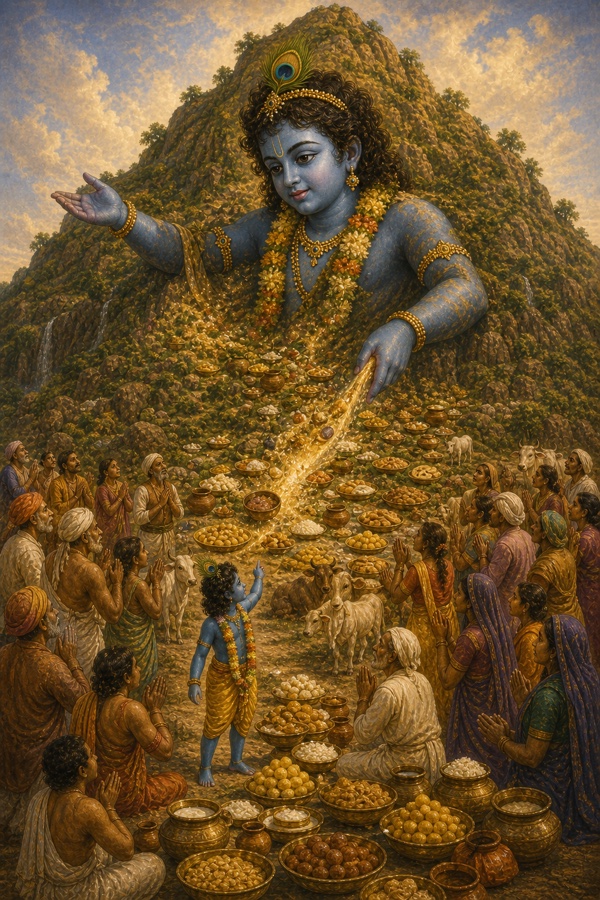
And Kanha himself, to settle the faith of the cowherds, raised a second body upon Giriraj, vast as the mountain, and saying “I am the hill, I am Giriraj,” took the whole offering into it. The great heaps of food set out before it vanished in a breath. Then the boy stood among the cowherds, folded his hands, and bowed with the rest of them to that mountain-shape of his own. “Look,” he said, “Giriraj has taken a visible form and shown us his grace. A god like this puts on any shape he pleases, and he destroys the forest people who slight him. For our own good, and our cattle’s, we bow to him.” Braj bowed to the mountain god, and the mountain god was the boy bowing beside them.
The children were delighted. The cowherds were delighted. The cows grazed on, content, swishing their tails.
But in one mind, far above, a fire had begun to smolder.
Indra sat on his throne in heaven and watched all of it, and counted himself, as he had always counted himself, the supreme ruler of the three worlds. The same Indra whose hand never trembled on the thunderbolt when the greatest asuras stood before him now shook with rage at one small village of cowherds.
“Such pride in these forest herdsmen! This is the drunkenness of wealth, nothing more. Men drunk on ritual trust their crossing of the world’s ocean to rites that are boats in name alone, leaky and unseaworthy, and give up the search for the self that would actually carry them over. These cowherds have done the same. They have thrown over a god and taken shelter in Krishna, a mortal, a garrulous, ignorant, arrogant child who imagines himself wise. On the word of one prattling boy they have insulted the king of the gods.”
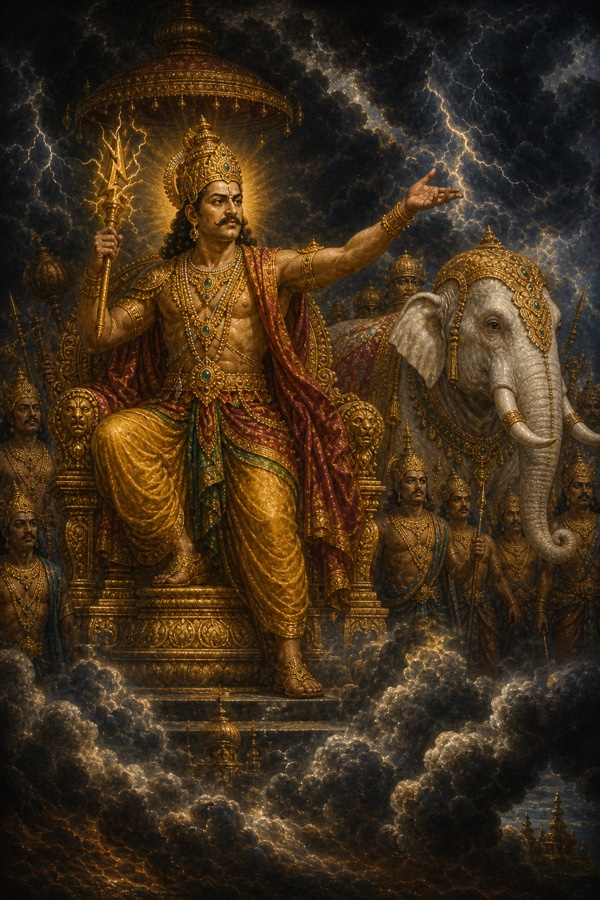
Nothing makes pride writhe the way being overlooked does; no blow cuts as deep. Indra could not bear the sting of it. He called up the Samvartaka clouds, the herd of the world’s dissolution, the ones kept chained until an age ends and the waters are due to drown the earth. He struck off their chains himself and, full of fury, gave the command.
“Go. Grind these cowherds’ pride into the dust. Their arrogance is fattened on wealth and puffed up by Krishna; break it. Kill their cattle where they stand. I will follow on Airavata, my white war elephant, with the Maruts beside me, the storm gods whose strength has no match in the sky, and I will finish Nanda’s Braj myself.”
The clouds massed, black and heavy, from one edge of the sky to the other. In the middle of the day the sky went dark as night.
The rain came, and it fell as it had never fallen in any year of any man’s memory. Every drop came down thick as a pillar and struck the back like a stone. Lightning tore the sky open on every side, the clouds cracked as they collided, and a violent gale drove great hailstones into whatever stood in the open. The wind bent the trees double. Within a little while there was no telling high ground from low in all of Braj; on every side lay one unbroken sheet of water.
The cowherds went numb with fear. Every animal shivered and shook. Children clung to their mothers and cried. The cows stood out in the open, drenched, trembling with cold, lowing, and their lowing kept drowning in the roar of the storm. When they saw the animals dropping senseless under the hail, the last of the cowherds’ and the gopis’ courage gave way.
Clutching their children to their chests, covering the small heads with their own bodies, shaking, they came running through the water to Kanha, and reached for the soles of his feet.
“Krishna! Beloved Krishna! You alone are the master of all Gokula, this whole world of cattle and herdsmen, and you alone its protector. Lover of your own! Save the cows, whose only shelter is you, and save us, from Indra’s anger. Only you can.”
Kanha looked a moment at those wet, shaking faces. They were calling him as their own child, with no thought of any lord of the three worlds. He knew at once whose work the storm was. Indra, his worship broken, had sent the deluge down out of its season to destroy them. He would answer it with his own power, and in the answering he would empty the gods of a delusion, for they had come to fancy themselves the rulers of the world. Pride of that kind had no business in gods at all, for they are woven of sattva, the clear bright strand of nature, and to bring the proud down from their high seats is a mercy to them; it gives them back their peace. And Braj had come to his shelter, had called him its own; Braj was his family. He would protect what was his. That was his vow, spoken of in all the worlds, and it had never once been broken.
He smiled, softly. “Do not be afraid. Come with me, all of you.”
They came to the hill of Govardhana. Kanha walked to its base and stood there. Behind him all of Braj pressed close, breath ragged, water on every eyelash.
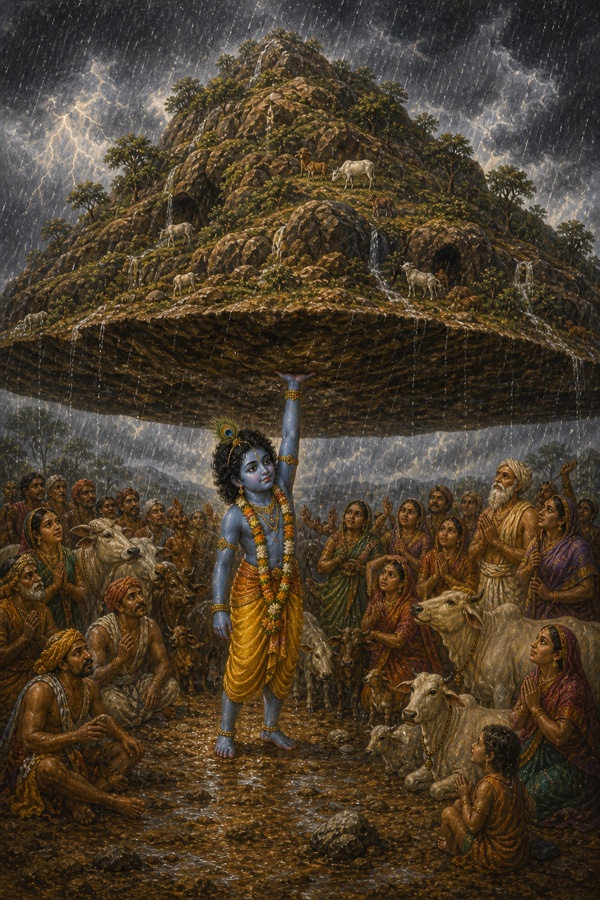
He looked once at the mountain, the way a man murmurs something to a very old friend. Then he slid one hand, the same small hand that only yesterday had gone digging in the butter pot, under the root of the hill.
The fingers found the stone’s cold, wet underside. The palm spread flat. And the hand began to rise.
First a finger’s width. Then the span of a hand. Braj watched the root of Govardhana lift free of the earth as easily as a child pulls a mushroom up out of wet ground. The cows on its slopes rose with it and went on grazing; the springs rose and went on running. A whole mountain, with all its trees and caves and springs and grazing cattle, stood steady in the air.
Under it was the single hand of a boy of seven.
And on that hand there was no weight at all. Each hammering drop burst on the stone roof far above and rolled its thunder down through the rock. The boy stood; the elbow never bent by a hair; the fingers lay open on the stone exactly as they had settled; and on his face was the same faint butter-thief smile, as though he had done nothing more than raise an umbrella against the rain, the way a small child at play tips a monsoon mushroom over his own head.
“Mother, Father, all you people of Braj, come. Every one of you, bring your cows and your goods and settle in easily under the hollow of this hill. And do not once let the thought in that the mountain might slip from my hand. There is no fear here, none of the storm, none of the rain. I have already seen to it.”
The villagers stood dumbstruck. But the fear ran too deep to leave room for wonder. With their herds, their women, their children and their old, their goods loaded onto carts, their priests and their serving folk beside them, one by one they moved in under the mountain, and there turned out to be room for every last soul of them.
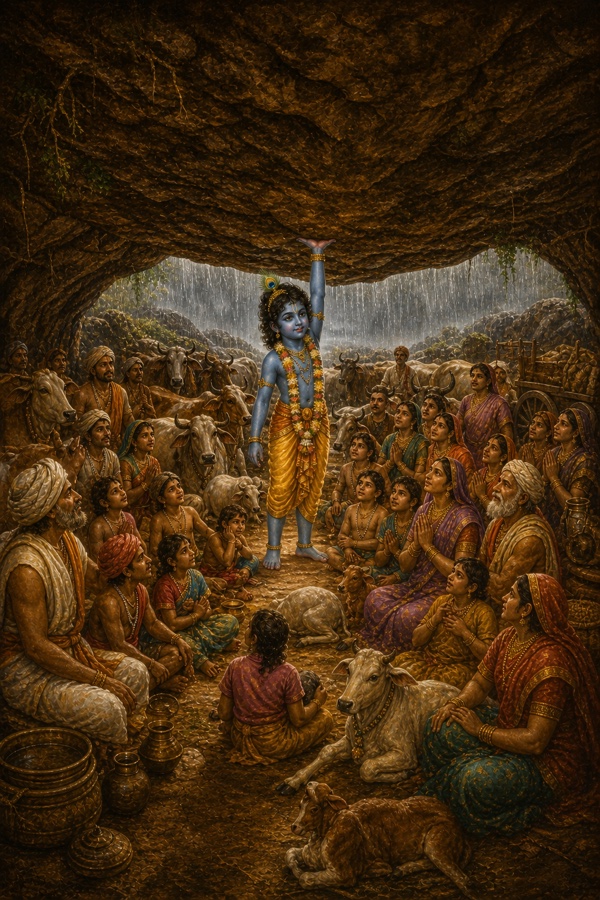
The mountain hung overhead, and beneath it a wide dry courtyard had opened. Above, the wall of water kept falling; below, not one drop came through. Inside, the cowherds settled in with their cows, their wives, and their children, the bullock carts drawn up in a ring around them, and the boom of the rain outside reached them like a far-off sea.
Kanha stood with the mountain on his hand, the same faint smile on his face.
One day passed. A second. A third.
He did not tire, his breath did not break, he did not shift so much as one step from where he stood. The mountain stayed as it was; the boy stayed as he was. And the people of Braj, sitting under it, forgot their own hunger and thirst and never thought of rest, so fixed were their eyes on that small face, the face of the same lala who went from house to house begging butter. On the first day they watched him in fear. By the third, in love. And the murmuring began, low, from blanket to blanket. Remember Putana, the poisoned nurse whose breast he drank dry as an infant, and her life along with the milk. Remember the loaded cart he kicked to pieces at three months, the whirlwind demon who snatched him into the sky and came down dead, the two great arjuna trees he pulled down while dragging the mortar his mother had tied him to, the serpent Kaliya he drove from the black pool of the Yamuna. And now this. A child of seven, and there the great Giriraj, day after day on one hand, held as easily as a bull elephant holds a lotus stem. The mothers rose again and again and moved toward that hand, and stopped, and came back and sat, their laps opening of themselves and folding shut again.
Indra watched from above. His rain was spending its whole strength, and below there was a hand that would not move by a hair. His purpose came to nothing, and his swagger drained slowly out of him.
Seven days passed this way.
At last it broke on Indra that this was no ordinary child. Astonished, emptied of his pride, beaten at the very thing he had set out to do, he called back his clouds.
The rain stopped. The sky cleared, and the sun stood up over a drowned world. Kanha, still holding the hill, turned to the cowherds. “The storm is over, and the rivers have nearly run themselves empty. Take your women and children and your cattle, and go out now, free of all fear.”
They took up their goods and their herds and came out, one by one, the women and the children and the old, their carts loaded, everything as it had been, blinking in the first sunlight they had seen in a week. And then, with every creature watching, Kanha set the mountain down as gently as he had raised it, back into its own place, the way you lay a sleeping child onto its bed.
Their faces had stayed dry through all of it, and they had changed. The lala whose pranks they used to laugh at had held their whole world on his hand for seven days. The people of Braj came at him in a rush of love, arms open. The gopis sprinkled him with curds and unbroken rice and poured their blessings over him, and Yashoda, who had raised him, and Rohini, who had raised his brother, caught him up and held him, and Nanda and Balarama, the elder brother whose strength had no equal in Braj, blessed him with their arms still around him. High above, the gods and the Sadhyas, the Siddhas and the Charanas, let fall showers of flowers, conches and kettledrums sounded across the sky at the gods’ own prompting, and Tumburu, first among the gandharva singers, led heaven in singing him. Then Braj walked home around its boy, and the women went from door to door singing what he had done.
A little later Indra came himself, quietly, alone, slipping past every eye, and found the boy in a lonely place away from the village. The same Indra who seven days before had thundered the order for a deluge now stood before Kanha with his palms joined, ashamed to the bone, and bent until his crown, bright as the sun itself, touched the boy’s feet.
“Forgive me, Lord. I know now what I am looking at. Your own nature is pure sattva, clear, even, all wisdom; the restlessness and the darkness that churn this world never touch you, and this whole universe of maya finds no footing in you at all. Greed, anger, the hunger to be honored, those belong to the ignorant, to creatures who mistake the body for the self; and yet you take up the rod, for you guard what is right and you break what is wicked. You are the father of the worlds, their teacher, their true king, the Time that none of us can turn aside. You put on bodies at your own pleasure and walk about in them for the world’s good, and in them you crush the pride of fools like me who imagine themselves rulers of the universe. A fool sees you stand unafraid under everything a god can hurl, and his pride runs out of him like water, and from that day he walks the road your devotees walk. Drunk on my own splendor, blind with power, ignorant of what you are, I sinned against you. Forgive me, Lord, and let a mind this deluded never turn toward evil again. My worship was interrupted, and in rage and pride I set out to destroy this village of yours with rain and wind. You crushed my pride and wasted my whole effort, and that was your kindness to me. I have come to take shelter in you, my ruler, my teacher, my own Self.”
Kanha raised him to his feet. On his face was the same soft smile, without a single line of anger in it, and when he spoke he was laughing outright, in a voice deep as the rain clouds Indra had just called home. “Indra, you were drunk on the pride of your own splendor. I broke your worship as a kindness to you, so that you would keep me in mind from now on. A man blinded by wealth and power takes no notice of me, though I hold the rod over every head; so the man I mean to bless, I first bring down from his high seat. Go back now to your Amaravati. Keep your throne and do your work, serve your charge faithfully, and let self-importance never take you again.”
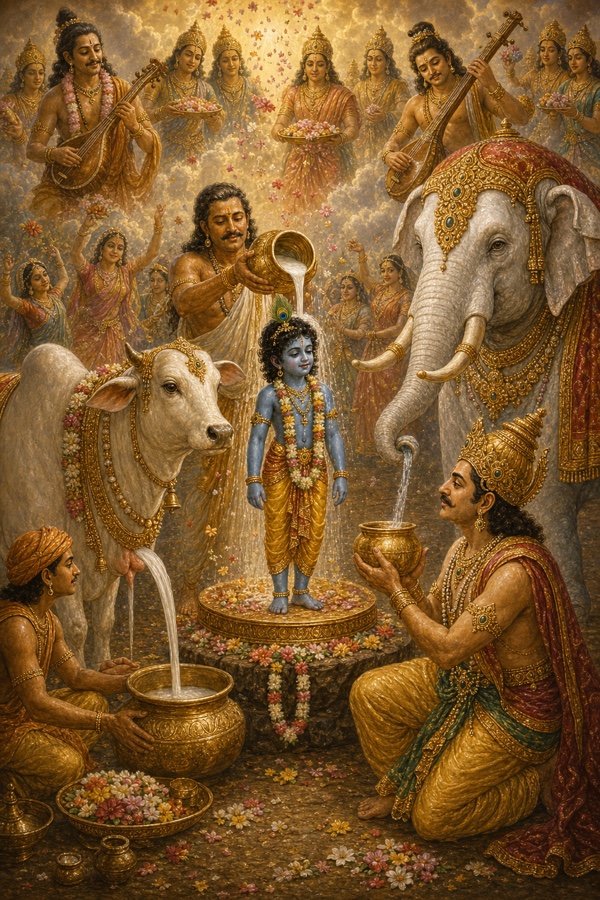
Surabhi, the mother of all cows, had come down from Goloka, the world of cows above the heavens, with her calves around her, and now she came to Kanha’s side and spoke. “We have been favored past measure, Krishna. You are our supreme deity. For the good of the cows, the Brahmins, the gods, and every soul that lives rightly, be our ruler from this day, Lord of the universe. Brahma himself has directed us: we will crown you our king, you who have come down to lift the burden of the earth.” She bathed him in streams of her own milk. And Indra, urged on by Aditi and the mothers of the gods, with the sages of heaven gathered around him, filled Airavata’s trunk with the clear water of the heavenly Ganga and poured it over the boy. There, on the wet grass of Braj, the master of the cows and protector of the cowherds was given a name: Govinda, the cows’ own lord. Above, the gods rained down flowers, Narada and Tumburu led the gandharvas, the vidyadharas, the siddhas, and the charanas in singing a glory that burns the sins of the world off whoever hears it, and the apsaras danced for pure joy.
And the three worlds answered. The cows let their milk run until it wet the earth. The rivers ran sweet, with milk and honey moving in their waters; the trees dripped honey; grain stood up in fields no plow had touched; and the bare rock of the hills showed gems on its surface. Even the wild animals of the forest, savage by their nature, Rajan, let go of their old enmity and stood at peace among the herds. Then Indra, with Kanha’s leave, rose back to heaven with the gods, and behind them the whole sky opened. Sunlight came down on a washed Govardhana, the springs ran again, and in the wet grass the cows lowered their heads and grazed, as though nothing at all had happened.
Literary context
The lifting of Govardhana runs across the tenth Skandha of the Shrimad Bhagavata, chapters 24 to 27. Krishna argues Nanda into turning the yearly worship of Indra toward the three who actually sustain Braj, the cows, the Brahmins, and Giriraj (10.24.25, 28-29), with food going to the chandalas, the fallen, and even the dogs, and grass to the cows. Slighted, Indra looses the world-ending Samvartaka clouds, and the rain falls for seven days; the boy holds the hill up “saptaham nachalat padat”, for a week he did not stir a step from his place (10.25.23). His age is seven (10.26.3), and lifting a mountain on one hand is likened to a child pulling up a monsoon mushroom, “chhatrakam iva” (10.25.19). Krishna takes the offering in a mountain-vast form, “shailo’smi”, I am the hill (10.24.35). Afterward Surabhi and a humbled Indra together bathe and consecrate him and give him the name Govinda, the lord of the cows (10.27).
The same katha elsewhere
- Harivamsha · The Lifting of Govardhana
The lifting of Govardhana as the Harivamsha tells it