On this page
Muchukunda
Long before Krishna’s life in Mathura, the devas were hard pressed by the asuras and asked King Muchukunda to command their defense. He belonged to the Ikshvaku line, was a son of Mandhata, and was known for truthfulness and devotion to brahmanas.
“O Rajan,” they said, and it was a strange thing to hear entreaty in voices that mortals prayed to, “take up the command of our army. Guard us on every side. You alone can hold these asuras back.”
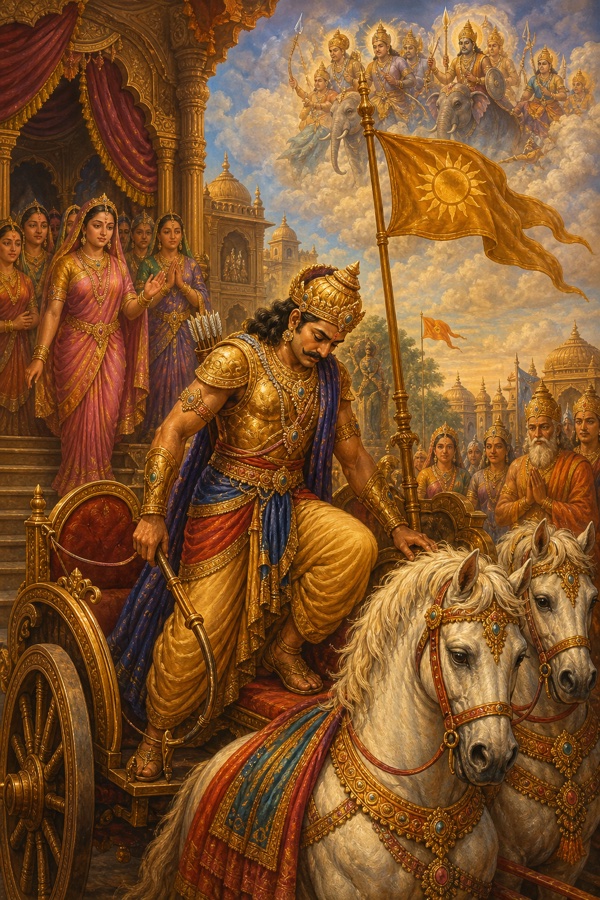
Muchukunda left his kingdom. He did not ask how long the war would run, or what the watch would cost him. He fought on the side of the devas for a long time, standing over heaven the way a sentry stands over a sleeping camp, protecting them while they lacked another commander.
Then one day the devas found their commander in Kartikeya, the son of Shiva whom they call Guha, the war-god born for exactly this office, and the strength of the asuras began to break. The mortal sentry could at last be relieved. That day Muchukunda’s chariot came to a halt, and once it halted, his heart had no wish to move it again.
The devas came before him. “O crown of warriors, rest now. You bore great toil and hardship in our defense, you gave up even your kingdom. And while you stood here holding our sky, your own world went on turning without you. Your sons, your queens, your kinsmen, your ministers, and all the people of your time have long since passed into the jaws of Kala. The Time-Spirit is mightier than the mighty, Rajan, and drives created beings before him the way a herdsman drives his herd, idly, at his own pace, sparing none. Ask us for anything you wish except kaivalya, the moksha of final release, for the power to grant moksha rests in the imperishable Bhagavan Vishnu alone.”
Muchukunda was exhausted. Long vigilance had overcome his senses, and the boon he wanted was rest.
“I need only one thing, deva.”
“Say it, Rajan.”
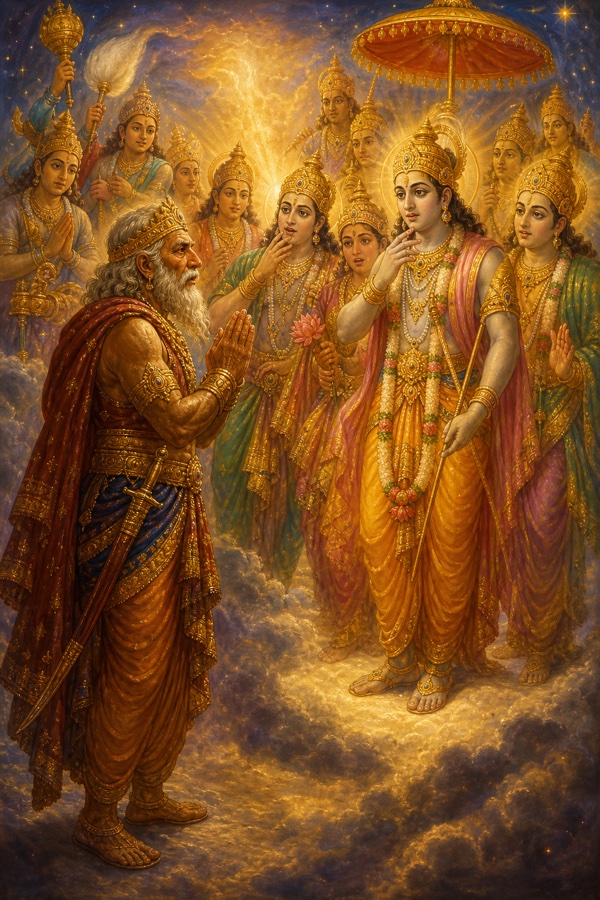
“Let me sleep. To my heart’s content, with no one calling me.”
The devas stopped short. They had come prepared to hand over kingdoms, heavens, lifetimes. A king before whom the boons of all three worlds stood with folded hands, and he was asking for sleep. “Sleep? Nothing more?”
“What else would I want? My eyelids are falling under their own weight. I have seen the pleasure of being called a god among men, I have seen kingship, I have seen my wars. Those I called my own, Kala carried off while I stood at my post, and I never even got the news. No messenger, no farewell, only this, told to me ages too late. I have no wish now to hear the call of any of it. Only one long, deep sleep, where no one wakes me.”
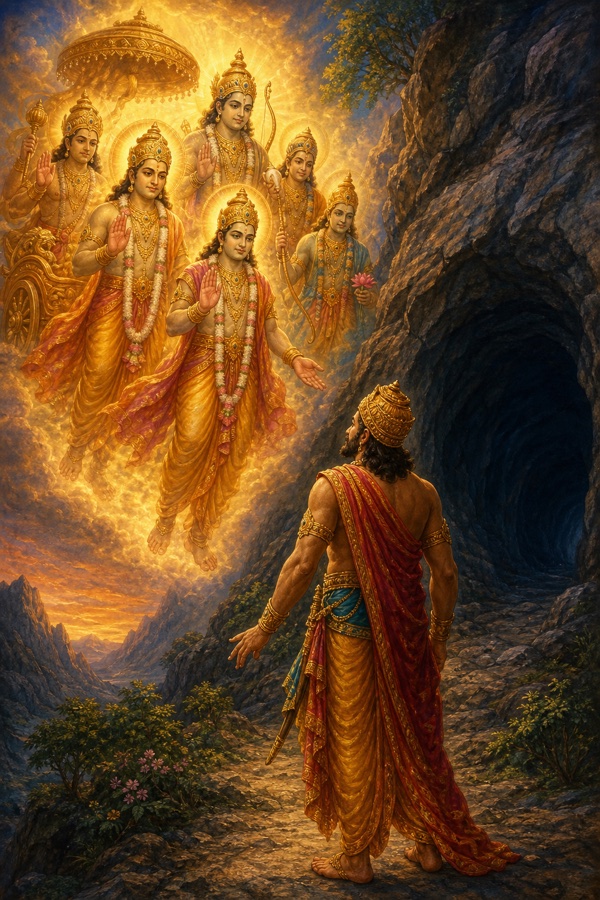
The devas granted the boon, and set upon it the kind of guard that only gods can post. “So be it, Rajan. And hear this, while you sleep, if some fool thoughtlessly wakes you in the middle, the instant your gaze falls on him he will be burned to ashes.”
Muchukunda went down into a lonely cave on a mountain far from any people, a black mouth in the rock that no herdsman’s path came near. The light of the outside world fell away behind him step by step, and within was a cold, thick silence in which there was only the sound of his own breath. There he lay down on the bare stone, a king with no bed, no attendant, no lamp, and the moment his eyelids closed it was as if some entire age had been drawn over him like a blanket.
He slept on. In the world above, days and nights came and went, the rains arrived and withdrew, the seasons turned through their round, and men measured out whole lives by them. Inside the cave time did not move.
Generations passed. Muchukunda’s eyelid did not stir.
In Mathura, Shri Hari had appeared in the Yadu line as Krishna. He had already killed the tyrant Kamsa and restored Ugrasena to the throne. Kamsa’s death then drew the power of Magadha toward the city.
Kamsa’s two widowed queens, Asti and Prapti, went home weeping to their father, and their father was Jarasandha, emperor of Magadha, the most feared arm on the earth in that age, a man to whom lesser kings sent tribute the way rivers send water to the sea. He heard how his son-in-law had died, and grief in him hardened into a cold vow: he would wipe the Yadavas from the face of the world. He raised an army of twenty-three akshauhinis, a whole ocean of foot and horse and elephant and chariot, each akshauhini in itself a nation under arms, and threw it around Mathura on every side.
Krishna and Balarama went out to meet him, and the ocean broke against them. Balarama caught Jarasandha up in his arms the way one lion takes another, and could have finished him then. Krishna stayed his brother’s hand, and behind the mercy lay a general’s long arithmetic. Kill this one man now, he reasoned, and the evil coiled inside him would only scatter across the earth and grow again under a hundred smaller names. Let him live, and he will keep gathering that evil into one place, army after army, until the whole weight of it can be lifted at once. So Jarasandha was let go, and he walked alive out of a battle he had no business surviving, went back to Magadha in shame, and came again.
He came seventeen times. Seventeen times he wound twenty-three akshauhinis around Mathura, and seventeen times the Yadavas, shielded by Krishna, ground his host to nothing and let the emperor himself walk away with his life. Seventeen armies raised, marched, and buried. The people of Mathura had learned to live with siege the way a coast learns to live with storms, counting their years by it.
The eighteenth campaign was still gathering when another threat arrived. There was a yavana king named Kalayavana, a sovereign with no rival among men and great pride in his own strength. The sage Narada had named the Yadavas as warriors fit to stand against him. Kalayavana marched on Mathura at the head of thirty million mlechchhas and surrounded the city.
Krishna weighed it and saw the trap closing from two sides at once. Kalayavana was at the wall today; Jarasandha would be at it tomorrow, or the day after. If both armies caught the Yadavas in the open together, his kinsmen would be cut down or dragged off to Magadha in chains. So before he answered the barbarian at all, he moved to set his people beyond reach. He had Vishvakarma, the architect of the gods, raise a fortress in the western sea, and inside it a city twelve yojanas across, a marvel of streets and quadrangles and gardens of celestial trees, gateways of crystal, domes of gold that touched the sky, floors of emerald. Indra sent down his own hall of assembly, the Sudharma, and the Parijata tree; Varuna sent white horses, each with one dark ear, swift as thought; Kubera, the lord of treasures, sent his eight treasures, and every guardian of the spheres returned to the Lord the riches once held in trust from him. Then, by the power of his yoga, Krishna carried every soul of Mathura across the water into that sea-girt city, a whole population lifted past the siege lines without one sword drawn. Men would come to call it Dwarka. With his people safe behind its walls, he turned back alone to deal with the barbarian at the gate.
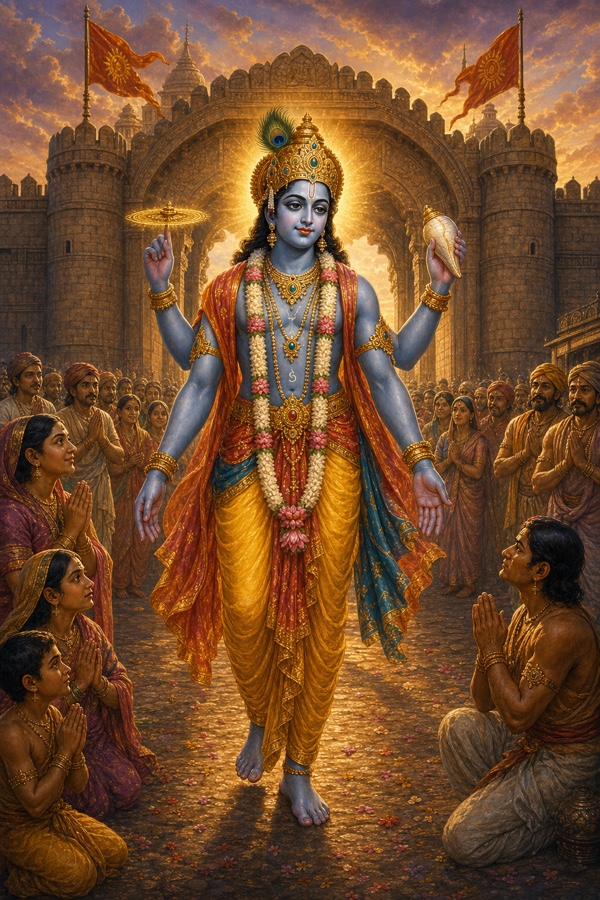
Shri Krishna came out through the city’s main gate on foot, alone, carrying no weapon at all, a garland of lotuses swaying at his chest, walking toward thirty million enemies the way a man strolls out to meet the morning. His dark body was as lovely to see as the moon rising in the east, and over it the sheen of silken pitambara was a thing apart. On his chest the mark of Shrivatsa, at his throat the blaze of the Kaustubha gem, four long arms, and eyes soft and red at the corners like lotuses freshly opened. In his ears the makara-shaped earrings glinted.
The instant he saw him, a certainty settled inside Kalayavana, and with it a soldier’s strange chivalry. “This man is Vasudeva. Every sign Narada named, the Shrivatsa on the chest, the four arms, the lotus eyes, the vanamala at the throat, and beauty carried to its very limit, all of it meets in him. And look, he comes on foot without any weapon. Then I too will fight him without a weapon.” Thinking this, he ran after Krishna.
Krishna, at his lila, kept running ahead as if in great fear, his back turned to an enemy for the only time anyone would remember. This fleeing of the field was itself a lila, for the killing of Kalayavana was written for another’s hand, and Krishna had come out only to lead him to it. The Lord whom even yogis, after lifetimes of discipline, find hard to reach, Kalayavana kept believing at every step that now he had him, now, this stride, the next. Yet that hand always stayed one stride ahead, no more and no less, the distance never widening and never closing, as if measured on a cord. In this way he drew Kalayavana far off, mile after mile from his own army, all the way to a cave in a lonely mountain.
As he ran, Kalayavana now and then flung a taunt from behind, between gulps of breath, “Ho there, brother! You were born in the far-famed Yadu line, and this fleeing of the fight does not become you.” But his evil was not yet full, its measure still filling, and so no reach of his could lay hold of Krishna.
Krishna went inside the cave of that mountain, the very cave that had held one sleeping king since the Satya-yuga, and took his place in the darkness of one corner.
Panting, Kalayavana pushed into the cave after him, certain his quarry was cornered at last. Within was a thick darkness that swallowed the daylight behind him. There he saw a different man altogether, sunk in deep sleep, though in that blackness he had no way of knowing it.
Seeing him, Kalayavana’s mind flared with irritation. “Look at this, he has dragged me all this way, and now he lies here playing the holy man asleep, as if he knew nothing at all!”
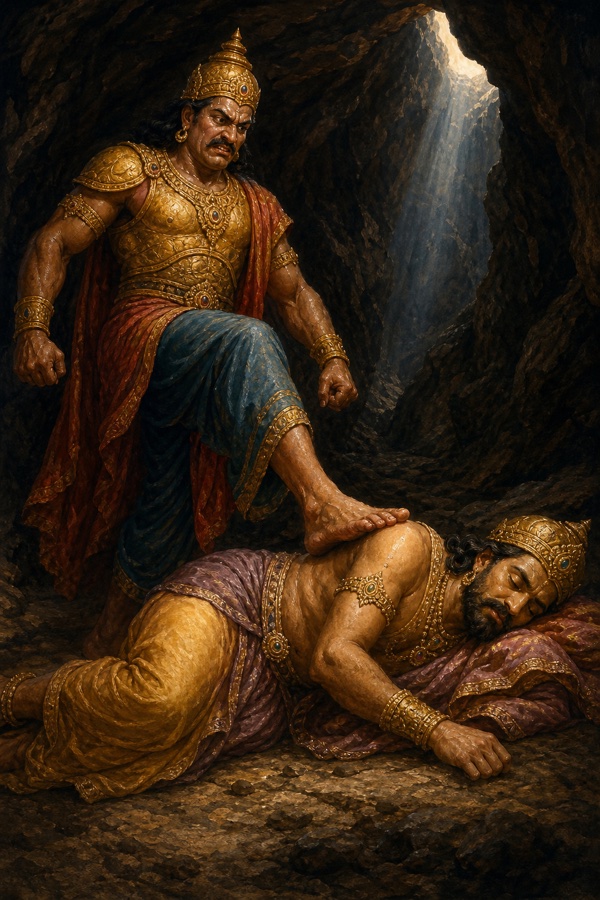
His chest was working like a bellows, drops of sweat on his brow, and his throat had gone dry with rage. Of all the insults one man can offer another in that country, the touch of a foot is the last and lowest, and he chose it. He poured all his contempt into a single kick. His foot came down on the body of the sleeping king.
The sleep of thousands of years, which had run from the Satya-yuga to the end of the Dvapara in one single turn, trembled at that one jolt.
First something moved beneath the eyelids. Then Muchukunda’s chest drew a long, quivering breath, the first full breath after ages. The fingers of his hand slowly opened. Into the cave’s thick silence, where until now there had been only the sound of his own breath, there had crept the panting breath of a stranger and the smell of sweat. Muchukunda did not yet even rightly remember who he was, where he was. The names of his fathers, his kingdom, his wars, all of it still lay under the same deep water. Only this much rose from within, someone was here, someone touched me, someone dared to break this endless sleep of mine.
Very slowly he opened his eyes. His eyelids were set fast with the ages, and they parted the way the leaves of a door shut for years swing open, grain by grain, against their own weight. And after ages his first gaze, still half open, still recognizing nothing, carrying nothing in it yet except the affront of having been woken, fell on Kalayavana standing beside him.
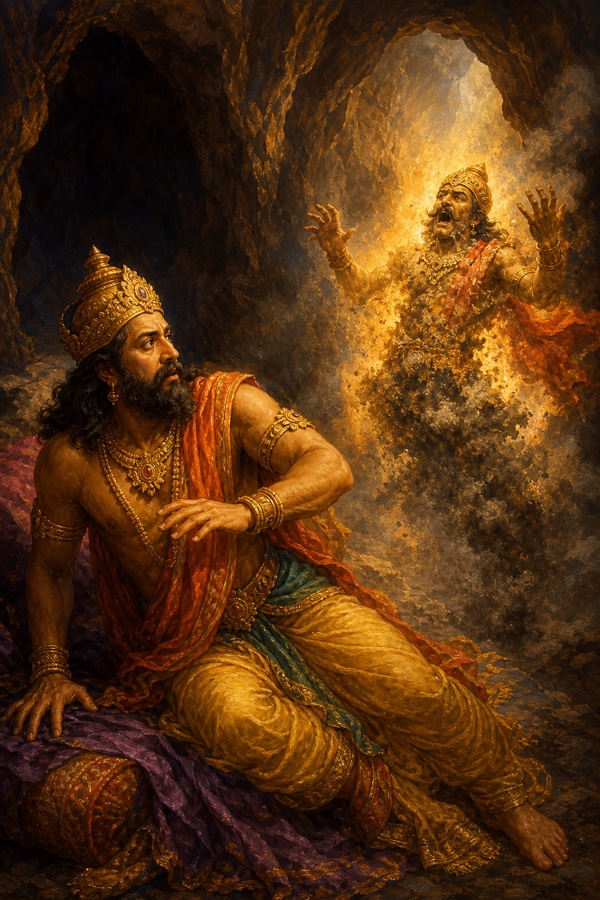
For one instant nothing happened. Then fire broke out from inside Kalayavana’s own body. Weapon and outer flame played no part, all the pride of his strength, all his arrogance, began to burn within his own flesh. His mouth stayed open, not even a scream came out, and in a moment he was a single heap of ash. A sharp, burnt smell filled the cave, and then the same old silence returned.
Muchukunda started up, sitting bolt upright. “What has happened here?”
Then, piece by piece, the memory of ages returned, that boon given by the devas, that whoever woke him in the middle of his sleep would be burned to ashes the instant his gaze fell on him.
He stood, the ash of a king at his feet, and looked all around in the darkness of the cave.
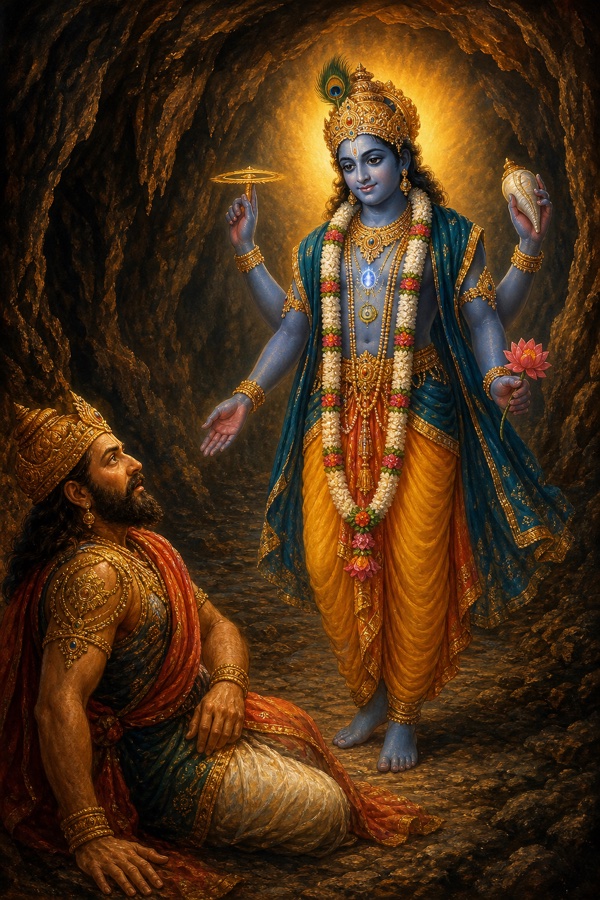
In one corner stood a youth, holding himself with the unhurried poise of a young lion. Dark like a monsoon cloud, the Shrivatsa on his chest and the Kaustubha gem at his throat scattering their light, four arms, and to one side a Vaijayanti garland swaying down to his knees. His lotus face was open with a great gladness, on his lips a loving smile, and in the look of his eyes such tenderness that the cave’s thick darkness was melting of itself before the radiance of that face, the way a lamp set in the dark drives it away.
Muchukunda was a man of great intelligence and steadiness, a king who had faced the armies of the asuras without blinking, and even so, seeing that form of light he was struck with wonder, dazzled by a brilliance his eyes could not hold. For a long while he could not even look that way. Then, trembling, he asked.
“Who are you? In this fierce forest full of thorns, in this mountain cave, why do you walk on feet soft as lotuses? Surely you are the embodied splendor of all the splendid, or Agni himself? Or are you the sun, the moon, Indra king of the devas, or some other guardian of the worlds? I believe you are one of the three, Brahma, Vishnu, and Shankara, the Purushottama, for as a lamp takes away the dark, so with the light of your body you drive the darkness from this cave, and from my mind as well. We are kshatriyas of the Ikshvaku line, and I am sprung from Mandhata, called Muchukunda. Long ages of watch and war wore me down, my senses drowned in sleep, and I lay in this lonely cave undisturbed until someone woke me just now, some man burned to ash by his own sin, and immediately after, I saw you. Tell us, if it please you, of your birth and your deeds and your name.”
That youth answered in a voice deep as a cloud, laughing as he spoke. “Rajan, my births, my deeds, and my names are in the thousands, without end, so many that even I cannot count them. A man might spend many lives counting the grains of dust on the earth and finish sooner than reckon them all. But in this birth, prayed for long ago by Brahma to lift the burden of the earth and to end the demons who had become its weight, I have taken avatar in the Yadu line, in the house of Vasudeva. People call me Vasudeva. Until now I have slain Kalanemi, who was born as Kamsa, and Pralamba, and many another asura who hated the good. And this was Kalayavana, who at my own prompting was burned to ash the moment your keen gaze fell on him.”
“It is to show you grace that I have come into this cave. You called on me again and again, ages ago, and no prayer of that kind is ever lost on me, for I am bhakta-vatsala, tender toward those who love me. Ask, Rajan, ask whatever your heart desires. For one who comes into my refuge, nothing is ever left to grieve over.”
Within Muchukunda the words of old Garga, the elder, heard ages before, woke again, that in the twenty-eighth turn of the Dvapara Bhagavan Narayana himself would come down into the Yadu line, and that Muchukunda would be given the rare grace of seeing him and speaking with him. He knew now that this was he, standing an arm’s length away in a cave at the end of the age. His hands joined of themselves, and his eyes brimmed. But when he opened his mouth to ask, in place of words there first flowed out an old wound.
“Prabhu! I was a king, gone drunk on the fortune of my throne. I took this dying body itself for my true self, and stayed caught in greed and delusion for prince, queen, treasure, and land. Ringed by the fourfold army of chariots, elephants, horses, and foot, with the four quarters conquered and no rival left to fear, I roamed here and there over the earth, hailed as a god among men, and all the while I had forgotten that you were Time itself, standing behind me. As a snake, its tongue flickering with hunger, seizes a careless mouse, so did Kala carry off heedless me in a single turn. The very body I preened over was one day to be left as worms, dung, and ash. My six enemies, the five senses and the one mind, never once fell quiet, and the thirst for their objects grew by day and by night. Not for a single moment did I find peace.”
“This is how it goes, Prabhu, for the creature blinded by your maya. He will not turn to you. He wins a human birth, the one birth so hard to come by, and spends it clinging to a house that is a well of misery, calling it his happiness, like a beast that has fallen into a pit grown over with grass and cannot climb back out. Only when the long round of births and deaths is nearly run does he stumble at last into the company of the holy, and only there, in that company, does love for you finally take root. Giver of refuge! Now I have come to the shelter of your lotus feet, which are without fear, without death, without grief. Sole lord of all the worlds! Paramatman! Protect me, who have surrendered to you.”
Krishna smiled again. “Sovereign among kings! Your mind, your resolve, is pure and of the highest order. See, I held out to you again and again the lure of a boon, to let the world see what your watchfulness was made of, and still your intelligence did not fall under the sway of desire. This is the very mark of those who love me and nothing else, that their minds cannot be turned by the world’s enjoyments, however sweet they look. Other men may throttle the mind with breath and hard discipline, and still it breaks loose again, because the thirst beneath it was never quenched. Yours is quenched.”
He stepped forward and laid his hand on Muchukunda’s head. In that touch the weariness of ages seemed to melt and flow away.
“Now fix your mind on me and wander the earth as you please. My pure bhakti will stay in you always. The many creatures you killed in the hunt and elsewhere while keeping to a kshatriya’s dharma, wash that sin away now with tapas, worshiping me with a mind held to one point. Then in your very next birth you will be a brahmana, a true friend and well-wisher of every creature, and then you will attain me, the pure Paramatma who is awareness solid and entire.”
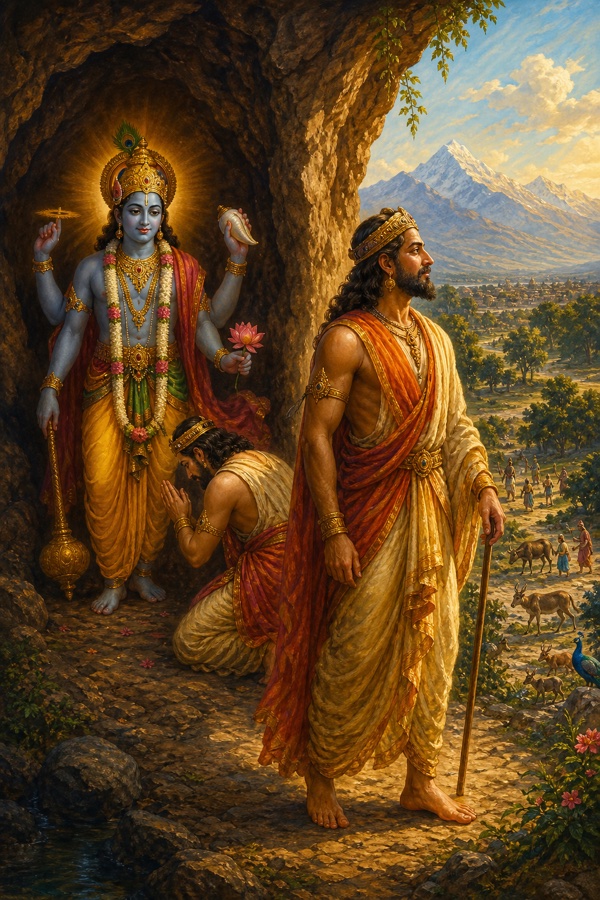
Muchukunda walked around Bhagavan in reverence, keeping him always to his right, bowed to him, and came out through the mouth of the cave, into the sunlight for the first time after ages.
His body was the same, but every single thing outside had changed. Men, animals, creepers, and trees had all grown much smaller than before, as though the world itself had lost stature while he slept, for each age men are made a little less than the men of the age before. From this he understood that the Kali-yuga had come, the last and smallest of the four. And still complaint and unrest had left his heart; one unshakable peace remained. He set off toward the north, toward the great mountains where those who are done with the world have always gone, on the road to the Gandhamadana mountain, where the Badarikashrama of Nara-Narayana stood among its groves, and there, doing tapas in quietness, bearing heat and cold as one thing, his mind at rest in that same Shri Hari, he went on toward the one whose darshan had been waiting for him on the far side of his sleep.
Literary context
The story of Muchukunda spans two chapters of the tenth Skandha of the Shrimad Bhagavata, the fiftieth and the fifty-first. Muchukunda, son of the emperor Mandhata of the Ikshvaku line of the sun, fought the demons on behalf of the devas through long ages and asked, when they offered him any boon but liberation, for nothing more than unbroken sleep.
The fiftieth chapter tells how Jarasandha of Magadha, seeking vengeance for his son-in-law Kamsa, besieged Mathura seventeen times and was repelled each time. With Jarasandha preparing another campaign and Kalayavana surrounding Mathura, Krishna built the sea-fortress of Dwarka and carried the Yadavas there for safety. The fifty-first chapter tells how he led Kalayavana into Muchukunda’s cave, where the waking king’s glance reduced the pursuer to ash. Krishna then gave Muchukunda his darshan and showed him the road to liberation.
A question for the evening
Muchukunda’s eyelids fell in the Satya-yuga and lifted at the end of the Dvapara, and the moment they lifted, Shri Hari stood before him. All day long we live with our eyes open. On the day our real eye opens, who will we find standing before us?