On this page
Kaliya the Serpent
Shukadeva held still a moment, and began.
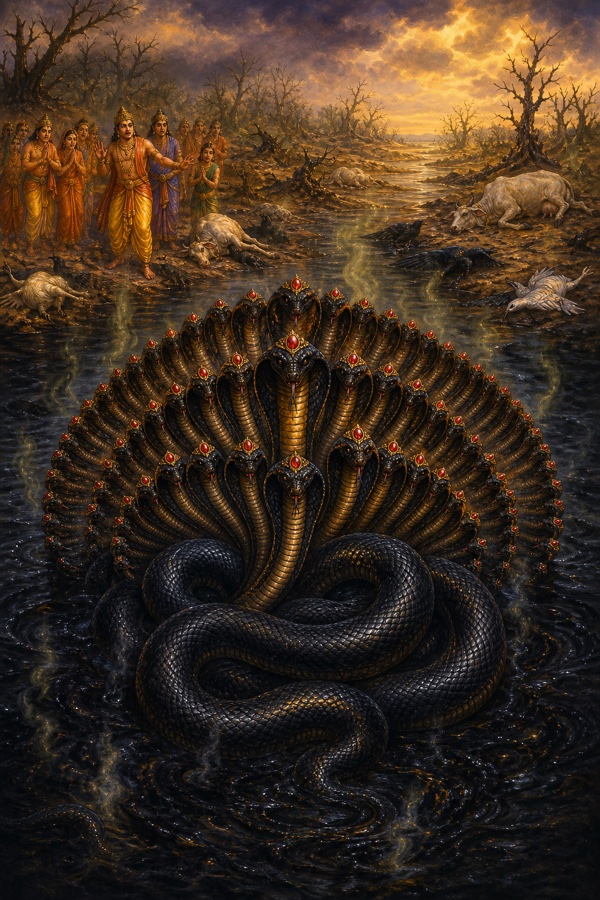
The Yamuna’s water had been sweet once. Clear, cold, and everyone’s: the cattle’s, the birds’, the children’s. Then a serpent came to one stretch of it, a deep pool at the river’s very middle, and settled in, and whole ages of the world passed over him while he lay there under water no line could sound. His name was Kaliya. He was immense, he was venom through and through, and he was a son of Kadru, the ancient mother of serpents. A hundred and one hoods rose off his body, and set into the crown of each hood glowed a red jewel. His poison burned so hot that the water around him simmered and went black, and even the vapor that lifted off that black water carried death in it.
How he came to be there was an old story. His true home lay far off in the sea, on the island of Ramanaka, where the serpent races lived. And over that island hung an arrangement none of them loved. Garuda, the great golden eagle who carries Vishnu on his back, hunts serpents; it is what he was born to do. So the people who lived in the nagas’ shadow, and worshiped them out of that fear, carried tribute month after month to the foot of an appointed tree, and at each new moon the serpents set out Garuda’s share of it with their own hands, buying their lives with food. Kaliya refused. Drunk on the strength of his own venom, he ignored Garuda and swallowed the offerings himself. Garuda came down on him for it with terrible speed. Kaliya met him with raised hoods and sank his fangs into him, and Garuda, who is the very seat of Vishnu and swifter than anything that flies, flung him back and struck him one blow with his left wing, a wing bright as beaten gold. That single blow broke him. Shaken and hurt, Kaliya fled, and he fled to the one water in the world where Garuda could not follow. Long before, in the reign of the emperor Mandhata, the sage Saubhari had kept his austerities in this very pool, down among its fish. One day a hungry Garuda swooped in over the sage’s protest and carried off the king of those fish, his favorite food, and Saubhari, watching the shoal grieve around the empty place where their leader had been, spoke a sentence to keep the pool safe forever: if Garuda ever entered this water again to hunt, that instant would be his last, and this was truth itself. No serpent alive knew of that curse except Kaliya. In its shelter he lay easy. The venom he had carried into hiding became, inside that safety, his pride.
Slowly the poison worked its way outward through the whole river. Vrindavan lived by that water, and Vrindavan began to grieve. Cows walked down to drink and dropped where they stood. Birds crossing above the pool brushed the rising vapor and folded out of the sky, dead before they reached the surface. Along the banks the grass lay scorched and the trees stood withered, as though fire had passed through without leaving ash.
One day Krishna brought the herd to graze along that very stretch, his friends around him. Balarama had stayed behind. The summer heat lay heavy, and the boys and the cows, parched past caring, drank straight from the river. The poison dropped them all by the waterline, boys and cattle together, dead. Krishna, the master of all the masters of yoga, turned and looked at them, only looked, and that gaze fell across them like a rain of nectar. They stirred, sat up out of their own deaths, and stared at one another in wonder at the water’s edge. Then Krishna considered the pool itself. He had come down into the world for exactly this, to curb the wicked, and here was a serpent whose poison had fouled his own dear playground of a river. He was done letting it stay.
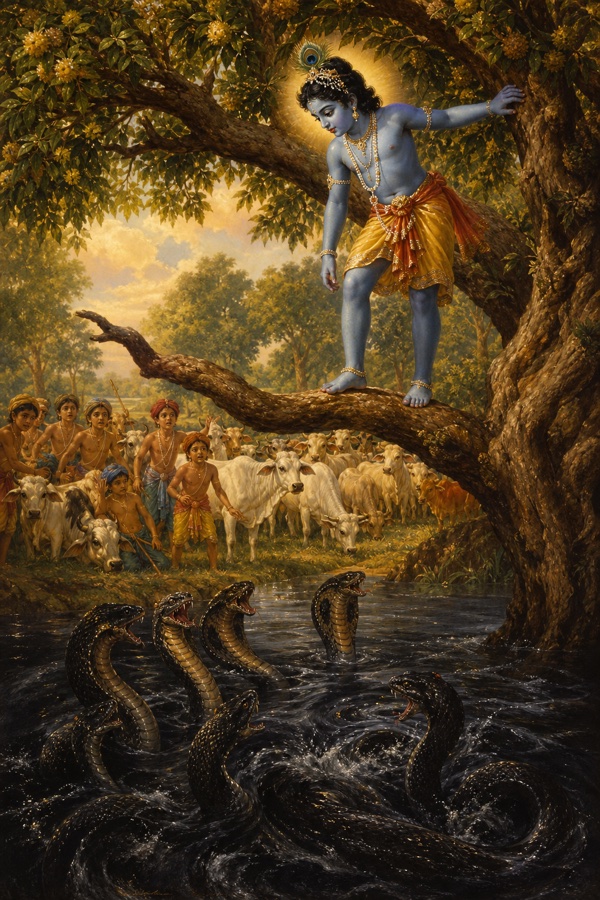
A kadamba tree stood on the bank, very old and very tall, the one living thing the poison had somehow spared, as if it had been kept for this. One long branch leaned out over the pool. Krishna tightened the cloth at his waist, climbed the trunk, walked out along the branch, looked down at the water for a single breath, slapped his arms once like a wrestler stepping into the pit, and leaped.
Straight down into the heart of the Yamuna, into Kaliya’s own house.
The pool convulsed. A boy’s weight had struck it, and the water rose as if the river had been seized by the roots and shaken. The serpents below thrashed, their venom boiled the flood higher, and waves stained red and yellow with poison ran out a hundred bow-lengths in every direction, four hundred cubits of churning water. For the one who had jumped, whose strength has no far edge, this was nothing at all. On the bank the cowherd boys were screaming his name. “Krishna! Krishna!”
Down in that deep water Krishna began to play. He plunged and rolled and struck the water like a great elephant at his bath, and the strokes of his arms rang through the pool like blows on a drum. Now, a serpent’s hearing lives in its eyes; Kaliya listened with his gaze, and what that gaze heard was unbearable. Someone was in his house. Someone was in his kingdom, and feared him so little that he was splashing. Kaliya went for him.
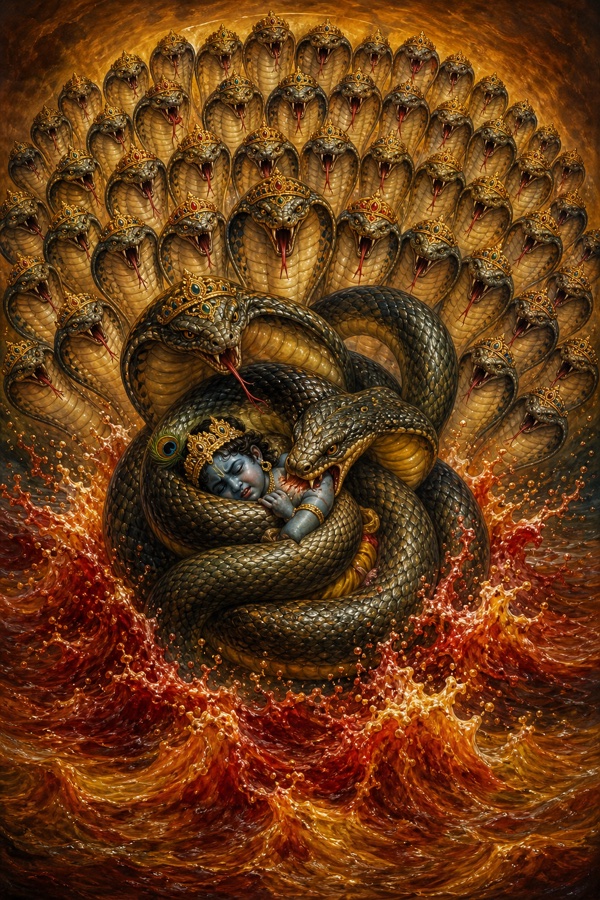
Every one of Kaliya’s hundred and one hoods came up at once. What he closed on was a child: a body soft and dark and glowing like a rain cloud, a line of gold across the breast, yellow silk at the waist, a smile still resting on the face, small feet tender as the heart of a lotus. He drove his fangs into the boy’s vital points in his fury, wound coil over coil around him, and drew the whole knot tight. Krishna vanished so completely inside that living cage that the surface of the pool showed nothing at all.
Up in Vrindavan, the world itself began to flinch. Omens broke out in threes, on the earth, in the sky, in the bodies of living creatures, the kind of signs that walk ahead of a disaster. Nanda and the cowherds read them, and then came the word that frightened them more than the omens did: Krishna had taken the herd out today without Balarama. That was all it took. Desperate to set eyes on their boy, the whole of Gokula poured out, men and women, children and the very old, leaving doors standing open behind them. And the path itself led them. In the dust, among the prints of all the other feet, lay footprints flagged with marks no other foot on earth carries: the lotus, the barley grain, the goad, the thunderbolt, the banner. Print by print, they followed him to the Yamuna.
From a distance they saw it. Krishna lay in the middle of the pool, wound inside the serpent’s body, utterly still. The cowherd boys lay senseless where they had fallen at the water’s edge. The cows, the bulls, the calves stood in a ring at the bank, eyes fixed on him, lowing as though they were weeping. The gopas went down where they stood; grief, remorse, and terror dropped them all at once. These were people who had signed over everything they had to one dark-skinned boy: body, kin, wealth, wives, every comfort, breath itself. And the boy was under water, in coils, and he was not moving.
The gopis lived on him even in ordinary hours: his warmth, his sweet half smile, the way his glance rested on a person, the honey he could put into three words. Now, with their darling shut inside a serpent, the three worlds went empty around them all at once. Yashoda broke for the water after her child, and it took the arms of many women to hold her back, women whose own hearts were tearing in the same direction. Those among them who still had their wits began telling her, over and over, the stories of everything her son had already survived, Putana and the poison on her breast, every impossible rescue, anything to keep her breathing. Most of the rest lay where they had fallen, as though dead, their eyes locked on his face across the water. And a little apart in that same crowd stood Balarama, and Balarama laughed. He said nothing, and he did not take one step toward the water; he knew, as no one else there knew, exactly what his little brother was. When Nanda and the other men began wading in after Krishna, it was Balarama who stopped them, talking some of them back, gripping some of them hard, steadying the rest.
Then, inside the water, the balance shifted. Krishna had let the coils hold him for the better part of an hour, moving through this life at a mortal boy’s pace. Now, seeing his whole Gokula standing on the bank with nothing left in the world except him, he began to grow. He swelled, spread, made himself heavy, and every knot of Kaliya’s lashed body began to ache around him. Loop by loop the coils gave. The serpent let go because he had no choice left, and reared back with every hood raised, hissing, venom streaming from his nostrils, flames guttering out of his many mouths, his eyes fixed and burning like iron pans left in the fire.
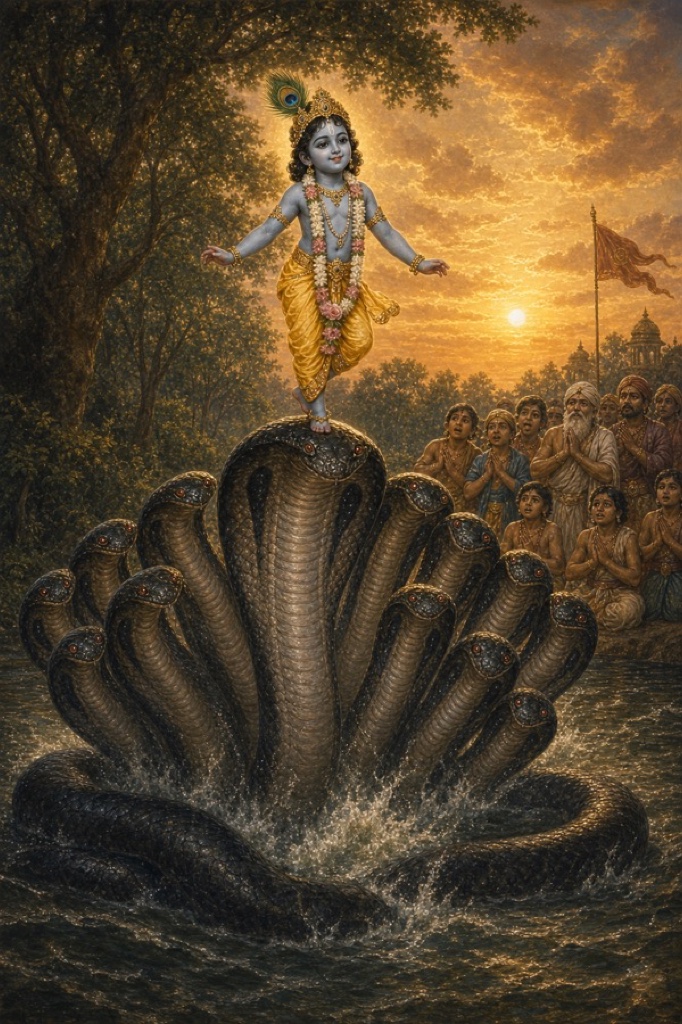
What followed looked, from the bank, like a game. Krishna wheeled around the serpent the way Garuda wheels, circling, feinting, always half a breath ahead, and Kaliya turned with him, forked tongues flickering at the corners of his mouths, his glances pouring out a fire of poison, each circling the other and waiting for his opening. The wheeling itself was the trap. Round upon round, the great body spent its strength in its own turning, though the heads still rode high. Then Krishna reached out, pressed the tall heads down with his hands, and sprang up onto the broad crowns of the hoods.
And he began to dance.
The one who first taught every art its measure, dance among them, began to keep time on a serpent’s head. The first footfall landed, and a shudder ran the whole length of Kaliya’s body. The jewels set in the hoods ground against those small soles, soft as new lotus, until they glowed crimson, as if someone had painted them with mahavar for a festival. One hood bowed under the beat; he sprang to the next. Whichever head reared up in fury, hissing, certain the boy was elsewhere, found the boy arriving, heel first, and went down under him. The blood the serpent wept from his eyes spattered across those dancing feet like handfuls of red flowers laid there in worship. A hundred and one hoods, and a beat on every hood.
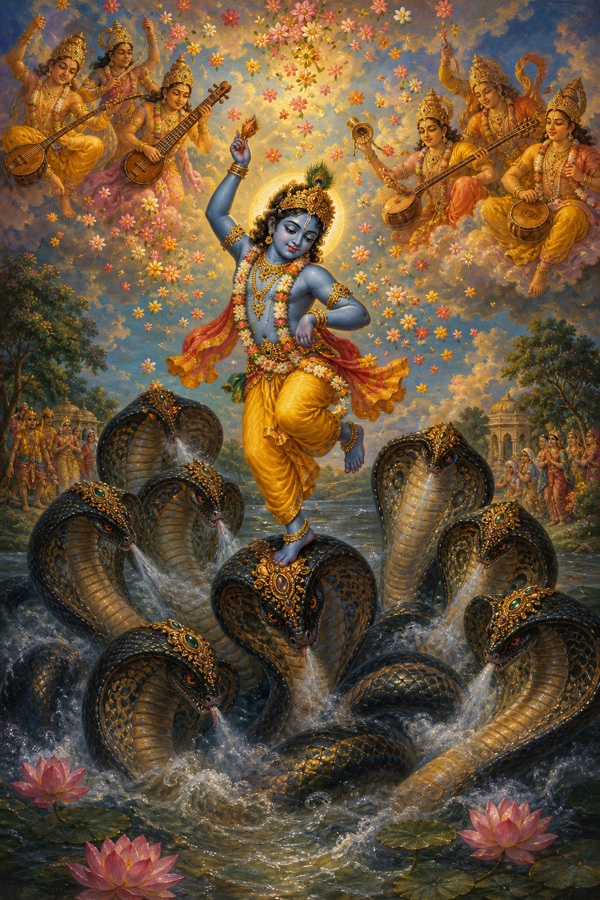
Every footfall drove a pulse through the water, and the people on the bank felt it arrive through the soil under their feet. Above the pool, another audience was gathering. The gandharvas came, heaven’s own musicians, and with them the siddhas and the devas, the charanas, the apsaras, all the shining servants of the Lord, crowding the air the moment they understood that he meant to dance. They brought the instruments themselves: mridangas, tabors, great booming drums. Song rose over the water. Flowers came sifting down out of the open sky and lay drifting on the black surface of the pool. The drum spoke, the small foot answered, and in between fell the faint hush of flowers landing on water.
Kaliya had seized the boy to crush the life out of him. Now the crushing ran the other way. Whichever hood rose in pride took the soft foot, and the foot came down each time a little heavier, until under that pressure the venom itself began to leave him, pouring from his mouths and nostrils mixed with his blood. His umbrella hoods split and buckled one by one. His body slackened knot by knot, sinking, for the boy dancing on his heads was the one who holds whole universes inside his own body, and the serpent was going down under that weight. The poison he had spent a lifetime calling his strength was being wrung out of him drop by drop, and with every drop some of the arrogance went too. Far down, past pride, past fury, at the very end of himself, the old serpent turned his mind to Narayana, the most ancient of persons, refuge of everything that moves and everything that stands still, and silently asked him for shelter. Then the darkness took him.
And Krishna? Krishna was dancing. His breath ran level. The half-open smile never left his lips, as if all of this were simply play.
On the bank, the cowherds forgot to blink. The scent of the fallen flowers drifted in off the water, and under everything ran the far-off throb of the drums. What they were watching, none of them could have said.
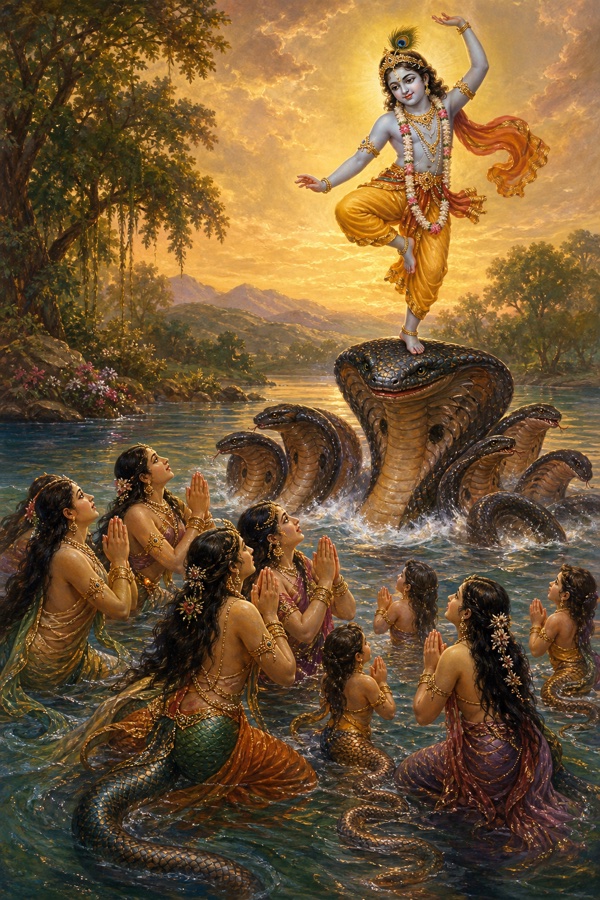
Then the water parted, and Kaliya’s wives came up out of the pool. They had watched their husband broken, and dread had undone them; their garments hung awry, their ornaments sat knocked askew, their braids had come loose down their backs. They set their small children in front of them, and then all of them together laid themselves flat upon the water, palms joined, faces lifted toward the dancing boy. They had come with no argument against the punishment. They knew it was just. They knew what their husband was, what filled him, and that this wringing-out was the only cleansing left for such a poison. They asked one thing alone: that his life be spared.
“Natha,” they said, and their voices shook. “This punishment is just. You have come down into the world for exactly this, to curb the wicked, and you look on an enemy and a son with the same even eye. You strike only where the striking heals. What has fallen on our husband we count as your grace, for your anger burns away the very sin that puts a soul into a serpent’s body. And it is more than grace. What can this creature ever have done, what austerity in some forgotten life, what unremembered kindness to living things, to earn what came to him today: the dust of your feet on his own head? Lakshmi herself, the goddess of fortune, gave up every pleasure and kept hard vows through long ages for that dust. Those who have once held it stop wanting anything else, heaven, the throne of the earth, Brahma’s own seat, the kingdoms under the world, the powers of yoga, even freedom from birth itself. And here is Kaliya, born of darkness into the race of wrath, wearing that dust on all his heads. Lord of time and witness of time, maker of this universe and the stuff it is made of, the one seated in every heart, we bow to you. A master forgives what his own servant breaks; forgive this dull creature who did not know what you were. The breath is going out of him. Our lives live inside his life; give our husband back to us, your servants, women the good are bound to pity. Or command us. Whatever you order we will carry, and whoever carries your order with reverence walks free of fear itself.”
Krishna let the beat fall still, and looked at them.
By then Kaliya was surfacing back into himself. Breath came hard, dragged in and paid out with labor. He gathered what was left of him and joined his own palms. “Natha, we are wicked from our very birth. Wrath is the womb we were born from, tamas the stuff we are made of, and the nature a creature is born inside is nearly impossible to set down. You are the one who spun this whole universe out of your own power, every kind of being in it with its own strength, its own seed, its own hungers, its own shape. Among them all you made us serpents, ferocious from the egg. Deluded as we are, how would we ever cross your maya by our own effort? Only you can carry a creature past it. So do with me now whatever you see fit. Show grace, or finish the punishment.”
Krishna said, “Serpent, you are done living here. Go back to the sea, and go today: take your wives, your children, and your kinsmen, and return to Ramanaka. This river belongs to the cows and to the people who drink from it. And hear the rest. Any mortal who remembers this command of mine, morning and evening, need never fear a serpent again. And whoever bathes in this pool where I have played, offers its water to the gods, keeps a fast, and worships me here, is washed clean of every sin.”
Kaliya hesitated. Ramanaka was the very island he had fled, and what circled the skies near Ramanaka was Garuda. Krishna read the thought as it formed. “Do not be afraid of Garuda. Your hoods carry the print of my feet now. When he sees that mark, even Garuda will stop where he is. He will never eat you.”
Then the serpent people paid him what a defeated king pays a greater one, and paid it gladly. Kaliya and his wives brought up their treasures and worshiped him where he stood: cloth from no earthly loom, garlands, gems and great jewels, perfumes of heaven, sandal paste, and a wreath of lotuses laid before the Lord whose own battle flag bears the image of Garuda. Then, with his leave, Kaliya circled him sunwise in honor, bowed his ruined heads, and slid away across the water with his wives, his sons, and his kin, glad at heart, toward the sea and the island of Ramanaka.
And in that instant the Yamuna turned. The poison went out of the water in one breath, and what remained ran sweeter than it had ever run, sweet as amrita, the nectar of the deathless.
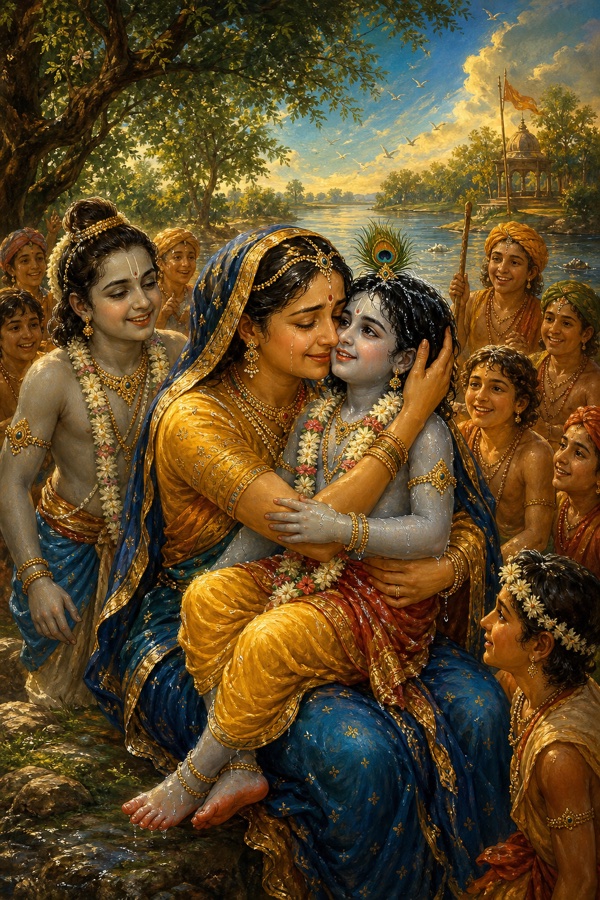
Krishna came up out of the pool wearing the serpents’ farewell: the unearthly garland, the perfumes and sandal, the fine cloth, a great gem, gold bright against his skin. The cowherds rose from where they had fallen the way the senses rise in a body when life comes back into it, all at once and everywhere, and they crowded him, held him, passed him from embrace to embrace. Yashoda and Rohini, Nanda, the gopas and the gopis came back to themselves and had the one thing they wanted. Balarama caught his little brother to his chest and laughed out loud. Even the hills seemed to lighten; the cows and bulls and calves pressed in as joyful as the people. The family priests came to Nanda with their wives and said it plainly: by fortune your son has come free of Kaliya; mark his deliverance with gifts. Nanda, glad past holding it in, gave them cows and gave them gold. And Yashoda, who had her child back from the far side of death, lifted him into her lap and held him against her heart while tears of joy fell and kept falling.
Krishna’s hair was still dripping. And on the soles of his feet, where the serpent’s jewels had ground against them through the whole long dance, the red still bloomed.
He was laughing, as if the whole of it had truly been just a dance.
Literary context
The taming of Kaliya appears in the tenth skandha of the Shrimad Bhagavata, chapters 16 and 17. Kaliya’s return to Ramanaka Dvipa and the promise of safety from Garuda both follow the Gita Press text.
The image of the boy dancing on the hoods, ‘Kaliya-mardana,’ has been sung and staged in the classical dance traditions for centuries, and sculptors have loved it just as long.
The same katha elsewhere
- Harivamsha · The Taming of Kaliya
The Harivamsha’s telling of the taming of Kaliya