On this page
King Vena and Prithu
In the line of Dhruva, the child who had done tapas in the forest until the Lord set him blazing in the northern sky as the polestar, there came in time a king named Anga. A rajarshi, a sage who happened to wear a crown, gentle by nature, devoted to the Brahmins, with dharma governing his conduct and the yajna, the fire-rite, in his very breath. His granaries were full, his borders were quiet, his court wanted for nothing. Only the years kept passing, and his lap stayed empty.
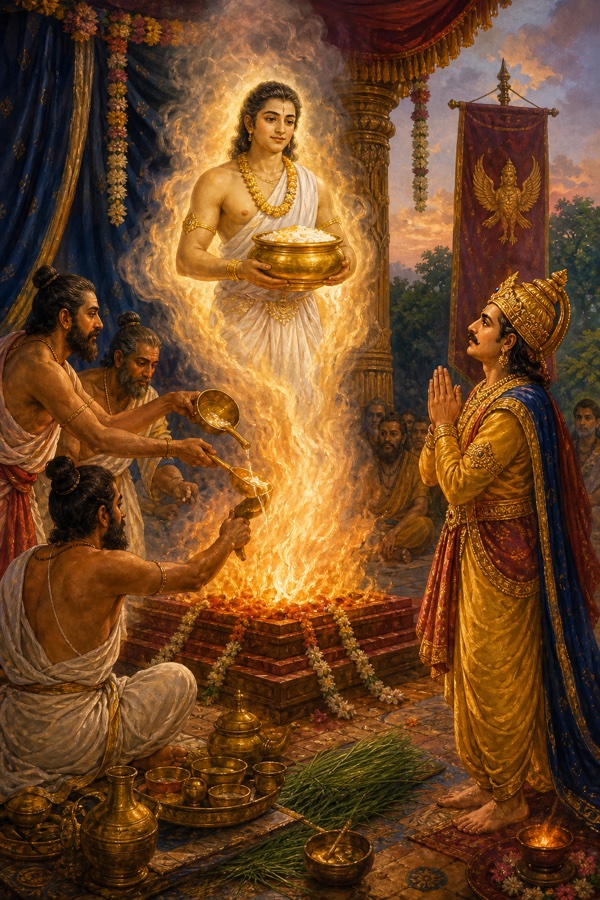
For a son, Anga set in motion the great horse-sacrifice, the costliest rite a king can undertake. The altar was faultless, the offerings pure, the Vedic chants sound in every syllable, and still the gods did not come down to take their share, though the sages called them again and again. The officiating priests stood amazed. Anga, who had kept the sacrificer’s vow of silence through it all, asked their leave to speak and put the question plainly: the gods refuse my oblations and refuse the soma pressed for them; tell me what offense I have committed. The priests searched and found none, none in this life. A sin carried over from a former birth had left him sonless, and that old debt now stood between his offerings and heaven. Their counsel was this: turn the whole sacrifice toward Shri Vishnu, the Lord to whom every offering finally travels, and ask him for a son. Let the Lord be pleased, and the gods, who are rays of his own light, will open their hands of their own accord.
So the priests shaped the purodasha, ground rice pressed into a cake, and offered it into the fire with Vishnu’s name upon it. And out of the flames a being rose, adorned with a golden necklace and clothed in spotless white, bearing in a golden vessel kheer already cooked, rice boiled soft in sweetened milk. With the priests’ leave Anga received it in his cupped hands, breathed in its sweetness, and gave it, glad to the bone, to his wife Sunitha. She ate it, and in time she bore a son. But in the hour he came into the world, in place of joy an unspoken dread settled over the house.
The infant’s eyes held no cry for milk. In them sat a cold burning. He was named Vena.
Sunitha was the daughter of Mrityu, Death himself, and Death had sprung from a portion of Adharma, the spirit that presides over every form of wrong. The boy fastened himself to that grandfather from his earliest days, took his ways for a model, and so leaned toward wrongdoing from his first breath.
Anga held him to his chest and tried everything a father can try. Softness, sternness, discipline, teaching. Nothing took. The boy grew as he had been born, harder with each passing year. He would carry a bow into the woods, playing the huntsman, and cut down deer that had threatened no one, until people cried out at the sight of him, “Here comes Vena.” He would seize children of his own age at their games and strangle them with his hands, coolly, the way a butcher handles animals.
The grief of it hollowed Anga out. He began to say to himself what no father should have to say: the childless, who must have pleased God in some former birth, do better than they know, for they are spared this; a son like this binds the heart with delusion, drags the family’s name into the dirt, sets every hand against the house, and fills the home with affliction; a bad son serves a man better than a good one, since a bad son makes the house a hell he can finally bear to leave. One night, while the palace slept, he rose from beside the sleeping queen, crossed the threshold of all that vast wealth, and walked out. He told no one. He never came back. The people, the priests, and the ministers searched the whole earth for him, the way men who have never learned the secret of yoga search outside themselves for the One seated in the heart, and they found no trace. They returned to the capital and, with tears standing in their eyes, told the assembled sages that their king was gone.
The throne stood empty, and without a king the people began sliding toward the state of beasts. Bhrigu and the other great sages watched it happen, sent for the queen mother Sunitha, and, over the ministers’ objections and with heavy hearts, crowned Vena, in the hope that the weight of the crown might steady him. For a moment it seemed to work. Word that a hard hand now held the scepter sent the thieves and bandits into hiding, like rats when a snake enters the house.
The hope was short. The throne fed the fever in him. Master now of the wealth and reach that belong to the eight guardians of the world, he set himself above every recognized spiritual authority in the realm, mounted his chariot, and rolled through his dominion like a bull elephant with no goad on its neck, making earth and sky shudder as he went. Then he had the war drum beaten and a decree cried through the whole kingdom: “From this day no twice-born man shall perform a sacrifice, bestow a gift, or pour an oblation into the fire, under any circumstance whatever.” The gates of worship were shut by royal order.
The rishis were gathered at a sacrificial session when the reports reached them, and they weighed the calamity from every side. The people were being eaten from both ends now, by the robbers on one side and the ruler on the other, like ants in a log lit at both ends. Fear of anarchy had made them crown an unfit man, and the protector himself had become the terror; they had poured milk for a snake, and the snake had grown. Still they resolved on patience first. Let him be reasoned with, so that his sin should not touch them; if he spurned gentle words, there would be time enough for their fire. Banking their anger, they came to the court and spoke to him in kind and measured speech.
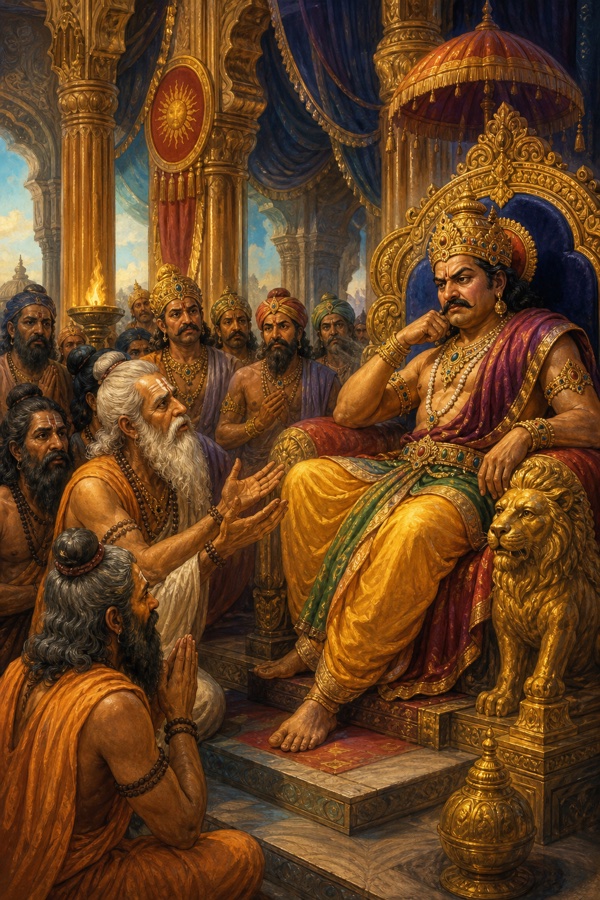
“Hear us, Rajan, for what we ask will lengthen your life and swell your strength, your fortune, and your fame. Duty done with mind, speech, and body carries a man to worlds beyond sorrow, and carries the man free of attachment to the eternal state itself. Your duty is the safety and the flourishing of your people. Let that fall, and a king drops from his own splendor. The ruler who guards his subjects against grasping ministers and against thieves, and takes his revenue by the measure the scriptures allow, is happy in this world and the next. And more than revenue moves through your realm. When each of your people does the work of his own station and stage of life, that daily labor itself becomes worship of Shri Hari, the Yajnapurusha, the Person inside every sacrifice, by whose power the whole world turns. He is sovereign over the very guardians of the worlds; all the worlds and their gods carry tribute to him, and when he is pleased, nothing remains out of reach. The gods themselves are rays of his light: honored with sacrifice in your kingdom, they will pour back every boon upon you. Do not bar your gates against the gods, Rajan. Do not strike at the hands that hold up your throne.”
The old burning flared up in Vena’s eyes.
“Fools, all of you, and worse than fools, for you dress adharma up as dharma. You abandon the lord who feeds you and wait upon another, the way a faithless wife slights her husband and dotes on a lover. This Yajnapurusha of yours, who is he? Show him to me. Vishnu, Brahma, Shiva, Indra, Vayu, Yama, Surya, Parjanya who sends the rain, Kubera who keeps the treasure, Soma, Agni, Varuna, the goddess of the earth herself, every god who can bless and every god who can curse lives in the body of the king. The king alone is made of all the gods. So put your jealousy away, worship me, and bring your offerings here, to this throne. What other person alive deserves them?”
The sages rose without a word and walked out. In the open air they met one another’s eyes.
“To leave him standing is itself adharma. He is pitiless to the marrow; let him live and he will burn the whole world to ash in no time. He sits on a throne he never deserved, and he reviles, to our faces, Shri Hari, the Lord of sacrifices, by whose grace alone that throne has held him. Who else in creation, owing every scrap of his power to that grace, would stand up and curse it? And the people will be ground to nothing under his hunger.”
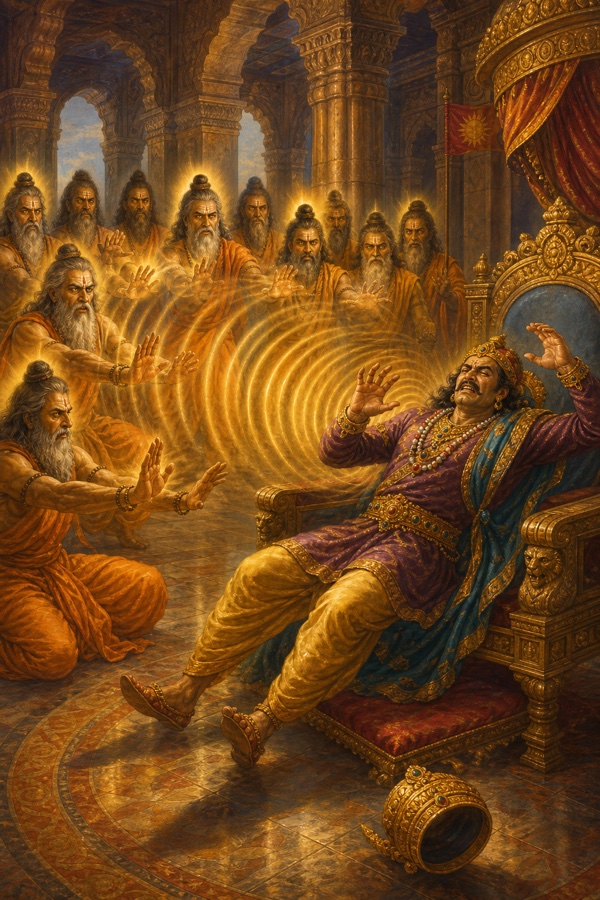
Their patience was spent at last. Stung past bearing by the blasphemy of that shameless man, the sages woke the mantra that lived sheathed in their hearts and finished him with the force of sound alone. A single utterance: “Hum.”
In that one syllable moved the whole stored power of their tapas, years of austerity discharged in a breath. And it met a man already hollow, for whoever reviles the Lord has cut his own root long before anything strikes him. Vena shook once and dropped where he stood. His breath stopped in that instant.
The sages went back to their hermitages, and the grieving Sunitha, by mantra and preserving arts, kept her son’s corpse from decay. With the king dead the land slid into open anarchy. Thieves multiplied, and the people were stripped bare on every road. Some days later, when the sages had bathed in the Saraswati, fed their sacred fires, and sat on the bank speaking of the Lord, they saw dark omens climbing the sky, and on every horizon the dust of robber bands scattering with their plunder; the state had gone slack, and the strong were already killing one another over the spoils. The sages had power enough to stop it by force, and would not use it, knowing what violence costs even in a righteous hand. But the reckoning would not leave them alone. A Brahmin who looks on all with an even eye, and then lets the afflicted suffer within his sight, drains away his stored tapas like water from a cracked jar. And the line of Anga must not be allowed to gutter out, for in that line had come kings of unfailing strength who leaned on Keshava alone. So they resolved, and gathered around the dead king’s body.
First they churned Vena’s thigh, fast and hard, the way fire is drawn from the two arani sticks.
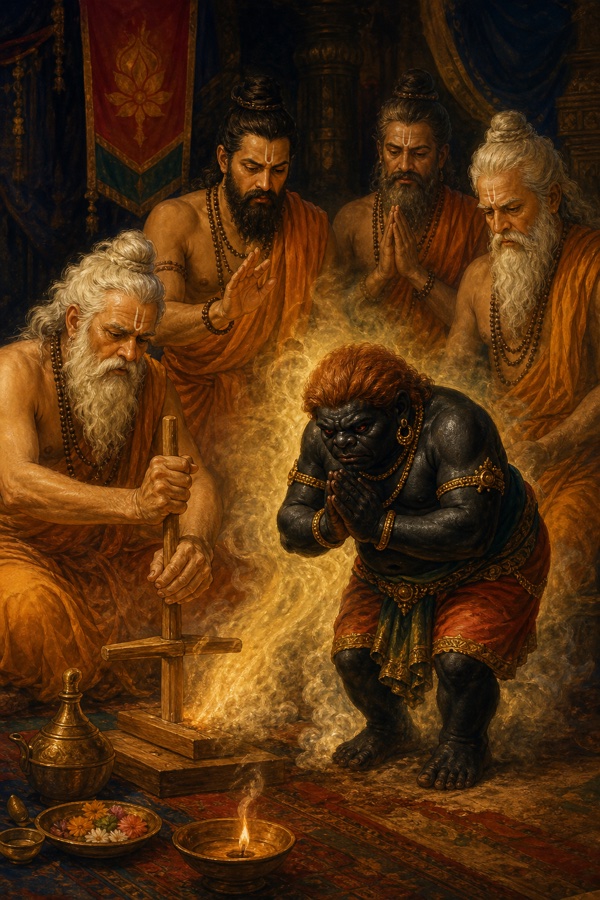
Out of it came a man of low stature. Black as a crow, dwarfish, his limbs strangely foreshortened, arms and legs both, with heavy jaws, a flat nose, bloodshot eyes, and copper-red hair. On his face sat the same burning that had once lived in Vena’s eyes.
Bowed low and meek, he asked, “What shall I do?”
The sages said, “Nishida,” which is to say, sit down. From that word he took his name, Nishada. And in the very act of being born he had drawn the whole of Vena’s terrible sin onto himself, as though every wrong in the dead king had been bound into one bundle and lowered into a single body.
Nishada bowed his head and set off toward the forest. From him came the Nishada people, who carried his nature in them and made their home in the hills and the woods. So the Purana tells it.
Vena’s body lay lighter now, scoured of its sin. This time the sages worked his arms, and from the right arm a man and a woman rose together.
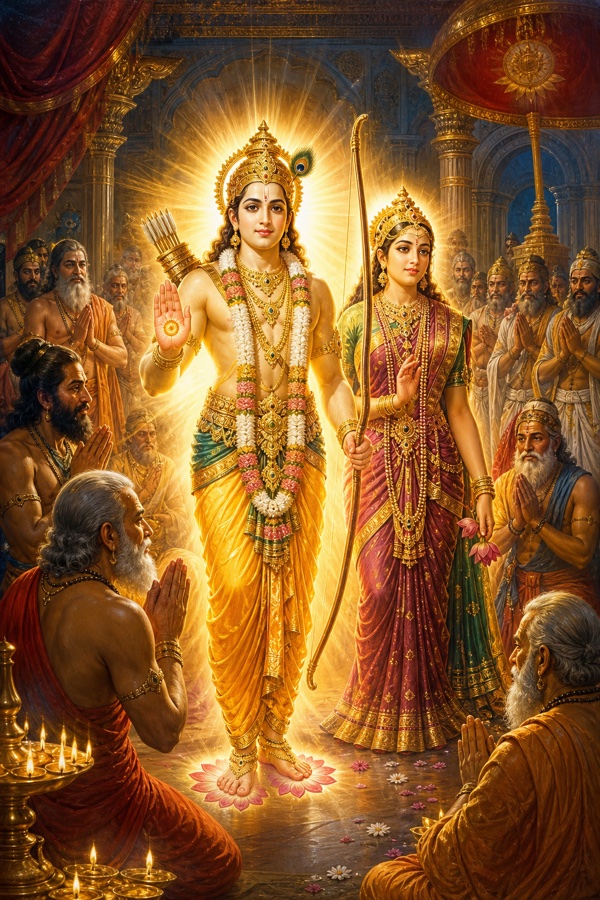
The man who appeared made the lamps of the court go pale. A hero blazing with splendor, a bow and arrow already in his hands, on his right palm the mark of the discus, whole and uncrossed by any line, the sign of a sway no enemy would ever break, and on the soles of his feet the mark of the lotus. Conches and drums sounded in heaven, the gandharvas sang, the siddhas rained flowers, the apsaras danced, and the celestial sages came down to look on him; Brahma himself, arriving at the head of the gods, read those marks and knew that a portion of Shri Hari had entered the world.
With him came a woman of her own radiance, graced with every virtue and every ornament, so lovely she seemed likely to outshine her husband: Archi, his companion.
The brahmavadi sages folded their hands. “This man has come forth from that portion of the all-pervading Lord which upholds and protects the world. His name is Prithu, for the splendor of that name will spread far and wide across the earth. And this woman is a ray of Shri Lakshmi, the goddess of beauty and abundance who is never parted from the Lord; she is Archi, and she will never be parted from him. Among all kings he will be the first, and the most glorious emperor the world will know. Here is our king.”
The Veda-knowing Brahmins performed Maharaja Prithu’s consecration with every rite in its place, and creation itself came bearing gifts. The deities of the rivers, the seas, and the mountains came, of the sky and the earth, and with them serpents, birds, deer, and cows. Bathed with the waters of installation and arrayed in royal dress, with Archi adorned beside him, Prithu shone like fire given a second body. Kubera, lord of treasure, brought him a throne of gold; Varuna, lord of waters, an umbrella that shed fine spray and glowed like the moon; Vayu brought two fans of yak hair, Dharma a garland of unfading fame, Indra a shining crown, and Yama, lord of restraint, the scepter by which the world is governed. Brahma brought an armor made of the Veda itself, Saraswati a necklace of rare design, and Shri Hari laid in his hand the discus called Sudarshana, while Lakshmi granted him prosperity that would never fail. Rudra gave a sword marked with ten moons, Durga a shield marked with a hundred; Soma gave horses formed of nectar, Twashta a chariot, Agni a bow made of horn, Surya arrows as bright as his own rays. The earth gave him sandals that would carry him wherever he set his will, the sky the gift of fresh celestial flowers each day, the gandharvas their arts of music and dance, the ocean a conch born of its own depths; seas, mountains, and rivers opened roads for his chariot. Then a herald, a bard, and a panegyrist stepped forward to sing his praise, and the new king stopped them with a smile, his voice deep as cloud thunder. Praise me later, he said, when there are deeds of mine worth the telling; sung now, your verses would stand as lies in my name, and a man who lets himself be celebrated for virtues he does not yet own becomes a joke to his own people. The forehead that took the crown was already bowed, bent under the weight of the dharma set on it and empty of any appetite for the seat itself.
Yet the moment he was king, the first calamity stood waiting at the door. Under Vena’s lawless years the earth had dried to dust, and not a single grain would rise from her.
The earth had drawn her whole yield back into her own body. Through the age of Vena she had watched the grains and herbs the creator made at the beginning of things being devoured by men who kept no rites and honored no order, with no protector left to stop them; so she had gathered the seed of every growing thing into herself and held it, keeping it against the day when sacrifice returned and a guardian stood ready to receive it.
Then the famine walked into the palace. His subjects came before him with their bodies wasted, and their plea shook him: hunger eats us from within, Rajan, the way fire eats a tree from its own hollow; you are our protector, set over us to feed us; find us food before we die for the want of it. Prithu pondered long, searching for the root of it, and saw where the harvest had gone.
He lifted his bow. He set an arrow to the string, and his eyes went crimson as he turned toward the earth herself, his aim as level as Shiva’s on the day that god drew down the three flying cities of Tripura with a single shaft. His hand did not tremble. In his mind were the faces of his starving people, and the vow of a guardian who cannot stand and watch his own die of want.
The earth took fright, put on the form of a cow, and ran. She fled like a doe with a hunter behind her, through the four quarters and the corners between them, up through heaven and down again, and everywhere she turned the same drawn bow was waiting. No refuge opened for her against the son of Vena, any more than a refuge opens for living things against death. At last, worn through and shaking, she stopped, and turned, and faced him.
“Rajan, you know dharma to its floor, and you are kind to the afflicted; then protect me too. Why loose your arrow at a meek and harmless female? Men spare a woman even when she has done wrong; how shall a knower of dharma strike one down? And think what it is you would strike. I am the boat, old and undecaying, that carries the whole creation over the deep. Break me, and what will hold you and your people above the water?” Then her voice changed, and she spoke to something vaster standing inside the archer. “I know you, Lord. You are the Person beyond change, who by your own maya puts on all these forms; the Maker who framed me at the beginning to be the house of every living thing. At the dawn of creation, when I lay drowned in the flood, you took the body of the primeval Boar and raised me out of the water on your tusks. Now that same hand is drawn against me for the sake of milk. Whom else shall I run to? The ways of the divine are past the reckoning of creatures like me, tossed on the very maya that made them. I bow to you.”
“Then give back what you owe,” said Prithu. “You take your share in every sacrifice, yet you will not yield us food; you have turned your ear from my command, and a cow that eats her fodder every day and gives no milk from her udder has earned the rod. The seed you hide in your body was Brahma’s own making, created by the self-born at the dawn of things, and you have buried it while my people starve on the ground above it. And do not shelter behind your woman’s form: when a king cuts down the cruelest of the merciless, whoever they may be, that is no killing at all. If you refuse me, my arrows will open your body, I will still the crying of the hungry with your own flesh, and I will hold up every living creature by the sheer force of my yoga. You wear this cow shape as a screen for your stubbornness. Drop it, and yield.”
The cow that was the earth bowed her head, steadied the trembling in her limbs by an act of will, and joined her forelegs like folded palms. “Then cool your anger and hear me, Rajan, for a wise man takes the essence out of everything, the way a bee takes the honey and leaves the flower standing. The seers of old found and tested the means by which living beings gain their ends in this world and beyond it; the man who honors those means succeeds, and the man who scorns them fails though he try a hundred times. The herbs and grains Brahma made were being devoured by lawless men who kept no rites, and no king protected me; the long years folded that seed deep into my body, and I meant to keep it for sacrifice alone. Draw it out now by the fit expedient. Set up a calf, appoint a worthy vessel and a milker, and milk me with love: what I have held back comes down to tenderness, and force will draw out nothing. And do one thing more, king of boundless power. Level my rough places, so that when the rains have passed the water will stand on me and soak in, and nothing heaven pours down will run to waste. It will be a blessing on you.”
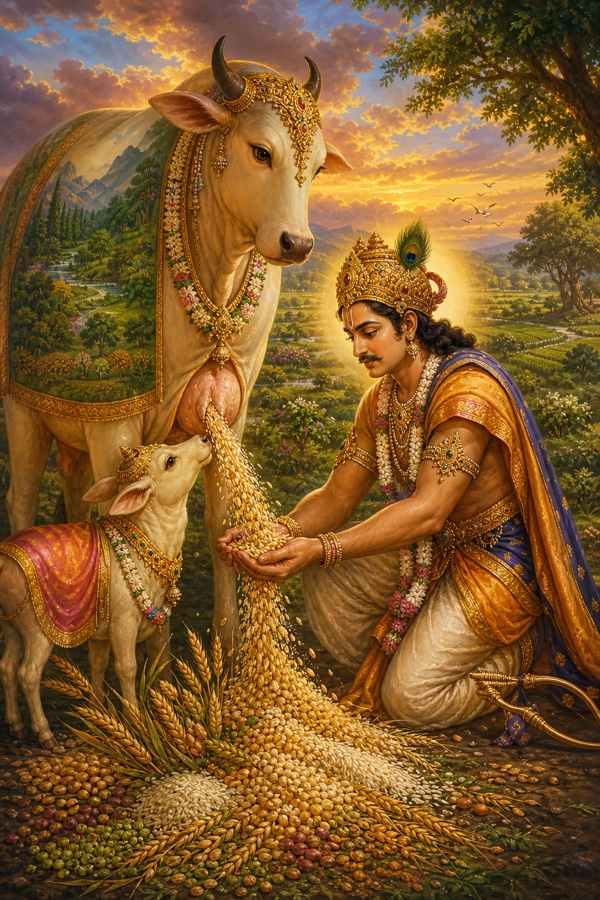
Prithu made Svayambhuva Manu, the first father of mankind, the calf, cupped his own hands for the vessel, and milked her. What flowed from her was every herb and every grain the world had lost, rice and wheat and barley and pulses, pouring out golden where milk should have been.
And once she had been gentled into a cow for his sake, all the orders of creation came to her in the same fashion, each with its own calf and its own vessel, each drawing the food proper to its nature. The seers made Brihaspati, teacher of the gods, their calf, and with hearing, speech, and mind for their vessel they drew the Veda itself. The gods made a calf of Indra and drew soma, the drink of the immortals, with vigor of mind and sense and body, into a vessel of gold. The daityas and danavas set up Prahlada, the noblest ever born among them, and drew wine into a pail of iron. The gandharvas and apsaras, heaven’s singers and dancers, milked sweetness of song and beauty into a cup shaped from a lotus; the ancestors drew kavya, the food offered to the departed, into a dish of unbaked clay; the siddhas, with the sage Kapila for their calf, drew into the open bowl of the sky those powers that answer to bare thought, and the vidyadharas drew the art of walking the air. The kimpurushas, through Maya the great conjurer, drew the craft of vanishing at will. The yakshas, the rakshasas, the ghosts, and the flesh-eating pishachas milked a drink of blood into vessels of skull, with Rudra, lord of spirits, for their calf. Serpents and scorpions drew poison through Takshaka, their own mouths for vessels. The grazing beasts drew grass into the vessel of the open forest, with the bull of Shiva for their calf; the fanged hunters, through the lion, drew flesh into the pot of their own bodies; the birds, through Garuda, drew all that moves and all that stands still; the trees drew their sap through the banyan; the mountains, through Himalaya, drew minerals into the basins of their own ridges. The earth is the wish-yielding cow of the whole creation, and to every being that came to her with a fit calf and a loving hand she gave its own milk.
The parched land went green again. The threshing floors filled, the hearth fires came alight, and into the homes of the people the smell of cooking grain returned.
Prithu was pleased with her then, this earth who had come to him first in terror and now held nothing back, and he took her for a daughter and loved her as one. And he kept his word to her. With the tips of his bow he broke the crests of the mountains and drew her body level. Like a father providing for his household he portioned out dwellings according to fitness: villages, towns, and cities, forts of every design, stations for the cowherds and pens for the cattle, camps for the armies, mines, farmhouses, and hamlets on the hillsides. Before Prithu the earth had known nothing of planned and ordered settlement; men had lived scattered wherever chance set them, unwalled and unsheltered. Now, for the first time, a man could sleep anywhere in the land secure in his life and his goods.
From this same Prithu the earth took the name she still carries, Prithvi: Prithu’s daughter.
Prithu ruled by dharma for long years, guarded what he had built, fed the crops and the towns, lent virtue his own shoulder, and discharged to the last measure the commission for which the Lord had sent him into the world. Under him the people had food and justice. Then one day he saw that he had grown old. He entrusted the earth, his daughter, weeping as it were at the parting, to the care of his sons, and while his subjects stood desolate he walked out of his own capital with Archi at his side, unattended, toward the forest and the life of tapas. He brought to austerity the same fire he had brought to conquest. He lived first on roots and fruits, then on dried leaves, then for whole fortnights on water, then on air alone. In summer he sat inside the ring of the five fires with the sun overhead for the fifth; in the rains he took the open sky’s lashing; in winter he stood neck-deep in freezing water; and the bare ground was his bed the year round. Celibate, his speech and senses reined in, offering the whole of it to the pleasure of Shri Krishna, he worshiped through the yoga that the boy-sage Sanatkumara had once taught him in his own palace garden, until his karma burned away, the veil of I-and-mine tore through, and every craving, even the craving for wisdom itself, let go of him. Then, at the hour he himself chose, that great hero left his body by the yogi’s road: he drove his breath upward stage by stage, from the base of the spine to the navel, the heart, the throat, the brow, the crown, gave back air to air, flesh to earth, heat to fire, the body’s hollows to the sky, and water to water, folded the senses into their sources and mind and self-sense into the one great ground, and, established in Brahman, freed of the last knot, he passed into the abode of Shri Hari.
Archi had followed him into the forest from the first day, a queen so delicately raised that the rough ground bruised her feet, and she never once called it hardship; serving her husband, sharing his austerities, living on the hermit’s roots and fruits, she was thinned to a shadow and content, for his hand still rested on her hair. When she found the body of the sovereign of the whole earth empty of its lord, she wept for a while. Then she raised his pyre on the ridge of the hill, performed the rites, bathed in the stream, offered the water in her joined palms for that doer of mighty deeds, bowed to the gods who watched from their vimanas in the sky, and walked three times around the fire with her mind fixed on her husband’s feet. The wives of the gods rained flowers down on the mountain and said to one another: blessed is she, who served her lord as Lakshmi serves Vishnu himself; look, she is passing beyond us and beyond our heavens. So Archi entered the fire, and reached the very abode her husband had reached, and joined him there.
Literary context
The katha of Vena and Prithu runs through the fourth Skandha of the Shrimad Bhagavata, discourses 13 to 18. Under King Vena’s lawless rule the people were tormented and every form of worship was banned. The sages killed him with the mantra “Hum,” then churned his thigh to bring forth the Nishada, into whom the whole of Vena’s sin passed, and from the churning of his arms rose Prithu, a portion of Shri Hari, together with his consort Archi.
From the earth, who had taken the form of a cow, Prithu, making Svayambhuva Manu the calf, drew forth all grain and made the land fit for the plow. The name Prithvi descends from this same Maharaja Prithu, the first true king of the earth.
The philosophical lens
The heart of this katha sits in a single line. The king is the keeper of the earth and its people; no deed of ownership was ever written into the crown. Vena claimed mastery, and swallowed everything within reach. Prithu claimed service, and the earth laid open before him all that she had.
The earth yields to tenderness, and force draws nothing from her. Into the lap of the one who tends her as a mother, the grain comes down; before the one who sees her only as a thing to be used, she closes her body. And there is a deeper reading still. She is the wish-yielding cow of the whole creation, giving her milk to gods and seers and ancestors alike, to every order of being its own sustenance, so long as it is drawn with a fit calf and a loving hand. Maharaja Prithu is the standing emblem of that dharma.
Why this katha matters now
The same question stands before every generation. The one into whose hands the lives of others are given, does he feed them, or feed on them? Vena and Prithu are two answers out of a single body. Whoever hands the arrogance inside him over to the forest wakes the protector within, and only then does the earth give her grain again.
The same katha elsewhere
- Harivamsha · Vena and Prithu
The Harivamsha’s account of Vena and Prithu