On this page
Introduction
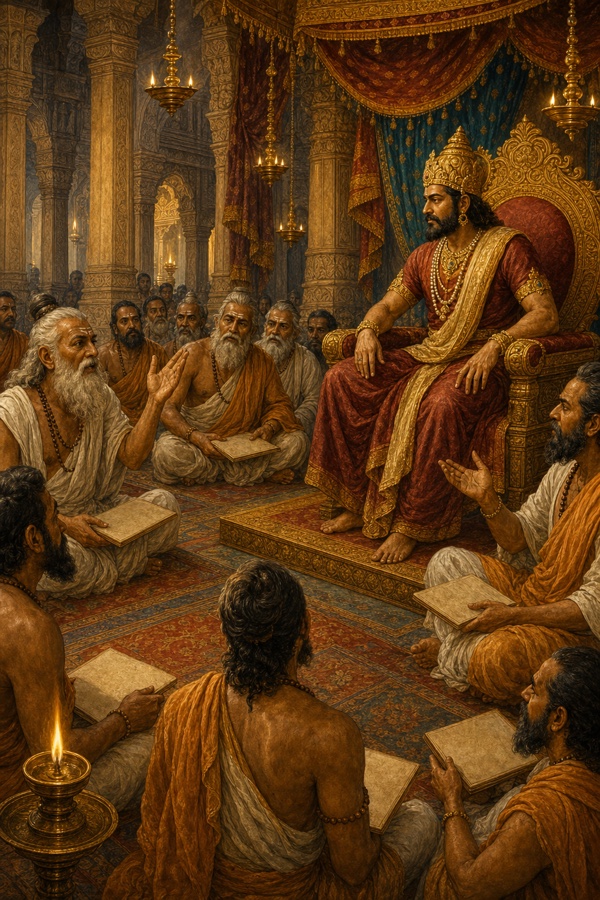
The court of Mithila. King Janaka sat enthroned. All around him, pandits, scholars of the shastras, commentators. As on any day, the debate ran on, over shlokas, over Mimamsa, over dharma.
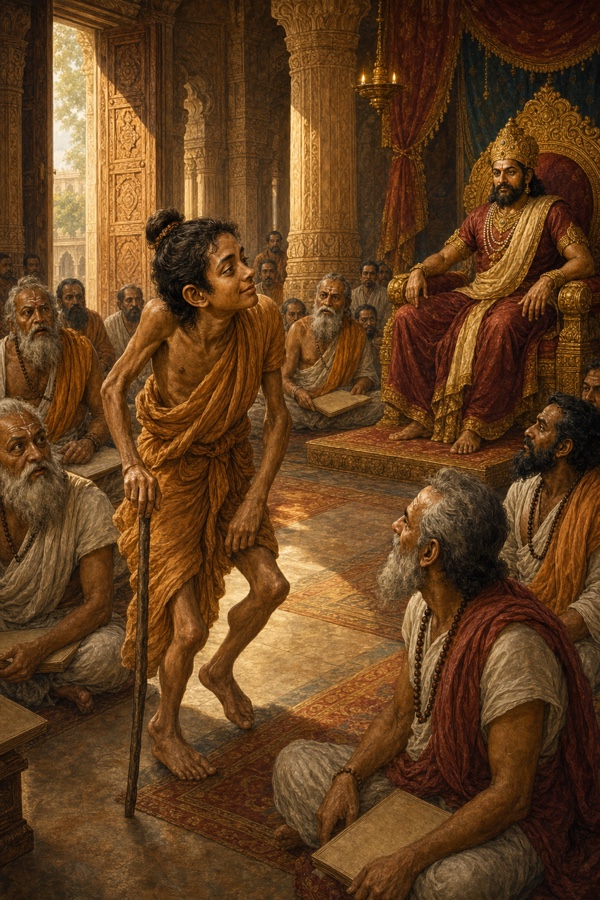
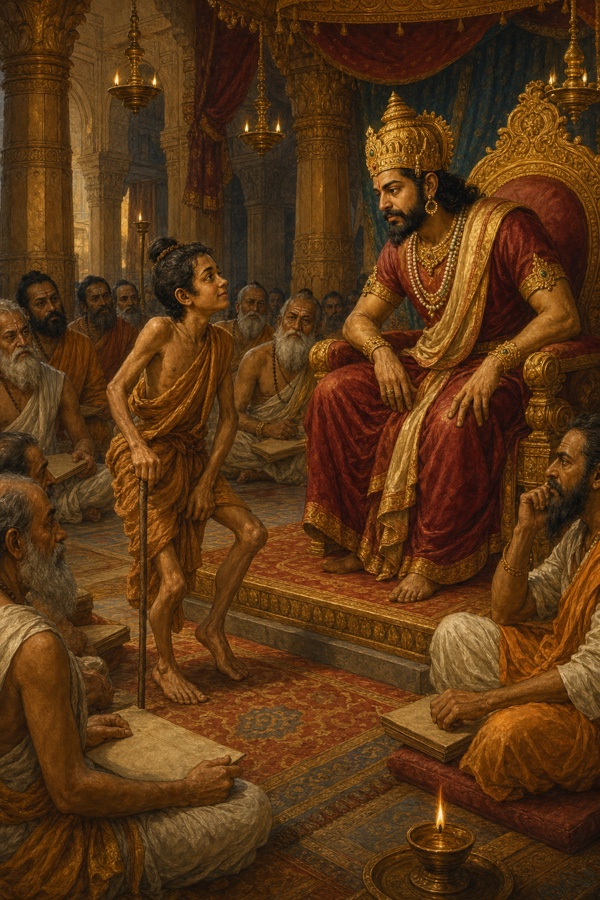
Then a young man came in. Thin, dark-skinned, his body bent in eight places, at the knees, at the elbows, at the neck. The reason went back to before his birth. His father, Kahoda, used to recite the Veda beside the mother’s womb, and once he faltered at a certain passage. The child growing in the womb corrected him. In anger the father laid down a curse: “Be bent in eight places.” And so the child was born. He was named Ashtavakra.
What followed comes down to us in popular tradition. That same Ashtavakra, grown now, stood today in Janaka’s court. The pandits saw his bent body and burst out laughing. What had this crooked boy come here to do?
Ashtavakra laughed too. His laughter held something else.
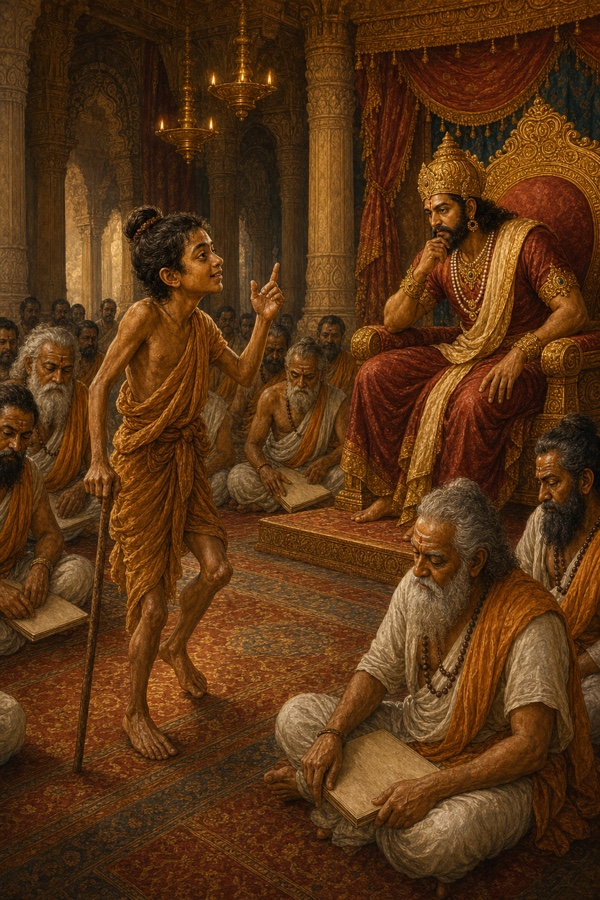
“King,” he said to Janaka, “I used to think that wise men sat in your court. Now I see that everyone here is a worker in hides. They keep their gaze only on the skin. Their eyes cannot touch the atman at all.”
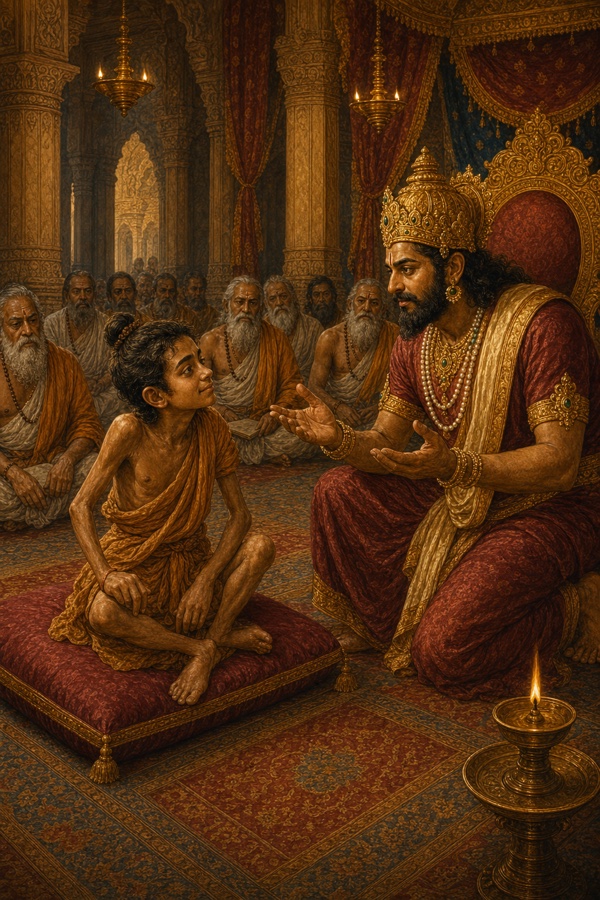
The pandits fell silent. Janaka seated Ashtavakra before him and put three questions to him: “How is knowledge gained? How is liberation reached? How does dispassion awaken?”
Ashtavakra’s answer, and Janaka’s condition afterward, this is the Ashtavakra Gita. It spreads across two hundred ninety-eight shlokas, yet the whole of it settles into the second shloka of the first chapter.
It is simple to hear. To let it sink into the heart is another matter. Ashtavakra’s two hundred ninety-eight shlokas carry this one thing all the way to the heart, again and again, from many sides, through many images. In places the listener hears it in the voice of the sage, in places in the voice of Janaka.
And in between, in the first shloka of chapter two, Janaka speaks a single sentence. That sentence is the heart of this dialogue. After that moment Janaka was no longer the same.
The order to read in
For a first acquaintance, chapters one, two, three, and eighteen are enough. Chapters one and two lay the ground, chapter three deepens it, and chapter eighteen (a hundred shlokas) is the gist of the whole dialogue. The remaining chapters repeat these same themes from ever new directions.
For anyone who has read the Bhagavad Gita, a difference opens up here. The Gita offers a path you climb in order, karma-yoga, bhakti-yoga, jnana-yoga, three stairs of a sort. Ashtavakra asks for only one recognition, with no stair at all. The demand is severe, and its path is short as well, though it is short only for those who are ready.
If, as you read, your mind says, “this is so impossible that it cannot be true,” that is natural. This dialogue was composed to quiet that very resistance. Keep going. Within a few shlokas that resistance begins to settle on its own.
A few questions, a few answers
How does the Ashtavakra Gita differ from the Bhagavad Gita?
The Bhagavad Gita was spoken on a battlefield, the Ashtavakra Gita in a royal court. The Gita’s listener is Arjuna, broken by grief and delusion. Ashtavakra’s listener is Janaka, already a knower who needs only the final confirmation. The Gita offers three paths: karma, bhakti, jnana. Ashtavakra offers only jnana, and says this is the one path. The Gita leads you along in stages; Ashtavakra sets everything down in a single moment.
Why is the Ashtavakra Gita called the most fearless Advaita?
Because it calls even sadhana, every spiritual practice, pointless. The goal of every sadhana is “to attain liberation.” Ashtavakra says that treating liberation as a thing to be attained is itself the illusion, because you are already free. In chapter two Janaka says it himself: the body, heaven and hell, bondage and liberation, and fear are all mere imagination. This utterance unsettles the yogi, because his whole sadhana stands on the assumption that there is something to “attain.”
What is it in the first shloka of chapter two that shakes a person so?
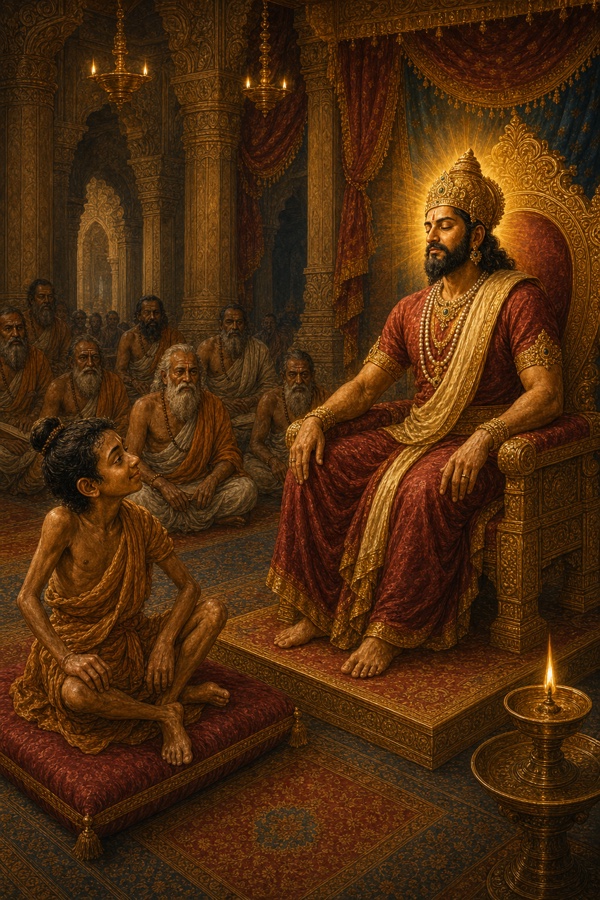
In chapter one, Ashtavakra showed the nature of the atman across twenty shlokas. In the first shloka of chapter two comes Janaka’s reply: “Aho niranjanah shanto bodho’ham prakriteh parah, etavantam aham kalam mohenaiva vidambitah.” It means: “How astonishing! I am pure, at peace, awareness itself, beyond nature. All this time I was fooled by nothing but delusion.” One shloka of teaching, one shloka of recognition. This compression is the rare thing about this dialogue.
Does the Ashtavakra Gita mean anything for a householder?
Janaka was a king. A wife, children, ministers, war, the treasury of the realm, all of it rested on his shoulders. Even after the Ashtavakra Gita he went on ruling. In practice, then, this dialogue came down for the householder. That does not make it easy. It says: let all your responsibilities run on as before, and let your identity stay unbound from those responsibilities. Holding that distance is the real practice.
What was Ramana Maharshi’s connection to this dialogue?
Ramana Maharshi spoke of the Ashtavakra Gita with respect. The witness of chapters one and two sits very close to Ramana’s self-inquiry, “Who am I?”
Chapter eighteen has a hundred shlokas. Is it necessary to read them all?
Chapter eighteen is the gist of the whole dialogue. There Ashtavakra says one thing from many directions: how the knower looks, what flows within him, what happens around him. This repetition serves a purpose. The recognition of Advaita is not a thing you grasp once and then set aside. It has to be heard again and again, through many illustrations. These hundred shlokas work like one long meditation.
Does this dialogue mean anything for those on the path of bhakti as well?
Yes, in its own time. At the start of bhakti, the bond between devotee and God grows firm: “I am the devotee, you are God.” Ashtavakra dissolves that very bond. For those who have come far enough on the path of bhakti, this is the final door, where “I” and “you” begin to appear as two forms of one consciousness. For a new devotee it can be confusing. So first the Narada Bhakti Sutra, then Ashtavakra, that order is more fitting.
Why was Ashtavakra’s body bent in eight places, and what does that have to do with this dialogue?
The story goes that his father, Kahoda, faltered at a certain passage while reciting beside the mother’s womb. From the womb Ashtavakra corrected him. In anger the father cursed him: “Be bent in eight places.” This story is itself a kind of parable. Those who judge by the body cannot see knowledge. Ashtavakra’s very first words in the court showed exactly this. The body is only a covering. Whether it holds a bend or a straight line, that is not the form of the atman. The whole dialogue stands on this one point, from beginning to end.
The twenty chapters
Each panel leads to a chapter of its own. The reading order is the same as the original. Read one, two, three, and eighteen first, and understanding comes quickly.
Read alongside
- Bhagavad Gita, Chapter 2 Sankhya Yoga, where the ground of the truth of the self is laid.
- Yoga Sutras, Pada 1 What samadhi is, bound up with Ashtavakra’s vision of liberation.
- Kena Upanishad “Who moves the mind,” an early form of Ashtavakra’s question.
The same story, elsewhere
- The awakening of King Janaka
Yoga Vasistha: the sudden awakening of King Janaka - Brihadaranyaka Upanishad
Brihadaranyaka Upanishad: Yajnavalkya in Janaka’s assembly - Chapter 2: Sankhya Yoga
Bhagavad Gita, Chapter 2: the marks of the steady-minded - Part 14 · The marks of the one liberated in life
Vivekachudamani: the marks of the one liberated in life