Vivekachudamani
Part 14 · Recognizing the jivanmukta, the whole Brahman held in the heart · Shlokas 408-440
First a three-shloka refrain that holds up one and the same picture three times over, the whole Brahman kept in the heart. Then that celebrated four-rung ladder that climbs from dispassion to peace. And at the end, what a liberated man walking and moving about on the ground is like within, set out in sixteen exact marks.
The method of samadhi and the verdict of non-duality built up until now arrive at one particular place, at a single picture. The guru lifts a line that will return three times over: the wise man holds the whole Brahman in the heart, in samadhi. Here “kalayati”, to hold, speaks of cradling more than of doing, as if the heart were a vessel and Brahman rested inside it, filled with ease. For the first time Brahman is described this way: ceaseless awareness, the form of bliss alone, matchless, past every bound, eternally free, still and without striving, like a boundless sky, partless and free of all variance.
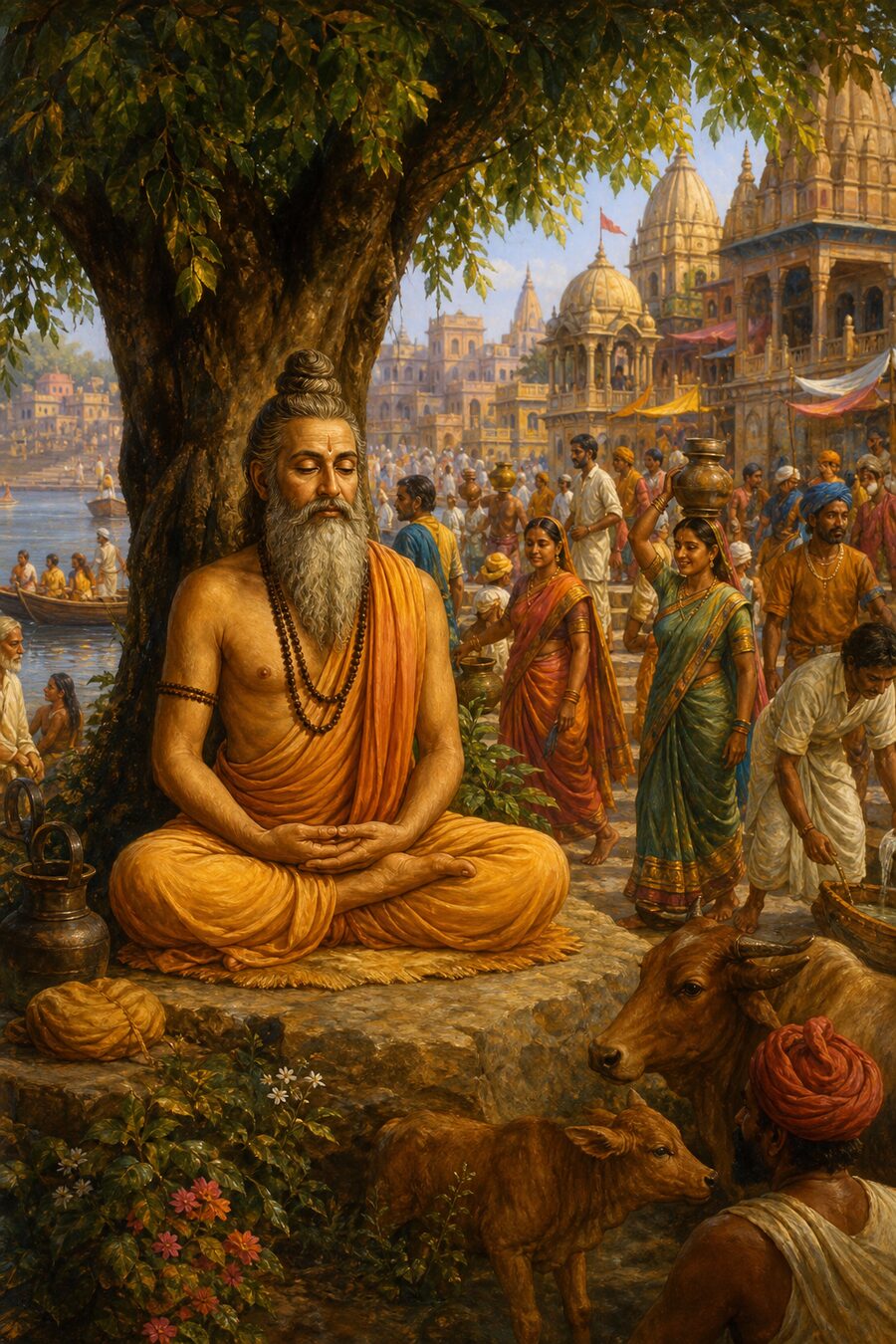
408 · The wise hold the whole Brahman in the heart, in samadhi
किमपि सततबोधं केवलानन्दरूपं निरुपममतिवेलं नित्यमुक्तं निरीहम् ।
निरवधिगगनाभं निष्कलं निर्विकल्पं हृदि कलयति विद्वान् ब्रह्म पूर्णं समाधौ ॥ 408 ॥
The same heartbeat sounds a second time, now carrying one extraordinarily beautiful word, “asmat-prasiddham”, renowned to us. This is nothing foreign. All of us know it already, though not with the kind of knowing we use on objects. It is the knowledge that lives inside our very being, and the word of the Veda clears it up while adding nothing new; it only reminds. Then a third and final time the same line returns, now with the loveliest image of all, a vast body of still water in which there is no wave, no ripple, no stir. And “akhya-viheenam”, without a name, because whatever name we give, it stands past all names. This third repetition comes to rest on one word, “ekam”, one.
409 · 410
प्रकृतिविकृतिशून्यं भावनातीतभावं समरसमसमानं मानसं बन्धदूरम् ।
निगमवचनसिद्धं नित्यमस्मत्प्रसिद्धं हृदि कलयति विद्वान् ब्रह्म पूर्णं समाधौ ॥ 409 ॥
अजरममरमस्ताभाववस्तुस्वरूपं स्तिमितसलिलराशिप्रख्यमाख्याविहीनम् ।
शमितगुणविकारं शाश्वतं शान्तमेकं हृदि कलयति विद्वान् ब्रह्म पूर्णं समाधौ ॥ 410 ॥
Now the guru turns toward the student and gives a call that takes courage. With a gathered inner instrument, in your own true nature, look upon that atman whose glory is unbroken. And cut this bondage that is steeped in the scent of the world, for bondage is like a perfume, rising from every side. Here comes the hard line: make your human birth succeed, for this life earns its meaning only when it does this one thing. Then he takes you deeper. Take the atman that is free of every limiting adjunct, being-consciousness-bliss, one without a second, and go past merely thinking it: feel it, settle into it, because once this conviction sets firm, no reason remains to return to the road of birth and death.
411 · 412
समाहितान्तःकरणः स्वरूपे विलोकयात्मानमखण्डवैभवम् ।
विच्छिन्द्धि बन्धं भवगन्धगन्धितं यत्नेन पुंस्त्वं सफलीकुरुष्व ॥ 411 ॥
सर्वोपाधिविनिर्मुक्तं सच्चिदानन्दमद्वयम् ।
भावयात्मानमात्मस्थं न भूयः कल्पसेऽध्वने ॥ 412 ॥
What of the body? The guru paints a lovely picture, the shadow. A shadow walks step for step with a man, and still the man and his shadow are known, easily, to be two. The mahatma’s body is like this too: it walks along, it stays visible, and it is only a semblance; it is never the “I”, and he never joins it back into himself. Then comes a sharp, deliberately unpleasant image, “vanta-vastu”, a thing vomited out, which no one wishes to recall; in the same way, once the body-sense is dropped, it is never to be recalled again. And this asks for more than setting it aside: “samoolam”, it must be burned down with its roots, because if the roots of ignorance survive in the subtle body and the latent tendencies, the plant sprouts once more; nirvikalpa samadhi is the very fire that reaches down to the root, and the finest of the wise then comes to rest in the ever-pure atman of awareness and bliss.
413 · 414 · 415
छायेव पुंसः परिदृश्यमान् माभासरूपेण फलानुभूत्या ।
शरीरमाराच्छववन्निरस्तं पुनर्न संधत्त इदं महात्मा ॥ 413 ॥
सततविमलबोधानन्दरूपं समेत्य त्यज जडमलरूपोपाधिमेतं सुदूरे ।
अथ पुनरपि नैष स्मर्यतां वान्तवस्तु स्मरणविषयभूतं पल्पते कुत्सनाय ॥ 414 ॥
समूलमेतत्परिदाह्य वन्हौ सदात्मनि ब्रह्मणि निर्विकल्पे ।
ततः स्वयं नित्यविशुद्धबोधानन्दात्मना तिष्ठति विद्वरिष्ठः ॥ 415 ॥
Now the guru brings a plain village image, the garland on a cow’s neck. Someone drapes a flower garland on a cow’s neck; the cow neither knows nor cares. This body, strung together by prarabdha (destiny already in motion), is just the same: whether it goes or stays, it makes no difference to the knower of truth, whose mind is dissolved in Brahman, the atman of bliss. And a sweet question rises: one who has already realized the atman of unbroken bliss, in what hope, and for whose sake, would he run to dress and adorn the body? The urge to tend it comes only to those for whom the body still feels like “mine”. Then the guru names the true fruit of liberation-in-life, and it is no miracle, no seat in heaven, only “bahih antah”, within and without, the ceaseless taste of the ever-blissful rasa in the atman. This is the real test: anyone finds bliss in samadhi, and the jivanmukta finds it in the marketplace too.
416 · 417 · 418
प्रारब्धसूत्रग्रथितं शरीरं प्रयातु वा तिष्ठतु गोरिव स्रक् ।
न तत्पुनः पश्यति तत्त्ववेत्ता आनन्दात्मनि ब्रह्मणि लीनवृत्तिः ॥ 416 ॥
अखण्डानन्दमात्मानं विज्ञाय स्वस्वरूपतः ।
किमिच्छन् कस्य वा हेतोर्देहं पुष्णाति तत्त्ववित् ॥ 417 ॥
संसिद्धस्य फलं त्वेतज्जीवन्मुक्तस्य योगिनः ।
बहिरन्तः सदानन्दरसास्वादनमात्मनि ॥ 418 ॥
Now comes that most memorable four-rung ladder. The fruit of dispassion is awareness; the fruit of awareness is cessation (uparati); and from the experience of one’s own bliss comes peace, and that is the fruit of cessation. Four words, four steps, and the clean map of a whole journey, where every rung is needed for the next. But the guru at once adds a stern point: if the next rung is missing, everything below it comes to nothing. Dispassion without awareness leaves the dispassion useless; awareness without cessation leaves the awareness useless. Half a ladder carries you nowhere. And the fruit of the full climb is “svatah”, the supreme contentment of a turning-away that rises on its own, that matchless bliss which no amount of doing can bring.
419 · 420
वैराग्यस्य फलं बोधो बोधस्योपरतिः फलम् ।
स्वानन्दानुभवाच्छान्तिरेषैवोपरतेः फलम् ॥ 419 ॥
यद्युत्तरोत्तराभावः पूर्वपूर्वन्तु निष्फलम् ।
निवृत्तिः परमा तृप्तिरानन्दोऽनुपमः स्वतः ॥ 420 ॥
Now the guru offers a very practical test: what is the visible fruit of knowledge? Only this, that the sorrows standing in front of you no longer raise the old panic. Sorrows will come, illness, defeat, insult; the difference lies in whether you fall into agitation or hold steady without it. And the many blameworthy deeds done in the time of delusion fall away on their own once discernment arrives, because now they no longer even look worth doing. The guru makes this clear with one plain picture, the mirage. A thirsty man takes a mirage for water and runs toward it, and that is the fruit of ignorance; one who knows stays clear of the same mirage, and that is the fruit of knowledge. This difference shows itself directly, far more than any matter of theory, and this is the true test of knowledge.
421 · 422
दृष्टदुःखेष्वनुद्वेगो विद्यायाः प्रस्तुतं फलम् ।
यत्कृतं भ्रान्तिवेलायां नाना कर्म जुगुप्सितम् पश्चान्नरो विवेकेन तत्कथं कर्तुमर्हति ॥ 421 ॥
विद्याफलं स्यादसतो निवृत्तिः प्रवृत्तिरज्ञानफलं तदीक्षितम् ।
तज्ज्ञाज्ञयोर्यन्मृगतृष्णिकादौ नोचेद्विदां दृष्टफलं किमस्मात् ॥ 422 ॥
The guru lays down an argument: once the “hridaya-granthi”, the knot of the heart which is chiefly the identity “I am the body”, breaks fully open, how, on their own, would sense-objects set an unwilling man into action? The moment the knot loosens, “my pleasure” no longer survives inside the objects, and even standing right in front of him they cannot pull. Then he names the outer limit of all three, dispassion, awareness, and cessation. That craving does not stir even at the sight of an enjoyable thing, that is the limit of dispassion; that the pride of “I” does not wake whatever happens, that is the highest limit of awareness; and that the tendencies already dissolved never lift their heads again, that is the limit of cessation.
423 · 424
अज्ञानहृदयग्रन्थेर्विनाशो यद्यशेषतः ।
अनिच्छोर्विषयः किं नु प्रवृत्तेः कारणं स्वतः ॥ 423 ॥
वासनानुदयो भोग्ये वैरागस्य तदावधिः ।
अहंभावोदयाभावो बोधस्य परमावधिः लीनवृत्तैरनुत्पत्तिर्मर्यादोपरतेस्तु सा ॥ 424 ॥
Now the guru draws a wonderful picture, the everyday life of the jivanmukta. He rests always in the form of Brahman, free of any sense of outer objects, and even his awareness of things to enjoy comes only when others point them out. “Nidralu-vat bala-vat”, like one sunk in sleep, like a child; a child does not ask for food, the mother gives, the child eats, and a man deep in sleep does not deliberate while things go on around him. The jivanmukta sees this world the way one sees a world glimpsed in a dream, seated somewhere with knowledge attained, enjoying the fruit of endless merit, honored on the earth. He is the very “sthitaprajna” the Gita made famous, who tastes eternal bliss, his self dissolved in Brahman alone, changeless and free of action.
425 · 426
ब्रह्माकारतया सदा स्थिततया निर्मुक्तबाह्यार्थधीर् अन्यावेदितभोग्यभोगकलनो निद्रालुवद्बालवत् ।
स्वप्नालोकितलोकवज्जगदिदं पश्यन् क्वचिल्लब्धधीर् आस्ते कश्चिदनन्तपुण्यफलभुग्धन्यः स मान्यो भुवि ॥ 425 ॥
स्थितप्रज्ञो यतिरयं यः सदानन्दमश्नुते ।
ब्रह्मण्येव विलीनात्मा निर्विकारो विनिष्क्रियः ॥ 426 ॥
Now the guru defines “prajna” and “sthitaprajna” in the plainest possible words. Prajna is the movement of mind that sinks into the oneness of the purified Brahman and the atman, free of all alternatives, and pure consciousness, “chin-matra”, awareness alone. Only when this movement grows “susthita”, strong and settled, is the person called a sthitaprajna; everything rests on its staying, on a prajna that holds firm and does not merely flare up once. From here comes the first brief definition of the jivanmukta, in three marks: one whose prajna is steady, whose bliss is unbroken, and for whom the whole spread of the world has become “vismrita-praya”, almost-forgotten. This third word is subtle: the world has turned almost-forgotten rather than wholly gone, still visible, and yet with no hold left anywhere.
427 · 428
ब्रह्मात्मनोः शोधितयोरेकभावावगाहिनी ।
निर्विकल्पा च चिन्मात्रा वृत्तिः प्रज्ञेति कथ्यते सुस्थितासौ भवेद्यस्य स्थितप्रज्ञः स उच्यते ॥ 427 ॥
यस्य स्थिता भवेत्प्रज्ञा यस्यानन्दो निरन्तरः ।
प्रपञ्चो विस्मृतप्रायः स जीवन्मुक्त इष्यते ॥ 428 ॥
The second definition is lovelier still, “leena-dhee”, the intellect dissolved, and yet awake. Ordinarily, when the intellect dissolves, in deep sleep or in samadhi, we are not awake; and when we are awake, the intellect is running, sunk in thought and dealing. The jivanmukta stands in a third state, awake and with the intellect dissolved at the same time, doing all his work outside, everything at peace within, and his awareness “nirvasana”, which no craving can shake. The third definition holds a wonderful paradox, “kalavan api nishkalah”, possessed of parts and yet partless. The body shows, the limbs are there, and his identity rests in partless consciousness rather than in the limbs; the imagining of the world has quieted inside him, and his mind is free of care, whatever worries stand nearby.
429 · 430
लीनधीरपि जागर्ति जाग्रद्धर्मविवर्जितः ।
बोधो निर्वासनो यस्य स जीवन्मुक्त इष्यते ॥ 429 ॥
शान्तसंसारकलनः कलावानपि निष्कलः ।
यस्य चित्तं विनिश्चिन्तं स जीवन्मुक्त इष्यते ॥ 430 ॥
From here begins that deep chain of sixteen marks, each one a small window opening onto the change inside. The first mark is the most basic and the hardest: even in this present body, which follows him like a shadow, the absence of any grip of “I” and “mine”. Anyone can know that “I am not the body”, and holding that awareness steady through the day’s rush is the real test. The second mark spreads across all three times: no repeated dwelling on what is past, no thinking about what is to come, and even toward the present that has fallen in front of him, indifference. The guru here goes a step past merely staying in the present: even in this moment right before you, the mind should catch nowhere.
431 · 432
वर्तमानेऽपि देहेऽस्मिञ्छायावदनुवर्तिनि ।
अहन्ताममताभावो जीवन्मुक्तस्य लक्षणम् ॥ 431 ॥
अतीताननुसन्धानं भविष्यदविचारणम् ।
अउदासीन्यमपि प्राप्तं जीवन्मुक्तस्य लक्षणम् ॥ 432 ॥
The third mark belongs to vision. The world stays as it is, filled with virtue and flaw, many-formed by its very nature; it does not change, what changes is the eye of the one who looks. Equal vision, “sama-darshita”, still lets him see the difference between virtue and flaw. What it adds is this: everywhere the same single atman shows itself, in a beggar or a king, an enemy or a friend, one consciousness standing behind them all. The fourth mark is the most daily and the most demanding form of this, that whether the welcome or the unwelcome arrives, there is no change in either. Experience still happens; it simply does not harden into a distortion, the way a stone dropped into a still lake raises a small wave while the lake stays the lake.
433 · 434
गुणदोषविशिष्टेऽस्मिन्स्वभावेन विलक्षणे ।
सर्वत्र समदर्शित्वं जीवन्मुक्तस्य लक्षणम् ॥ 433 ॥
इष्टानिष्टार्थसम्प्राप्तौ समदर्शितयात्मनि ।
उभयत्राविकारित्वं जीवन्मुक्तस्य लक्षणम् ॥ 434 ॥
The next mark gives an intimate glimpse, “the not-knowing of inside and outside”. Ordinarily we stay split between inside and outside, work on the outside, turmoil within; but once the mind sinks fully into the taste of the rasa of Brahman-bliss, that division melts, nothing stays inside, nothing outside, only one rasa. Then a very practical mark: the work of the body and the senses keeps running, food has to be given, the tasks of the senses have to be met, and yet the jivanmukta puts no “I am doing this”, no “this is mine” into them. The indifference here means detachment. It does not mean neglect. The work goes on, the body keeps doing it by itself, as though someone apart from it sat watching.
435 · 436
ब्रह्मानन्दरसास्वादासक्तचित्ततया यतेः ।
अन्तर्बहिरविज्ञानं जीवन्मुक्तस्य लक्षणम् ॥ 435 ॥
देहेन्द्रियादौ कर्तव्ये ममाहंभाववर्जितः ।
अउदासीन्येन यस्तिष्ठेत्स जीवन्मुक्तलक्षणः ॥ 436 ॥
The guru gives one more beautiful phrase, “shruteh balat”, by the force of shruti. One who came to know the Brahman-nature of his own atman by standing on the firm ground of the words handed down, past all private guesswork, and who broke free of the world’s bondage, he bears the mark of the jivanmukta; your own seeking and your own experience matter, and “the force of shruti” is what lends them authority. Then a very fine point of non-duality arrives: “I” and “this” are a single pair. Only when “I am the body” is present does all the rest become “this, the other”; in the jivanmukta neither stands, no “I” in himself, no “this” in others, only one consciousness remains, without a limit, without a division.
437 · 438
विज्ञात आत्मनो यस्य ब्रह्मभावः श्रुतेर्बलात् ।
भवबन्धविनिर्मुक्तः स जीवन्मुक्तलक्षणः ॥ 437 ॥
देहेन्द्रियेष्वहंभाव इदंभावस्तदन्यके ।
यस्य नो भवतः क्वापि स जीवन्मुक्त इष्यते ॥ 438 ॥
Now the guru sets out non-duality on two levels. First, the inner “I” and Brahman are one; second, Brahman and its creation are one. Most people reach the first oneness, “I am Brahman”, while the second oneness, “this creation too is Brahman”, stays hard; the jivanmukta knows both unities through prajna, through direct experience rather than through the intellect. And the guru saves the most demanding mark for the end, evenness in honor and in insult. Let the holy revere this body, and there is an opening for pride to rise; let the wicked torment it, and there is an opening for anger and pain to rise; these are the oldest reactions of the mind. But one in whom the same evenness holds in both places, he is the jivanmukta, because once the grip of “this body is I” is finished, whether the body is worshipped or tormented, it never touches the real “I” at all.
439 · 440
न प्रत्यग्ब्रह्मणोर्भेदं कदापि ब्रह्मसर्गयोः ।
प्रज्ञया यो विजानिति स जीवन्मुक्तलक्षणः ॥ 439 ॥
साधुभिः पूज्यमानेऽस्मिन् पीड्यमानेऽपि दुर्जनैः ।
समभावो भवेद्यस्य स जीवन्मुक्तलक्षणः ॥ 440 ॥
What comes after this
The very next page is Part 15, where the river of sense-objects dissolves into the ocean of the jivanmukta without raising any disturbance. Then comes a clean analysis of the three karmas, sanchita (accumulated), prarabdha (in motion), and agami (yet to come), and the seven-shloka refrain of “एकमेव अद्वयं ब्रह्म नेह नानास्ति किंचन”.
The gist of this part sits in shloka 440: whether the holy revere you or the wicked torment you, one same evenness holds within. Honor and insult are both among the oldest reactions of the mind, and to the exact degree that these still move you, the old grip tied to the body is still left over.
The same story, elsewhere
- Chapter 2: Sankhya Yoga
Bhagavad Gita, Chapter 2: the marks of the sthitaprajna - Ashtavakra Gita
Ashtavakra Gita: the state of the liberated man