The Purusha Sukta
A body the world cannot contain, and the yajna that becomes the world
Picture a body so vast that it covers the whole earth, every sea and every mountain of it, and then keeps going past the edge with room left over. This is the Purusha. And in the story that follows, this same body is laid on the fire as a yajna (fire-rite), and out of what the fire takes, the entire world is made.
Its source is Rigveda 10.90, sixteen verses long. The same hymn returns in the Vajasaneyi Samhita 31, the Atharvaveda 19.6, the Samaveda, and the Taittiriya Aranyaka 3.12-13. The later liturgical text adds the verses of the Uttaranarayana, which bind the Purusha to Narayana and give the hymn a Vaishnava color.
A body larger than the world
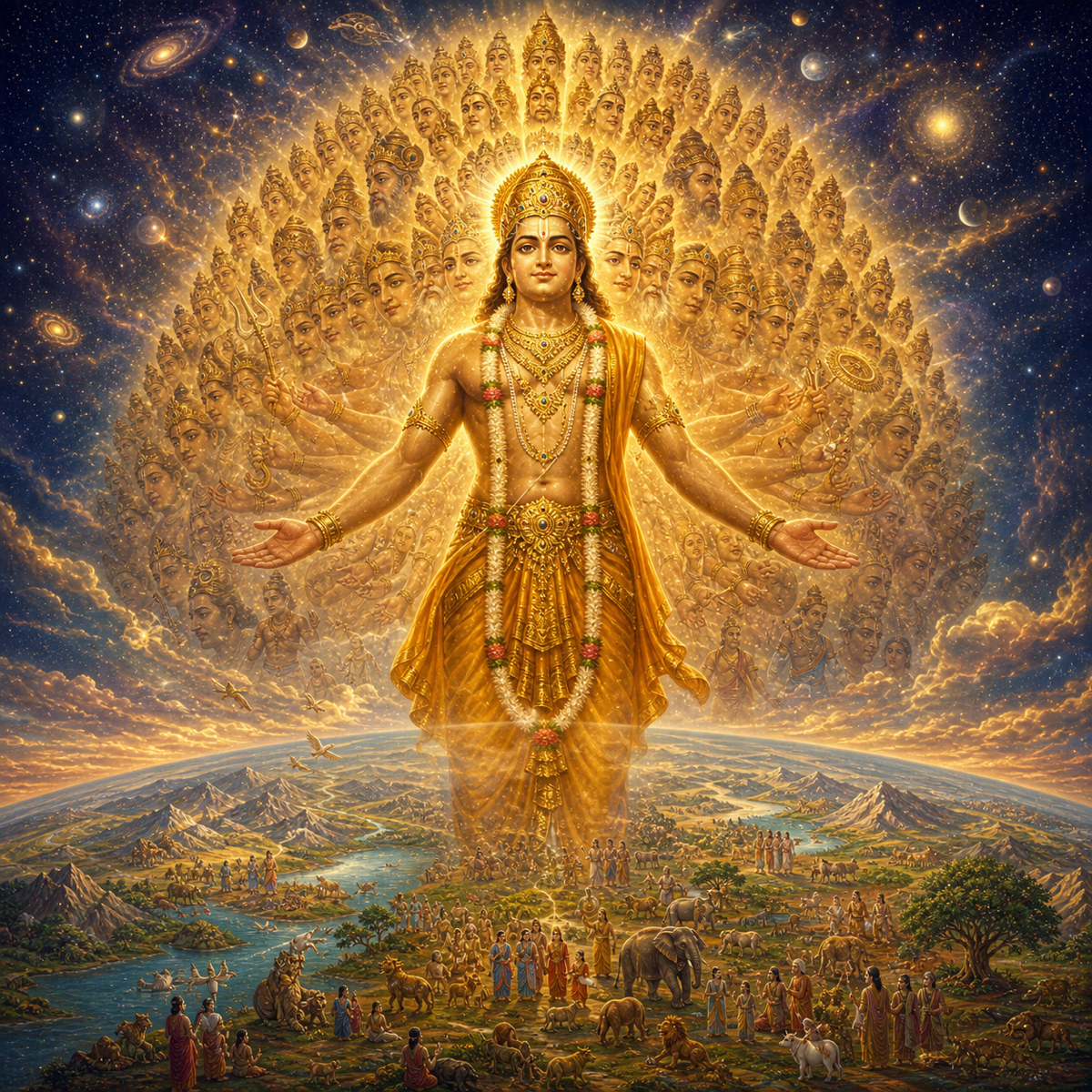
The hymn opens with a colossal body. This Purusha has a thousand heads, a thousand eyes, a thousand feet. He covers the earth on every side, and where that covering runs out he reaches ten fingers (dashangulam) further still, a span you could measure off on your own two hands, set here against a body the size of the world. He is what has already been and what is yet to be. Then the hymn gives its proportion, and it is worth slowing down for. All living beings, everything that breathes, come to one quarter of him, and the other three quarters are the immortal part in heaven: “pado ‘sya vishva bhutani, tripad asyamritam divi.”
The yajna that becomes the world
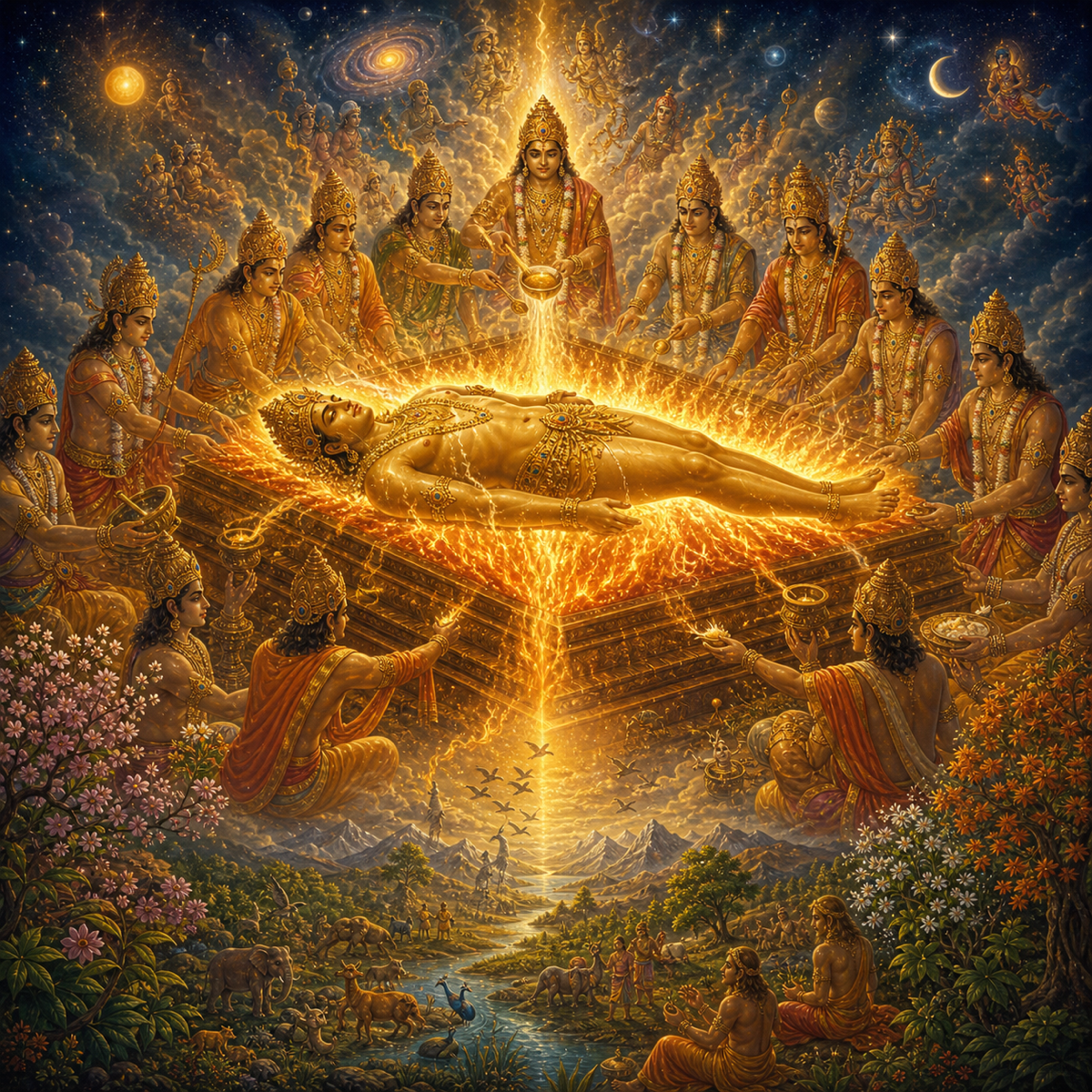
Then the gods make that Purusha the oblation of a primordial yajna, and the seasons become its materials. There is no world yet to build an altar on, so the rite is performed with the only things that exist, a body and time. From that dismembered body the ordered world rises, the ric hymns and the saman chants and the meters, the animals, and the divisions of the worlds. Creation here is a yajna, and the yajna is the act that shapes the world and then keeps holding it together.
The matching of the limbs
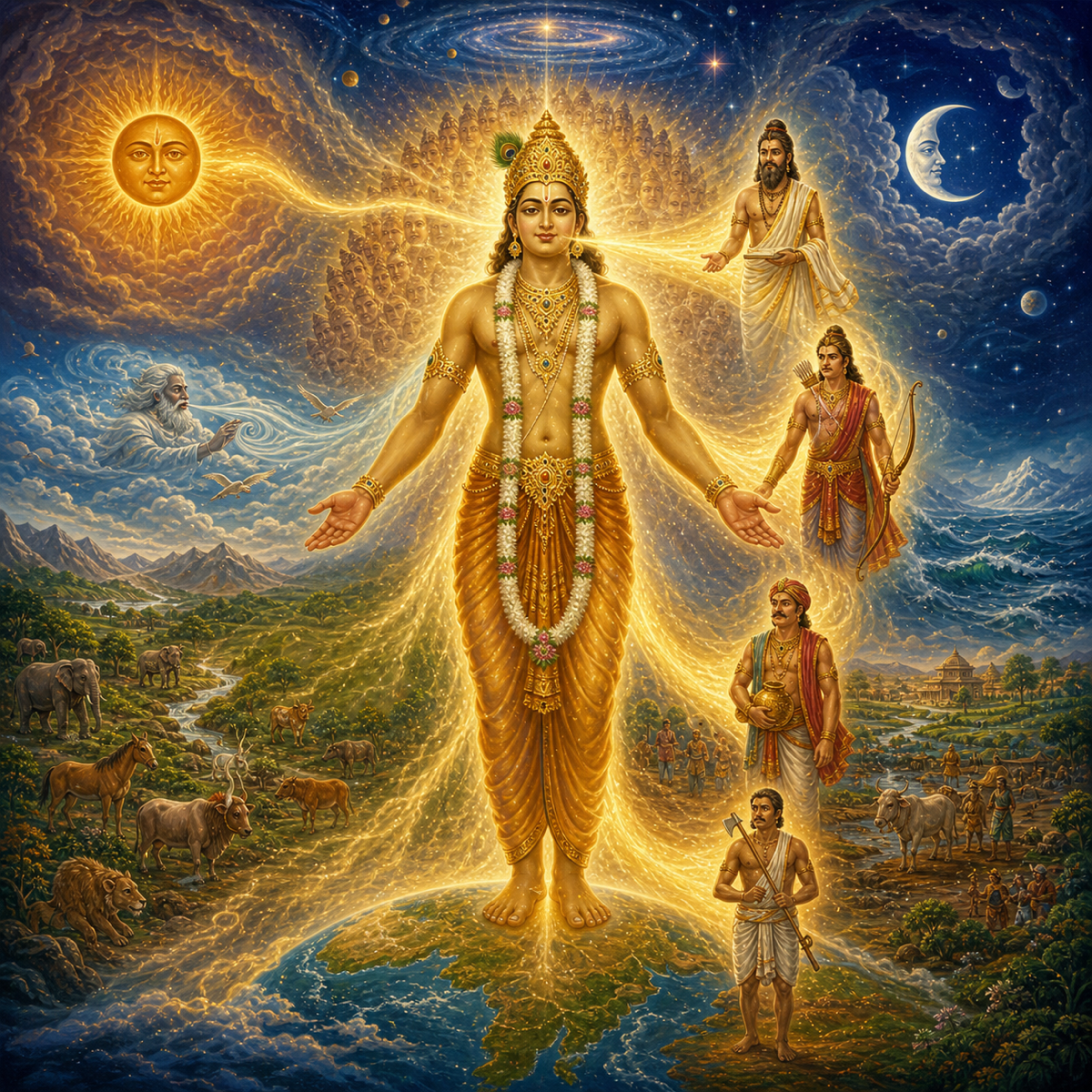
Look at the correspondences, and notice that they all run one way, out of the body and into the world. From his mind, the moon; from his eye, the sun; from his mouth, Indra and Agni; from his breath, the wind; from his head, the sky; and from his feet, the earth. Everything you can lift your eyes to has a limb standing behind it. And the varnas of society come out of that same body, from his mouth the Brahmin, from his arms the Kshatriya, from his thighs the Vaishya, and from his feet the Shudra (Rigveda 10.90.12). This verse has to be stated plainly, because it is the textual root of the varna order. The debate tied to it is kept in the caste section of the Hinduism page.
The weight it carries
This weight runs in several directions at once. Casting creation as a yajna makes the yajna itself the machinery that builds the world and keeps it running. A single reality beneath all multiplicity: this is a step toward the Brahman and the atman (self) of the Upanishads. The correspondence among body, cosmos, and society is a major subject among scholars (Brian K. Smith). And its sixteen verses are matched with the sixteen services (upacharas) of puja.
The date, and a wider view
The tenth mandala is a later layer of the Rigveda, and 10.90 is one of its later hymns (Jamison and Brereton), which puts this vision at the far end of the collection. A cosmos fashioned from a primordial body: this image returns again and again across the Indo-European and ancient worlds, Ymir, Tiamat, Pangu (Bruce Lincoln).
The sixteen verses, one by one
The first verse is the colossal body itself. A thousand heads, a thousand eyes, a thousand feet; he wraps the earth on every side and still stands ten fingers beyond it. In its very first breath the hymn sets down a measure and something that no measure can hold, and it keeps both in the same hand for the rest of the way.
The second verse says that everything that has already been and everything that is still to come is this Purusha, and nothing else. He is the lord of immortality as well, the one who waxes greater still by food.
The third verse gives the proportion. So great is his majesty, and the Purusha is greater still than that. All living beings are one quarter of him; the other three quarters are the immortal part in heaven. Every creature you can see makes up that single quarter, and no more than that.
In the fourth verse the Purusha rises upward with those three quarters, and one quarter comes into being here again. From that single quarter he spreads out in every direction, over what eats and over what does not eat, over the living and the lifeless both, so that nothing on either side of that line is outside him.
The fifth verse ties a strange knot in the order of birth. From this Purusha the Viraj was born, the sovereign splendor that rules far and wide, and from the Viraj in turn the Purusha. As soon as he was born he reached out past the earth, behind it and before it. Cause and effect here give birth to each other, and the hymn does not apologize for it.
The sixth verse opens the yajna. The gods spread out the rite with the Purusha as the offering, and the seasons served as its materials: spring was its clarified butter, summer its fuel, autumn its oblation. Time itself is poured onto the fire.
In the seventh verse the Purusha, born before everything, is consecrated as the victim on the sacred grass. With him the gods performed the rite, and the Sadhyas performed it, and the seers performed it. The ones who sacrifice and the one who is sacrificed stand together in the same verse, and the hymn will come back to that before it ends.
The eighth verse gathers what the fire gives back. From that all-offered yajna, in which everything had been given up, the clotted butter was collected, the mixture of curd and ghee that the rite yields; and out of it were made the creatures of the air, the animals of the forest, and the animals of the village.
In the ninth verse, from that same all-offered yajna the ric verses and the saman chants were born, the meters were born, and the yajus formulas were born from it. The voice of the Veda rises here out of the sacrificial fire, and the hymn in which this is said counts itself among what rose.
The tenth verse brings the herd. From it the horses were born, and every animal that carries teeth in both jaws, the upper and the lower; from it the cows were born, and from it the goats and the sheep. A farmer’s entire stockyard arrives in a single verse.
The eleventh verse is a question. When they divided the Purusha, into how many parts did they divide him? What was his mouth called, and what his two arms? What were his thighs, and what were his feet called?
The twelfth verse is the answer. The Brahmin was his mouth, the Rajanya was made from his arms, his thighs became the Vaishya, and from his feet the Shudra was born. Of the sixteen, this is the verse that carries the heaviest weight, and it has been carried for a very long time.
In the thirteenth verse the moon was born from his mind, the sun from his eye, Indra and Agni from his mouth, and the wind from his breath. What had been inside a body was hung in the sky.
In the fourteenth verse the middle air came from his navel, the sky took shape from his head, the earth from his feet, the directions from his ear; and so they fashioned the worlds. The map of one body turns out to be the whole cosmos, drawn to scale.
The fifteenth verse measures the altar. There were seven enclosing sticks, and three times seven pieces of fuel were made ready; and when the gods spread out the rite, they bound the Purusha as the victim. Between the twenty-one sticks and the seven enclosures stands, bound, the one from whom everything was made.
The sixteenth verse closes the hymn. With the yajna the gods sacrificed to the yajna; these were the first ordinances. Those mighty ones reached the heaven where the ancient Sadhyas and the gods dwell. The rite is the means and the rite is the goal, and that is the last thing the hymn has to say.
Frequently asked questions
Where is the Purusha Sukta from?
The source is Rigveda 10.90, sixteen verses long. It also returns in a few other Samhitas and in an Aranyaka, and in the later text the verses of the Uttaranarayana are added.
What does “ten fingers beyond” mean?
The Purusha covers the earth and still extends beyond it by that small measure. This is a way of saying that he is within creation and also past it.
Why is the verse about varna included here?
Because 10.90.12 is the textual root of the varna order, and it has to be stated clearly and directly. The criticism and debate tied to it are kept in the Hinduism page.
What is its connection to puja?
Its sixteen verses are matched with the sixteen upacharas of puja, one verse for each service offered, so it is recited again and again in formal worship.
Further reading
- Stephanie Jamison and Joel Brereton, The Rigveda
- Wendy Doniger, The Rig Veda
- Brian K. Smith, Reflections on Resemblance, Ritual, and Religion
- Bruce Lincoln, Myth, Cosmos, and Society
This hymn is a map, one that sets the body, the cosmos, and society on a single chart and lets you read across from any point to any other. Its idea is to make the world by dividing one reality into limbs, so that nothing in it is foreign to anything else. And on this same map sits the verse that ties varna to the body, a verse you need to know and whose criticism you need to keep beside it, both at once, in the same hand.