Textual context
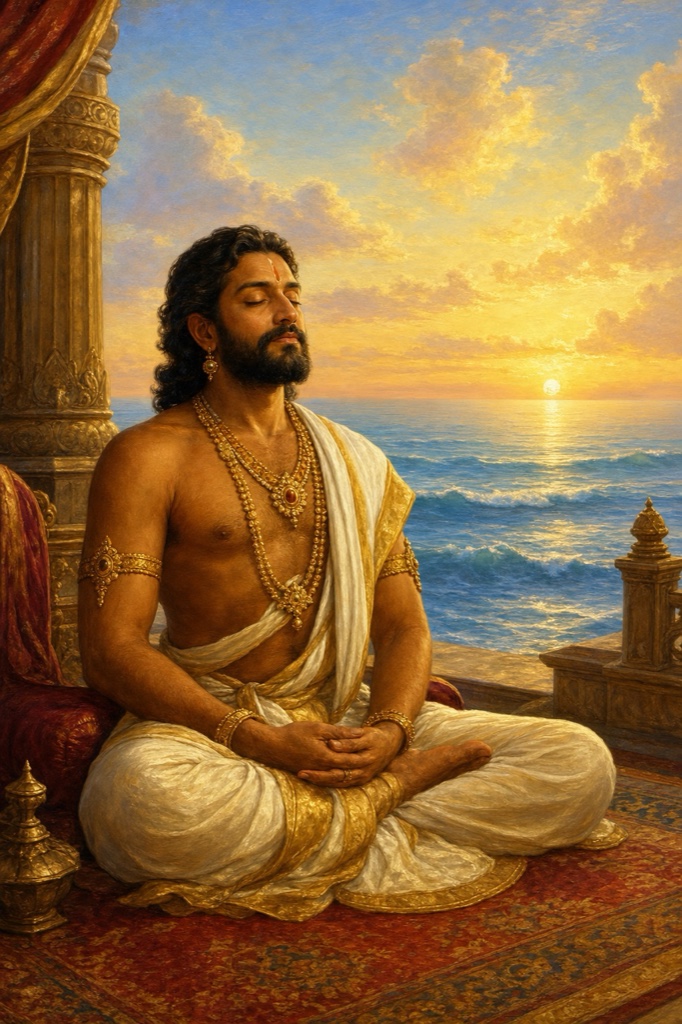
The sixth chapter is named Cit, consciousness. The Sanskrit root cit means to perceive, to know, to be aware, and the noun built on it names the knowing itself. Consciousness is the nearest English, a passive word for an active thing; cit is the lit state of a lamp, the shining itself.
In 1995 the philosopher David Chalmers gave the name hard problem of consciousness to the question of why there is any experience at all. Janaka’s four verses begin where that question stops: awareness is the one thing he is sure of, and he measures the world against it.
Consciousness
Consciousness · 4 shlokas
Janaka speaks four verses, and each closes on the same line: this is knowledge, and so there is no renouncing the world, no taking it up, no dissolving it. Ashtavakra has just told him four times to dissolve, and the king answers that even dissolving the world is one action too many.
Cit is the middle term of sat-cit-ananda, being, consciousness, bliss, the three words later Advaita Vedanta used for Brahman. Janaka’s own tools are four comparisons, space and a pot, an ocean and a wave, mother-of-pearl and silver, and a fourth that needs no picture.
So far
Ashtavakra has told the king four times to dissolve. Janaka takes the word out of his hands.
Janaka speaks, and the first picture he reaches for is the one Ashtavakra closed his first chapter with, the pot and the space around it. The king picks it up and turns it toward himself. I am endless like space, he says, and the world of nature is like a pot. Space has no edge; the pot is a thing made of clay, standing in the space without altering it by a hair. That alone is knowledge. A man who knows himself as the space has no quarrel with the pot. There is no reason to throw it away, no reason to take it up and no reason to melt it down, since the clay wall never divided anything. So of this world there is no renouncing, no accepting and no dissolving. Every tradition fills with two kinds of seeker, the ones who give the world up and the ones who take it on, and the two argue. Janaka stands outside the argument. The world is a pot, and it may stay on the shelf.
Shloka 1
I am endless like space, and the world of nature is like a pot. This is knowledge, and so there is no renouncing the world, no taking it up, no dissolving it.
The second picture is the ocean and the wave, and this too came from Ashtavakra, in the third chapter, when he asked the king why a man in whom the universe flashes like waves on the sea runs about like a man in want. Janaka hands it back as a settled fact. I am like the great ocean, and the whole manifold world is like a wave. A wave is seawater held in a shape and nothing more, so there is nothing in it to renounce, nothing to accept and nothing to dissolve. A seeker imagines that one day the wave will merge into the ocean. Janaka says there is no dissolving either, because the wave was never separate; what never began to be apart cannot begin to end. A wave rising is the sea moving, and a wave falling is the sea moving. The king is speaking of his own world, and nothing in it has to end for the sea to be the sea.
Shloka 2
I am like the great ocean, and the manifold world is like a wave. This is knowledge, and so there is no renouncing the world, no taking it up, no dissolving it.
The third picture is the mother-of-pearl and the silver. A shell lying in the sun shines like silver, and a man bends to pick it up. Ashtavakra used the picture in the third chapter for the greed that comes from not knowing the shell; Janaka takes it for himself. I am like the mother-of-pearl, he says, and the universe is the silver imagined on it. Nobody has ever renounced imagined silver, or picked it up, or melted it down. If people take the shell for silver the error is theirs, and the shell is unchanged by it. The world takes you for one thing and then another, wise, foolish, good, bad, and all of it is silver on a shell. The shell stays exactly what it was. What you are rests on no one’s opinion.
Shloka 3
I am like the mother-of-pearl, and the imagined universe is like the silver seen in it. This is knowledge, and so there is no renouncing the world, no taking it up, no dissolving it.
In the fourth verse Janaka gives up pictures. I am in all beings, and all beings are in me, and both halves are true at once. For one who is in everything and in whom everything is, the world is no object standing opposite him that could be renounced, accepted or dissolved. Four verses, one declaration, and the hall has heard its king tell his teacher that there is nothing to dissolve, with no disrespect anywhere in it. In the seventh chapter Janaka goes on speaking, the comparisons fall away, and what is left is the ocean itself, saying how it feels about the ship on it. On that the sixth chapter closes.
Shloka 4
I am in all beings, and all beings are in me. This is knowledge, and so there is no renouncing the world, no taking it up, no dissolving it.