Ganapati Atharvashirsha
An Upanishad of the Atharva Veda · The Vedic text of Ganesha · Fourteen sections between two peace invocations
First, one thing
This text is short, and its weight is large. It reaches past praise into something more: it is an Upanishad, and behind it stands the full authority of the Atharva Veda. That one word changes what you are holding. In homes it is often heard in the morning, on special occasions, and through the days of Ganesha Chaturthi, running under the cooking and the visitors and the noise of the street. It runs ten or fifteen minutes, yet read it with its meaning understood and it becomes a whole small journey of meditation.
Each section opens slowly, with what it holds, line by line. Make one thing clear at the outset: this text treats Ganesha as far more than a single deity. It says that Ganesha is that very Brahman, the one that is everything. This is a statement of Vedanta, and it arrives in the opening line, before a single word of praise has been spent. Devotion to image and form took shape after it.
How to read this
One way is to read the whole thing in a single sitting, pausing here and there, a thirty-minute experience. Another way is to take one section a day and finish over ten or twelve days, resting ten minutes on each section. A third is to recite it aloud from a chanting text, again and again, without looking at the meaning, so that the rhythm of the mantra settles into you on its own, working on you before you have agreed to anything, and then to return one day with the meaning in hand. Many people recite it once a day for eleven days during Ganesha Chaturthi.
The opening prayer
Every Upanishad of the Atharva Veda opens with this prayer, and before the recitation begins it steadies the ears, the eyes, and the body. The plea to the gods is that we hear what is auspicious with our ears, see what is auspicious with our eyes, and with strong and steady limbs live out the full span of life that is dear to the gods. Notice the order of the asking: the ears first, then the eyes, then the body, the instruments of listening put right before anything is listened to. Then four Vedic deities are called on, Indra, Pushan, Garuda, and Brihaspati, that all of them bring us well-being. This is a recitation made in company, a gesture of sitting down with the whole tradition. At the end, peace three times, and that same “Bhadram karnebhih” line that appears in the Mundaka, Mandukya, and Prashna Upanishads as well, because they too belong to the Atharva.
Peace invocation
The principle of Ganapati: “You alone are Brahman”
The whole of Vedanta is laid down in the very first line. Salutation to Hari, to Om, and to Ganapati, and then the plain declaration, with no preamble and no argument built up to it: you are the manifest principle in front of us, you alone the maker, you alone the sustainer, you alone the remover. All of this is surely Brahman, and you are that, directly and eternally the atman (the self). The echo of “tat tvam asi”, you are that, settles here. To name the three roles of making, sustaining, and removing is to place the trinity of Brahma, Vishnu, and Shiva within a single reality, three offices and one holder. And “sarvam khalvidam brahma”, all this is truly Brahman, is a sentence from the Chandogya Upanishad, carried here exactly as it stands, which ties this text to the entire Vedic and Upanishadic tradition.
Section 1
Rita and Satya
Two words, and a complete declaration. “I speak rita, I speak satya.” In the Vedic tradition these two are not the same. Rita means the order of the universe, the way things ought to be. Satya means what actually is, the way things are. One is an ideal, the other a fact. This small line is saying that whatever follows now will rest on both of them at once, and that it can be held to both. It brings to mind the old habit of lawyers and judges, the pause before anyone is permitted to speak, when what is coming is put under a standard first; this is the very compressed Vedic form of that.
Section 2
A plea for protection, from every direction
This whole section is a protective prayer that closes in from every side. “ava”, meaning protect, is repeated twelve times, each time from a slightly different angle. Protect me, protect the speaker, the listener, the giver, the sustainer, the guru, and the student too. Then the six directions, behind, in front, north, south, above, below, sealing the space one face at a time, and at the end a repeated call for protection from every side. This repetition builds a rhythm that carries the signature quality of a mantra. When someone in a household is sent off on an important errand, a mother’s prayer runs much the same way, naming every road he might take, watch over him from every side. This is the formal Vedic form of that.
Section 3
Ganapati in five layers
Here Ganesha is named through a chain of words ending in -maya, which recalls the sheaths of the Taittiriya Upanishad, though these six words are different from the five sheaths there. You are made of speech, you are made of consciousness, you are made of bliss, you are made of Brahman. You are being, consciousness, and bliss, one without a second. You are the manifest Brahman, and you are made of knowledge as well as of deep wisdom. Yet there is a leap here, and it happens in the space of a single compound: by calling him “sat-chit-ananda, one without a second”, the text carries Ganesha past the map of the sheaths, all the way to that underlying unity which holds every one of the sheaths in place.
Section 4
Creation, sustenance, dissolution, all of it you
Now the whole of creation is set on Ganesha, and the four lines that do it are built to be felt as one long breath. All this world is born from you, rests on you, will dissolve into you, and will return into you. You are earth, water, fire, air, and space, the five great elements. And you are the four levels of speech. “chatvari vak-padani”, the four stations of the word, echoes the Rigveda’s four quarters of speech, which later tradition names Para, Pashyanti, Madhyama, and Vaikhari, where Para is the subtlest form of speech and Vaikhari the most concrete, the spoken word. So the building blocks of creation and the whole of language are both mapped onto Ganesha. This cycle of creation, sustenance, and dissolution appears in the seventh chapter of the Bhagavad Gita as well.
Section 5
Beyond the gunas, the states, and time
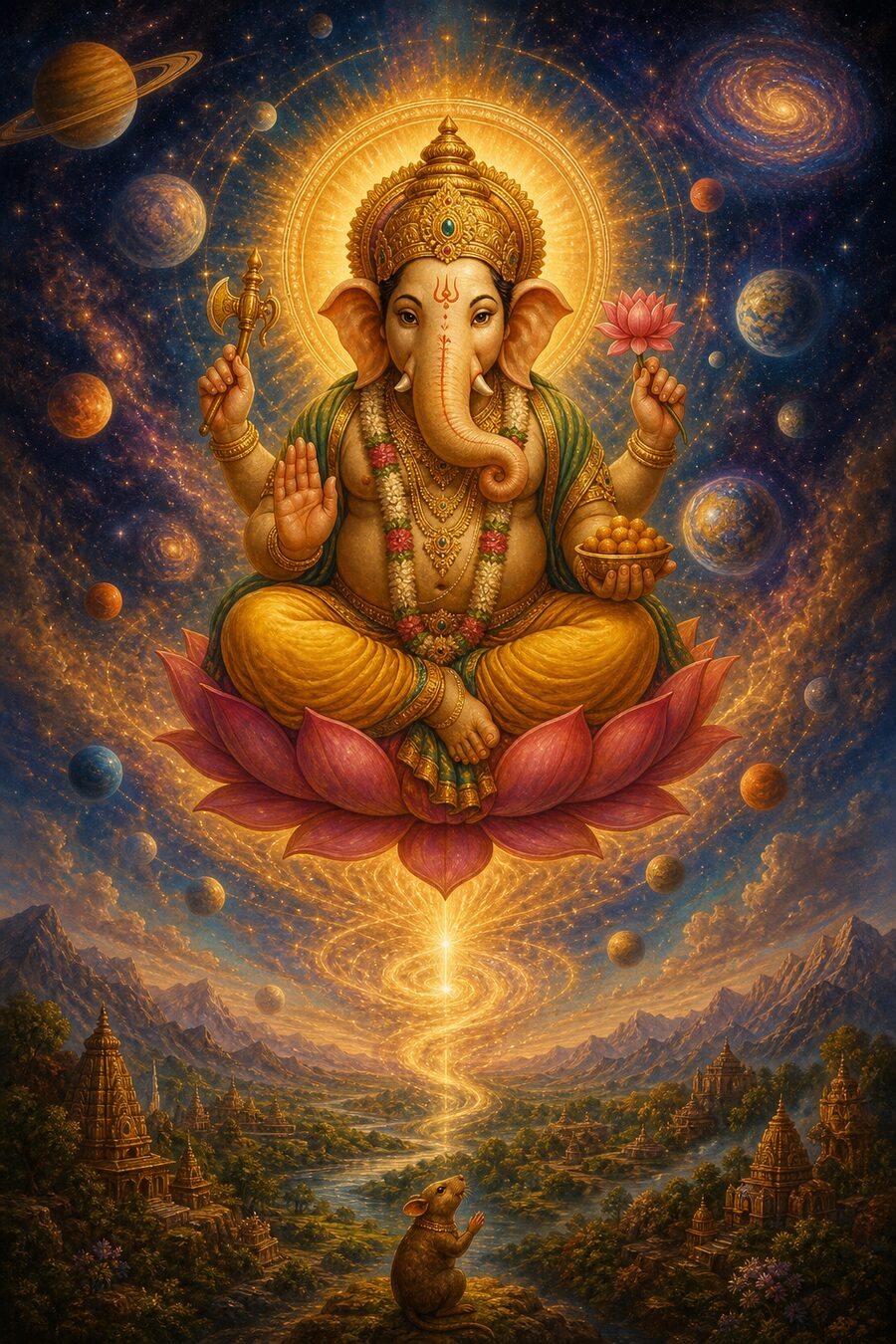
This section is the heart of the whole text. First it lists what Ganesha stands beyond, clearing the ground in fours: the three gunas (sattva, rajas, tamas), the three states (waking, dream, deep sleep), the three bodies (gross, subtle, causal), and all three tenses of time. Everything a person could use to locate him is taken away in four lines. Then a very precise pointer, that he is forever seated in the Muladhara chakra, that base point of Kundalini yoga, which sets him at the lowest place in the body after placing him past everything. He is the very form of the three powers (will, knowledge, and action), and yogis meditate on him without pause. And then the founding declaration, you are Brahma, you are Vishnu, you are Rudra, Indra, Agni, Vayu, Surya, Chandrama, you are the three worlds and Om. Every deity is one facet, and all of them are faces of a single reality.
Section 6
The Ganesha mantra: “Om gam”
This whole section explains how a mantra is built, and it reads like an assembly instruction, one piece set on the next. First say “ga”, then “a”, then add the anusvara, place a half-moon above it, and let it be made firm with the high note, which is Om. This is your mantra form, “Om gam”. “Ga” is its first part, “a” the middle, the anusvara the last, and the dot the upper form. The sound itself is the join, the samhita itself is the sandhi. This is the Ganesha-vidya, whose rishi is Ganaka, whose meter is the Nichrid-Gayatri, and whose deity is Ganapati. Then the plain mantra, “om gam ganapataye namah”, salutation to Ganapati. In the Vedic tradition every syllable carries its own weight; a mantra’s words matter, and so do its pronunciation, its rhythm, and its context. This same short mantra is still chanted at the start of worship today, often one hundred and eight times.
Section 7
The Ganesha Gayatri
Now that same famous Gayatri meter, cast for Ganesha. May we know the one with a single tusk, may we meditate on the one with the curved trunk, and may that tusked one urge us on. Like every Vedic Gayatri, this too has the three-step frame of knowing, meditating, and being inspired. Ekadanta and Vakratunda are marks of Ganesha, and each holds its meaning: the broken tusk a sign of sacrifice (a popular telling has it snapped off and made into a pen to write the Mahabharata), and the curved trunk a sign of the path that does not run straight. This Gayatri frame comes from the Rigveda, and on it were built the Gayatris of Surya, of Durga, of every deity.
Section 8
Ganesha’s form for meditation
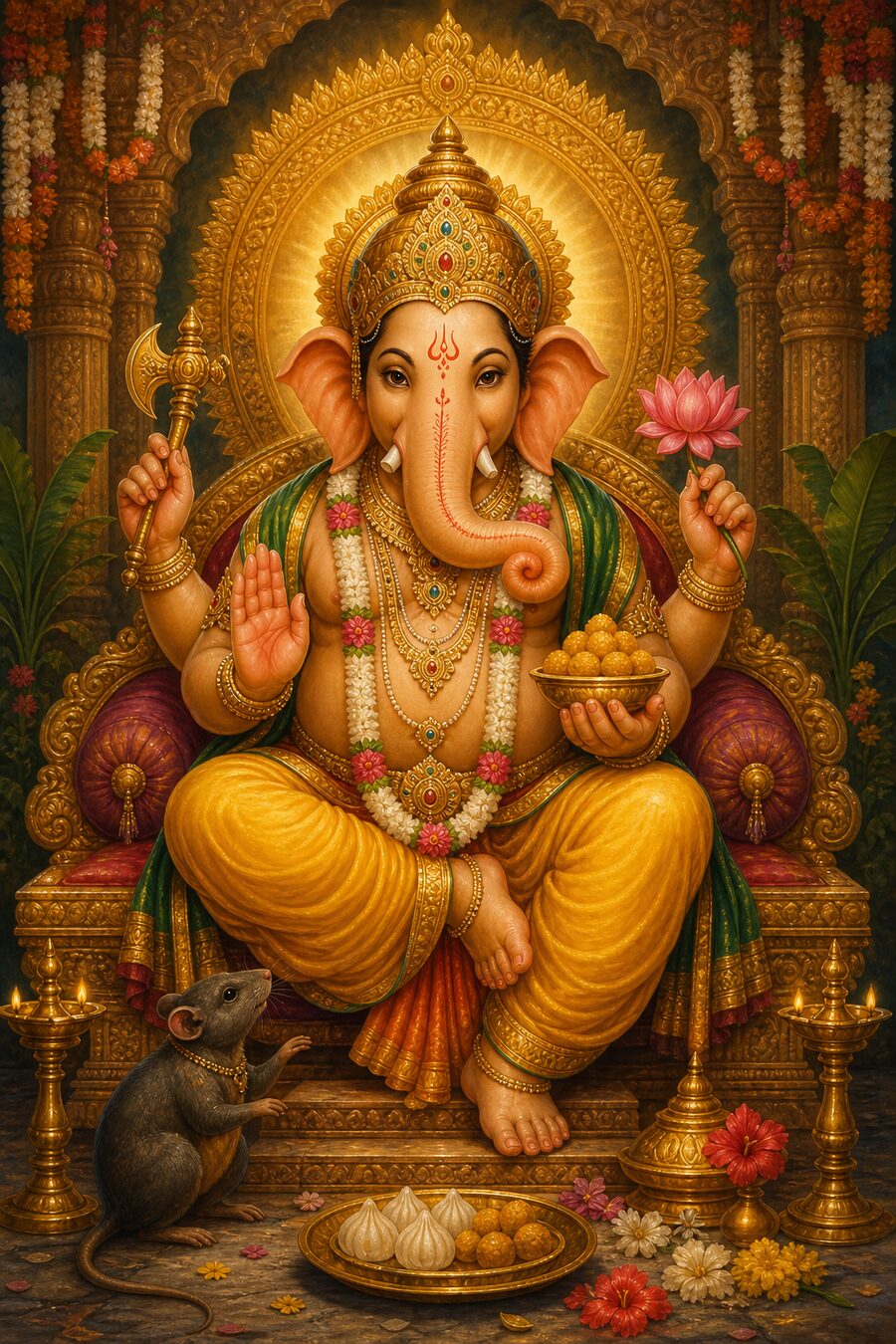
Here the full form of Ganesha stands before the eyes, assembled detail by detail the way a painter would lay it in. One tusk, four hands, a noose and a goad in the hands, one broken tusk, and the gesture of blessing, and with it the banner of the mouse. A red body, a large belly, ears like winnowing baskets, red garments, smeared with red sandal paste, worshiped with red flowers, until the whole picture is one shade of red. Gracious to devotees, the cause of the world, Achyuta the imperishable, appeared at the beginning of creation, beyond both Prakriti and Purusha. Whoever meditates on this form daily is the finest yogi among yogis. Every detail carries meaning: the four hands the four aims of life (dharma, artha, kama, moksha), the noose the bond that will be cut, the goad the staff that shows the way, the red color the power of Prakriti, and the mouse the ego, which Ganesha neither kills nor sends away; he rides it, and keeps it beneath him.
Section 9
The eight names of Ganapati
Now eight names, each from a different angle. Salutation to Vratapati, the lord of all the groups of vows. To Ganapati, the leader of all hosts. To Pramathapati, the lord of Shiva’s attendants. To Lambodara and Ekadanta, the one who holds vast capacity and the one who stands for sacrifice. To the destroyer of obstacles, the son of Shiva, and to Shri-Varada-murti, grace made visible, salutation again and again. This list of names is made for recitation aloud, and it is built to be said fast, one salutation running into the next. The collection of 108 names begins from these same eight.
Section 10
Phalashruti, the fruit of the recitation
Now the phalashruti, what comes of this. Whoever reads this Atharvashirsha becomes fit for the state of Brahman, his happiness grows on every side, no obstacle binds him, and he is freed from the five great sins. Reading it in the evening erases the day’s wrong, reading it in the morning the night’s, and doing it at both times leaves him free of sin. Reading it anywhere clears away hindrances, and all four of dharma, artha, kama, and moksha come to him. Then a warning, and the tone changes for it: do not give this recitation to one who is unfit, and whoever gives it out of infatuation becomes guilty. The fault lands on the giver, not on the one who received it. And at the end, by a thousand repetitions whatever desire is held is fulfilled. That line, “do not give it to the unfit”, means that a mantra handed over without context and preparation stays barren.
Section 11
Special observances, and the close
The last three sections hold some special observances and their fruits, and each offering carries its own distinct reward, matched to it as precisely as a key to a lock. One who consecrates Ganapati with this mantra becomes a master of speech; one who chants it on Chaturthi without eating becomes learned and renowned; and one who comes to know all the coverings, beginning from Brahma, is never afraid. Further, one who worships with shoots of durva grass grows wealthy like Kubera, one who worships with parched rice becomes renowned and gifted, one who worships with a thousand laddus obtains the fruit he desires, and one who worships with ghee and sacrificial sticks obtains everything. At the end, one who has eight Brahmins receive this properly becomes radiant like the sun, and by chanting during a solar eclipse on the bank of a great river or near an image, the mantra becomes perfected, and he is freed from great obstacles, great faults, and great sins, and becomes all-knowing. Whoever knows it thus, this is the Upanishad. Modak, durva grass, parched rice, all these offerings are still tied directly to this same tradition in the homes and pandals of Ganesha Chaturthi today, carried up to the image by people who have never read a line of this text.
Sections 12-14
The final peace invocation
The recitation ends with that famous Upanishadic prayer found in nearly every Upanishad, “saha navavatu”. It is the shared plea of guru and student, may we both be protected, may we both be nourished, may we gain strength together, may our study be radiant, and may we bear no ill will toward each other. Every clause of it is in the dual, two people and never one. Then the opening peace invocation returns, and with peace three times the Shri Ganapati-Atharvashirsha is complete here. This spillover shows that knowledge is held here as a discipline undertaken together, something two people build side by side. “saha navavatu” is a closing mantra of the Yajurveda, and several Upanishads such as the Taittiriya, the Katha, and the Shvetashvatara open or close with it as well, which shows this text’s continuity with the whole of the Veda.
Closing peace invocation
Read alongside
- Saundarya LahariA hymn to the Devi, from this same lineage
- Vishnu SahasranamaA hymn of 1000 names, a parallel format
- Hanuman ChalisaBhakti (devotion) in its Hindi form
- Other UpanishadsFrom this same Upanishad family
- Yoga Sutras, Pada 1The formal text behind the “yogis meditate” line