The Sri Rudram and the Chamakam
Before a god who terrifies you and whom you still petition, and then his two halves
This is about Rudra, the one you would rather not meet in the dark and the one you go to anyway. The Rig Veda sees him in the storm and in the mountain, and calls him the physician of physicians. The Namakam bows first and salutes his every form. The Chamakam then opens its hands and asks for the whole platter of life. Two halves, one breath.
This whole text is called the Sri Rudram, and also the Rudra-prashna, the Rudradhyaya, or the Shatarudriya, four names for one recitation, which tells you how many hands have carried it. It comes from the Krishna Yajur Veda, and it splits into two halves that do opposite work, the Namakam (Taittiriya Samhita 4.5) and the Chamakam (Taittiriya Samhita 4.7).
Who Rudra is
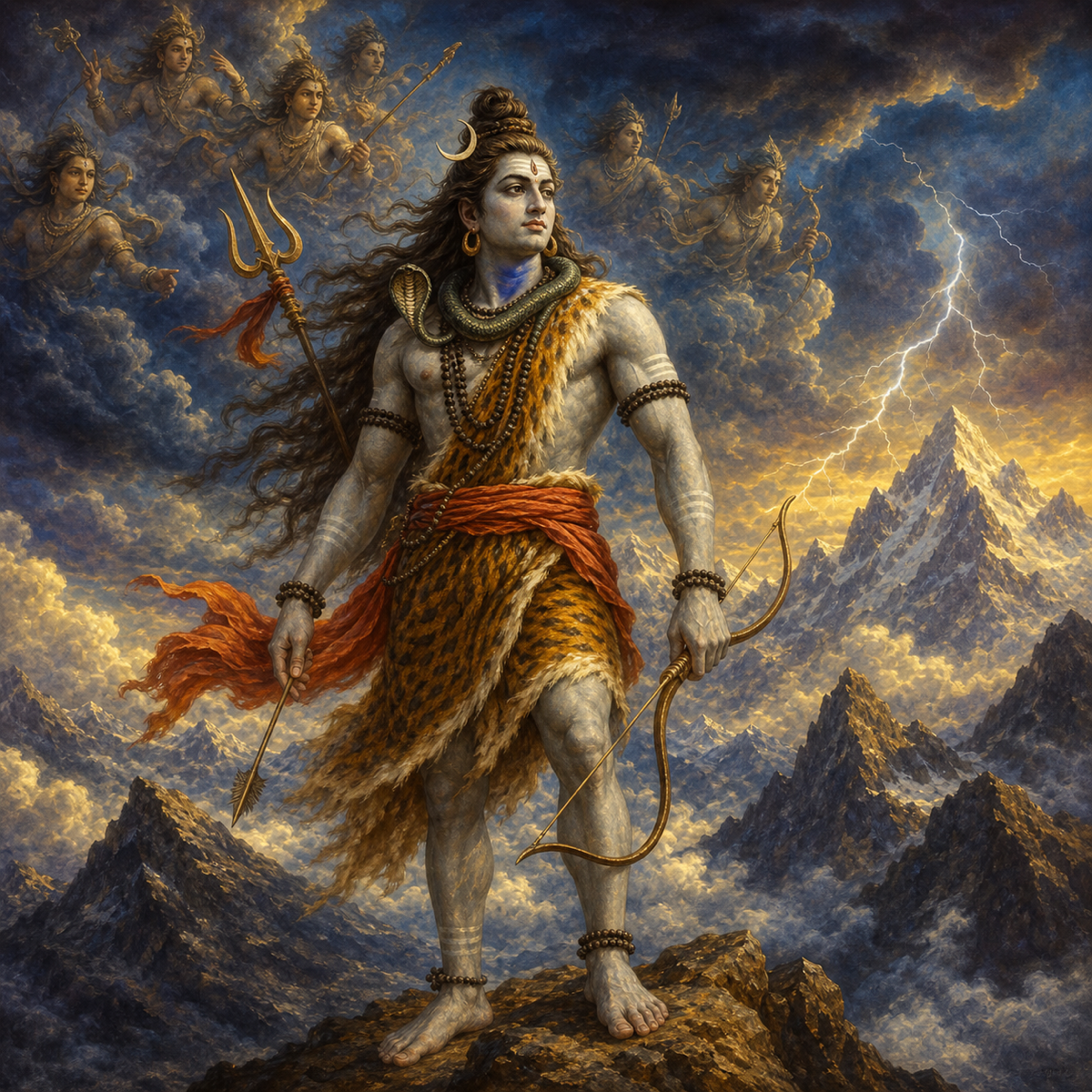
The Rig Veda sees Rudra in the storm, the mountain, and the arrow, the leader of the Maruts, and it holds two things about him at once: he brings disease and death, and he takes them away again. The same hand does both. One of the great hymns to Rudra (Rig Veda 2.33) calls him the physician of physicians, and in the same breath begs him to hold back his arrows, which is what speech sounds like in front of a power you can neither argue with nor walk away from. Shiva, the auspicious one, is an address that settled on him over time, and the Sri Rudram sits among the texts where Rudra can be seen becoming Shiva.
The Namakam, which bows
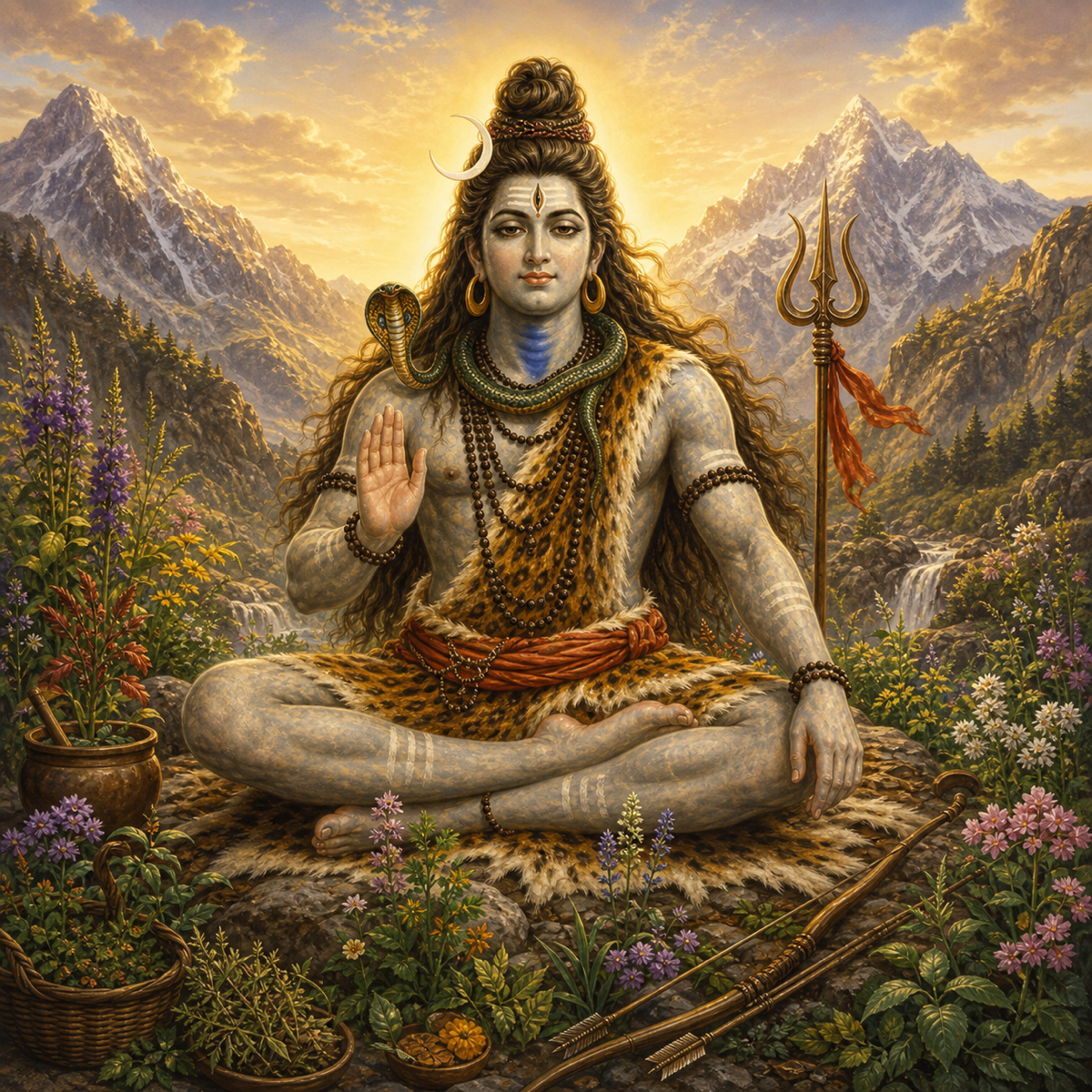
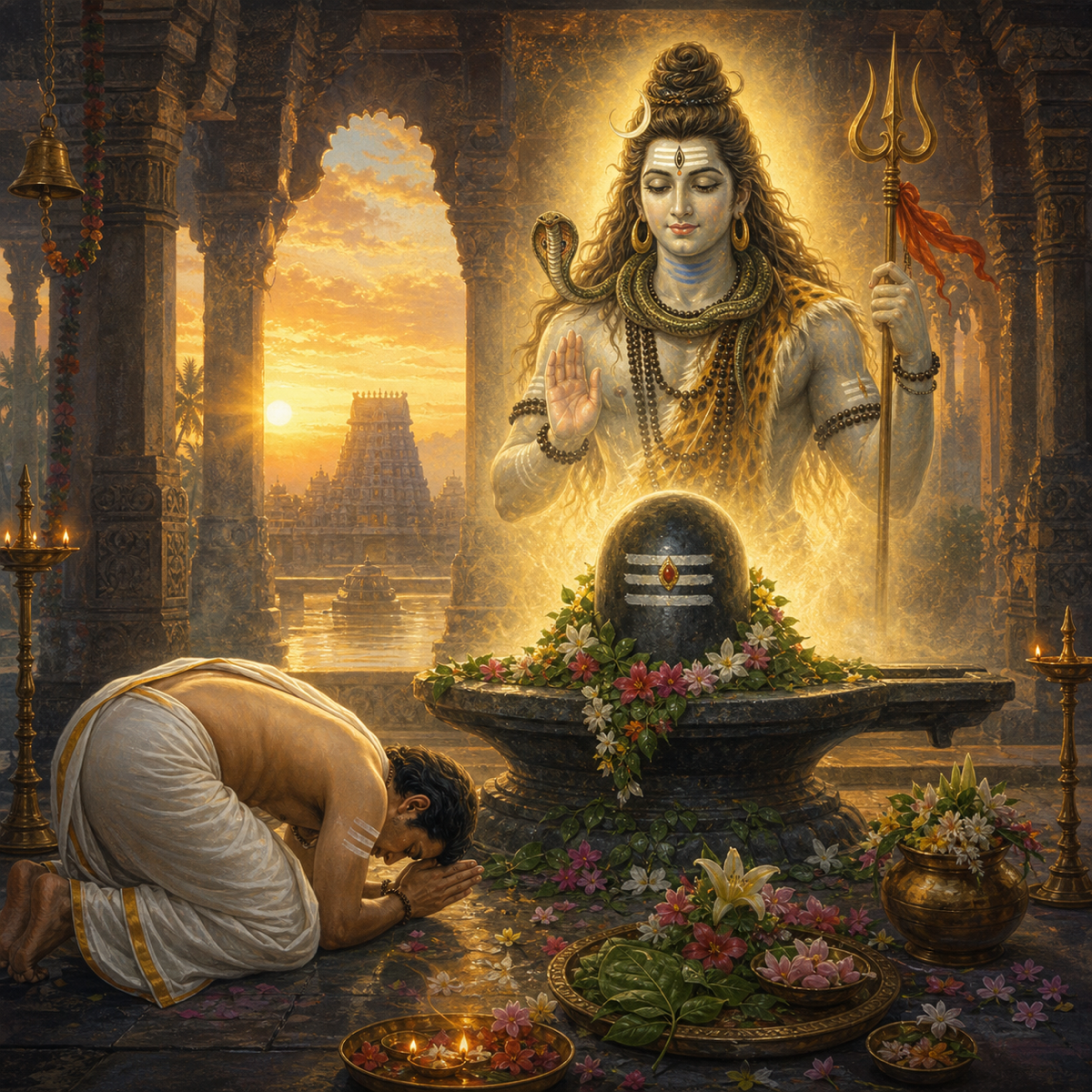
The Namakam takes its name from its refrain namo, meaning salutation, a word that comes back and comes back until the coming back is itself the practice. Its eleven anuvakas bow to Rudra in his every form, in his weapons, in the mountains and rivers, and in the people of every trade, until there is no corner of the world left over that is not him. The eighth anuvaka holds the five-syllable mantra, namah shivaya, salutation to Shiva. Alongside it the Tryambaka, or Mahamrityunjaya, mantra is also recited, the one found at Rig Veda 7.59.12. The Namakam’s whole motion is surrender.
The Chamakam, which asks
The Chamakam takes its name from its refrain cha me, meaning and to me, and from its endlessly returning line, cha me yajnena kalpantam, meaning let all these come to me through the yajna (fire-rite). It too has eleven anuvakas. After the Namakam has finished bowing, the Chamakam opens its hands and asks, without once lowering its voice. It asks for almost the entire platter of life: strength and the root energies, the limbs of the body and the powers of mind and speech, faith and truth, grain and cattle, gold and wealth, the seasons and the gods, and the very implements and meters of the yajna itself. The eleventh anuvaka is a chant of counting, the odd numbers from 1 to 33, and the even numbers in multiples of four, up to 48, as if everything that can be counted. Leave nothing uncounted, and nothing goes unasked for. It asks for worldly abundance and liberation, both in a single breath.
The life of the text
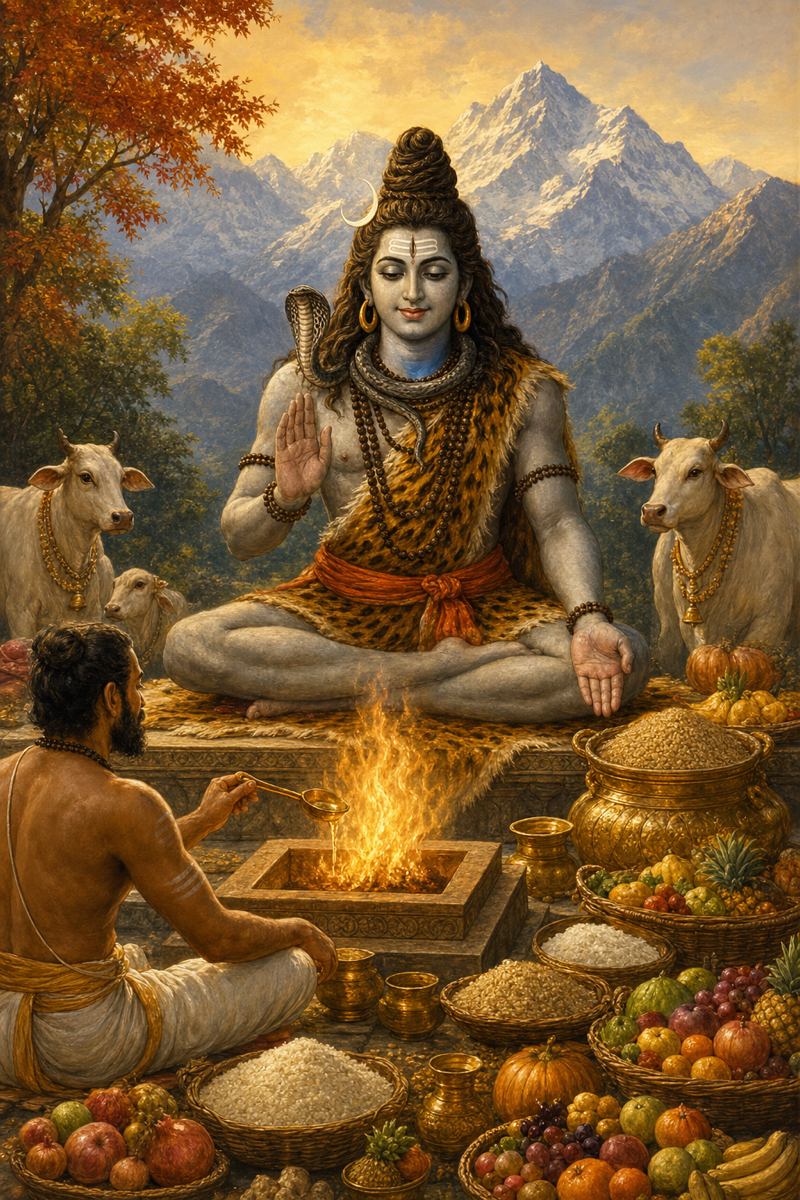
Its central rite is the Rudrabhishekam. One of its older homes is in the altar-ritual of the Agnichayana, where the Shatarudriya calms the hundred-formed power that has settled into the altar (Shatapatha Brahmana). And there is an ascending ladder of recitation, where eleven units make the next single unit and every rung is elevenfold the one beneath it: one Rudri, then the Laghurudra (eleven Rudris), then the Maharudra (one hundred and twenty-one Rudris), and then the Atirudra (thirteen hundred and thirty-one Rudris).
Two stories
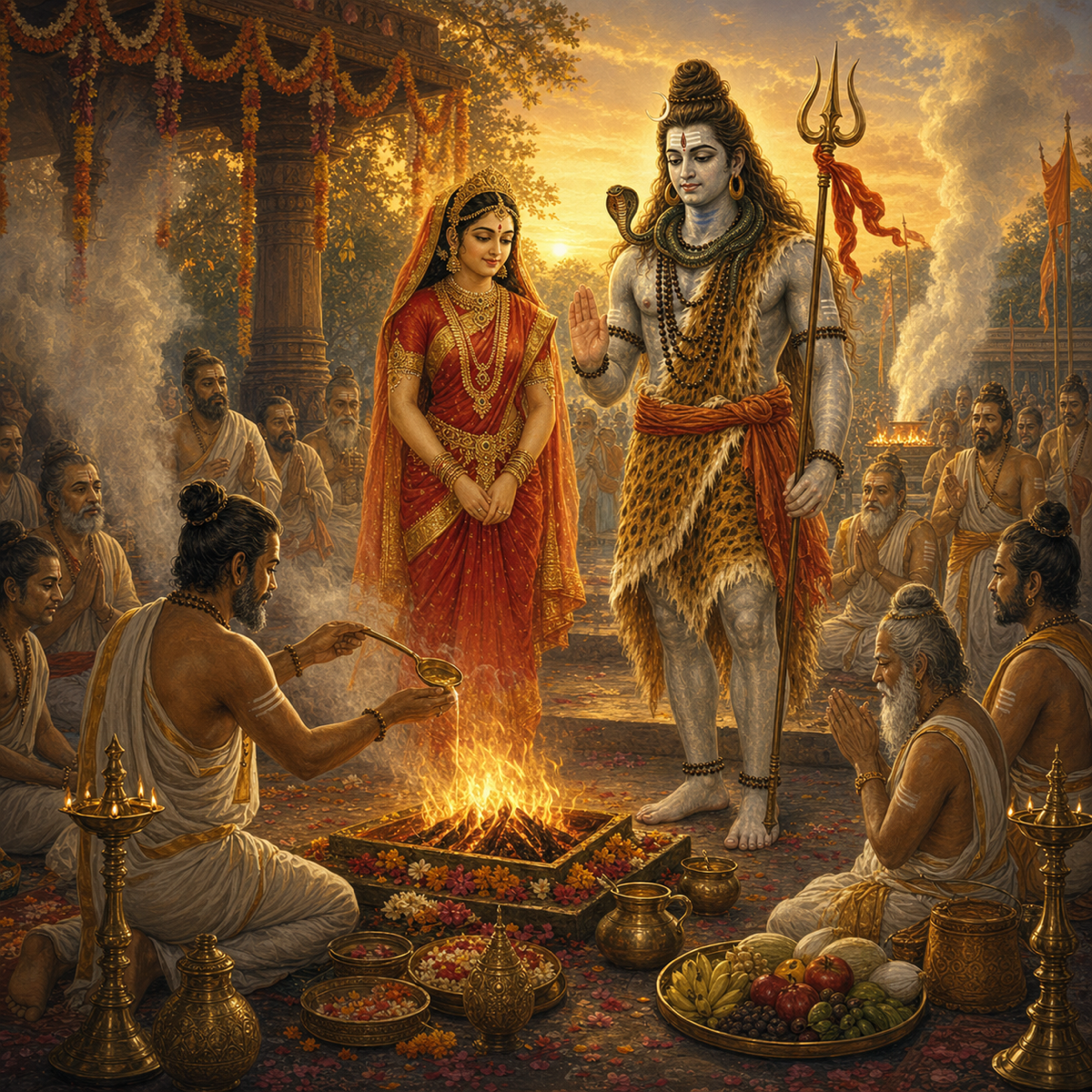
Two stories stand behind it. One is from a Brahmana, where the birth of the name Rudra is tied to a weeping child, who cries and is given names, and the crying itself is read into the name, so that the god carries the sound of his first grief for the rest of time. The other is the Puranic story of Daksha’s sacrifice, where Rudra-Shiva is kept out of a great sacrifice, his consort Sati gives up her life, his fury tears that sacrifice apart, and in the end he is given his share. A ritual truth hides inside it, and every host who has ever counted the guest list knows it: this power has to be honored and given its portion.
The eleven anuvakas of the Namakam
The first anuvaka begins with the part of Rudra that frightens. It bows to his anger first, then to his arrow, then to his bow, then to the two arms that hold them, and only after that does it ask for anything. What it asks is that he come to the people praying with his arrow made kindly, his bow made kindly and his missile made kindly, and be gentle to them; and that he look on them with the body of his that is kindly and without dread, auspicious to look on and the most potent to heal. The dweller on the mountain is asked to make the arrow in his hand kind, and to harm neither man nor any moving thing. In the same breath he is named the first physician among the gods, the advocate who has spoken up for the people, crushing the serpents and driving off the sorceresses, so that the hand that fires the arrow and the hand that heals the wound are shown to be the same hand. Then the eye lifts to him, copper-colored, red, brown and auspicious, and to the Rudras by the thousand who surround him in every direction, whose wrath the hymn asks to have turned aside; and then to the one who glides away, blue-necked and red, whom the cowherds have seen and the women carrying water have seen. The anuvaka ends on its plainest requests. Loosen the bowstring from both ends of the bow. Cast down the arrows in your hand. Unstring the bow, blunt the points of the arrows, and be gentle toward us. Let the missile from your bow pass us by on every side, and lay that quiver of yours somewhere far from us.
The second anuvaka is a string of names, and every name comes with a realm attached. Salutation to the golden-armed leader of armies and to the lord of the directions; to the trees with their green tresses, and to the lord of the cattle; to the one tinged yellow and red like young grass, the radiant one, the lord of the paths; to the brown one who pierces, the lord of food; to the green-haired one who wears the sacred cord, the lord of prosperity; to the weapon of Bhava, the lord of the moving world; to Rudra with his bow drawn, the lord of the fields; to the lord of the woods and the lord of the trees; to the counselor and the trader, the lord of the thickets; to the one who stretched out the world, the lord of the healing plants; to the loud-calling one who makes others cry out, the lord of the foot soldiers; and to the one who runs at full stretch, the lord of the warriors. In the space of one anuvaka Rudra has become the master of everything a person lives off, the road, the field, the herd, the plant that cures, and in the market he stands as the counselor and the trader himself.
The third anuvaka turns to the dark side of the road. Salutation to the strong one who pierces, the lord of the bands that attack; to the leader who carries the quiver, the lord of thieves; to the quiver bearer, the lord of robbers; to the cheat and the swindler, the lord of burglars; to the one who glides and roams about, the lord of the forests; to those armed with bolts who destroy, the lord of pilferers; to those who carry swords and wander at night, the lord of cutpurses; to the turbaned one who roams the mountains, the lord of those who snatch. Then comes the full grammar of the bow: salutation to the arrow bearers and the bowmen, to those who string the bow and those who set the arrow, to those who draw and those who let fly, to those who hurl and those who pierce. And then to those who sit and those who lie down, to those who sleep and those who are awake, to those who stand and those who run, to the assemblies and the lords of the assemblies, to the horses and the masters of horses. No one is left outside, and the thief is bowed to with the same word as the lord of the assembly.
The fourth anuvaka opens on the powers that wound and pierce, the bands and the destroyers, and goes on through the sharpers and their lords, the hosts and the lords of hosts, the troops and their chiefs, the deformed and the ones who wear every form, the great and the small, those with chariots and those without, the chariots and their masters, the armies and their captains. Then it walks down the line of every trade a man can follow: the charioteers and the drivers of horses, the carpenters and the chariot builders, the potters and the smiths, the Punjishtas and the Nishadas, the arrow makers and the bow makers, the hunters and the men who lead the hounds, the hounds and the masters of hounds. The same Rudra turns on the potter’s wheel and strains at the end of the dog’s leash.
The fifth anuvaka moves in pairs, two names to a line, and many of the pairs hold a tension between their ends. Bhava and Rudra. Sharva and Pashupati, the lord of beasts. The blue-throated and the white-throated. The one with the matted hair and the one with the shaven head. The thousand-eyed and the one with a hundred bows. The dweller on the mountain and Shipivishta. The most bountiful and the one who carries arrows. The short and the dwarfish. The great and the full grown. The grown and the still growing. The foremost and the first. The swift and the quick. The rapid and the hasty. The one in the waves and the one in still water. The one in the current and the one on the island. Wherever a pair pulls two ways, Rudra sits at both ends of it.
The sixth anuvaka keeps the same stride. The eldest and the youngest. The firstborn and the later born. The middle one and the unripe one. The hindmost and the one in the depths. The one who keeps company with Yama and the one at peace. The one in the sown field and the one on the threshing floor. The one in renown and the one at the end. The one in the forest and the one in the brush. The sound and the echo. The one with the swift army and the one with the swift chariot. The hero and the one who rends asunder. The armored and the corsleted. The one in mail and the one in a cuirass. The famous one and the one whose army is famous.
The seventh anuvaka starts with the war drum and the stick that beats it, then goes to the bold one and the prudent one, the messenger and the one sent, the one with the quiver and the owner of the quiver, the sharp-shafted and the armed, the one with fine weapons and the one with a fine bow. Then it maps every road and water a person could meet, and the weather over them. Salutation to the one on the paths and on the roads, in the hollows and in the pools, in the ditches and in the lakes, in the rivers and in the ponds, in the cisterns and in the wells, in the rain and in the dry weather, in the cloud and in the lightning, in the bright sky and in the heat of the sun, in the wind and in the storm, in the house and in the guardian of the house.
The eighth anuvaka is the one in which Soma and Rudra are called together. Then the copper-colored and the red; the giver of weal and Pashupati, the lord of beasts; the fierce and the terrible; the one who kills from in front and the one who kills from far away; the killer and the greater killer; the trees with their green tresses; the deliverer who carries across. And then the voice changes. Salutation to the source of peace and the source of delight, to the maker of peace and the maker of delight, to Shiva and to the one more auspicious still. The five syllables sit here, in the middle of the hymn, and the whole Namakam has been walking toward them. After that the water comes back: the one at the fords and on the banks, the one on the far shore and the one on this shore, the one who crosses over and the one who crosses back, the one at the crossing and the one in the ocean, the one in the tender grass and the one in the foam, the one in the sand and the one in the flowing stream.
The ninth anuvaka looks for him in every kind of ground, the wild and the lived in. In the cleft and in the far distance; in the stony ground and in the ground where people can live; as the one with matted hair and as the one with smooth hair; in the cow pen and in the house; in the bed and in the hall; in the hollow and in the abyss; in the lake and in the whirlpool; in the dust and in the mist; in the dry and in the green; in the copse and in the grass; in the earth and in the gully; in the leaves and in the fallen leaves. Then salutation to the one who threatens and the one who strikes away, to the one who drags and the one who drives off; and to them all in the plural, the bright hearts of the gods, the ones who discern, the ones who cannot be overcome, the ones who destroy. To all of them, and to all of them together, the one word, namo.
The tenth anuvaka is the anuvaka of pleading, and it is the part of the hymn where you can hear a household praying. The pursuer, the lord of the soma plant, the one who is red and blue, is asked to frighten none of these people and none of these cattle, and to let none of them come to harm. That kindly form of his, which heals every day, is asked to be the form with which he shows them mercy, so that they may live. A prayer goes up to the mighty Rudra with the braided hair, that the two-footed and the four-footed may be well, and that everyone in the village may thrive and be free of sickness. Then comes the list that every family in the world could sign. Do not strike our great ones, nor our little ones, nor the one who is growing, nor the one full grown, nor the father, nor the mother; do not harm these bodies that are dear to us. Do not harm us in our children, our descendants, our length of life, our cows, our horses. Do not kill our brave men in your anger. We come before you with the offering in our hands and with reverence. Far from us be the one who slays cattle and men, and near us his good will. We praise the famous young one on the chariot seat, dread as a fierce wild beast, and we say: being praised, be kind to the one who sings, and let your missiles strike someone other than us. Let the weapon of Rudra pass us by, and let the wrath of the blazing one pass us by; unstring your strong bow, and be gracious to our children. You who give most and who are most auspicious, be auspicious and kindly toward us; set your weapon down on the highest tree, and come clothed in your hide, carrying the Pinaka bow. Let your thousand missiles strike someone other than us, and turn away the points of the thousands of weapons in your arms.
The eleventh anuvaka turns one Rudra into thousands. The Rudras who are on the earth by the thousand upon thousand, we unstring their bows from a thousand leagues away. The ones in the great ocean of the middle air; the blue-necked, white-throated ones who move beneath the ground; the ones in the trees, green as young grass, blue-necked and red; the overlords of living beings, without the topknot and with matted locks; the ones who strike at people through their food and through the cups they drink from; the ones who guard the paths, who bring food and fight; the ones who haunt the fords with quivers and blades; these many, and more than these, spread through every direction, we unstring their bows from far off, and to them we say namo. To the Rudras in the earth, in the middle air, and in the sky, whose arrows are food and wind and rain, ten salutations toward the east, ten toward the south, ten toward the west, ten toward the north, ten upward. Let them be kind to us, and whoever we hate, and whoever hates us, is laid in their jaws. After this the recitation, by tradition, goes on to the Tryambaka mantra and the closing verses.
The eleven anuvakas of the Chamakam
The first anuvaka of the Chamakam opens with a single verse to Agni and Vishnu, and then begins with vigor and with the impulse to act, and within a few words it has climbed inside the body. Effort, resolve, understanding, the will to do; the voice, fame and renown, light and heaven; the in-breath, the out-breath, the breath that moves between them; thought and learning; speech and mind, eye and ear; skill, might, force and strength; a span of life, and old age along with it, because old age too is asked for; the self and this body; shelter and armor; the limbs, the bones, the joints, the whole frame. The first plate set on the table is the body itself, the thing with which everything else will be asked for.
The second anuvaka looks upward. Seniority and lordship; anger and the heat of anger; force and impetuosity; victory, greatness, breadth, height; what has grown and what is still growing; truth and faith; the moving world and wealth; the power to command, radiance, play and gladness; what has been born and what is yet to be born; the well-made hymn and the well-done deed; what has been gained and what is yet to be gained; the past and the future; the easy road and the good path; success and its increase; understanding, and good understanding.
The third anuvaka is the list of happiness. Peace and ease; what is dear and what is wished for; desire and a glad heart; the good, the better and the finer still; fame and fortune; wealth; the one who guides and the one who upholds; security and steadiness; the whole and the greatness of the whole; understanding and knowledge; begetting and birth; the plow and the harrow; cosmic order and deathlessness; freedom from wasting disease and freedom from illness; life and long life; freedom from enemies and freedom from fear; a smooth road, rest, a beautiful dawn, a good day.
The fourth anuvaka walks into the kitchen. Nourishing strength and kind, true speech; milk and sap; ghee and honey; eating together and drinking together; plowing and rain; conquest and victory; riches and more riches, increase and growth; plenty and mastery; much, and more than much; full, and fuller still; what never runs out; even the poor crop; food, and the end of hunger. Then it counts the grains one by one: rice, barley, black gram, sesame, mung, vetch, wheat, lentils, millet, two kinds of panic grass, and wild rice.
The fifth anuvaka goes down into the earth. Stone and clay; hills and mountains; sand and the great trees; gold and bronze; lead and tin; iron and copper; fire and water; the creepers and the healing plants; what grows when it is plowed and what grows without plowing; the animals of the village and the animals of the forest, may they all be made right through the yajna. Then wealth and the getting of wealth, attainment and the act of attaining, possessions and a place to live, work and the strength for it, aim and power, motion and going.
The sixth anuvaka belongs to the gods, and beside every god it sets the name of Indra, the king among them, as if no gift could be asked of any of them without his being in the room. Agni and Indra. Soma and Indra. Savitr and Indra. Sarasvati and Indra. Pushan and Indra. Brihaspati and Indra. Mitra and Indra. Varuna and Indra. Tvashtr and Indra. Dhatr and Indra. Vishnu and Indra. The two Ashvins and Indra. The Maruts and Indra. All the gods together and Indra. The earth and Indra. The middle air and Indra. The sky and Indra. The directions and Indra. The head and Indra. Prajapati and Indra.
The seventh anuvaka belongs to the cups of the soma rite, the grahas, the drawn portions of soma that are filled one after another in the order the ritual sets. The amshu and the rashmi; the adabhya and the adhipati; the upamshu and the antaryama; the cup for Indra and Vayu and the cup for Mitra and Varuna; the cup for the Ashvins and the pratiprasthana; the shukra and the manthin; the agrayana and the vaishvadeva; the dhruva and the vaishvanara; the cups of the seasons and the extra drawings; the cup for Indra and Agni and the great cup for all the gods; the one for the Maruts and the one for great Indra; the one for Aditya and the one for Savitr; the one for Sarasvati and the one for Pushan; the one for Tvashtr with the wives of the gods and the one for the yoking of the bay horses. To someone outside the rite it sounds like a rain of names. To a priest it is the whole order of a day.
The eighth anuvaka asks for the tools of the yajna itself. The firewood and the sacred grass; the altar and the lesser altars of the priests; the ladles and the cups; the stones that press the soma; the chips from the sacrificial post; the sounding holes and the pressing boards; the wooden tub and the cups for Vayu; the bowl for the purified soma and the mixing bowl; the altar of the Agnidh priest and the holder of the oblations; the house and the Sadas, the hall of the priests; the cakes and the cooked offerings; the final bath and the closing cry of good speed. Whatever a yajna is performed with is being asked for through the yajna, so that the rite can feed itself.
The ninth anuvaka names the rites and their elements. Fire and the heated pot; the ray and the sun; breath and the horse sacrifice; the earth and Aditi; Diti and the sky; the shakvari verses, the fingers and the directions, may these be made right through the yajna. Then the ric verse and the saman chant; the stoma and the yajus formula; the consecration and the austerity; the season and the vow, made right through the rain of day and night; and the two great samans, the Brihat and the Rathantara.
The tenth anuvaka stands in the cow pen and counts the animals by age. The embryos and the calves; the bull calf and the heifer at eighteen months; the male and the female at two years, at two and a half, at three, and at four; the draft ox and the draft cow; the bull and the barren cow; the steer and the cow that miscarries; the bullock and the milch cow. Then the sentence the whole Chamakam rests on turns back toward the body. May my span of life be made right through the yajna; may the in-breath, the out-breath, the breath between, the eye, the ear, the mind, the speech, the self be made right through the yajna; and may the yajna be made right through the yajna.
The eleventh anuvaka is the chant of numbers, and when the counting is done it asks for the last things: vigor and impulse, the later born, resolve, the heaven of light, the head, the one called Vyashniya, the offspring of the last and the last itself, the offspring of the world and the world itself, the overlord; and then the recitation ends. Everything that could be counted has been asked for, and nothing has been left off the table.
Frequently asked questions
What is the difference between the Namakam and the Chamakam?
The Namakam salutes, bowing to Rudra in every form it can find him in. The Chamakam then asks, for the fullness of life and for liberation, both. One bows, the other opens its hands.
Which Veda is it from?
From the Krishna Yajur Veda. The Namakam in Taittiriya Samhita 4.5, and the Chamakam in 4.7.
Are Rudra and Shiva one?
Rudra is the storm god of the Rig Veda. Shiva, the auspicious one, is an address that settled on him over time. The Sri Rudram belongs to the texts of that very transition, and you can hear the change happening inside it.
What are the Rudri, Maharudra, and Atirudra?
They are the ascending measures of the recitation. It starts with one Rudri, and each rung is elevenfold the last, up through the Laghurudra, the Maharudra, and the Atirudra.
Further reading
- Arthur Berriedale Keith, The Veda of the Black Yajus School entitled Taittiriya Sanhita
- Stella Kramrisch, The Presence of Śiva
- Wendy Doniger, Śiva: The Erotic Ascetic
The very architecture of this text is its message, and the order of the two halves is the whole of it. First the Namakam bows before every form and sets the ego down, then the Chamakam, with open hands, asks for both life and liberation. Placing surrender and asking within a single frame, this is its craft, and this is what makes it a full plate.