On this page
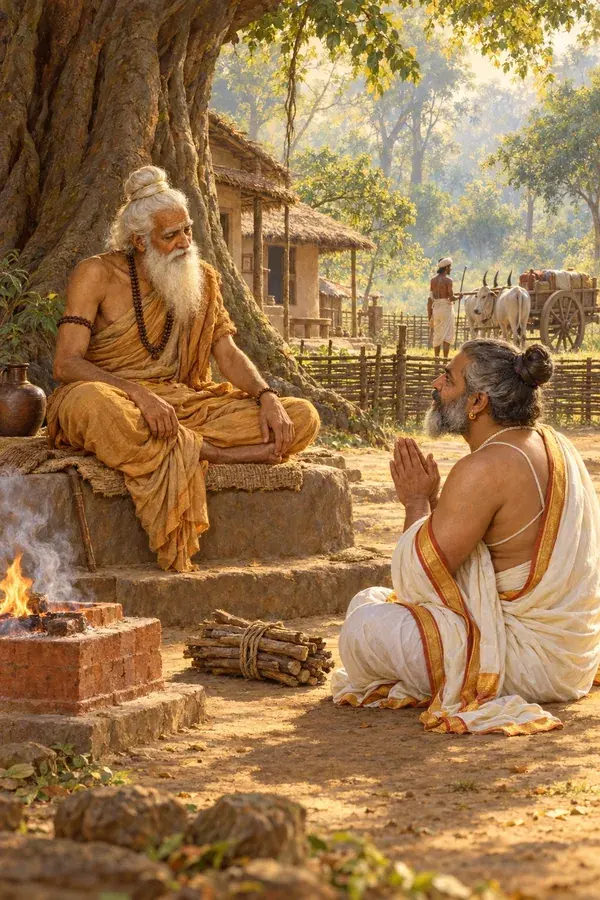
A great householder, a man whose granary never runs short, whose fire for offerings is kept burning by rule, the roll of boys studying in whose school runs long, walks one day to Angiras. His name is Shaunaka. He seats himself nearby according to the rule and asks a single sentence. Inside that sentence there is no complaint, no account of any sorrow, no petition. He asks, “kasmin nu bhagavo vijnate sarvam idam vijnatam bhavati”, bhagavan, what is that which, once known, leaves all this known. The Mundaka Upanishad opens right here, and through all three mundakas it walks behind this one question.
This Upanishad belongs to the Atharvaveda, and its gait differs a little from the others. There is little prose here and a great deal of meter. Three mundakas, two khandas inside each mundaka, six khandas in all, and the whole text settles its business in somewhere around sixty five mantras. In so small a space it does very large work. It cuts knowledge into two halves, measures the entire apparatus of sacrifice and shows where its edge falls, describes the akshara purusha, makes a bow out of Om, and finishes by drawing a picture of two birds seated on one tree. Along the way it leaves behind a line every Indian recognizes today, satyameva jayate, mostly without knowing that it comes from here.
Put some weight on the word the text uses for the man who asks. Shaunaka is called mahashala, and what that named was visible from the road. A great hall, which is to say a long house with the grain stored at one end and room enough for whoever arrived. Herds out on the grazing. Fields with people working them who ate from his kitchen. Fires burning under his roof that had been lit at his wedding and kept alive ever since, fed at dawn and after dark, with somebody whose whole duty was to see that they never went out. Travelers came to his gate and were given a meal and a place to lie down, since sending one away put a debt on the household that had to be worked off later. When a sacrifice was performed in that district he paid for it, and priests left his yard driving cattle.
That is the man walking out one morning to Angiras. “Shaunako ha vai mahashalo’ngirasam vidhivad upasannah paprachchha”, Shaunaka the mahashala, having come near to Angiras according to the rule, asked. Vidhivat upasanna is his humility written into procedure. He arrived, and then he went down and sat near, lower, in the place a student sits, and waited to be allowed to speak. Everything he owned stayed outside that seating. The word upanishad has the same sitting lodged inside it, and in a world where a man’s standing in a room could be read off the floor in one glance, a householder of that size taking the lower seat was a statement everybody present understood.
The main figures of this Upanishad
Brahma: the first to come into being among the gods, maker of the universe and guardian of the world, who spoke this knowledge to his eldest son Atharva
Atharva: Brahma’s elder son, through whom brahmavidya reached Angir
Angir: the link who handed this knowledge on to Satyavaha Bharadvaja
Satyavaha Bharadvaja: through whom this knowledge came to Angiras, with the scale of the lineage held level
Angiras: the teacher of this Upanishad, who tells Shaunaka the difference between para and apara and carries him as far as the akshara
Shaunaka: the mahashala householder, who comes near according to the rule and asks the question the whole text rests on
The two suparnas: two birds seated on one and the same tree, one tasting the fruit, the other watching without eating
From Brahma down to Shaunaka, and the question everything rests on
The Upanishad starts its business with a lineage, and this beginning is no small matter. Brahma came into being first among the gods, the maker of this universe and the guardian of the world. He spoke brahmavidya, which is the foundation of all knowledges, to his eldest son Atharva. Atharva handed that same knowledge to Angir, Angir gave it to Satyavaha Bharadvaja, and Bharadvaja gave it to Angiras. Five names, four handings over, and every time one man sits down in front of another man and speaks. This knowledge travels from voice to voice, and the tradition has kept the name of every link in its care.
A chain of names does a particular job in a world with no books. None of this was written anywhere. A teaching existed in the mouths of the men who held it, and its authority came from being traceable, name by name, back to where it started. Somebody arriving in a village saying he carried a knowledge could be asked whose pupil he was, and whose pupil that man had been, and a gap anywhere in the answer ended the conversation on the spot. So the opening of this text is doing the work a deed of title does. And the form of every handing over is identical, one man seated in front of another and speaking aloud, which means the whole of it has come down through a sequence of rooms in each of which somebody had to be trusted with it.
At the far end of this chain, in front of Angiras, Shaunaka comes and sits. The text calls him mahashala, a man of large household, a man of a big house, the kind of man whose fire for offerings never goes cold. He comes near according to the rule, and he asks. There is a cleverness in the build of his question. He wants information about no single thing. He asks which one it is such that, once it has been known, the knowing of everything else stops being left over. As though a goldsmith recognized gold and every ornament became for him one metal wearing different names.
Angiras tosses no name back in answer. He first cuts knowledge into two halves. Those who know brahman have long been saying that there are two vidyas worth knowing, para and apara. This division is the spine of the whole Upanishad. Everything that comes afterward stands on one side or the other of this line, and Shaunaka’s question receives its answer from the far side of the line.
What has been put into apara gives a jolt on first hearing. Rigveda, Yajurveda, Samaveda, Atharvaveda, and along with them all six angas, shiksha, kalpa, vyakarana, nirukta, chhandas and jyotisha. That is the whole schooling of that age, everything the learning of which used up half a man’s years. This text belongs to the Atharvaveda itself, and it puts the Atharvaveda in the same pan. There is no censure of the vedas anywhere in this. Their reach is being stated, the way a man points at a ladder and says that this one goes as far as the roof.
To feel what that list cost, walk one boy through it. He left his parents’ house young and went to live in a teacher’s, and he stayed there for years. He cut the wood, watched the cattle and begged food for the house. What he learned, he learned through the ear, with nothing on a page in front of him at any point, tens of thousands of syllables, every one of them carrying its own pitch, since a word spoken on the wrong tone came out as a different word. To keep the text from drifting over the generations it was drilled in interlocking patterns, the words paired, reversed, paired again and woven through one another, so that an error had no way of surviving the crossings. On top of the four collections came the six limbs: the science of the sounds, the manuals of rite, the grammar, the glossary of the words nobody understood anymore, the meters, and the reckoning of stars and calendar that fixed which morning a sacrifice could begin on. Half a lifetime went into that. It was also an income and a rank, since what a family’s men could recite decided where they sat.
Angiras puts the whole of it in the lower pan while Shaunaka, who has paid for it, houses it and has sons inside it, sits in front of him. The Upanishad is measuring the reach of that learning, and the measuring is done by a man who has it all by heart himself.
And the identifying of para is settled inside a single line, “atha para yaya tad aksharam adhigamyate”, para is that by which that akshara, the imperishable, is reached. That is all of it. No inventory of para vidya is counted out, no syllabus is laid down, no book is recommended. It is identified by its outcome. Whatever gets a man to the akshara is para. This is a very open statement and a very severe one, because now no course of study can call itself para until it delivers a man there.
The Upanishad describes the akshara with a string of denials. It cannot be seen, it comes into no grasp, it has no gotra, no varna. It has no eyes and ears, no hands and feet. It is eternal, spread through everything, arrived everywhere, exceedingly fine, never diminishing, and the womb of all beings. The steady see it from every side. In this entire description there is no word that ties it into any shape, and even so the description feels complete, because every denial clears something away and leaves the room emptier.
Then three comparisons arrive, and all three come from the house. “Yathorna-nabhih srijate grihnate cha”, as a spider spins its web out of itself and then gathers it back inside. As plants come up of themselves on the earth, with nobody sowing them. As hair comes up on the body of a living man, with nothing done by him. In that same way this whole universe comes out of that akshara. In all three comparisons the workman and the material stand undivided. The web belongs to the spider, the plant belongs to the earth, the hair belongs to that same body.
The eighth mantra walks the stairway of creation downward, and its first step startles. Brahman is heaped up by tapas, from it food is born, from food prana, from prana the mind, from the mind truth, from truth the worlds, and deathlessness in works. Take tapas here in the sense of a discipline that wears the body down and the sentence jams. Shankara’s commentary reads it as the heat of knowledge, and the next mantra gives that reading its support, because it says that from the one who is all knowing, all understanding, whose tapas is made of knowledge, this brahman takes birth as name, form and food.
In short: Shaunaka arrives with a single question, what is that which, once known, leaves everything known. Before answering, Angiras cuts knowledge into para and apara, and puts all four vedas into the pan of apara. The whole identification of para is that the akshara is reached through it, and that akshara brings this world out of itself the way a spider brings out its web.
Leaking boats, seven flames, and the man walking off with kindling in his hand
The second khanda begins with a jolt. The vedas had just been called apara, and now the same Upanishad says that this work of the rites is truth. The works the seer poets saw inside the mantras lie spread out in many ways in the treta. Those who long for truth should perform them by rule; this is the road that runs to the world of good work. Sacrifice is called false nowhere here. It is being given its own place, and that place is real, it is measured, and out of the same measuring its boundary will come later.
Then the text turns so fine that the color of the fire for offerings becomes visible. When the bearer of oblations has caught well and the flame is licking upward, that is when the oblations are to be poured in between the two portions of ghee. This instruction is in the language of a man who sits in front of the fire himself. And in that same language the next mantra gives a warning. The man whose agnihotra is without darsha, without paurnamasa, without chaturmasya, without agrayana, deprived of a guest, offered with no oblation, without the vaishvadeva, and poured against the rule, that offering damages his worlds all the way through the seventh.
Read that list of failures as a calendar. The agnihotra was the offering poured at first light and again after dark, every day, for the whole of a married life. Darsha came with the vanishing of the moon and paurnamasa with its fullness, which fixed two observances into every month a man lived through. Chaturmasya arrived with the turning of the seasons, at intervals of four months. Agrayana came when the new grain came, before any of the harvest could be eaten. The vaishvadeva was the portion set aside daily for all the gods out of the household’s own cooking, taken off the fire before the family sat down. And standing in the middle of that list of rites is the guest. Somebody who arrived at the door hungry sat on the same line of the ledger as the new moon, and skipping him did the same damage. This is a religion that runs on attendance, and the mantra is saying that a gap in the attendance eats through the worlds a man is building, all the way to the seventh.
After this come the names of the seven tongues of the fire, and they sound like names somebody called out while watching the flames. Kali, Karali, Manojava, Sulohita, Sudhumravarna, Sphulingini and Vishvaruchi. The Upanishad calls them lelayamana, licking and flickering. The man who walks among these shining flames at the proper time, whom the oblations take up at the proper moment, is carried by these rays of the sun to where the lord of the gods dwells alone.
That carrying has been written very beautifully as well. The oblations themselves turn luminous, seat the sacrificer upon the rays of the sun and take him along. All the way they speak sweetly to him, they honor him, and they say, come, come. This is your merit, this is the brahmaloka built out of your good work. A sweeter picture of the fruit of sacrifice is hard to find anywhere. And right behind this sweetness the Upanishad brings out the knife.
“Plava hy ete adridha yajna-rupa”, these things in the shape of sacrifice are boats, and they are unsound. The work of eighteen parts spoken of in them has been called the inferior kind; Shankara’s commentary fills out that count of eighteen from the sixteen ritviks, the sacrificer and his wife. The fools who take these boats for the highest good and delight in them arrive at old age and death all over again. The same rays that carry a man up to the brahmaloka set him down again one day, because whatever is built out of doing lasts as long as doing lasts.
Take the measure of what is being called unsound. A large sacrifice was the biggest undertaking a family attempted. Sixteen priests had to be engaged, each with his own office and his own share of the fee. Ground was cleared and leveled, altars were built to measurement, fires were carried to their places, and the whole proceeding could run for days with the household feeding every person on the field. The fees went out in cattle, in gold, in cloth, in land. Men borrowed against a harvest to have it done. The rite was the event a family would be spoken of for through the next generation, and what it bought was sons, rain, cattle, long life, and at the far end a seat in a bright world overhead. Nearly every ambition a person was permitted to hold ran through that one machine.
Into a room where this is the shape of the whole religious life, the text says the boats leak. It has just spent six mantras describing them with open affection, the flame licking upward, the seven tongues called off by name, the oblations turning luminous and seating the sacrificer on the rays of the sun and speaking sweetly to him the whole way up. The picture is drawn at its most beautiful, and then the plank is pressed and found soft. The reason given is a piece of carpentry: “nasty akritah kritena”, what was never made comes by no making. Anything put together holds while the putting together holds, and the world that good work builds is a built thing.
The three lines that follow are the sharpest lines in this Upanishad. People living inside avidya while holding themselves to be steady and learned wander about taking blows, “andhenaiva niyamana yathandhah”, like blind men having the road shown to them by a blind man. Carrying on inside avidya in many ways, children imagine that we have finished the work. The men of works fail to understand because of their attachment, and so they suffer, and when their worlds are used up they fall.
Those who hold ishtapurta, the sacrifices and the digging of wells and step tanks, to be the highest thing recognize no other good at all. On the ridge of the sky, on the back of heaven, they enjoy the fruit of their good work, and then they come back into this world or go down into some poorer one. Those who live in the forest with tapas and shraddha, quieted, learned, moving on begged food, go out through the door of the sun, free of dust, to where that deathless purusha is, whose self never diminishes.
And then comes the mantra that is the outcome of this entire khanda. Having examined the worlds heaped up by works, a brahmana should come to nirveda, seeing that what was never made comes by no making. To know that, “tad vijnanartham sa gurum evabhigachchhet samit-panih shrotriyam brahma-nishtham”, let him go to a guru with kindling in his hand, to a guru who is shrotriya, versed in what has been heard, and settled in brahman. And that learned man in his turn, to the student who had come near according to the rule, whose mind was quieted, who was filled with sham, told that brahmavidya as it truly stands, the knowledge by which the akshara purusha, that truth, is known.
Look at what the man is carrying in his hand on that walk. Firewood. He comes to the teacher’s gate with fuel, because there is a fire in that house that has to be fed and feeding it is about to become his work, and setting the wood down at the door says the whole thing with no negotiation in it. He is offering the service before he has asked for anything. In the same motion he is announcing that he intends to stay. It is the road Shaunaka took in the opening lines of this text, a man with a full granary walking out of his own house toward somebody else’s fire.
In short: This khanda gives sacrifice its full honor, counts off the names of its seven flames, and draws the picture of a ride upon the rays of the sun. Then it calls that same boat unsound. Whatever is built out of doing runs out, so the man who examines things walks off one day with kindling in his hand toward a teacher who is settled in brahman.
Sparks flying off a fire, and the purusha whose body is this world
The second mundaka opens with the same word that opened the second khanda of the first mundaka, this is truth. This time a comparison stands behind that word. “Yatha sudiptat pavakad visphulingah sahasrashah prabhavante sarupah”, as thousands of sparks rise from a hard blazing fire and every one of them carries the form of fire, in that same way many kinds of beings are born out of that akshara, somya, and go back into it as well. This comparison goes one step past the spider, because here the thing that came out is carrying the form of its source too.
The introduction of that purusha comes after this, and it is shaped like no image. He is divine, formless, outside and inside at once, unborn. He has no prana, no mind, he is bright, and he is higher than the high beyond that akshara. This one sentence opens the depth of this Upanishad, because the talk here is of a level past even the akshara out of which the universe had just come, and that beyond is being spoken of as the same single purusha.
From him prana takes birth, the mind takes birth, all the senses take birth. From him the sky, the wind, light, water, and this earth which holds everything up. And then comes the vast picture that all the devotion of later ages repeated. Agni is his head, the moon and the sun his two eyes, the directions his ears, the opened vedas his speech, the wind his breath, this whole universe his heart, and out of his feet this earth came. He is the atman seated inside all beings.
After this the Upanishad runs a long list, and as the list goes by it begins to come clear what it is doing. From him is that fire whose kindling is the sun. From soma the raincloud, from the cloud the plants of the earth, and a man pours seed into a woman, and in this way a great many children spread out of that same purusha. From him the richas, the saman, the yajus, the consecrations, all the sacrifices, all the kratus, all the fees, the year, the sacrificer, and those worlds where soma flows and where the sun moves.
From him the gods spread out in many kinds, the sadhyas, men, cattle, birds. From him prana and apana, rice and barley, tapas, shraddha, truth, brahmacharya and the rule. Notice that grain and faith are arriving in this count in one breath. The Upanishad draws no wall between the thing a man eats and the state inside him, because both are coming out of one source and both will return to one place.
Then the rhythm of seven comes into the hand. Seven pranas come out of him, seven flames, seven kindlings, seven oblations, and those seven worlds in which the pranas move. Seven and seven, lodged in the cave. In the same way from him the seas and the mountains, from him flow the rivers of every form, from him all the plants and their sap, by which this inner atman goes on standing together with the elements.
And the last mantra of the khanda ties the whole list into one fist. This entire universe is purusha, work is he, tapas is he, brahman is he, and the supreme deathless is he. Whoever knows him set down in the cave of the heart, somya, scatters the knot of avidya right here. The word granthi, knot, arrives here for the first time, and in the next khanda of the second mundaka this same word will come back, this time with the name of the heart attached to it.
In short: The second mundaka shows the world that came out of the akshara as a flight of sparks, every spark carrying the form of its source. Then it draws the vast picture of the purusha, in which fire is the head and the directions are the ears. Grain and faith arrive together in the list, and the khanda closes by saying that knowing him set down in the cave scatters the knot of avidya right here.
Pranava is the bow, the atman is the arrow, and the knot is in the heart
This khanda begins from very close by. He is manifest, he is set right up against you, he moves inside the cave, and his name is the great station. Whatever stirs, whatever breathes, whatever blinks, all of it is offered into him. Know him, because he is the choicest thing past the existent and the nonexistent together, past understanding, the finest among creatures. The distance is finished off in the opening itself, and that is the pitch of this khanda.
The next mantra lays one more layer over him. What is shining, what is finer than the finest, in whom the worlds are lodged and the dwellers in the worlds along with them, that is this akshara brahman, that is prana, that is speech and mind. That is truth, that is the deathless. And then the teacher’s voice changes, because he says that this is the thing to be pierced, somya, pierce it. The matter has turned from understanding toward taking aim.
After this comes the comparison this Upanishad is remembered for. Take up the great weapon of the upanishad, this bow. Set on it the sharp arrow whetted by upasana. Draw the string with a mind sunk into the state of that very thing, and the target is that akshara. Then it opens the comparison out and lays it down, “pranavo dhanuh sharo hy atma brahma tal lakshyam uchyate”, Om is the bow, the atman is the arrow, and brahman is called the target. It is to be pierced without a slip, and a man is to become absorbed in it the way an arrow is.
The life of this comparison lives in its last part. In archery the arrow strikes the target and drops; here the arrow enters the target and stays. What was released arrives and becomes the place it arrived at. This is why upasana has been called the whetting of the arrow here, a labor with no separate worship of its own. And calling the bow Om is a sign that the syllable is the very force that sends the seeker off toward the target.
Further on it widens out again. Know as one that atman in whom the sky, the earth and the middle air are woven, and the mind along with all the pranas, and let the other words go; this is the bridge to deathlessness. Where the spokes stay joined in the hub of a chariot wheel, where the nadis meet in that same fashion, he moves about in there, taking birth in many forms. Meditate on the atman as Om, and may it go well with you for the crossing over to the far side of the dark.
Then the address of that atman is given. He who is all knowing, all understanding, whose greatness is spread over this earth, stands established inside the divine city of brahman, in the space within. He is made of mind, the leader of the breath and the body, settled in food, holding himself in the heart. The steady see him from every side through vijnana, in the form of bliss, deathless, shining. The word brahmapura is calling this body a city, and in the middle of that city there is one quiet room in which he is seated.
And then comes the line that became the definition of liberation through the whole of vedanta. “Bhidyate hridaya-granthish chhidyante sarva-samshayah”, the knot of the heart is broken, all doubts are cut through, and his works run thin, when that one is seen who is the higher and the lower at once. In that golden upper sheath is that stainless brahman, without parts. There the sun does not shine, nor the moon and the stars, nor do these lightnings shine, and where would this fire come from. Everything shines behind him as he shines; by his light all this is lit. And at the end, measuring off all four directions, it says brahman in front, brahman behind, brahman to the south and to the north, spread below and above, this whole universe is that.
In short: This khanda begins by erasing distance and ends on a target. Om is the bow, the atman is the arrow, brahman is the target, and the arrow is to be absorbed into the mark. When he is seen, the knot of the heart breaks, the doubts are cut, the works run thin. And the light the sun itself borrows from is spread through all four directions.
Two birds on one branch, and the road of truth they call devayana
The third mundaka opens with a picture, and the picture is so clear that a listener sees it without shutting his eyes. “Dva suparna sayuja sakhaya samanam vriksham parishasvajate”, two birds with beautiful wings, yoked together, friends to each other, sit clasping one and the same tree. One of them is tasting the sweet fruit of the pippala. The other eats nothing and goes on watching. This much is said, and the whole of vedanta has been set down inside it.
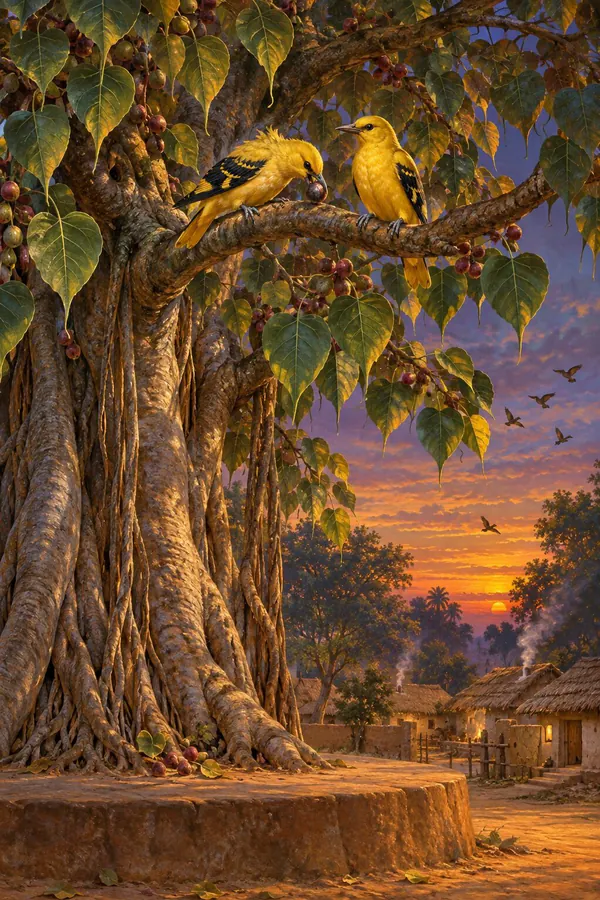
The tree in the picture is named by its fruit. Pippalam is what grows on the pippala, the tree that stands at the center of a village and outlives every person born under it, sending roots down out of its own branches to take hold in the ground again, filling at dusk with birds coming in. Anybody who heard this mantra had sat in that shade in the heat of an afternoon. So the scene is domestic and it is immediate. One bird has the fruit in its beak and is working at the sweetness of it. The other is on the same branch, close enough to touch, eating nothing, looking. Neither of them has left the tree.
“Tayor anyah pippalam svadv atty anashnann anyo abhichakashiti”, one of the two eats the sweet fruit, the other watches and eats none of it. The two are called sayuja and sakhaya, yoked together and companions to each other. They arrived together and they stay together, and everything that follows in this khanda turns on the fact that the watching one has been there the entire time.
The next mantra walks into the picture. On that same tree the purusha lies sunk, grieving over his own helplessness, staying lost in delusion. When he sees that other one, the lord who is served, and sees his greatness, then his grief goes. Notice that the tree stays the same in this, the fruit stays the same, the sitting stays the same. The glance lifts, and the load of grief comes off.
The third mantra states the outcome of that seeing. When the seer sees the one of golden color, who is the doer, the lord, the purusha, the womb of brahman, then that learned man shakes off both merit and sin and, made spotless, arrives at the highest sameness. That merit also has to be shaken off has already been said in this text, back when the talk was of unsound boats. Here the same matter is shown happening inside one man.
Then comes a line that gives the mark of a knower of brahman, and the mark arrives in a very ordinary shape. That prana which is shining in all beings, the learned man who knows it becomes one who is no ativadi, a man who has stopped speaking to win arguments. He plays in the atman, he takes his delight in the atman, and he goes on doing his work. Among the knowers of brahman this one stands highest. Quiet and work sit together inside one and the same man.
The next mantra names the price. This atman is got through truth, through tapas, through right knowledge, and through unbroken brahmacharya. He is seated inside the body, full of light, bright, and the ascetics whose faults have run thin see him. Four words, and the weight of each one differs. Truth belongs to conduct, tapas to endurance, right knowledge to understanding, and brahmacharya to the conserving of strength. On these four legs the next mantra stands.
“Satyam eva jayate nanritam satyena pantha vitato devayanah”, truth alone conquers, the false does not, and by truth is laid out that road which they call devayana. Up it climb the rishis whose wanting has been fulfilled, and there the highest treasure house of truth is kept.
The mantra standing directly before it had named the price of this atman, and the naming is worth carrying whole: “satyena labhyas tapasa hy esha atma”, this atman is got through truth, through tapas. Satya heads that list, and in the world these words were spoken in, truth held things up. Nothing was written. A contract was a sentence said in front of witnesses. A debt was a sentence. A marriage was a sentence, and so was the boundary between two men’s fields. Whose son a man was, and therefore what he could inherit and whom his children could marry, came down to what the older people of the village would say when they were asked. The entire body of learning described earlier in this same chapter existed only as accurate speech carried in living memory. Someone who let his words come loose from the facts was pulling a thread out of the one fabric holding the arrangement together, and every person in the room knew it. Satya was a practice with a daily cost on it, the way the fire was.
And the conquest in that half line has a direction attached. The rest of the mantra says where the conquering goes. A road is laid out, people whose wanting is finished climb it, and at the top of it something is kept. So the winning named here is the opening of a road and the arriving at a storehouse. Today this line stands in Devanagari under the state emblem of India, at the base of the lion capital from Sarnath, where millions of people pass their eyes over it. In its own place it is the third line of a passage about what it takes to see something.
After this it describes that treasure house. It is great, it is divine, its form cannot be thought, and it shines finer than the finest. It is farther than far, and it is right here, quite near. For those with eyes it lies set down here itself, in the cave. And then every instrument of grasping is taken away one by one. It comes into no hold of the eye, none of speech, none of the other gods, none of tapas, none of work. The man whose sattva has been made clean by the grace of knowledge is the one who, meditating, sees that partless thing.
The end of the khanda turns inward again. This atom-like atman is to be known by the mind, the atman in whom prana has entered in five ways. The mind of all creatures is woven through with the pranas, and on the cleaning of the mind this atman comes out into the open. Whichever world a man of clean sattva desires with his mind, and whichever desires he desires, he wins that world and those desires. So let the man who wants prosperity honor the man who knows the atman.
In short: Two birds on one branch, one sunk in the fruit, one watching. The tree stays as it was, the glance lifts, and grief comes off. Satyameva jayate arrives inside this sequence, right after truth, tapas, right knowledge and brahmacharya, and the conquest spoken of is a road named devayana. One way of reaching it remains, a mind made clean by the grace of knowledge.
The one it chooses, and rivers that lose their names in the sea
The last khanda begins from the man who has come to know. He knows that supreme abode of brahman where this whole universe lies set down, shining bright. Those who give up their wanting and worship that purusha, those steady ones pass over this shukra, this seed. And the reverse of it comes in the next mantra. The man who desires desires and goes on taking himself to be made of them keeps taking birth here and there behind those same desires.
And for the man whose wanting has been fulfilled and whose self has been made, all desires dissolve right here, in this very birth. This sentence is the great compassion of this Upanishad. Liberation is being put off to no later date, no other world, no time after dying. The desires go out here, inside this same body, in the middle of this same world, and the man goes on standing where he stood.
Then comes the mantra that broke the whole stiffness of practice. “Nayam atma pravachanena labhyo na medhaya na bahuna shrutena”, this atman is got by no discourse, by no sharpness of intellect, by no great quantity of listening. The one whom it chooses for itself is the one who gets it, and to that one this atman opens out its own form. All the stairs of learning are set aside in one stroke, and the choosing is said to come from the other side.
Slackening off right here is a thing the Upanishad refuses to allow. The very next mantra says that this atman is got by no man without strength, by no carelessness, by no tapas that carries a mark of nothing. The learned man who makes his effort through these means, into him this atman enters the abode of brahman. Read the two mantras together and the matter stands. Completing the effort is our work, and the opening comes from his side.
After this there is a small picture of the ones who have arrived. Having reached him, the rishis are satisfied with knowledge, their self has been made, their attachment is gone, they are at peace. Those steady ones, having reached the all pervading from every side, holding themselves joined, enter into everything. And the ascetics who have settled the meaning firmly through the vijnana of vedanta, whose sattva has become pure through the yoga of sannyasa, become supremely deathless in the worlds of brahman at the final hour and are released on every side.
Then comes the scene of the scattering. The fifteen kalas go back into their own stations, all the gods into their own presiding deities, and works and the atman made of vijnana, all of these become one in that supreme imperishable. And to explain this comes the comparison everybody afterward repeated. As flowing rivers reach the sea and set there, leaving name and form behind, so the learned man, released from name and form, reaches that divine purusha who is higher than the high.

The rivers in that comparison come down out of the hills carrying names, and a name on a river is an address. It has banks that belong to particular families, a ford where the road crosses, a stretch where the dead are burned, water that tastes like itself and no other water. People swear by it and time their year on it. All of that goes into the sea, and what goes in is water. Nothing in the arithmetic is destroyed. The name and the shape stop being needed once the water has arrived where the water was going.
And then the answer to Shaunaka’s question comes back in a full circle. Whoever knows that supreme brahman becomes brahman itself. In his line there is nobody who fails to know brahman. He crosses over grief, he crosses over sin, and released from the knots of the cave of the heart he becomes deathless. The matter of “once known, leaves all this known” that began in the opening mantra comes to rest here, on the knower himself turning into brahman.
At the end the Upanishad lays down one condition, and this condition is its closing note. This brahmavidya should be told to those who are active in the rites, who are shrotriya, who are settled in brahman, who pour the oblation into the ekarshi fire themselves with faith, and who have completed the shirovrata according to the rule. The man who has left that vow undone does not study this. Shankara’s commentary connects the shirovrata with the practice of the Atharvaveda in which fire is carried upon the head, and the name of this Upanishad is held to be tied to the same vow. This truth the rishi Angira spoke long before. Salutation to the supreme rishis, salutation to the supreme rishis. On this doubled salutation this Upanishad is complete.
That condition deserves a pause, because it names who the whole text was meant for. “Kriyavantah shrotriya brahma-nishthah”, those who keep up the rites, who carry the recitation by heart, who are settled in brahman. The man being handed this knowledge is the man who has been pouring the oblation with his own hands, in faith, morning after morning, and who has carried a vow through to its end. Every leaking boat described in the first mundaka is a boat he has been rowing for thirty years. He is told the planks are soft by a teacher who then requires him to keep rowing, and that requirement is spoken at the very end, after all the demolition is finished, as the last thing the text says before it bows twice and stops.
In short: The last khanda says that the atman comes to hand through no discourse, no intellect, no quantity of listening, and along with that, that the man without strength and the careless man never receive it. The effort is ours, the opening is his. Rivers leave their names in the sea, and the knower turns into brahman. The text closes on one condition and a salutation spoken twice.
And in the end, toward yourself
The most useful thing in this Upanishad is perhaps its very first sentence. Shaunaka left out the question of what he would get. He asked what there is such that, once known, everything else comes untangled. Our days run the other way around. We look for the solution of one thing at a time, we settle each question separately, and the list never finishes. Shaunaka’s way is to go under the list and look at whether all of it has one root. Asking that question costs a man nothing, and the shape of the day changes the moment it is asked.
The second useful thing is those unsound boats. The Upanishad brings sacrifice down through no disparagement of it. It shows the construction, that whatever is built out of doing runs as long as doing runs. Our own boats are of the same build, the ladder at work, the account of savings, the reliance on praise, all of it that we have put together. Sitting in them is fine, and they carry a man some distance. Simply knowing that water comes into them keeps a person ready for the day the shore has to be changed.
And at the end, those two birds. That picture belongs to all of us. Inside, one part is fastened to the fruit, to the taste, to the reckoning, to the next thing. And on the same branch one part is quietly watching, eating nothing, tangled in nothing. The Upanishad asks nobody to give up eating. It says this much, that you lift your eyes once toward the one who is watching. Grief comes off with that one glance, and the line satyameva jayate starts to feel like a road laid out under your feet.
Source: Mundaka Upanishad, all three mundakas, khandas 1.1 to 3.2; read against the Sanskrit, with Shankara’s reading noted where readings differ.