Textual context
Tattva-jnana, knowledge of what is, names the fifteenth chapter. The Sanskrit schools distinguish two grades of knowing: paroksha, what comes secondhand through a teacher’s word or a scripture’s line, and aparoksha, what is one’s own, as a man knows he is awake. Every verse here presses toward the second.
Bertrand Russell (1872 to 1970) drew a line of the same shape between knowledge by acquaintance and knowledge by description. Ashtavakra drew it in Mithila, for a king, long before him.
Knowledge of Truth
Knowledge of Truth · 20 shlokas
Janaka has just said, in four verses, that desire has left him and that he no longer troubles himself even about liberation. Ashtavakra answers with twenty, the most concentrated stretch of the dialogue: body, mind, world, grief, bondage and freedom, each taken up once and set down. Six of them end on the same instruction, be happy.
Tattva is the thatness of a thing, and tattva-jnana is the knowing of it. A short primer handed down under Adi Shankaracharya’s name, the Tattva-bodha, takes the word for its title and was for centuries the first text put into a beginner’s hands. These twenty verses are for a pupil at the far end of that road.
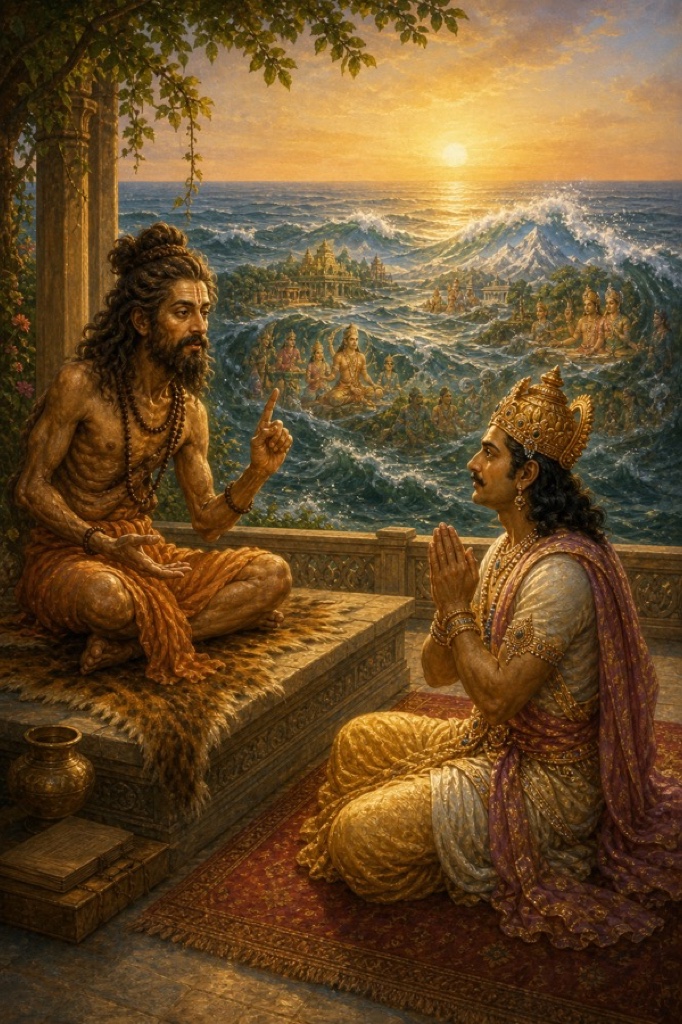
The king has finished speaking, and the courtiers wait to see what the boy will make of such a claim from a throne. Ashtavakra does not praise it. He begins by sorting hearers into two kinds and lets the king find himself in it: one man of clear mind is finished the moment a teaching reaches him, however offhand; another asks for a whole lifetime and stays bewildered. Then the shortest account of bondage and freedom in the dialogue, the taste for the things of the senses and the loss of that taste, and after it a sentence strange from a teacher: do as you wish. This knowledge, the third verse explains, turns an eloquent, tireless man mute and idle in the eyes of the world, and men who want their pleasures see the cost and keep away. The hall is full of such men, and Ashtavakra says it in front of them.
Shlokas 1 · 2 · 3
A man of clear understanding is fulfilled by a teaching given in passing. Another inquires his whole life long and stays bewildered.
Liberation is distaste for the objects of the senses; bondage is relish for them. That is all there is to know. Now do as you wish.
This knowledge of truth makes an eloquent, wise and energetic man mute, inert and idle. That is why those who want enjoyment shun it.
Now he turns to the king directly, and the first thing he takes away is the body. Janaka is not the body, the body is not his, and he neither enjoys nor acts; he is consciousness, the witness that needs nothing. The verse ends on an instruction a king rarely hears: live happily. The fifth verse takes the mind. Attachment and aversion belong to the mind, and the mind was never Janaka’s; he is awareness with no construct laid over it, nirvikalpa, and nothing in him changes. The sixth widens the circle to everyone in the hall: the self in every being, every being in the self, and the two words a king lives by, “I” and “mine”, fall away.
Shlokas 4 · 5 · 6
You are not the body, nor is the body yours; you are neither the enjoyer nor the doer. You are consciousness, the witness always, needing nothing. Live happily.
Attachment and aversion belong to the mind, and the mind is never yours. You are free of mental constructs, awareness itself, changeless. Live happily.
Knowing the self in all beings and all beings in the self, be free of ego and of “mine”, and be happy.
Then an image, and it is the sea. The universe rises in Janaka as waves rise in the ocean, and he is the ocean; there is no doubt in it, and the fever of the mind can go out. The eighth verse changes register. A boy of twelve calls the king child, tells him twice to have faith, and warns him against delusion here. What Janaka is asked to trust is the chapter’s largest claim: he is the self, the Lord whose nature is knowledge, beyond prakriti, beyond everything made and changing.
Shlokas 7 · 8
That in which this whole universe arises like waves in the sea, that you are, without any doubt. You who are the form of consciousness, be free of fever.
Have faith, child, have faith; do not be deluded in this. You are the self, the Lord whose very nature is knowledge, and you are beyond prakriti.
Now he goes to the root of grief: the body ends. The body, wrapped in the gunas, the three strands everything in nature is spun from, stays a while, arrives, departs. The self does neither, so why mourn for it. Let the body last until the kalpa closes or go today; to pure consciousness neither is gain nor loss. Then the sea again, turned the other way: Janaka is the endless ocean, the world a wave that rises and sinks in him by its own nature, and the ocean is no fuller for its rising and no emptier for its fall.
Shlokas 9 · 10 · 11
The body, wrapped in the gunas, stays, comes and goes. The self neither comes nor goes. Why do you grieve for it?
Let the body last until the end of the aeon or go this very day. What gain or loss is there for you, whose form is pure consciousness?
In you, the endless ocean, let the wave of the universe rise or fall of its own nature. You neither gain nor lose.
He calls the king child a second time, because what he says next removes the last tool a seeker has. Janaka is pure consciousness and the world is nothing apart from him; then who is left to reject anything or accept it, and how, and where? The thirteenth verse names Janaka in one long compound, the one imperishable, peaceful, stainless sky of consciousness; a sky has no place for birth, or action, or ego. Then the goldsmith’s example, worn on every arm in that court: bracelet, armlet and anklet, three shapes and one gold. Whatever Janaka sees is Janaka appearing in it, as the gold appears in each ornament.
Shlokas 12 · 13 · 14
Child, you are pure consciousness, and this world is not separate from you. So whose is the notion of what to reject and what to accept, and how, and where?
In you, the one, imperishable, peaceful, stainless sky of consciousness, where is birth, where is action, and where is ego?
Whatever you see, it is you alone who appear in it. Do bracelet, armlet and anklet appear as anything separate from the gold?
Now the line every mind draws: this is me, this is not. Ashtavakra asks the king to erase it: settle that all of it is the self, let sankalpa, the mind’s resolve, fall silent, and be happy. The sixteenth is the bluntest verse of the chapter: the universe stands on Janaka’s ignorance and on nothing else, he is one, and apart from him there is no one in samsara and no one out of it. The man who has taken this in, certain that the whole appearance is an error and amounts to nothing, is emptied of old desire; what is left is awareness, as quiet as if nothing had ever been there.
Shlokas 15 · 16 · 17
Give up dividing things into “this I am” and “this I am not”. Certain that all is the self, be free of intentions and be happy.
The universe exists through your ignorance alone; in ultimate truth you are one. Apart from you there is no one bound to the world and no one free of it.
One who is certain that this universe is mere error and nothing at all becomes free of latent desires, pure awareness, and is at peace as though nothing existed.
The close gathers the three times into one sentence. In the ocean of becoming there was, is and will be one; so Janaka has no bondage to escape and no moksha to reach, and the word Ashtavakra gives him, krita-kritya, belongs to a man who has done everything there was to do. Walk on happily, he tells him. The nineteenth verse names the two motions that keep a mind churning, sankalpa and vikalpa, the resolve and the second thought behind it, and asks the king to let both settle and rest in his own self, whose form is bliss. Then the last verse, and the most daring thing said in this court. Give up meditation. Hold nothing in the heart. Janaka is the self and is free already, and thinking it over will add nothing. The boy stops there. The king will not speak again until the nineteenth chapter.
Shlokas 18 · 19 · 20
In the ocean of worldly existence there was, is and will be one alone. You have neither bondage nor liberation. You have done all there is to do; live happily.
You who are made of consciousness, do not agitate the mind with intentions and doubts. Grow calm and abide happily in your own self, whose form is bliss.
Give up meditation altogether; hold nothing in your heart. You are the self, already free. What will you accomplish by thinking it over?