On this page
Yoga Vasistha · Story 8
Janaka: From the Siddhas’ Song to Steady Wisdom
On a spring evening, King Janaka of Videha leaves his attendants behind and walks alone into a grove on a hillside, and from a thicket of tamala trees hears voices he cannot see: siddhas, singing to one another about the Self. He goes home in silence, climbs to the highest balcony of the palace, and takes his whole life apart there, the kingdom, the pleasures, the body, the dynasties of gods that have already died. When the chamberlain comes to call him to his bath and his Brahmins, he has to decide whether a man who has seen this can still rule. Vasistha tells Rama the story as the example of knowledge that falls into a life like a fruit out of the sky.
Voices in the Spring Garden
"I have told you the usual road to knowledge, Rama, the one most people take," Vasistha said. "Now I will tell you of another, quite distinct from it. A soul born in a human body has two goals worth the name: the bliss of heaven, and the final release, apavarga, from which there is no return. And there are two ways of reaching them. One is to follow the instruction of a teacher, which brings a man step by step to perfection, in this birth or over many. The other is knowledge that comes by intuition, by the self-culture of a being who is already partly awake, and that is like getting a fruit that drops out of the sky into your hand. Hear how that happens, from an old tale. It is a happy and holy story. It loosens the fetters of our good deeds and our bad ones alike, and the people born last, the ones alive now, should taste it with relish for their enlightenment, as other people relish a fruit fallen from heaven for the pleasure of it."
There lives a mighty king of the Videhas, the people of the country called Tirhut, and his name is Janaka. He is blessed with every prosperity and with an understanding that has no bounds. To the crowd of those who come asking, he is the kalpa tree, the tree of the gods that gives fruit in every season. To his friends he is the sun that opens them like lotuses, to his relatives the spring that brings out their flowers, and to women he is the god of love himself. Like the moon, the king of the twice-born, he makes the Brahmins bloom as the moon makes the lilies open, and like the sun he burns off the darkness of his gloomy enemies. He is an ocean of the gems of goodness for everyone, and he holds up his realm the way Vishnu holds up the world.
One spring evening he happened to go wandering in a forest full of young creepers with bunches of crimson blossom on them, loud with the kokilas, the black cuckoos, warbling in their tuneful choirs. He walked among flowering arbors that looked like graceful women dressed in their ornaments, and he sported in their bowers the way Indra, the king of the gods, disports himself in Nandana, his own garden in heaven.
Then he left his attendants behind him and went up to a grove that stood on the slope of a hill in the middle of that romantic forest, where the playful winds carried the fragrance of the flowers about in every direction. And in one spot there, from inside a bower of tamala trees, he heard a mingled sound of voices, like the voices of aerial spirits, siddhas, and he could see no one.
"I will recite to you now, Rama, the songs of the siddhas," Vasistha said, "who live in the retired solitudes of the mountains and in the caverns of the hills, and whose songs are mostly about their own spiritual meditations." This is what the king heard from the trees. "We adore that Being which is neither the subject nor the object, neither the one who sees nor the thing seen, and which in our belief is the positive felicity that rises in our souls and never fluctuates."
Other voices took it up. "We adore that Being which is beyond the three states of the subject, its attribute and its object, beyond sight and seeing and seer. It is the light of the soul, the spiritual light that existed before the light of vision, which is only borrowed from the sun."
And others. "We adore that Being which stands in the midst of all that is and all that is not, between existence and nonexistence, the spiritual light that lights up everything that is lit."
Some sang: "We adore that real existence which is all, whose all things are, by whom they are all made, from whom they all sprang, for whom they exist, in whom they subsist, to whom they all return, and into which they are all absorbed." And some sang: "We adore that Spirit which begins with the letter a and ends in ha with the dot of m above it, aham, the I, which we breathe in and breathe out without ceasing in every breath we take."
Others said: "Those who forsake the Lord, Isha, who sits in the cavity of their own hearts, and run to others outside themselves, are hunting for trifles while they ignore the kaustubha, the jewel that lies on Vishnu’s own breast, which has been put into their hands." And others declared: "It is by forsaking every other desire that a man obtains this one object of his wish, and once he has it, the poisonous plants of all the other desires are torn out of his heart by the root."
Some of them pronounced: "The foolish man who knows the insipidity of all worldly things and still fixes his mind on earthly objects is an ass and no human being." Others said: "The appetites of the senses rise incessantly out of the cavities of the body like snakes, and they are to be killed with the cudgel of reason, the way Indra broke the hills with his thunderbolts."
And at the last they said: "Let men try to secure the pure happiness of quietness, which gives tranquility to the minds of the righteous. The sober-minded, who are settled in their real and natural temperament, have their best repose in the lap of an undisturbed and everlasting tranquility."
Then the voices stopped, and the king stood in the hillside grove with the fragrance blowing past him and nothing to show for what had happened. He had come up the hill a man at play. He went down it dejected, Vasistha said, like a coward who has heard the noise of a battle starting.
The King Alone in the Palace
He turned homeward and went back to his house in silence, the way a stream glides in its quiet course under the overhanging trees toward the bed of the distant sea. He left all his household below, each in their own quarters, and climbed alone to the highest balcony of the palace, as the sun climbs to the top of a mountain. From there he watched the flights of birds crossing the sky at random in every direction, and he thought of the hurrying of men, which is the same, and he began to grieve inside himself over the deplorable condition they are in.
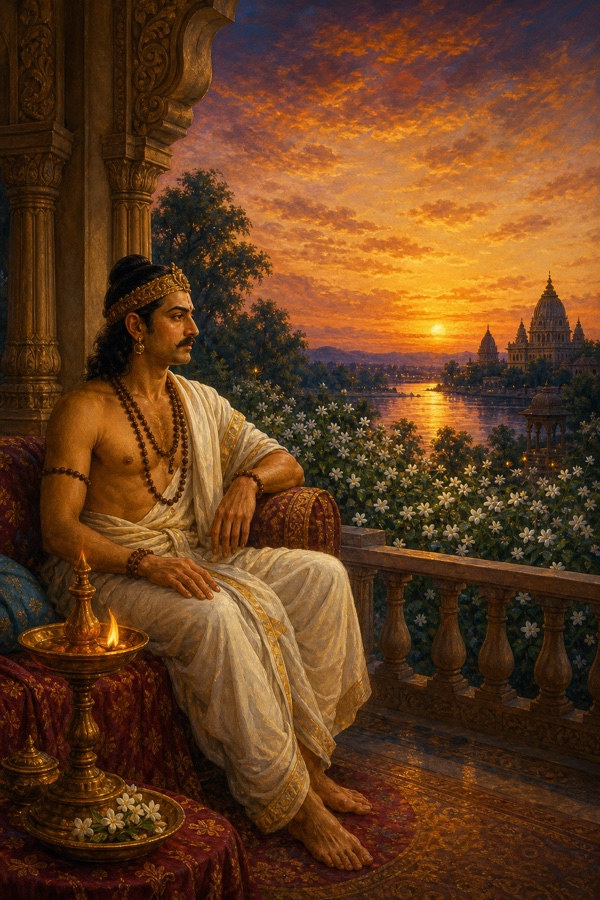
"Miserable me, that I have to go about in the pitiable state of this restless mob, rolling like a ball that one man pushes forward and another pushes back. I have a short span of endless duration allotted to me as my share of a lifetime, and I am senseless enough to trust that it will last. My royalty is short too, it is limited to the length of my life, so how is it that I feel as secure of its continuing as a man who has never thought at all? I have an immortal soul that was here before this existence and will go on after it, and this life is the thing that perishes, and I am fool enough to rely on it, like a boy who believes the painted moon is real. What sorcerer has bewitched me with his wand so completely that he has made me believe I am not spellbound at all?"
"What faith can I put in a world that has nothing substantial in it, nothing pleasant, nothing grand, nothing real, and still I do not know why my mind is taken in by it. What is far from me seems near, because I can feel it with my senses; what is nearest to me of all, my inmost soul, seems farthest away, because I cannot perceive it. Knowing that, I must give up the outward in order to see the inward. This hurry of men after their pursuits is as headlong and as brief as the torrent of a whirlpool. It carries them down into the depth of their dangers, and it is not worth the pain it costs the spirit. The years and months and days and minutes go round with our pains and our pleasures in succession, and the pleasures are swallowed up by the long trains of our misery. I have considered everything carefully and found all of it perishable, nothing durable, nothing lasting, nothing here that a wise man could rely on. The men who stand at the head of the great today are brought low in a few days. What is there in giddy, thoughtless greatness that deserves our regard?"
"I am tied to the earth without a rope. I am soiled here without any dirt on me. I have fallen, though I am sitting in this palace. Soul of mine, how have you been destroyed while you are still alive? Where did this causeless ignorance come from, that has overpowered my intelligent soul, and where did this shadow come from that spreads over its luster, as a dark cloud covers the disk of the sun? What use are these large possessions and these many relatives to me when my soul is sunk in despair, like a child afraid of ghosts and evil spirits? How shall I rely on the enjoyments of the senses, which are the forerunners of disease and death? What dependence is there on my possessions, which hold nothing except anxieties and cares? It makes no difference whether these friends, who feed on my fortune, stay with me or leave me at once. My prosperity is a bubble and a false appearance in front of my eyes."
"The richest men, and many good and great men, and our best friends and our kindest relatives, who have gone before, live now only in our remembering them. Where are the riches of the monarchs of the earth? Where are the earlier creations of Brahma? The past has given way to the present, and the present will give way to the future, so there is nothing to rely on anywhere. Many Indras have been swallowed up like bubbles in the ocean of eternity, so the wise would laugh at my expecting a long life. Millions of Brahmas have passed away, and what they made has vanished in endless successions; the kings of the earth have blown away like their own ashes and been reduced to dust. What confidence is there, then, in my life and my stability? The world is a dream in the night, and the body of the senses is a misconception of the mind. If I put any credence in them, I deserve the blame for it."
"My conception of myself and my perception of other things are false imaginings of my mind. It is my egoism that has laid hold of me, the way a demon seizes an idiot. Fool that I am, seeing and not seeing how the span of my life is measured off every moment by instants of time too small to perceive, and how small a portion they are leaving behind. I see the juggler, time, seizing Brahmas and Vishnus and Rudras and making playthings of them on his playground, the world, flinging them about like balls. I see the days and the nights passing away without a pause and never offering me a chance in which I might look on the true, imperishable one. The objects of sensual enjoyment lurk in the minds of men like cranes gabbling in a lake, and there is no prospect of the true and best object in the mind of anyone. We meet one hardship after another and buffet in the waves of endless miseries on this earth, and we are so shameless that we do not even feel disgusted with it. We see that every desirable thing we fix our thoughts on is frail and perishing, and still we do not seek the imperishable one, and our everlasting good in the evenness of the Soul."
"Whatever we find pleasant at the beginning, as pleasures are, or in the middle, as youth is, or at the end, as virtuous deeds are, or at all times, as earthly goods are, all of it is unholy and subject to decay. Whatever objects are dear to men’s hearts turn out to be subject to the changes of rising and falling, growth and decay. Ignorant people everywhere lean toward evil acts and grow more hardened in their wickedness day by day; they repent every day of their sins and never reprove themselves into being better. Senseless men are never the better for anything: they have no sense in their boyhood, they are heated by their passions in their youth, in their later days they are crushed by the care of their families, and at the end they are overcome by sorrow and remorse. Here the entrance and the exit, birth and death, are both accompanied by pain and crying. Here every state of life is contaminated by its reverse, health by disease, youth by age, wealth by poverty. Everything is unsubstantial in this seemingly substantial world, and still the ignorant rely on its unreal substance. The real good that is got here by painful austerities, by the arduous sacrifices, the rajasuya and the ashvamedha and the rest, or by attaining heaven, has no reality in it either, because it lasts so short a time, a small portion of a kalpa set beside eternity. What is this heaven, and where does it lie, below us or above us or in this lower world, where its residents are not overrun by swarms of evils like locusts? We have serpents creeping in the cells of our hearts, and our bodies are full of the brambles of disease and danger, and we do not know how to destroy them."
"I see good mixed with evil and pain lodged with pleasure. There is sorrow sitting on the top of every joy. So I do not know where I should turn. I see the earth full of common people being born in it and dying in it in multitudes, and I find few honest and righteous men in it. These beautiful forms of women, with their lotus eyes and the grace of their blandishments and their charming smiles, are made to fade so soon and die away. What account am I, among those mighty beings, Brahma and Vishnu, who at the twinkling of their eyes have created the world and destroyed it, and who have gone down to death at last themselves? And you, Janaka, are constantly searching for what is more pleasant and more lasting than the rest, and you never seek the highest prosperity, which lies beyond all your earthly cares. What is this great prosperity you take such delight in, except a vexation of your spirit? The vanity of it is the whole of your calamity. And what are these adversities you are so afraid of? They might turn into your true prosperity, by setting you free of earthly brawls and leading you toward your future felicity."
"The mind is broken to pieces by its fears, like the fragments of the moon floating on the waves of this ocean of the world. Its selfishness has tossed it to and fro, and once it is rid of this world it is at perfect ease. There is an unavoidable necessity working in our worldly affairs and accidents, so it is impudence to welcome some of them as good and to run from others as evil. We are drawn to things that are pleasant to look at and carry a mortal flame inside them, and they consume us like poor moths in a fire that is bright to see and fatal to touch. It would be better to roll in the continual flame of a hell one is used to than to rise and fall over and over in the furnace of this world, out of the frying pan and into the fire. The wise say this world is a boundless ocean of woe. How can anyone who has fallen into the middle of it expect any happiness here? Those who have not fallen in and been drowned outright take the lesser woes for lightness and delight, as a man condemned to be beheaded is glad to get off with a light punishment. I have grown the vilest of the vile. I am like a block of wood or stone. There is no difference between me and the ignorant clown who has never had a thought of his eternal concerns in his head."
"The great tree of the world, with its many branches and twigs and fruits, has sprung from the mind and is rooted in it. It is the conception of the world in my mind, the sankalpa, that gives it existence and sets its appearance before me. So I will try to efface this conception from my mind and forget this world altogether. I will no longer let myself be deluded, like a monkey, by the forms of things that I know are not real, ideas only, changeful and evanescent. I have woven and stretched out the web of my desires, and all I have collected in it is my woes and sorrows. I fell into the snare of my own making and I fled from it, and now I am resolved to take my rest in the soul. I have wailed much and wept bitterly to think of the depravity and the loss of my soul, and from now on I will stop lamenting, because I am not utterly lost."
The Thief Called Mind
He had been looking, all this while, at the world. Now he turned and looked at the thing that had been showing it to him.
"I am awake now, and I am glad to have found out the robber of my soul. It is my own mind. And I am determined to kill it, because it has robbed me for so long of the inestimable treasure of my soul. For so long my mind has been at large like a loose, unstrung pearl. Now I will pierce it with the needle of reason and string it on the virtues of self-control and subjection to wisdom. The cold icicle of my mind will be melted down now by the sun’s heat of reason, and it will be held in the endless meditation of its Eternal Maker, where it cannot come back from."
"I am awakened now to spiritual knowledge, like those holy siddhas and the saints and sages. I will pursue my spiritual inquiries now until my soul is content. I have found my long-lost soul, and I will go on looking at its pure light with joy in my lonely retreat, and I will stay as quiet and still in contemplation of it as a motionless cloud in autumn. I have thrown off the false belief that I am a body, and that these possessions and properties are mine, and I have broken the force of the mighty enemy, the Mind, and I will reach the tranquility of my soul with the help of my reason."
While Janaka was musing in this way, the chamberlain came in and stood before him, the way Aruna, the dawn, stands before the chariot of the sun and waits for it to move.
"Sire, your realm is safe under your protecting arms. Now rise and attend to the daily rites, as becomes your majesty. The maidservants are waiting there with their water pots, filled with water perfumed with flowers and camphor and saffron for your bath, as if the nymphs of the rivers had presented themselves in person before you. The temples are decorated with lotuses and other flowers, with the bees fluttering over them, and hung with fine muslin as white as the fibers of a lotus stalk. The altars are heaped with flowers and aromatic drugs and rice, and adorned with every decoration in the princely style. The Brahmins are waiting there for your majesty’s presence. They have made their sacred ablutions and purifications and offered their prayers for the remission of sins, and they are expecting their worthy gifts from you. The handmaids are at their duties, with the fly whisks in their hands, and the feasting ground has been cleansed with sandal paste and water. So rise from your seat, and may it go well with you, and perform the prescribed duties, because it does not become the best of men to be late in the discharge of what they owe."
Though the head chamberlain begged him in this way, the king stayed in his meditative mood, thinking on the wonderful phenomena of nature. "This royalty of mine and these duties are for a very short time," he said. "I do not need these things, which are so transitory in their nature. I must leave them. They are, at best, the waters of a mirage. I will stay close to myself in my lonely seclusion, like a calm and solitary lake, or a sea. These pleasures of the world that are spread out all around us are entirely useless to me. I will leave them promptly, and remain in my happy retirement."
"Heart, give up your cleverness in running after the objects of your desire, so that you can get past the snares of disease and death that have been laid along your road. Whatever state or condition of life the heart is set hankering in for its delight, it is sure to meet with some difficulty or distress or disappointment coming out of that very thing. Whether you are engaged in the objects of sense or disengaged from them, you will never find one of them, in act or in thought, that conduces to the true happiness of your soul. So forsake the thoughts of the vile pleasures of your senses, and take yourself to the thoughts that are full of the true happiness of the soul."
Thinking in this way, Janaka went silent, and his restless mind went so still that it sat him down like a figure in a painting, or a statue. The chamberlain did not say another word. He stood there silent, in mute respect, out of fear of his master and out of what he knew about the dispositions of kings. And Janaka, in his silent meditation, went over the vanity of human life again, with the cool calm of his mind, and said this.
"Now I must be diligent to find out the best and most precious treasure in the world, and to know what that imperishable thing is to which I can bind my soul as its surest anchor. What is the good of my acts, or of my ceasing from them, when nothing is produced out of anything that is not perishable in its nature? It makes no difference whether the body is active or inactive, since all its actions end in utter inaction at the last, as every force is reduced to rest. It is the pure intellect within me that is always the same, and it loses nothing by the loss of the body or by the want of the body’s actions."
"I do not wish to have what I have not got, and I do not dare to leave what I have already got. I am content with myself. So let me have what is mine and what I have. I get no real good from my acts here, and I lose nothing by refraining from them. What I get by acting, or by not acting, is all nothing, vanity of vanities, and nothing to my purpose or my liking. Whether I am doing or not doing, whether my acts are proper or improper, I have nothing to desire here, and nothing desirable that I have to expect from them."
"I have got what was due to my past actions, and this body is the result of my former acts. It may go on moving and acting, or it may be still and fade away; it is the same thing to me. When the mind has been set at ease by the want of action or passion, the actions of the body and its members are the same in their effects as not doing them. The acts of men that happen to take place as the results of their destiny or their previous actions are reckoned as no acts of theirs. The impression the inward soul bears of its past actions and passions gives its color to the nature and the character of the actions that come after. Now that my soul has obtained its imperishable state of spirituality, I am freed from the mutability of the transmigrations of my body and my mind."
So the man who had been going to leave his kingdom for a lake or a sea sat on the highest balcony of the palace and found, when he looked for it, no reason to go and no reason to stay, and nothing in either that could touch what he now knew himself to be. The chamberlain was still standing in front of him. The water in the pots was going cold.
One Day of Duty, One Night of Inquiry
Having thought all this, Janaka stood up and went to perform his daily rites as usual, and without any sense of being the agent of them. He did his duty the way the sun rises every day to make the morning, with no consciousness of doing it. He discharged his duties as they presented themselves to him, with no concern for them and no expectation of their rewards. He did them awake, as if he were asleep.
When he had discharged the duties of the day and honored the gods and the priests, he passed the night absorbed in his meditations. His mind was at ease now, and his roving thoughts were held back from their objects, and in the dead of the night he communed with his own mind, and this is what he said to it.
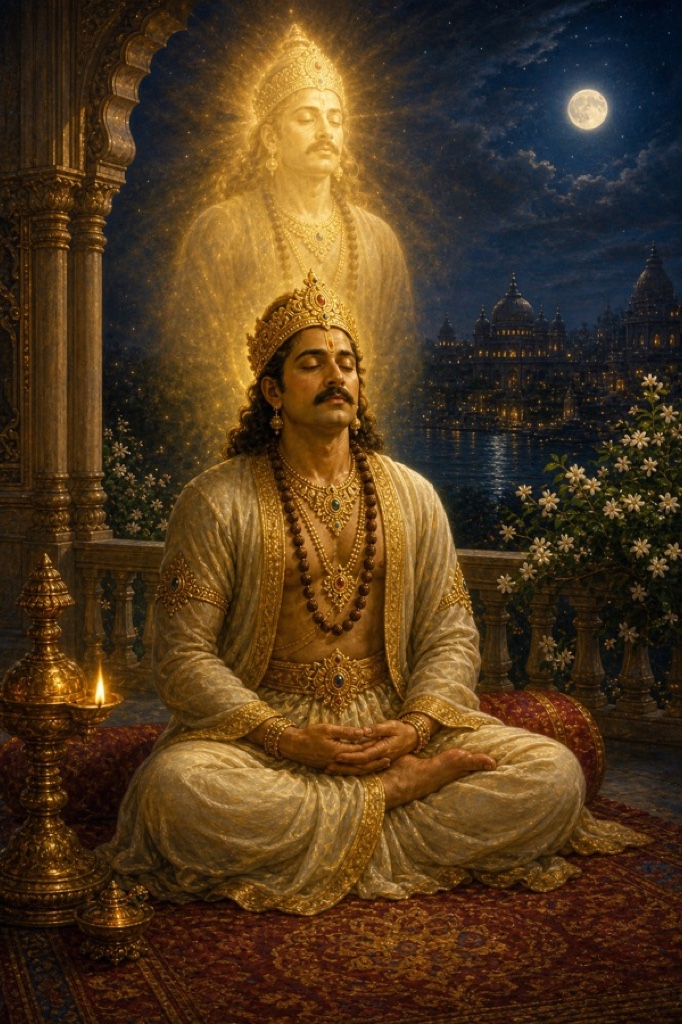
"Mind, you who go roving everywhere with the revolving world, understand that this restlessness of yours does not agree with the peace of the soul. So rest in quiet from your wanderings abroad. It is your business to imagine many things at your pleasure, and as you think, you have a whole world of thoughts in front of you every moment. You shoot out into innumerable woes by your desire for endless enjoyments, the way a tree shoots out into a hundred branches when it is watered at the roots. Now, since our births and our lives and all our worldly affairs are the productions of our wistful thoughts, I beg you, mind, to rest in quiet by giving up your earthly desires."
"Friendly mind, weigh this transient world carefully in your thoughts, and depend on it if you find anything of substance in it. Give up your fond reliance on these visible phenomena. Leave these things, and rove about at your own free will without caring for any of them. Whether this unreal scene appears to your sight or disappears from it, do not let yourself be affected by it either way. You can have no concern with visible objects. What concern can anyone have with an earthly thing that has no existence of its own, like an unsubstantial shadow?"
"The world is an unreality, like you, and there can be no true relation between two unrealities; it is a quarrel over words to maintain that two negatives are related to each other. Grant that you are real and the world is unreal, and there can still be no agreement between you, any more than there is between the living and the dead, or between a positive idea and a negative one. And should the mind and the world both be realities, coexisting forever, then there is no reason for the one to rejoice or grieve at the gain or the loss of the other."
"So avoid the great malady of worldliness, and enjoy the silent joy in yourself, like a man sitting in the undisturbed depth of the ocean with the tide and the waves rolling over his head. Do not burn up like a puppet in a fireworks show with the fiery remorse of worldliness, and do not burn down into the darkness of despair in this gloomy scene of the world. Wicked mind, there is nothing here so good and so great that you can reach your highest perfection by it, except by forsaking every frivolity and resting on your entire resignation to the unchangeable One."
The night wore through while he spoke to it. By the time the light came back over Videha, the mind that had sat him on the balcony like a statue had been told exactly what it was, and the business of the state was waiting downstairs, the same as the day before.
Ruling Videha Without Possession
Having expostulated with his mind in this way, Janaka attended to the affairs of the state and did not shrink from them because of his inward abstraction. Glad tasks and glad tidings did not gladden him; he was indifferent to them, as if he slept in his fixed-mindedness on his Maker. From then on he was neither intent on his duties nor forsaking them; he attended, unconcerned, to whatever business presented itself to him.
His constant habit of reasoning let him understand the eternal truth, and it kept his intellect from blunders, the way the sky is untouched by the dust that flies through it. By his cultivation of reasoning his mind was enlightened and filled with all knowledge. Unaccustomed to duality, his mind had learned to know the sole unity only, and his intelligent soul shone inside him like the full bright sun in the sky. He came to know the Soul that is inherent in every body, and saw all things abiding in the omnipotence of the Intellect, one with the infinite. He was never too joyful and never deeply sorrowful; he kept his evenness through every conflict between his soul and the objects of sense. The venerable Janaka has been liberated in his living state from that time, and he is renowned among mankind since as a veteran of the knowledge of God.
He goes on reigning over the land of the Videha people from that day, without being subject to a feeling of joy or sorrow for a single moment. Knowing the causes of good and evil, he is neither elated nor dejected by any favorable or unfavorable circumstance of his life, and he feels neither glad nor sad at any good or bad accident that touches the state. He did his duties without setting his mind on them, because his mind was wholly employed in its intellectual speculations. Remaining in that state of abstraction, which is like sound sleep, his thoughts stay withdrawn from every object around him. He is unmindful of the past and heedless of the future, and he enjoys the present moment only, with a glad heart and a cheerful mind. "He obtained the obtainable, Rama," Vasistha said, "what is worth obtaining, by his own reasoning, and by no other desire."
"So we should reason in our minds for as long as it takes to arrive at the conclusion of the subject. The presence of the Holy Light is not to be had from the lectures of a teacher, and it is not to be had from the teaching of the shastras. It does not come as the result of meritorious acts, and it does not come from the company of holy men. It is the result of your own intellection. A good understanding, assisted by the power of the perception that accompanies it, prajna, leads to the knowledge of that highest state, which the acts of your piety cannot reach. The man who has set the keen light of the lamp of his perception in front of his sight is able to see both the past and the future present before him, and no shadow of ignorance intercepts his vision. It is by that perception that a man crosses over the sea of dangers, the way a passenger crosses a river in a boat or on a raft. The man without foresight is overtaken by even the smallest mishaps, as a light straw is blown away by the slightest breeze. The man with foresight passes over the eventful ocean of the world without the help of friends or the guidance of the shastras. The man with foreknowledge sees the result of his actions before he acts, and the man without it is at a loss to judge what is about to happen."
"Good company and learning strengthen the understanding, the way watering a plant helps it to grow and to bear. The infant understanding, like a tender shoot, takes a deep root in time, and having grown up like a tree it bears its sweet fruit in its season, cooling as the moonbeams at night. Whatever exertions men make to acquire external properties should rather be devoted, at the start, to improving their understanding. Dullness of the understanding is the source of every evil and the storehouse of misery and the root of the tree of worldliness, and it must be destroyed before anything else. Great-minded men find in their own understanding whatever good they could hope to find on this earth, in the heaven above or in the world below. It is by good understanding alone that a man gets over the ocean of the world; his charities and his pilgrimages and his religious austerities will not carry him across. The divine blessing that attends mortal men on earth is the sweet fruit of the tree of knowledge. Wisdom nips off with its sharp nails the heads of the elephantine bonds of giddiness, as easily as a lion kills a deer, as if it were destroying a strong lion by a weak jackal."
"An ordinary man is often seen to become the ruler of men by having greater knowledge than the others, and the wise and discreet are entitled to glory in both worlds. Reason overcomes all its adversaries and their many kinds of sophistry, as a disciplined soldier overpowers a host of untrained savages. Reasoning is the philosopher’s stone that turns base metals to gold, and it lies hidden in the casket of a rational soul as its best treasure; it yields the fruits a man desires at a thought, like the kalpa plant of paradise. The right reasoner gets across the wide ocean of the world by his reasoning, while the unreasoning rabble are borne away by its waves, as the skillful boatman cuts across the current while the unskilled one is tossed about by the waves. A well-directed understanding leads an undertaking to success, and a misguided intellect goes to rack and ruin; the one sails to the shore before the wind, and the other is tossed in his wrecked vessel over the wide gulf of the world. The keen-sighted and unbiased wise man is never overcome by the evils that rise from his desires, as the arrows of an adversary do not pierce the body of a soldier in armor. A man’s wisdom gives him insight into everything in the world, and the all-knowing man is subject neither to dangers nor to reverses of fortune. The dark and wide-stretching cloud of blind egoism that overshadows the sunlight of the Supreme Spirit inside us is driven away by the breath of intelligence. The improvement of the understanding is the first thing required for the knowledge of the Supreme Soul, the way the cultivation of the ground is the first concern of a farmer who means to reap a rich harvest."