Textual context
Jivanmukti, liberation in life, is the eighteenth and largest chapter, a hundred shlokas long. The idea that moksha can be reached while a person is still alive, still eating and walking and answering to a name, is one of Indian philosophy’s own contributions. The Christian and Islamic traditions place salvation after death. Hinduism, Buddhism and Jainism all hold that it can be had here.
Jivanmukti
Liberation in Life · 100 shlokas
Ashtavakra’s longest chapter, and his last long speech in the court. A hundred shlokas, and each one comes at the same man from a fresh side: the one who knows there is no second thing and goes on living in Mithila all the same. The whole work gathers here. In the last century Ramana Maharshi spoke of the Ashtavakra Gita with respect.
Jivanmukti is the chapter’s name and its single subject: a person liberated while the body still lives. The Ashtavakra Gita and the Yoga Vasishtha give the idea its fullest treatment, and in the later Vedanta tradition Vidyaranya’s Jivanmukti-viveka, written in the fourteenth century, is the longest work given over to it. Ashtavakra needs no treatise. He describes a man.
So far
After the nature of reality, jivanmukti. Moksha while you are still alive.
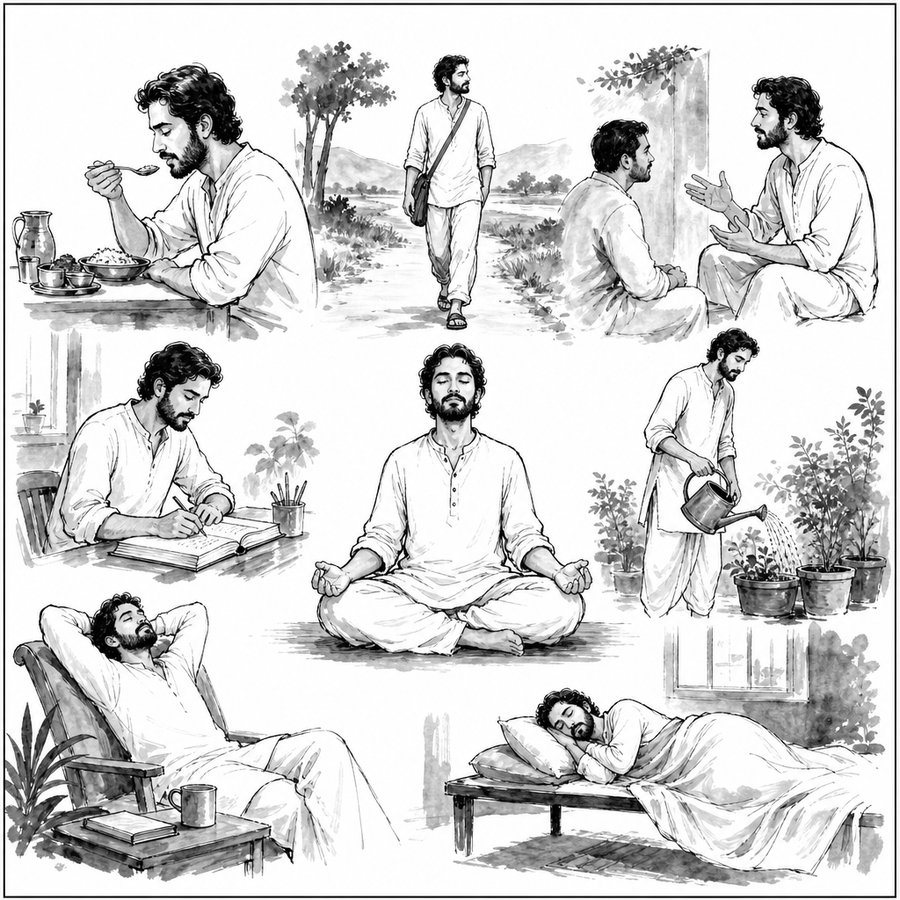
The hall at Mithila has been listening for a long time. Janaka has already said that he sees it, and the boy of twelve who stands bent in eight places before the throne has heard him. What follows is Ashtavakra’s longest speech, and he opens it with a bow, the way a reciter opens a text: homage to that one thing, bliss alone in its nature, calm and radiant, at whose dawning in a mind the whole confusion turns into last night’s dream. Janaka has acquired everything a man can acquire, and the enjoyments that come with it are in the room, in the silk and the lamps and the attendants; without an inner letting go of all of it, Ashtavakra says, no one is happy. Duty burns like a noon sun on the man who carries it, and only the cool rain of inner quiet puts that fire out. The world itself is a projection of the mind, nothing in the final reckoning, though what is real, for those who can tell being from non-being, never ceases to be.
Shlokas 1 to 4
Homage to That whose form is bliss alone, calm and radiant, at whose dawning in awareness delusion turns at once into a dream.
A man acquires every kind of wealth and gains abundant enjoyments, and still, without renouncing everything, he cannot be happy.
How can one whose inner self is scorched by the blazing sun of the pain of duty be happy without the downpour of the nectar of tranquility?
This world is mere imagination, nothing in reality. For those whose nature it is to tell being from non-being, the real never ceases to be.
Now he tells the king where the thing everyone in the hall has been looking for is, and the answer is a kind of joke at the expense of every seeker present. The state of the Atman is nowhere far off, and no narrowing of the mind brings it closer; it is already in hand, free of constructs, without effort, without change, without stain. The brahmins who have spent their lives in practice shift on their seats. Let delusion alone cease, let a man simply take hold of his own nature, and grief leaves him and he sees with nothing in the way. Then, to a king who has already understood, Ashtavakra asks what a steady man would go on practicing, like a child at its lessons, once he knows that everything is imagination and the self free and eternal; and what is left for a man without desire to know, to say or to do, once it is certain that the self is Brahman and that being and non-being are both imagined.
Shlokas 5 to 8
The state of the self is not far off, and it is not gained by narrowing; it is already attained, free of constructs, effortless, changeless, stainless.
When delusion alone ceases and they simply take hold of their own nature, people shine free of grief, their vision unveiled.
Knowing that everything is mere imagination and that the self is free and eternal, what would the steady one practice, like a child?
Certain that the self is Brahman and that being and non-being are imagined, what does the desireless one know, what does he say, what does he do?
Four verses now about the yogi who has gone quiet, and Ashtavakra says them to a king who has himself gone quiet. The alternatives that run through an ordinary mind all day, this I am, this I am not, thin out and end once a man is certain that all of it is the self. In that peace none of the pairs a practitioner measures himself by survives: no distraction and no concentration, no excess of knowing and no dullness, no pleasure and no pain. Then the verse that must have landed hardest in a palace. Sovereignty or a begging bowl, gain or loss, the town or the forest, none of it makes a difference to the yogi whose nature has no constructs left in it. Janaka hears the throne he sits on set beside a beggar’s bowl and weighed as equal. The fourth verse takes away even the ledger: for the man freed from the pair this was done, this was not, there is no duty, no pleasure, no wealth, and no discrimination among them.
Shlokas 9 to 12
For the yogi who has fallen silent, certain that all is the self, the notions “this I am, this I am not” have come to an end.
For the yogi at peace there is no distraction and no concentration, no excess of knowing and no dullness, no pleasure and no pain.
For the yogi whose nature is free of constructs, there is no difference between sovereignty and living on alms, gain and loss, the town and the forest.
For the yogi freed from the pairs “this is done, this is not,” where is duty, where is pleasure, where is wealth, where is discrimination?
Here the chapter’s word arrives for the first time: jivanmukta, liberated while living. Ashtavakra uses it of the yogi for whom no task remains and in whose heart nothing is colored by attachment, whose life simply goes on as it comes. For such a great soul, resting at the far edge of every intention, there is no delusion, no world, no meditation on it, and no liberation either; the last word on the list is the one the hall came to hear about, and he drops it with the rest. Then two verses on seeing. The man who has seen this universe may go on to deny it, and the man who has seen the supreme Brahman may think I am Brahman; the one in whom craving has ended does neither. Seeing, he does not see. With no second thing in front of him, he has nothing to think about.
Shlokas 13 to 16
The yogi liberated while living has no duty at all and no attachment in his heart. His life here simply goes on as it comes.
For the great soul at rest at the limit of all intentions, where is delusion, where is the universe, where is meditation on it, where is liberation?
Let the one who has seen this universe declare that it does not exist. What has the desireless one to do? Even seeing, he does not see.
One who has seen the supreme Brahman may think “I am Brahman.” What is there to think for one beyond thought, who sees no second?
Ashtavakra now sets the practicing man and the free man side by side, and the hall is full of practicing men. The one who has noticed his own distraction sets about restraining it, and that is sensible; the large-hearted one was never distracted, and with nothing left to achieve he has nothing to set about. The steady man is the world’s opposite inside and indistinguishable from it outside, and in himself he finds no absorption, no distraction and no stain to report. A wise man emptied of being and non-being, content, with no craving left, does nothing at all, however busy he appears to the people watching him. The last verse of the four is the one Janaka can take back to his council chamber: the steady one holds no stubborn position on acting or withdrawing. Whatever comes to be done, he does it, and stays at ease.
Shlokas 17 to 20
One who sees distraction in himself practices restraint. The noble one is not distracted; with nothing to achieve, what should he do?
The steady one, though he behaves like the world, is its opposite; he sees in himself neither absorption, nor distraction, nor stain.
The wise one who is free of being and non-being, content and without craving, does nothing at all, though in the world’s eyes he acts.
The steady one has no obstinacy about activity or withdrawal. Doing whatever comes to be done, he remains at ease.
Then an image from outside the palace. A dry leaf lifts off the road and goes wherever the wind takes it, and the free man moves like that, carried by the wind of his old impressions, with no craving, no support, nothing binding him and nothing to resist. For the man for whom the world has ended there is no elation anywhere and no dejection; cool-minded always, he shines as if he had no body, and Videha, the bodiless, is the old name of Janaka’s own kingdom. He wants to give nothing up and feels no loss anywhere, this steady one who delights in the self, cool and clear within. The fourth verse answers the courtiers who laughed when a crooked boy walked in. The steady man, his mind empty by nature, acting as things come, looks like any ordinary man, and neither honor nor dishonor reaches him.
Shlokas 21 to 24
Without craving, without support, free and unbound, he moves like a dry leaf blown by the wind of past impressions.
For one who is beyond the world there is no elation and no dejection anywhere. Always cool-minded, he shines as though bodiless.
The steady one who delights in the self, cool and very clear within, has no wish to give anything up and no sense of loss anywhere.
The steady one, his mind empty by nature, acting as things come like an ordinary man, is touched by neither honor nor dishonor.
Ashtavakra gives the king a sentence to hold: this act was done by the body, and not by me, who am pure. The man who keeps to that thought does nothing even in the middle of doing. He acts like someone who makes no claim on his acts, and he is no fool for it; liberated while living, happy, blessed, he shines even as he goes about the world, which is a description of the man on the throne. The third verse describes the end of a long argument. Worn out by every kind of reasoning, the steady one has come to rest, and now he does not imagine, does not know, does not hear, does not see. The fourth gives the reason he fits no category. Because he is in no samadhi and in no distraction, he is neither a seeker of liberation nor its opposite; having settled that all of it is imagined, this great soul simply abides as Brahman.
Shlokas 25 to 28
One who holds to the thought “this act was done by the body, and not by me, the pure self” does not act even while acting.
He acts like one who lays no claim to it, and he is no fool. Liberated while living, happy and blessed, he shines even as he moves through the world.
Wearied by endless reasoning, the steady one has come to rest; he does not imagine, does not know, does not hear, does not see.
Since he is in no samadhi and in no distraction, he is neither a seeker of liberation nor its opposite. Having seen for certain that all is imagined, the great soul abides as Brahman.
The ego is the hinge of the next four. Where there is an I inside, even sitting still is an act; where the steady man has no I, nothing is done and nothing is left undone, and the accounts a king keeps of his deeds close by themselves. Ashtavakra then looks at the mind of the liberated man as a physician looks at a pulse: not agitated, not pleased, not acting, with no tremor in it, no wanting and no doubt. That mind does not set out to meditate or to act, and still, with no motive behind it, it meditates and it acts. The last verse turns to the listeners who will go home from this hall. A dull man hears the truth plainly stated and is bewildered by it, or draws back from it. Some rare man who is not deluded hears it too, and withdraws so completely that he looks, from outside, like a fool.
Shlokas 29 to 32
One who has ego within acts even when he does nothing. For the steady one without ego, nothing is done and nothing is left undone.
The mind of the liberated one shines: not agitated, not pleased, not acting, free of tremor, without desire and without doubt.
His mind does not set out to meditate or to act, and still, with no motive, it meditates and it acts.
Hearing the truth as it is, the dull man is bewildered or shrinks back. Some rare undeluded man withdraws too, and looks like a fool.
Now the steady man is set against the deluded one, a pairing Ashtavakra will keep up for a dozen verses, and in a hall full of ascetics it is an uncomfortable one. The deluded practice concentration and restraint of the mind with great energy; the steady rest in their own place as a sleeper rests, seeing nothing that needs doing. Effort does not bring the deluded man peace and neither does the absence of effort, while the wise man comes to peace by the bare certainty of the truth. The self those practitioners are reaching for, Ashtavakra says, is pure, awake, dear, full, beyond the whole spread of appearances and free of every ailment, and the people bent on practice never come to know it, because practice presumes it is somewhere else. Action in the form of practice does not free the deluded; the blessed man is freed by knowledge alone and stays as he is, unchanged.
Shlokas 33 to 36
The deluded practice concentration and restraint of mind with great intensity. The steady, abiding in their own state as if asleep, see nothing to be done.
With effort or without it, the deluded man does not find peace; the wise man finds peace by the mere certainty of the truth.
People devoted to practice do not know the self, which is pure, awake, beloved, full, beyond the manifold and free of affliction.
The deluded man does not reach liberation through action in the form of practice. The blessed one, freed by knowledge alone, abides unchanged.
The reason the deluded man fails is the wanting itself. He does not reach Brahman because he wants to become it, and the steady man, who wants nothing of the kind, already shares its nature. Those with no ground under them, restless with grasping, are the ones who keep the world fed, and the wise have cut this whole misfortune off at the root. Peace goes the same way: the man who wants to be calm cannot be, and the man who has settled the truth is calm always, with no wanting in it. The fourth verse gives the hall something to look at, in the literal sense. Whoever leans on a seen thing, an image, a form, a teacher’s face, has no sight of the self by leaning there; the steady do not look at this and that, they look at the imperishable self.
Shlokas 37 to 40
The deluded man does not attain Brahman, because he wants to become it. The steady one, without even wishing, partakes of the nature of the supreme Brahman.
Without support and restless with grasping, the deluded keep worldly existence fed. The wise have cut away the very root of this source of misfortune.
The deluded man does not find peace, because he wants to become calm. The steady one, having settled the truth, is calm in mind always.
Where is vision of the self for the one who leans on what is seen? The steady do not see this or that; they see the imperishable self.
Ashtavakra turns the word restraint over once more, since the whole discipline of the ascetics depends on it. Restraint of the mind is a thing the deluded man insists on and strains after, and the straining is why he never has it; for the steady man who is at home in himself, restraint is simply there, with nothing contrived about it. Then three ways of thinking about what exists. One man holds that there is being, another holds that there is nothing at all, and some rare third man holds neither, and he alone is untroubled. Even the dull-witted contemplate the pure, non-dual self, Ashtavakra admits, and still never know it, kept from it by delusion, unquiet for the whole of their lives. The difference between a seeker and a free man comes down to one thing: a seeker’s intellect cannot stand without something to lean on, and the free man’s intellect leans on nothing and wants nothing.
Shlokas 41 to 44
Where is restraint of mind for the deluded one who strains so hard for it? For the steady one who delights in the self, it is always natural.
One man thinks “it exists,” another thinks “nothing exists.” Some rare one thinks neither, and so is untroubled.
The dull-witted contemplate the pure, non-dual self, and through delusion do not know it; they stay unquiet all their lives.
The seeker’s intellect cannot exist without a support. The intellect of the liberated one is always without support and without desire.
Two animal pictures, of the kind a court that keeps hunting elephants would recognize at once. In the first, the objects of the senses are tigers, and the people who catch sight of them run in fright for the nearest cave, which is the practice of restraint and concentration, and crouch there. In the second, the man without craving is a lion sitting quietly, and the objects of the senses are elephants: they see him and slip away, and those that cannot get away stay and serve him with the flattery of a defeated court. Free of doubt, his mind composed, that man does not even carry a manual of liberation; he sees, hears, touches, smells and eats, and lives at his ease. The man whose understanding has been made clean and untroubled just by hearing of the real, Ashtavakra says, finds in himself no right conduct, no wrong conduct, and no indifference either.
Shlokas 45 to 48
Frightened at the sight of the tigers of the sense-objects, those who want refuge dart at once into the cave, to achieve restraint and concentration.
Seeing the desireless lion, the elephants of the sense-objects quietly flee, or, when they cannot, serve him like flatterers.
Free of doubt, his mind composed, he takes up no means to liberation. Seeing, hearing, touching, smelling and eating, he lives at ease.
One whose understanding is pure and untroubled from merely hearing of the real sees neither right conduct, nor wrong conduct, nor indifference.
The straightforward man does what comes to be done, when it comes, whether the world would call it good or bad, and there is a child’s lack of calculation in it. Then four lines built on a single word, svatantrya, freedom, standing on one’s own: from freedom comes happiness, from freedom the supreme, from freedom peace, from freedom the highest state. It is the nearest thing to a declaration in the whole chapter, and Ashtavakra makes it to a king whose freedom until now has been the kind that commands armies. When a man understands that the self neither does nor enjoys, every movement of the mind wears thin at once. The last verse of the group looks at two kinds of stillness. The steady man’s condition may look unruly and has nothing contrived in it, and it shines; the peace of a deluded man whose mind is still full of wanting is manufactured, and it does not.
Shlokas 49 to 52
Whatever comes to be done, good or bad, the straightforward one does it then. His actions are like a child’s.
From freedom comes happiness, from freedom the supreme, from freedom peace, from freedom the highest state.
When a man knows that his own self is neither doer nor enjoyer, all the movements of the mind wear away.
The state of the steady one, unconventional and uncontrived, shines; not so the artificial peace of the deluded one whose mind is full of desire.
Here the pictures widen, because the free man can be found anywhere. The steady ones, with imagination gone from them, unbound, their understanding released, are sometimes seen among great pleasures and sometimes seen entering a mountain cave, and they are the same men in both places; Janaka in his palace and the hermit in the hills stop being opposites. A Vedic scholar, a deity, a holy place, a woman, a king, a loved one: the steady man sees each, honors each as custom asks, and no desire for any of them is left in him. His own household may laugh at him, servants, sons, wives, his daughters’ sons, his whole clan, and he is not bent out of shape by so much as a hair. Pleased, he is not pleased; pained, he is not pained. The strange condition he is in, Ashtavakra says, is known only to others in the same condition, and in that hall there are now two of them.
Shlokas 53 to 56
The steady, free of imagination, unbound, their understanding free, sometimes revel in great enjoyments and sometimes enter mountain caves.
Seeing and honoring a Vedic scholar, a deity, a holy place, a woman, a king or a loved one, the steady one has no desire in his heart.
Laughed at and scorned by servants, sons, wives, grandsons and kinsmen, the yogi is not disturbed in the least.
Pleased, he is not pleased; pained, he is not pained. Only those like him know his wondrous states.
Ashtavakra now says what samsara is, and his definition would empty a council chamber: the sense that something must be done, that itself is worldly existence. The wise do not see it, being empty in form, formless, changeless and free of every ailment. The dull-minded man is restless everywhere from the churning inside him even when he does nothing, and the skillful man is untroubled even with his hands full of tasks, which is the exact position of a king who has understood and still has a kingdom. Such a man, calm of mind, sits at ease, sleeps at ease, comes and goes at ease, speaks and eats at ease, in the ordinary business of a day. Nothing distresses him by his very nature, though he lives as everyone lives, and he shines like one of the great lakes of the plain, which no wind troubles, every affliction gone.
Shlokas 57 to 60
The sense of duty itself is worldly existence. The wise, empty in form, formless, changeless and free of affliction, do not see it.
The dull-minded one is restless everywhere from inner agitation even when he does nothing; the skillful one stays untroubled even while doing his duties.
The calm-minded one, even in daily affairs, sits at ease, sleeps at ease, comes and goes at ease, speaks and eats at ease.
He who by nature feels no distress, though he lives like everyone else, shines like a great lake, undisturbed and free of affliction.
The pairing of the deluded man and the steady one goes one turn further, into renunciation itself, which several men in the hall have made the work of their lives. Even withdrawal, in the deluded man, becomes a fresh activity; even activity, in the steady man, bears the fruit of withdrawal. The deluded man’s dispassion usually shows itself toward possessions, the house given up, the gold given away. For the man whose hope in his own body has melted, Ashtavakra asks what attachment and detachment could still mean. The deluded man’s outlook is forever fastened to imagining and to the effort to stop imagining; the self-settled man’s outlook, with the same objects before it, has the nature of not seeing at all. A sage who moves through every undertaking without desire, like a child, is pure, and action going on around him and through him leaves no mark on him.
Shlokas 61 to 64
Even the withdrawal of the deluded one becomes activity. Even the activity of the steady one bears the fruit of withdrawal.
Dispassion toward possessions is what the deluded usually show. For one whose hope in the body itself has melted away, where is attachment, where is detachment?
The outlook of the deluded is always fastened to imagining or to not imagining. The outlook of the self-settled one, even with objects to imagine, has the nature of not seeing.
The sage who moves through every undertaking without desire, like a child, is pure; no taint touches him even while action goes on.
Ashtavakra calls one man blessed, and the one he means is the knower of the self who stays level through every state of things, whose mind has no thirst in it while he sees, hears, touches, smells and eats. For the steady man, free of constructs always, as the sky is, there is no world, no appearance, no goal to reach and no means of reaching it. He is victorious, this man who has given up every aim, whose very body is the fullness of his own joy, and whose samadhi is natural and goes on in the unbounded without a seam. Then Ashtavakra stops himself, the way a man does who realizes he has said enough, and the stop is itself the verse: what use is there in saying more. The great soul who has known the truth wants neither enjoyment nor liberation, and everywhere, always, he has no relish for anything.
Shlokas 65 to 68
Blessed is the knower of the self who is level in every state, whose mind is free of thirst while he sees, hears, touches, smells and eats.
For the steady one, always free of constructs like the sky, where is the world, where is appearance, where is the goal, where the means?
Victorious is he who has renounced every aim, who is the embodiment of his own full joy, whose natural samadhi goes on in the unbounded.
What use is there in saying more? The great soul who knows the truth wants neither enjoyment nor liberation, and is always and everywhere without relish.
He goes on anyway; the king has not moved, and there is more to say about him. From mahat, the first great principle of creation, all the way down, this whole world of two is a spread of mere names, and for one who is pure awareness and has let the names go, no duty whatever remains. The man certain that all of it is an illusion and that nothing exists, whose inner shining no one around him can see, is at peace by his own nature, with no effort in it, and the courtiers who cannot see what has happened to Janaka are told, in passing, why they cannot. For one whose form is pure shining and who does not see the seen as real, there is no rule to follow, no dispassion, no renunciation, and no calm to cultivate. He shines in infinite form and sees no nature apart from himself, and so bondage and liberation, joy and sorrow, have nowhere to stand.
Shlokas 69 to 72
For one who is pure awareness and has given up the dual world, from mahat down, a display of mere names, what duty remains?
One who is certain that all this is illusion and that nothing exists, pure, his inner shining unseen by others, is at peace by his very nature.
For one whose form is pure shining and who does not see the seen as real, where is rule, where is dispassion, where is renunciation, where is even calm?
For one who shines as the infinite and does not see nature as apart from him, where is bondage, where is liberation, where is joy, where is sorrow?
The world, Ashtavakra says next, reaches exactly as far as the intellect reaches and no further, and inside that span what plays is illusion alone; the wise man, with no mine, no I and no wanting in him, shines in the middle of it. For the sage who sees the self as imperishable and beyond sorrow, there is no knowledge to speak of, no universe, no body, and no I or mine to attach to any of them. Then a warning, and it is aimed at the lesser men in the hall who have been nodding along. A dull-witted man who hears all this and drops his practices of restraint falls at once into daydreams and idle talk. The dull man can hear the truth itself and keep his delusion whole: outwardly, by effort, he looks like a man beyond thought, and inwardly he is hungry for the objects of the senses. The same words that free one listener can undo another.
Shlokas 73 to 76
In a world that reaches only as far as the intellect, illusion alone plays. The wise one, free of “mine,” free of ego, free of desire, shines.
For the sage who sees the self as imperishable and free of sorrow, where is knowledge, where is the universe, where is the body, where is “I” and “mine”?
If the dull-witted man gives up practices such as restraint of the mind, he falls that instant into daydreams and idle talk.
Even after hearing of the real, the dull man does not give up his delusion. Outwardly, by effort, he seems free of thought; inwardly he longs for the objects of the senses.
Against that dull man stands the one whose action has fallen away through knowledge. In the world’s eyes he is a doer still, a king signing orders, and yet he finds no occasion of his own to do anything or to say anything; the doing happens and he is not behind it. For the steady man, changeless and never afraid, there is no darkness and no light, no loss, nothing whatever. Ashtavakra then does something he has not done before. He takes back his own praise. Steadiness, discernment, fearlessness, the very qualities he has been crediting to the yogi for seventy verses, cannot be located in a man whose nature is beyond description and who has no nature of his own at all. Then the flattest sentence in the chapter: no heaven, no hell, and no liberation in life either. He has spent the whole chapter on jivanmukti and now names it as one more thing that is absent. Seen with the eye of yoga, he says, there is nothing at all.
Shlokas 77 to 80
One whose action has fallen away through knowledge, though in the world’s eyes he acts, finds no occasion to do or to say anything.
For the steady one, changeless and ever fearless, where is darkness, where is light, where is loss? There is nothing whatever.
For the yogi whose nature is beyond description and who has no nature of his own, where is steadiness, where is discernment, where is even fearlessness?
There is no heaven, no hell, and no liberation in life either. What use is there in saying more? In the vision of yoga there is nothing at all.
After the nothing, Ashtavakra comes back to the man, and the next verses are almost tender. The steady man does not ask for gain and does not grieve when it fails to come; his mind is cool, and it is filled with amrita, the nectar the gods churned out of the ocean, here held in nothing grander than a quiet mind. Having no wants, he does not praise the peaceful and does not blame even the wicked; level in pain and pleasure, content, he sees nothing that needs doing. He does not hate the world and does not strain to see the self either; free of joy and of anger, he is neither dead nor alive, which is as close as language comes. The fourth verse would have reached every householder in the room. The wise man has no clinging toward sons and wife and the rest, no desire for the objects of the senses, no anxiety even about his own body, and no hope, and he shines.
Shlokas 81 to 84
He does not seek gain, and he does not grieve when it fails to come. The steady one’s cool mind is filled with nectar.
The desireless one neither praises the peaceful man nor blames the wicked. Level in pain and pleasure, content, he sees nothing to be done.
The steady one neither hates the world nor seeks to see the self. Free of joy and anger, he is neither dead nor alive.
Without attachment to sons, wife and the rest, without desire for the objects of the senses, without care even for his own body, without hope, the wise one shines.
Now a wanderer appears, the figure the ascetics in the hall know best, and Ashtavakra claims him too. The steady man lives on whatever falls to him, walks through the countries as he pleases and sleeps wherever the sun goes down, and he is content in every one of those places. Let the body fall or let it rise, the great soul has no concern for it, resting on the ground of his own nature with the whole round of births forgotten. Owning nothing, going where he likes, past the pairs of opposites, his doubts cut through, attached to nothing, the wise man delights, alone, with nothing added. The last verse of the four reaches into the palace treasury. Free of mine, the steady man shines; a clod of earth, a stone and a lump of gold weigh the same to him, the knot of his heart is cut clean through, and the dust and darkness of rajas and tamas have been shaken off him.
Shlokas 85 to 88
Living on whatever comes, wandering freely through the lands, sleeping wherever the sun sets, the steady one is content everywhere.
Let the body fall or let it rise, the great soul has no concern for it, resting on the ground of his own nature, the whole of worldly existence forgotten.
Owning nothing, moving at will, beyond the pairs, his doubts cut through, unattached to all things, the wise one delights, alone.
Free of “mine,” the steady one shines. To him a clod, a stone and gold are the same; the knot of his heart is cut, and rajas and tamas are shaken off.
The sage reaches for a comparison and finds there is none to make. A liberated soul, wholly content, paying no particular heed to anything, with no desire left in his heart, can be set beside no one. Then the verse the whole tradition remembers from this chapter, three lines of the same shape: knowing, he does not know; seeing, he does not see; speaking, he does not speak, and who else could live like that except the man in whom craving has ended. It describes Janaka exactly as he sits there, listening and not listening. Beggar or king, Ashtavakra says, and the two words sit together in Mithila as nowhere else, whoever is without desire shines, once his sense of things as fine or ugly has dissolved. For the yogi who has become plain honesty itself and whose purpose is accomplished, there is no license and no restraint, and no ascertaining of the truth either, since the ascertaining is done.
Shlokas 89 to 92
With whom could one compare the liberated soul, wholly content, heedless of everything, with no desire at all in his heart?
Knowing, he does not know; seeing, he does not see; speaking, he does not speak. Who is like this, other than the one freed of craving?
Beggar or king, he shines who is without desire, in whom the sense of things as fine or ugly has melted away.
For the yogi whose purpose is accomplished, who has become guileless honesty itself, where is license, where is restraint, where is even the ascertaining of truth?
Ashtavakra admits the limit of his own speech. What a man content with rest in the self, wanting nothing and past all distress, experiences inside himself cannot be told; there is no how to it and no one to tell it to, and the boy who has talked for a hundred verses says so plainly. The steady man, content at every step, is in none of the three states the Upanishads count. Asleep, he is not in deep sleep; dreaming, he is not dreaming; awake, he is not awake. The knower thinks and is free of thought, has senses and is without them, has a fine intellect and is without intellect, has an ego and is without ego. Then the verse that takes away even what Ashtavakra has just given him: he is not happy and not unhappy, not detached and not attached, not a seeker of liberation and not liberated, not something and not nothing. The ascetics have been given a list of what they are not; the king has been given his portrait.
Shlokas 93 to 96
What a man content with rest in the self, desireless and free of distress, experiences within: how could it be told, and to whom?
Asleep, he is not in deep sleep; dreaming, he is not dreaming; awake, he is not awake. The steady one is content at every step.
The knower, though he thinks, is free of thought; though he has senses, is without senses; though he is intelligent, is without intellect; though he has an ego, is without ego.
He is neither happy nor unhappy, neither detached nor attached, neither a seeker of liberation nor liberated; he is neither something nor nothing.
The last four verses are the blessing a teacher gives at the end, and they are addressed to a man who needs none. The blessed one is not distracted in the middle of distraction and not absorbed in the middle of samadhi, not dull in dullness and not learned in learning; the boy who out-argued the court’s champion sets learning itself on the list of things the free man is without. The liberated man is at home in whatever condition he is in, finished with the done and the undone, and because the craving has gone out of him he is level everywhere and does not remember what he did or left undone. Praised, he does not warm to it; blamed, he does not flare; death does not shake him and life does not delight him. Then the hundredth verse, and Ashtavakra ends where a king and a hermit meet: the man of quieted mind runs neither to the crowd nor to the forest. However he is and wherever he is, he stays the same.
Shlokas 97 to 100
The blessed one is not distracted even in distraction, not absorbed even in samadhi, not dull even in dullness, not learned even in learning.
The liberated one, at ease in whatever condition, content with what is done, level everywhere through freedom from craving, does not remember what he did or did not do.
Praised, he is not pleased; blamed, he is not angry. He is not shaken by death, and he does not rejoice in life.
The one of quieted mind runs neither to the crowd nor to the forest. However he is and wherever he is, he remains the same.
Ashtavakra stops. A hundred verses have gone by and the king on the throne has not interrupted once, which is itself the answer to all of them. The courtiers look from the crooked boy to their sovereign and back, and what they see is a man who will go on ruling Mithila tomorrow, hearing petitions, judging disputes, eating from a gold plate, and who is, by every mark the sage has named, no longer anywhere in it. When the hall next hears a voice it will be Janaka’s. He has listened long enough, and in the two short chapters that remain he describes, from the inside, the place the boy has just spent a hundred verses describing from without.