Textual context
The seventh chapter is named Shanti, peace. Peace is usually a state, something that arrives after the quarrel and leaves with the next one, and Janaka speaks of it here as what he is made of. The difference carries weight: a state comes and goes, and a nature stays. Ramana Maharshi’s sahaja samadhi, the natural absorption that continues with the eyes open and the hands busy, is a later name for the same thing.
In the last century J. Krishnamurti (1895 to 1986) described in The First and Last Freedom (1954) a choiceless awareness, attention that keeps nothing and pushes nothing away. It sits beside the fifth verse of this chapter, where Janaka finds nowhere in himself for the idea of a thing to keep or a thing to discard.
Peace
Peace · 5 shlokas
Janaka speaks, and in five verses he lays his whole state open. The first three begin with the same phrase, mayy ananta-mahambhodhau, in me, the endless ocean, and the comparisons of the sixth chapter have gone; the king is the ocean now and speaks as one. The peace in these verses has no scholarship behind it. It is the sound of a thing that cannot be added to.
The seventh chapter is the king at rest. Peace here is the quality of his own nature, the way wetness is the quality of water, and no practice produced it, which sets it apart from the modern trade in trained calm, where peace is a skill and a skill can be lost. Ashtavakra has told him he already is this; in these five verses Janaka speaks from inside the fact.
So far
Janaka said there was nothing to dissolve. Now he says what is left when nothing is dissolved: an ocean, and a ship drifting on it.
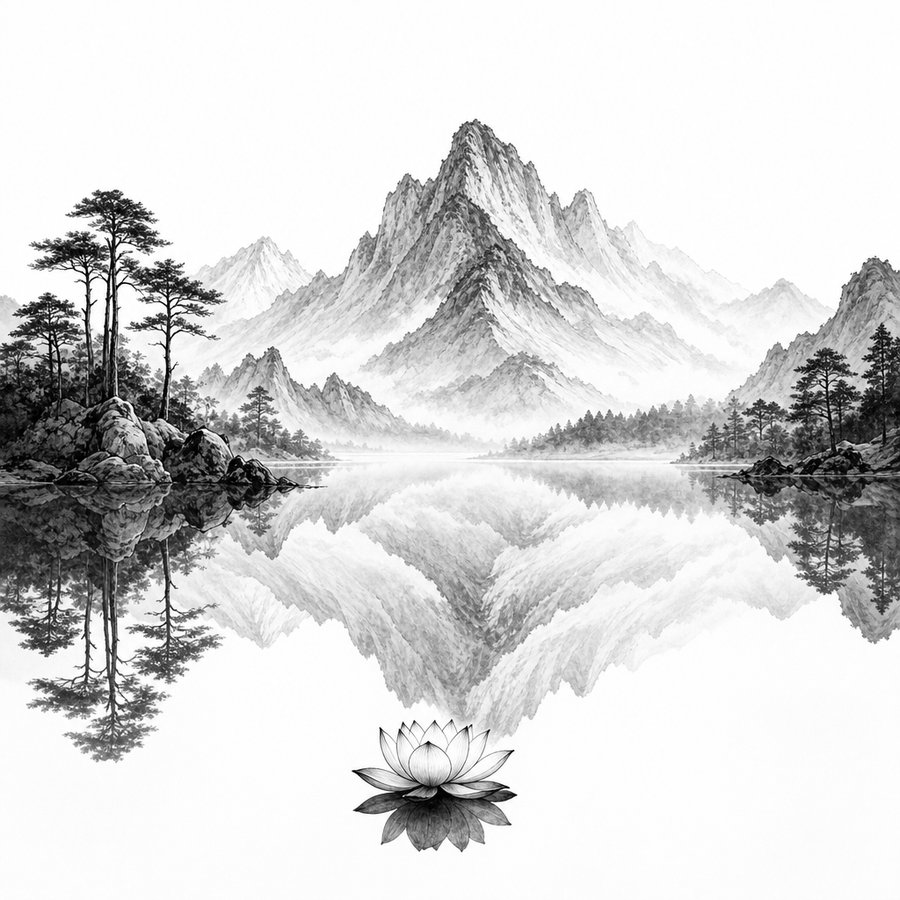
Janaka begins with the largest thing he can name. In me, he says, the endless ocean, and the court hears its king describe himself as the sea. On that sea the whole universe is a ship, and the ship wanders, pushed here and there by the wind of its own mind: wars, harvests, marriages, the thousand errands of a kingdom, all of it weather inside the ship. The ocean has no impatience with any of it. Wherever the ship goes, the water is already there; it is the thing the ship floats on, and a floor does not grow anxious about footsteps.
Shloka 1
In me, the endless ocean, the ship of the universe drifts here and there, driven by the wind of its own mind, and I feel no impatience.
The second verse keeps the ocean and changes the picture on it. The world is a wave now, and a wave rises and falls by its own nature; Janaka lets it do either. Let it rise, let it sink, he says, and the permission is the whole point, because a man who has to hold the wave up or push it down has made himself its servant. From its rising he gains nothing. From its falling he loses nothing. Every anxiety in the hall around him runs on exactly those two accounts, what grew today and what shrank, and the king has closed both.
Shloka 2
In me, the endless ocean, let the wave of the world rise or fall by its own nature; I neither gain nor lose by it.
The third verse goes further than the first two. The ship was at least a ship, the wave at least water in motion; now Janaka says that in the endless ocean this so-called universe is an imagining, a shape the mind has made. He has stopped describing the universe and started describing himself. Utterly calm, without form, he abides in this alone, in the ocean and nothing else, and the sentence is in the first person: this is where I stand. A king announces where he stands at the start of a war. Janaka announces it here, and the ground he names is the one ground nothing can be taken from.
Shloka 3
In me, the endless ocean, this so-called universe is only an imagining. Utterly calm and formless, in this alone I abide.
Then Janaka sets the Self against things, bhavas, everything that can be said to exist, the throne, the hall, the body on the throne, the mind that moves it. The Self is in none of them, and none of them is in that endless, stainless Self; the two have no common place where one could hold the other. A man who sees this has nothing to be attached to, since there is nothing in him for a thing to lodge in, and nothing to long for, since no thing could reach the place where he is. So he is unattached, free of longing, calm, and he abides in this alone, the same ground as before, named a second time.
Shloka 4
The Self is not in things, nor is any thing in that endless, stainless Self. So, unattached, free of longing and calm, in this alone I abide.
The last verse opens on the word Janaka’s whole second chapter was built from, aho, oh. I am consciousness alone, he says, and the world is like a magic show. Every court had its conjuror, and the king has watched the mango tree grow from a seed in an afternoon and the rope stand up on its own, and known, while gasping, that none of it was happening. So the question he ends with expects no answer: how, and where, could he hold the idea of a thing to reject and a thing to accept? A kingdom is run on that idea. Janaka has looked for the place in himself where it could stand and found no floor there.
Shloka 5
Oh, I am consciousness alone, and the world is like a conjuror’s show. So how, and where, could I hold the notion of something to reject or something to accept?