Textual context
Janaka’s first answer to the teaching is wonder, and the Greeks would have known the sound. Plato has Socrates tell a young mathematician in the Theaetetus that philosophy begins in wonder, and Aristotle repeats it near the opening of the Metaphysics. In Mithila the wonder comes after the knowing, from a man who has just seen what he is.
The twenty-five shlokas are built around one cry, Aho. Eight of them open on it and three more carry it inside the verse, and it works the way a refrain works in a song: each time it returns it carries everything that has been said since the last time.
Wonder
Wonder · 25 shlokas
Ashtavakra has finished speaking, and the king answers him. Every verse of this chapter is Janaka’s own. What a boy told him in the first chapter, that he is the seer and was never bound, he now says of himself, in the first person, in front of his court.
So far
Ashtavakra told the king that he is the one seer of everything, free from the start, and that his only bondage was taking the seer for someone else. Janaka has not spoken since his three questions. Now he does.
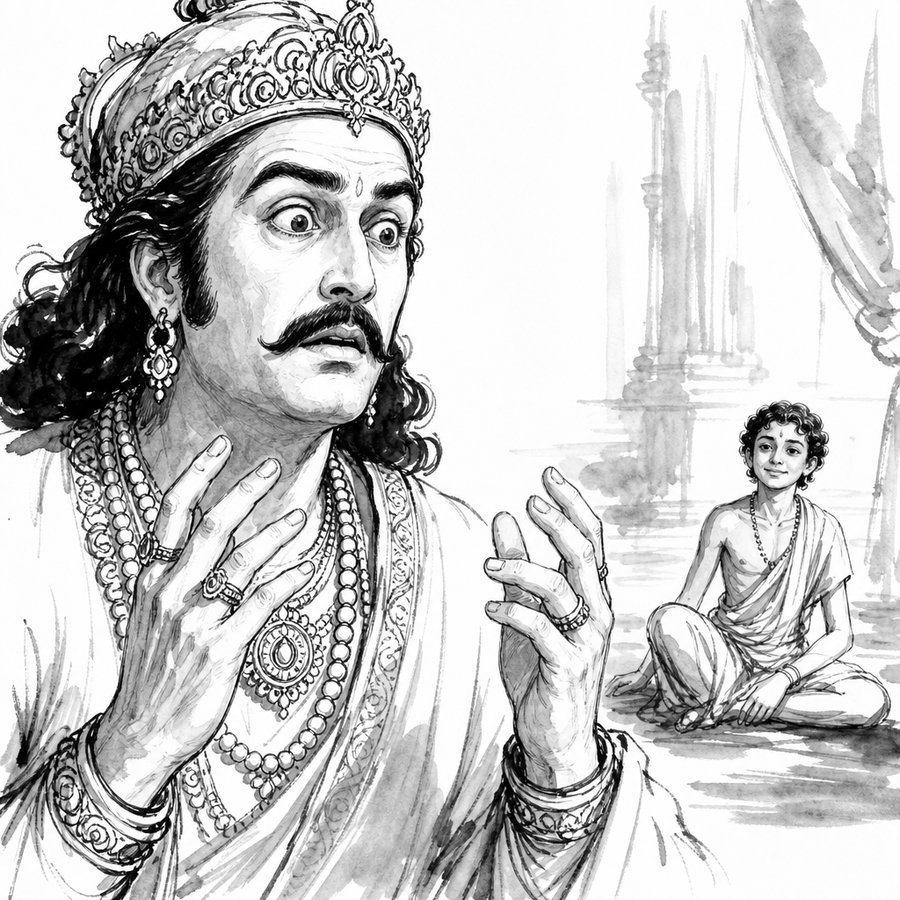
Ashtavakra has stopped at the clay pot, and the hall waits for the king. A court knows what a king does after a teacher speaks: he praises the teaching, he orders a gift. Janaka does neither. The first sound out of him is Aho, the sound a man makes when he finds a thing that was in his hand the whole time, and what follows is a confession made in front of everyone who serves him. He is stainless, he says, at peace, awareness itself, beyond nature. And for all this time delusion has been making a fool of him. The recognition landed whole, and the wonder in his voice is the sound of it landing.
Shloka 1
Oh, I am stainless, at peace, awareness itself, beyond nature. And all this time, delusion alone has made a fool of me.
Then the recognition starts to spread outward from the body. Janaka says that he alone lights up this body, and that the world is lit the same way. Then a conclusion with two faces: the whole world is his, or else nothing at all is his. Both say one thing. If he is the awareness in which everything appears, everything is within him, and there is no separate Janaka left over to own any of it. In the next verse he says that he has renounced the universe together with the body, and he says it from the throne, with the crown still on. The renouncing happened in the seeing. By some skill, he says, from somewhere, the supreme Self has come into view.
Shloka 2 · 3
As I alone light up this body, so I light up the world. So the whole world is mine, or else nothing at all is.
Oh, now that I have renounced the universe together with the body, by some skill the supreme Self is seen.
Now Janaka reaches for pictures, three of them in a row, each pointing from a different side at one fact. Waves, foam and bubbles are never anything other than the water they rise from, and the universe that has come out of the Self is never anything other than the Self. Take a cloth from the weavers of Mithila and look into it closely, and there is only thread; look into the world the same way and there is only the Self. Sugar made from cane juice is the juice through and through; there is no grain of it the juice has not entered. So the universe fashioned in him is filled with him, and there is no gap in it anywhere.
Shloka 4 · 5 · 6
As waves, foam and bubbles are not different from the water, so the universe that has come out of the Self is not different from the Self.
As cloth, looked into, turns out to be only thread, so this universe, looked into, is only the Self.
As sugar made in cane juice is pervaded by that juice, so the universe fashioned in me is pervaded by me through and through.
Then Janaka picks up the rope and the snake, the picture Ashtavakra handed him minutes earlier, and handles it as his own. While the Self is unknown, a world appears; the moment the Self is known, the world stops appearing, exactly as the snake lives only as long as the rope is unrecognized and is gone the instant the lamp arrives. Then he says what he is made of. Light is his own nature, and he stands not one step apart from it; whenever the universe shines, that shining is him. Everything anyone in that hall has ever experienced came as an appearing, and appearing is the work of consciousness alone.
Shloka 7 · 8
From not knowing the Self the world appears, and when the Self is known it appears no more; from not knowing the rope the snake appears, and when the rope is known it is seen no more.
Light is my own nature; I am nothing other than that. When the universe shines, it is I alone who shine.
The wonder deepens, and the cry comes back. Aho: this world, imagined out of ignorance, appears in him, the way silver appears in mother-of-pearl, a snake in a rope, water in the glare of sunlight. Three errors, and in each of them the ground is real and what is laid over it is imagined. Then the other direction. Whatever has come out of him dissolves back into him, as a pot goes back to clay, a wave to water, a bracelet to gold. A king’s goldsmith melts bracelets down every season, and the gold loses nothing by it; the bracelet was a shape the gold held for a while. Arising, lasting and dissolving are three movements of one substance.
Shloka 9 · 10
Oh, the universe, imagined through ignorance, appears in me, as silver in mother-of-pearl, a snake in a rope, water in the rays of the sun.
The universe that came out of me will dissolve back into me, as a pot into clay, a wave into water, a bracelet into gold.
From here Janaka does something no one in that hall has seen a king do. He bows to himself. Namo mahyam, homage to me: in a court where every head bends toward the throne, the man on the throne salutes what no crown can be set upon. The homage goes to the one in him that has no destruction, who stays when the whole world is wiped out, from Brahma down to a tuft of grass. Then again: homage to the one who is one even while wearing a body, who goes nowhere and arrives from nowhere, who stands pervading the entire universe. And a third time: there is no one here as skilled as he is, who has held up this whole universe for so long without once touching it with the body. The courtiers who laughed at a crooked boy an hour ago hear their king praise himself for a feat none of them can see.
Shloka 11 · 12 · 13
Oh, I bow to myself, I who have no destruction, who remain even when the whole world perishes, from Brahma down to a tuft of grass.
Oh, I bow to myself: I am one even while I wear a body, I go nowhere and come from nowhere, and I abide pervading the universe.
Oh, I bow to myself: there is no one here as skilled as I, who have upheld the universe for so long without touching it with the body.
The homage rises once more, and this time it carries a riddle. Nothing at all belongs to him, or else everything belongs to him that speech and mind can reach. Both hold at once. There is no separate Janaka left to keep a treasury, and there is nothing lying outside the awareness he is; a king who owns Videha has just said that he owns nothing and everything in one breath. Then he takes apart the last structure a thinker leans on. Knowing, the thing known and the one who knows are a triad, and the triad is unreal; it appears as three only through ignorance, and the stainless one in whom the three shimmer is himself.
Shloka 14 · 15
Oh, I bow to myself, I to whom nothing belongs, or else to whom everything belongs that speech and mind can reach.
Knowing, the known and the knower: this triad is not real. I am the stainless one in whom it appears through ignorance.
Then Janaka speaks like a physician who has found the one disease under all the symptoms. Suffering, he says, is rooted in duality, in the sense of two, and there is no other remedy for it; every cure a court physician could offer treats a symptom. All of this that is seen is false, and he is the one spotless essence of consciousness.
Shloka 16
Oh, suffering is rooted in duality, and there is no other remedy for it. All this that is seen is false; I am the one spotless essence of consciousness.
Now he puts his nature into the plainest words he has used. He is awareness alone, and every limiting adjunct, every upadhi, was imagined by him out of ignorance. A herald reads out a king’s upadhis each morning: lord of Videha, son of his father, master of so many elephants. Each is a label laid over the man, and the man under them does not change. Reflecting on this without pause, Janaka says, he abides in the state where no thought divides. From there a stranger sentence: he has neither bondage nor moksha; the error has ceased and has nothing left to stand on; the universe rests in him and, in reality, does not rest in him. If bondage never happened, no one needs releasing.
Shloka 17 · 18
I am awareness alone; every limiting adjunct was imagined by me through ignorance. Reflecting on this constantly, I abide in the thought-free state.
I have neither bondage nor liberation. The error has ceased, with nothing left to rest on. Oh, the universe rests in me, and in reality it does not rest in me.
Here the last foothold of imagining gives way. It is settled, Janaka says: this universe, his body included, is nothing, and the Self is pure consciousness alone, so there is nowhere left for imagination to take hold. Imagining needs two, one who imagines and a thing imagined, and there are no longer two. Then he counts off what the imagining had made: the body, heaven and hell, bondage and liberation, and fear. All of it is imagination, and one whose self is consciousness has no business with any of it. A court keeps priests on salary to secure the king’s place in heaven. Janaka has just put heaven, hell and moksha in one list and dismissed the list.
Shloka 19 · 20
It is settled: this universe, body and all, is nothing, and the Self is pure consciousness alone. In what, then, can imagining now take hold?
The body, heaven and hell, bondage and liberation, and fear as well: all this is mere imagination. What have I, whose self is consciousness, to do with it?
And now he looks up at the hall. Aho: even in this crowd he sees no second, no other; the whole throng has become for him like a wilderness, and he asks where in it he could take delight. The ministers and brahmins along the walls are still there. What has gone is the line between them and him. Then he names the bondage he carried. He is not the body, the body is not his, he is not the jiva who lives and dies in it; he is consciousness. His one bond, he says, was the craving to live, and he says it in the past tense.
Shloka 21 · 22
Oh, since I see no duality even in a crowd of people, it has become for me like a wilderness. In what should I take delight?
I am not the body, and the body is not mine; I am not the jiva, I am consciousness. This alone was my bondage: the craving to live.
Shloka 23 · 24 · 25
Oh, in me, the endless ocean, when the wind of the mind rises, the many-colored waves that are worlds leap up all at once.
When the wind of the mind dies down in me, the endless ocean, the ship of the world is wrecked, to the misfortune of the jiva, the merchant who sailed in it.
How wonderful: in me, the endless ocean, the waves that are living beings rise, strike against one another, play, and sink back, each by its own nature.
The chapter ends on one picture held for three verses. Janaka is the ocean, endless, and the mind is a wind that crosses it. When the wind gets up, waves rise all at once, and the waves are worlds, each one colored differently. When the wind drops, a ship goes down, the ship of the world, with a merchant aboard called the jiva; the sea is untroubled by the loss. And in the last verse the king watches the waves that are living beings rise, knock against each other, play and sink back. There is wonder in the watching and nothing to mourn. Then Janaka stops. The boy in front of him has heard a king say back everything he was taught an hour ago. In the third chapter Ashtavakra answers him, and the answer is a test.