Textual context
Akaivalya is the twentieth and final chapter. Kaivalya, aloneness, is the word Patanjali closes the Yoga Sutra with (4.34): the seer standing alone at last, apart from everything it once took itself to be. Akaivalya sets even that aside. Where there is no second thing, there is nothing to stand apart from.
The word marks the line between two schools. Samkhya and Yoga end at kaivalya, the purusha free of prakriti. Advaita Vedanta denies the second thing altogether, and Janaka’s fourth verse, which sets bodiless kaivalya among the things gone, is one of the oldest statements of that denial.
Akaivalya
Beyond even aloneness · 14 shlokas
The last chapter, and every verse of it is Janaka’s. Fourteen verses, each strung on the same small word, kva, where: where is the body, where the mind, where bondage, where moksha. He asks it of everything he once owned, and each time the answer is silence. Even kaivalya goes.
Akaivalya reads at first like a contradiction, not-aloneness, in a tradition where aloneness is the final state. In Samkhya kaivalya is what the whole path is for, the seer at last by itself. Janaka says the state he rests in lies past even that. There is no one left in it to be alone.
So far
Janaka’s last word. Fourteen verses that take leave of everything, the teacher included, and end in a hall gone quiet.
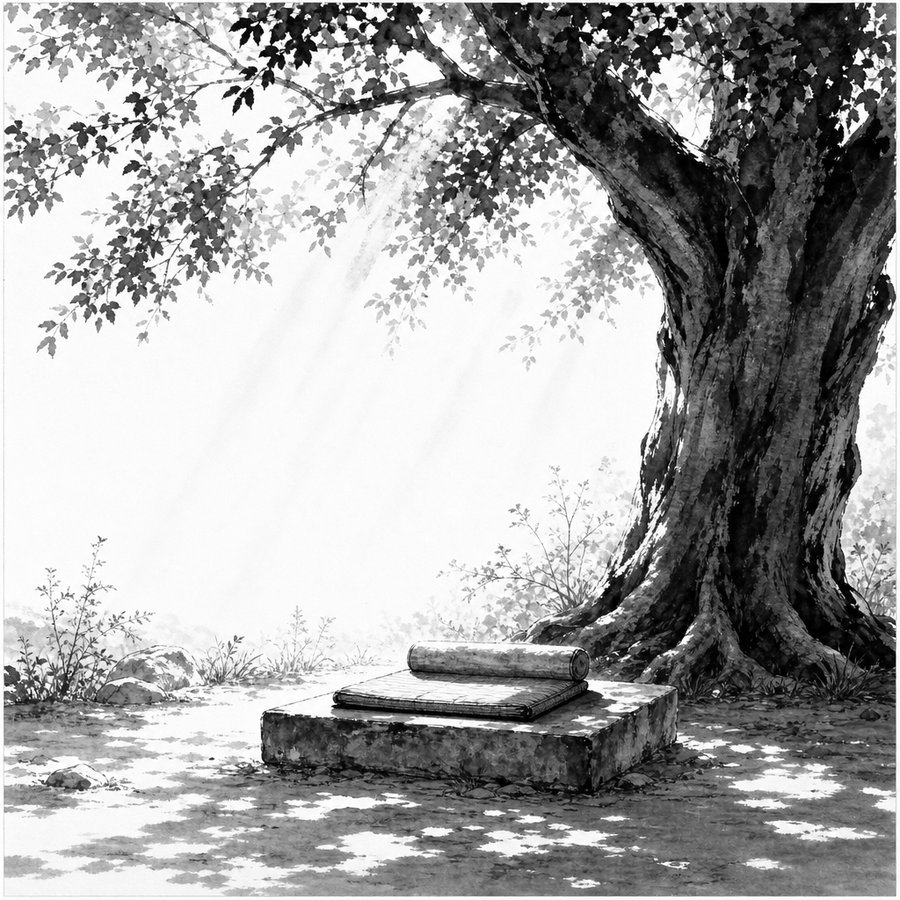
Janaka has pulled the thorn and said enough three times, and Ashtavakra does not answer. The boy who had a reply for every question in the first chapter has nothing to add, and the king goes on speaking, to no one now. He rests in his own stainless nature and takes leave of each thing he once held to be true. First the elements, the body, the senses, the mind. Then two things a seeker counts among his gains: the void the meditators reach for, and nairashya, the freedom from expecting anything. The second verse takes the rest of the ladder, scripture, self-knowledge, the mind emptied of its objects, contentment, the end of craving. For one past the pairs, none of the rungs has anywhere to stand.
Shlokas 1 · 2
क्व भूतानि क्व देहो वा क्वेन्द्रियाणि क्व वा मनः।
क्व शून्यं क्व च नैराश्यं मत्स्वरूपे निरञ्जने॥
In my stainless nature, where are the elements, where the body, where the senses, where the mind? Where is the void, where freedom from desire?
क्व शास्त्रं क्वात्मविज्ञानं क्व वा निर्विषयं मनः।
क्व तृप्तिः क्व वितृष्णत्वं गतद्वन्द्वस्य मे सदा॥
For me, forever beyond the pairs, where is scripture, where self-knowledge, where the mind free of objects? Where is contentment, where freedom from craving?
Knowledge and ignorance, I, this and mine, bondage and moksha: these are the words the whole dialogue was conducted in, and Janaka lets them go in a single breath. They are outlines, and nothing can be traced in outline on what he is. Then he says what no seeker in the hall is ready to hear. Prarabdha, the deeds already in motion; jivanmukti, freedom while still alive; videha-kaivalya, the bodiless aloneness held higher still. For one who has no attributes at all, each of these is one more name.
Shlokas 3 · 4
क्व विद्या क्व च वाविद्या क्वाहं क्वेदं मम क्व वा।
क्व बन्धः क्व च वा मोक्षः स्वरूपस्य क्व रूपिता॥
Where is knowledge, where ignorance, where “I”, where “this”, where “mine”? Where is bondage, where liberation? What form could my own nature have?
क्व प्रारब्धानि कर्माणि जीवन्मुक्तिरपि क्व वा।
क्व तद्विदेहकैवल्यं निर्विशेषस्य सर्वदा॥
For me, forever without attributes, where are the deeds already bearing fruit, where liberation in life, where that bodiless kaivalya?
The doer and the enjoyer were the first two things Ashtavakra took from him, in the sixth verse of the first chapter. Janaka now adds what lies under them: the actionless shining of awareness itself, direct knowledge, and the fruit that knowledge bears. Then the names. The world, the seeker of liberation, the yogi, the knower, the bound man, the free man: every person in the hall answers to one of them, and in his own non-dual nature there is no one for any of them to fit. Creation and dissolution, the goal and the means, the one who practices and what he attains make up the whole machinery of a spiritual life, and he sets it down as one more pair.
Shlokas 5 · 6 · 7
क्व कर्ता क्व च वा भोक्ता निष्क्रियं स्फुरणं क्व वा।
क्वापरोक्षं फलं वा क्व निःस्वभावस्य मे सदा॥
For me, forever without a nature of my own, where is the doer, where the enjoyer, where the actionless shining, where direct knowledge, where its fruit?
क्व लोकं क्व मुमुक्षुर्वा क्व योगी ज्ञानवान्क्व वा।
क्व बद्धः क्व च वा मुक्तः स्वस्वरूपेऽहमद्वये॥
Where is the world, where the seeker of liberation, where the yogi, where the knower, where the bound, where the free, for me in my own non-dual nature?
क्व सृष्टिः क्व च संहारः क्व साध्यं क्व च साधनम्।
क्व साधकः क्व सिद्धिर्वा स्वस्वरूपेऽहमद्वये॥
Where is creation, where dissolution, where the goal, where the means, where the seeker, where attainment, for me in my own non-dual nature?
The eighth verse dismantles knowing itself. Pramata, pramana, prameya, prama: the knower, the means of knowing, what is known, and knowledge, the four terms every school of debate in Mithila stood on; Vandi drowned men over fine points of them. For what is forever pure there is neither something nor nothing to know. Then the weathers of the mind: distraction and one-pointedness, unknowing and dullness, joy and sorrow. In what never acts, none of them turns. Last the two levels Vedanta itself keeps, the everyday real and the ultimate real, with pleasure and pain between them; for one beyond all reflection none of it leaves a mark.
Shlokas 8 · 9 · 10
क्व प्रमाता प्रमाणं वा क्व प्रमेयं क्व च प्रमा।
क्व किञ्चित्क्व न किञ्चिद्वा सर्वदा विमलस्य मे॥
For me, forever pure, where is the knower, where the means of knowing, where the known, where knowledge itself? Where is something, where nothing?
क्व विक्षेपः क्व चैकाग्र्यं क्व निर्बोधः क्व मूढता।
क्व हर्षः क्व विषादो वा सर्वदा निष्क्रियस्य मे॥
For me, forever actionless, where is distraction, where concentration, where ignorance, where dullness, where joy, where sorrow?
क्व चैष व्यवहारो वा क्व च सा परमार्थता।
क्व सुखं क्व च वा दुःखं निर्विमर्शस्य मे सदा॥
For me, forever beyond reflection, where is this everyday reality, where that ultimate reality, where pleasure, where pain?
Maya and samsara, attachment and detachment, and then the jiva and that Brahman, the soul that seems to be born and die, and the one being. That pair is the one the whole of Vedanta exists to reconcile, and Janaka drops it with the rest; for one forever pure there is no second thing left to reconcile. Activity and withdrawal, the householder’s road or the renunciant’s, is the choice a king of Videha is asked to rule on, and he sets it beside liberation and bondage. For what is unchanging, undivided and at rest in itself, none of the four arises.
Shlokas 11 · 12
क्व माया क्व च संसारः क्व प्रीतिर्विरतिः क्व वा।
क्व जीवः क्व च तद्ब्रह्म सर्वदा विमलस्य मे॥
For me, forever pure, where is maya, where the world, where attachment, where detachment, where the jiva, where that Brahman?
क्व प्रवृत्तिर्निवृत्तिर्वा क्व मुक्तिः क्व च बन्धनम्।
कूटस्थनिर्विभागस्य स्वस्थस्य मम सर्वदा॥
For me, forever unchanging, undivided and at rest in myself, where is activity, where withdrawal, where liberation, where bondage?
Then the last two. Teaching and scripture, disciple and guru: the bond this whole dialogue has stood on, a king and a boy of twelve, and Janaka takes leave of it too, along with every aim a human life is given. The word he uses for himself is shiva, blessed, auspicious, his own self without any limiting condition; the god who bears that name is nowhere in the verse. The final verse goes to the floor of language. Is and is not, one and two, and with two goes one, the non-duality every verse before it leaned on. What more is there to say. Nothing arises in me. The hall of Mithila is quiet. A boy bent in eight places stands where he stood when they laughed at him, and the king who asked three questions has none left.
Shlokas 13 · 14
क्वोपदेशः क्व वा शास्त्रं क्व शिष्यः क्व च वा गुरुः।
क्व चास्ति पुरुषार्थो वा निरुपाधेः शिवस्य मे॥
For me, free of every limiting condition and blessed, where is instruction, where scripture, where the disciple, where the guru, where any aim of life at all?
क्व चास्ति क्व च वा नास्ति क्वास्ति चैकं क्व च द्वयम्।
बहुनात्र किमुक्तेन किञ्चिन्नोत्तिष्ठते मम॥
Where is “is”, where “is not”, where “one”, where “two”? What more is there to say? Nothing at all arises in me.