On this page
The Water That Took Life
The twelfth year of exile was living out its final days, and the Pandavas now knew the kind of exhaustion that years in the forest drive down to the bone. In that hinge of time, with only a few months left and the thirteenth year of hidden exile waiting open-mouthed ahead, a small event drew them toward the strangest trial they would ever face. A brahmana from a nearby ashram had lost his arani, the two fire-sticks that are rubbed together to wake the sacred flame, when they caught in the antlers of a deer, and the animal had bounded off into the forest carrying them. Distraught, the brahmana came to the Pandavas, for without those sticks his fire rite would come to a halt.
For Yudhishthira, the keeper of dharma, this was no small matter. That a brahmana’s yajna (fire-rite) should stop was something he could not accept. All five brothers took up their bows and gave chase to the deer. This was no ordinary animal. It would show itself, then vanish; it would pause within an arrow’s reach, and the moment a bowstring was drawn, it would leap away and dissolve into the deeper forest. For hours they wandered after it, until at last it disappeared completely, as though it had never existed at all. What remained were the heaving breaths of five tired bodies, and a thirst that began, little by little, to press down on every thought.
They sat down in the shade of a dense tree. The sun stood overhead, their throats had turned to thorn, and in that silence even the distant call of a bird brought water to mind. Yudhishthira looked toward Nakula, the son of Madri. Son of Madri, he said, climb this tree and look in every direction. If you see any pool of water, any patch of green, any sign at all, tell me. Your brothers are desperate with thirst.
The first, and then the second
Nakula climbed up nimbly and let his gaze run into the distance. Not far off lay a patch of green, and from it came the calls of cranes, the calls that rise only near water. He climbed down and told them, and a line of relief crossed Yudhishthira’s face. Go, he said, and bring water quickly for everyone; carry it back soaked in your upper cloth.
Nakula reached the lake with quick steps. The water was so clear that it showed all the way to the bottom, and cranes strolled along its edge. Thirst pulled at him, and he bent down. The instant his hand reached to touch the water, a voice rose out of the air, deep and steady, as if the sky itself were speaking. Wait, the voice said. This lake is mine. Answer my questions first, then take the water. But Nakula’s thirst was greater than that warning. This must be some illusion, he thought, and he drank a cupped handful. The next moment his limbs went slack, and he fell right there at the edge, as though someone had blown out a lamp inside him.
Time passed, and Nakula did not return. Yudhishthira sent Sahadeva. He went along the same path, and the moment he reached the shore he froze; his brother lay there, motionless. Grief and thirst surged in him together. First let me sprinkle water on my brother, he thought, but before that let me wet my own throat. And the instant he bent down, the same voice rose again, the same warning. Sahadeva too let it pass unheard, drank the water, and lay down on the ground beside his brother.
Even the bow was no use
Now Yudhishthira’s mind grew more restless still. Two had gone and neither had returned. He said to Arjuna, You go, and be careful; something is wrong near that water. Arjuna set out gripping the Gandiva, an arrow already nocked, his eyes moving across every direction. When he saw his two brothers lying on the shore, his blood boiled. Then came the voice, the same condition of questions. Who are you, show yourself, Arjuna challenged; and he loosed a torrent of arrows toward the direction the voice had come from. But arrows cannot pierce words. Calmly the voice spoke again, answers first, then water. Arjuna, drying out with thirst, in the end did what his brothers had done, and that great archer too collapsed on the same shore.
When three brothers did not come back, Bhima rose. That mountain of strength was certain that whatever the danger, he would grapple with it. He reached the shore, saw his three brothers lying still, and filled with rage. Surely some yaksha or rakshasa has done this; I will find it and punish it now. But first this unbearable thirst. The same voice, the same warning, and from Bhima the same answer that strength so often reaches for, that one’s own need comes first and everything else after. He drank the water, and that vast body, mace still in hand, went down among his brothers as well. Now four Pandavas lay at the edge of that lake, and there was no voice anywhere, no movement.
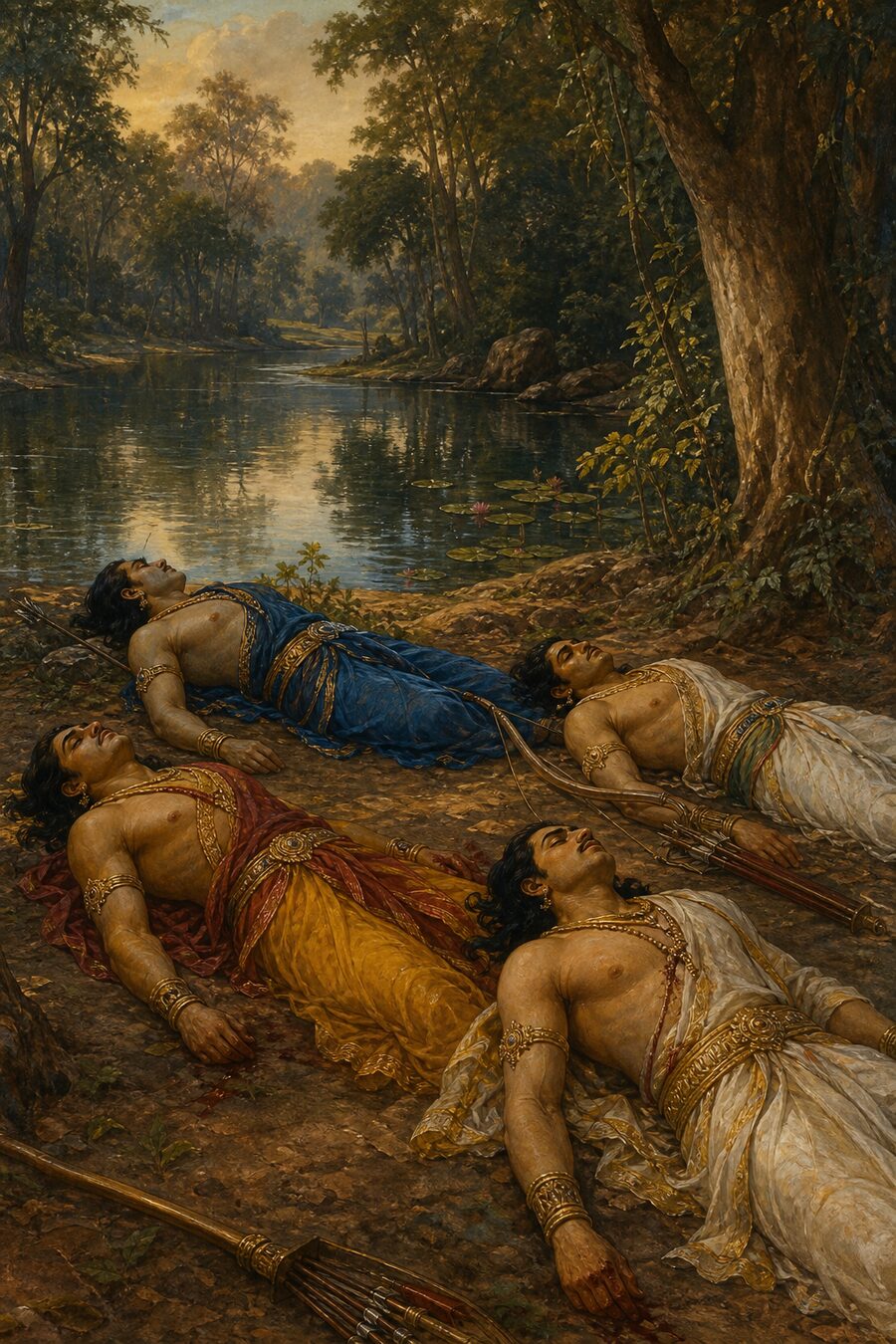
And then the eldest brother came
When no one returned for a long while, Yudhishthira rose himself. With every step a heavy dread grew in his heart. Cutting through the forest, he reached the lake, and the sight that met him rooted him to the spot. His four brothers, before whom the greatest warriors could not stand, lay at the water’s edge, as if in deep sleep. But this was no sleep. No moan, no whisper of breath, no sign of pain. On their bodies there was no wound, no mark of struggle. This was what unsettled Yudhishthira most, because whatever could lay these four low without a battle could be no ordinary power.
His eyes filled. These were the very brothers on whose strength he had dreamed of winning back his lost kingdom, and today they lay limp at the edge of a pond. Even amid that wave of grief, one question was rising in his mind, how had this happened. Just then, as if to answer, the same voice rose out of the air.
It was I who stopped them, the voice said, and I stopped them again and again. But they did not listen to me, and drank the water without answering, and so they lie asleep here. This lake is mine. If you too touch the water without answering my questions, the same fate will be yours.
Yudhishthira looked around. Near the water stood a crane, and the voice seemed to be coming from it. This time there was no anger in Yudhishthira, no challenge. In his mind there was only acceptance. A power that could lay four great warriors low without so much as a touch was to be honored, and wisdom lay in reverence toward it. He folded his hands. What is yours I will not take by force, he said in a calm voice. Ask. As far as my understanding reaches, I will answer.
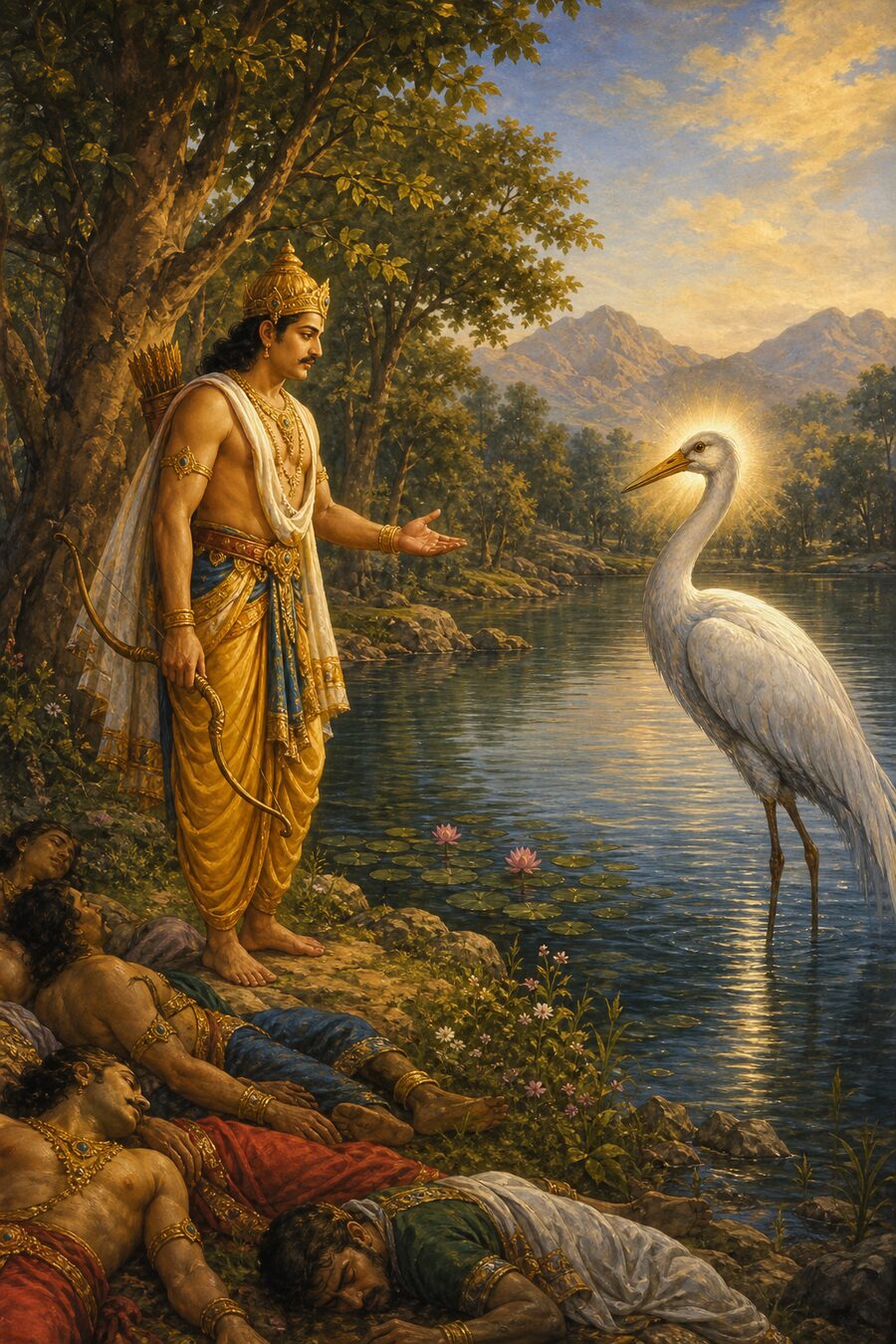
The questions that are still asked today
And then that strange dialogue began, one that held no weapon, no roar, only question and answer. The yaksha asked on, often several things in a single breath, and Yudhishthira answered on, each time in a few words, yet every answer seemed to place a finger exactly on some hidden knot of life.
What is heavier than the earth, the yaksha asked. The mother, said Yudhishthira, for she carries within her the weight of an entire life. What is higher than the sky? The father, beneath whose shadow a person feels tallest. Who is swifter than the wind? The mind, which crosses from one end of the world to the other between two blinks. And what is greater in number on this earth than the blades of dry grass? The worries of human beings, which cannot even be counted.
The yaksha pressed on. Who is it that does not close its eyes even in sleep? The fish, said Yudhishthira. What is it that, once born, does not stir or move? The egg. And tell me, who is whose companion. The friend of one who is far from home is his fellow traveler, he said; the companion of the householder at home is his wife; the companion of the sick man is the physician; and for one standing at the last edge of life, the companion of the dying man is his charity and his dharma, and nothing else goes with him.
Then the yaksha asked the question that has perhaps been repeated more than any other. What is the greatest wonder in this world? Yudhishthira paused, and then he spoke. Every day, before his own eyes, a person watches living beings depart for the house of death. One after another, beyond counting. And still those who remain go on living as though they will never die. What greater wonder could there be. The yaksha stayed silent for a few moments, because this answer held up a mirror.
And what is the news of the world, the yaksha asked, what is truly going on in this world? Yudhishthira’s answer came like a painting. This world is a vast cauldron, he said; the sun is its fire, day and night are its fuel, and the months and seasons are the ladle with which time keeps stirring this cauldron, slowly cooking every living being. That is the true news of the world.
Which is the path of dharma, the yaksha asked, when every road of reason collides with another? Yudhishthira said, Reason has no fixed trail; the shastras themselves speak differently from one another; and there is no single rishi whose word is the last. The heart of dharma lies hidden in a cave. So the true path is the one on which the great and the truthful have already walked; to follow their footprints is dharma.
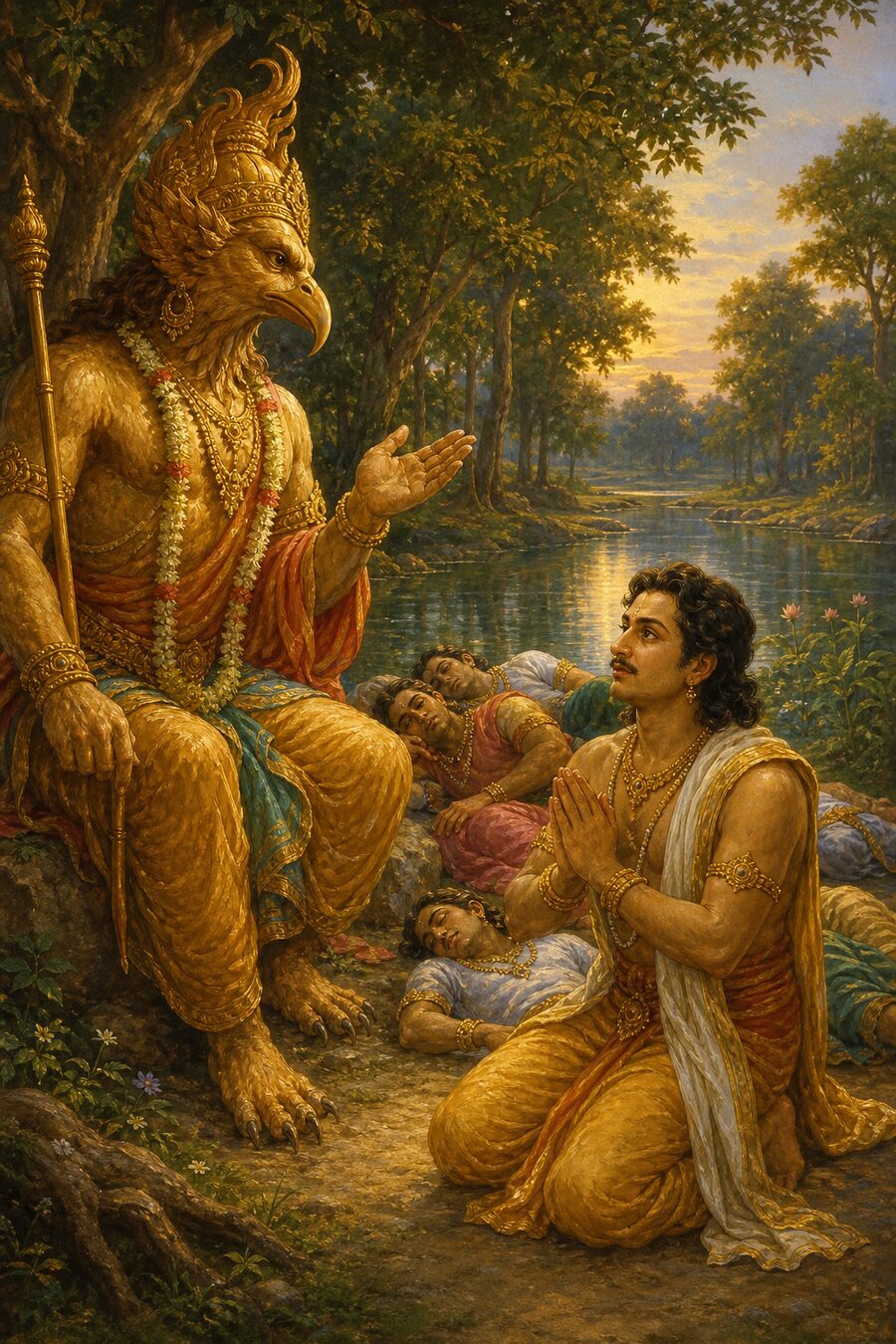
What makes a person a brahmana, the yaksha asked, birth, study, or some other cause? Yudhishthira answered plainly. Neither birth nor the mere reading of scripture makes him one. Character and conduct are what lift a person high. One whose nature is corrupt is not high, however lofty the family he is born into and however much he has studied; and one whose conduct is pure is the finest of all.
And at the end the yaksha set out the questions that seem the simplest and are the deepest. By giving up which one thing does a person become dear to everyone? Pride, said Yudhishthira. By giving up what does he never grieve? Anger. By renouncing what is he called wealthy? Desire, for who is richer than the one whose wants have come to rest. And by letting go of what does a person become happy? Greed; the moment greed loosens its hold, happiness comes on its own.
Question by question it went on, and with each answer that voice grew a little gentler. Because the one who spoke, even with his life in the balance and thirst tearing at him, spoke from a mind that had stayed still, and that stillness itself was the greatest answer of all.
One brother, and one choice
When every answer proved true, the yaksha’s voice filled with pleasure. I am satisfied with your answers, it said. I will grant you a boon: I will bring one of these four brothers of yours back to life. Choose whichever one you wish. Yudhishthira paused for a moment, and then, without wavering, he spoke. Let Nakula rise.
At this answer the yaksha was truly taken aback. This is strange, it said. Bhima, whose strength equals that of ten thousand elephants; Arjuna, on whose bow your lost kingdom rests; you pass over these and ask for Nakula? The brothers you will need most in the war ahead, you set them aside. Why this choice?
Yudhishthira’s answer was the true answer to his greatest trial. My father had two wives, he said, Kunti and Madri, and both are equal in my eyes. One son of Kunti, myself, stands alive. Justice says that a son of Madri should live too. I cannot draw a line between my own and another’s, between my mother and my second mother. That is why I ask for Nakula. Staying even between them matters more to me than strength.
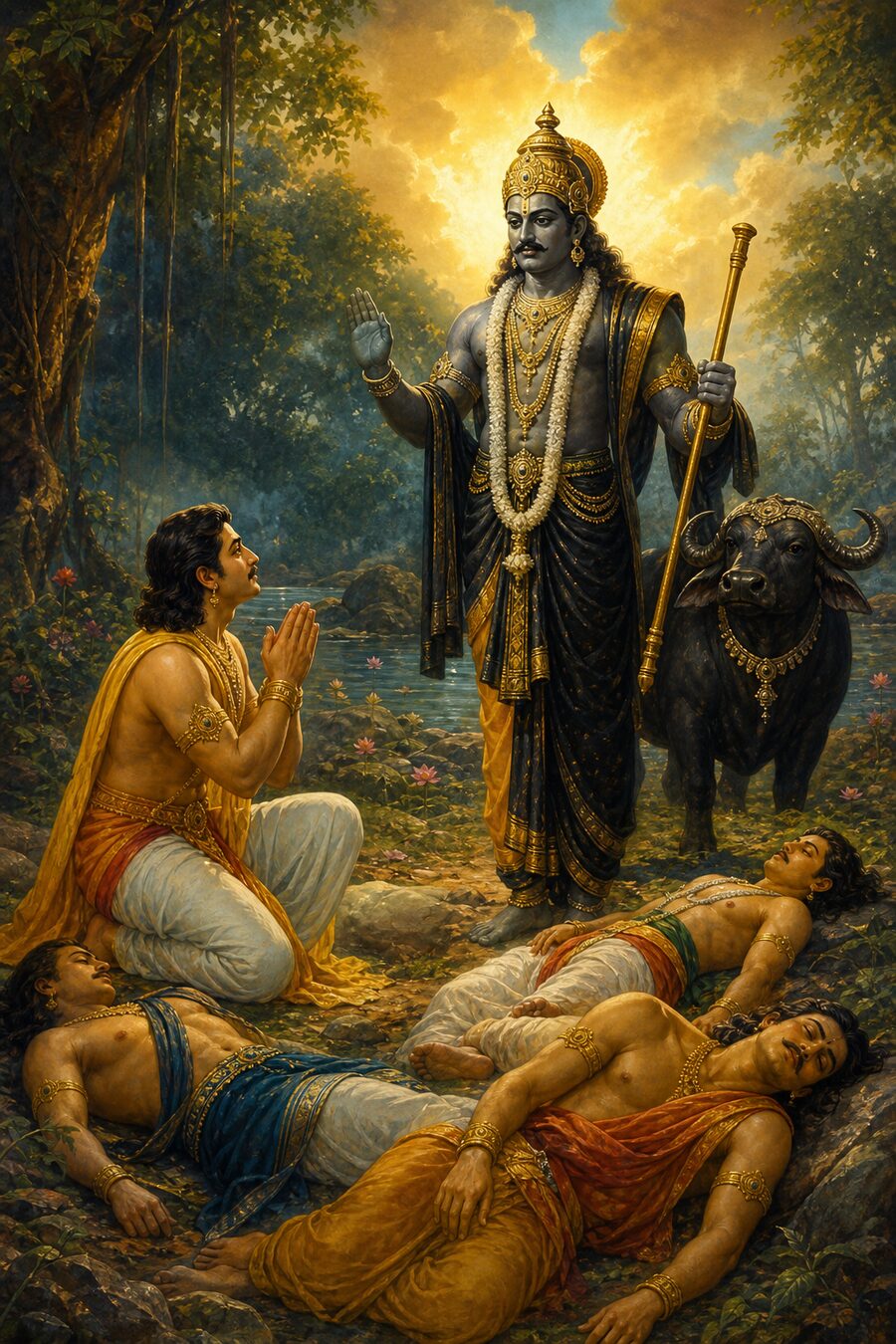
At these words, every trace of hardness in the voice melted away.
And then the father appeared
The crane, the unseen yaksha, now revealed his true form. He was none other than Dharma himself, the father of Yudhishthira. This whole episode, the thirst, the lake, the questions, all of it had been a test, to see whether this son would hold to dharma even with his life in danger. And the son had held, on every question, and on the greatest question of all, that choice.
Dharma cast a single glance, and all four brothers sat up, as if waking from a deep sleep. The thirst, the exhaustion, that touch of death, all of it fell away. Then the father, pleased, told his son to ask for a boon. Yudhishthira thought first of the brahmana: let his fire rite not be broken. Dharma told him that it was he who, in the shape of the deer, had carried off the fire-sticks to test his son, and he gave them back. For the second boon Yudhishthira asked that in the coming thirteenth year of hidden exile no one should recognize them, and Dharma promised that they would pass that year unknown in Virata’s kingdom. For the third he asked for what rose from the depths of his nature, that his restraint over greed, delusion, and anger stay firm, and that his mind stay forever immersed in charity, tapas (austerity), and truth.
With that, Dharma vanished. The five brothers were one again, and taking those arani sticks they returned to the brahmana, and his halted yajna was set going once more. But they carried away more than two sticks of wood. They carried the yaksha’s questions home with them, and the answer of the brother who had asked for Madri’s son.
This story is based on the Yaksha Prashna episode of the Mahabharata’s Vana Parva (Aranyaka Parva), told in expanded narrative form, following the original sequence of the tale and its dialogue.
This same story, there too
- Chapter 15 · Yaksha Prashna
Mahabharata (Vana Parva): the Yaksha Prashna, in narrative flow