Textual context
Tattva-svarupa, the seventeenth chapter, carries its meaning in its name. Tattva is the truth of a thing, the thatness of it, and svarupa is its own form, so the compound names the very form of truth, and here that form is a man, the knower in whom the truth eats and sleeps and walks. The Bhagavad Gita reaches for the same root when Krishna sends Arjuna to the tattva-darshinah, the seers of truth, to learn from them by service and by asking (4.34).
Swami Rama Tirtha (1873 to 1906), who lectured across America between 1902 and 1904, quoted the Ashtavakra Gita freely there, and the man this chapter describes, free while he lives and at ease on whatever comes, is the figure he kept setting before his audiences.
The Nature of Truth
The nature of the sage · 20 shlokas
Ashtavakra is drawing a portrait now. Twenty shlokas, each a single stroke, and the subject is the man who is free while he still lives: how he eats, how he sleeps, how he looks at a woman and at death. Janaka listens without a word, and the hall watches the king.
The sixteenth chapter ended on a hard saying: even with Shiva or Vishnu or Brahma for a teacher, the king would find no rest until he forgot everything he had learned. Now Ashtavakra shows what a man looks like once the forgetting has happened. The true nature does nothing and enjoys nothing; it simply is.
So far
Twenty signs of the man who is free while he lives, spoken to a king who shows every one of them.
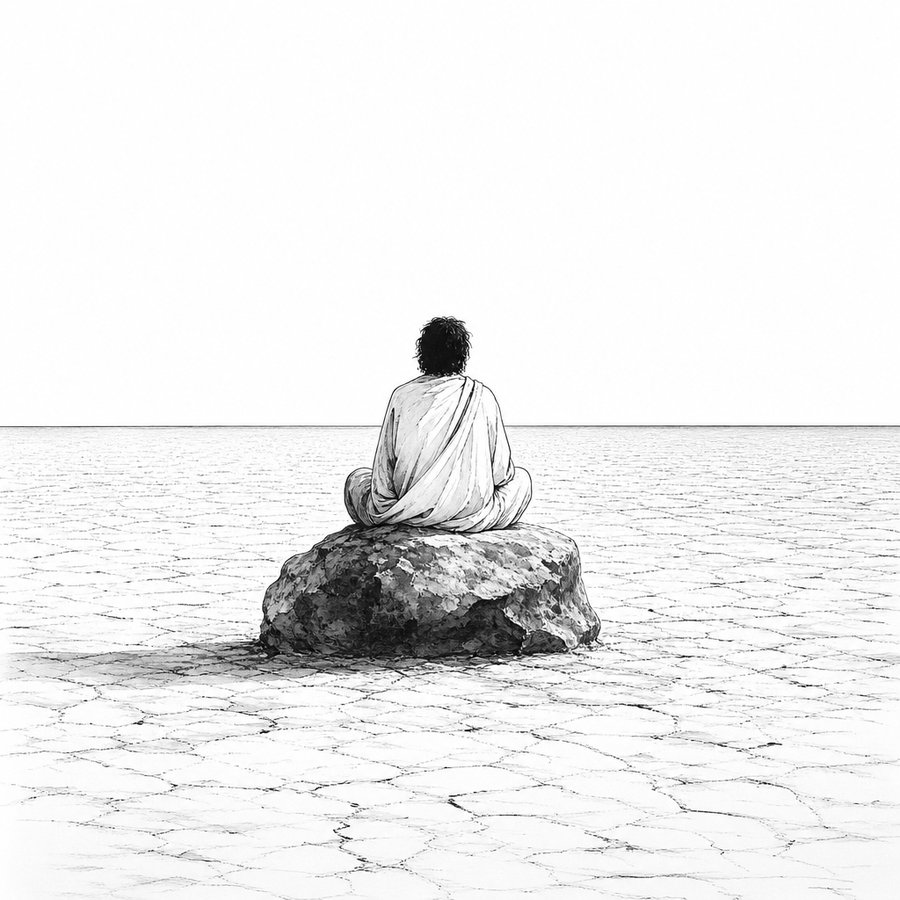
The first word Ashtavakra says is tena, by him, the way a man points across a room. He has just told the king that no teacher can give him rest while he holds on to what he knows; now he describes the one who has let go. That man has the fruit of knowledge and the fruit of yoga both, and the signs are plain: he is content, his senses are clear, and he delights in being alone. In a court where someone stands at every door, aloneness sounds like a loss. Ashtavakra’s second verse answers that: the knower of truth never grieves, because the whole cosmos is filled by that one alone, and a man who is everything has no one left to miss.
Shlokas 1 · 2
He who is contented, whose senses are clear and who always delights in being alone has gained the fruit of knowledge and the fruit of the practice of yoga as well.
Ah, the knower of truth is never distressed in this world, for this whole sphere of the cosmos is filled by him alone.
Then an image from the king’s own stables. An elephant that has fed on the sweet leaves of the sallaki will not touch the bitter neem, and no one has to forbid it; the better taste has settled the matter. So it is with the man who delights in the Self: the objects of the senses stop pleasing him on their own. Pleasures already enjoyed leave no mark on him, and pleasures not yet enjoyed raise no longing. The fifth verse goes further. Men who want enjoyment are everywhere, and men who want liberation can be found too; the great soul who wants neither is the rarest of all. Janaka, who began by asking how liberation would come, hears the wanting of it named as the last thing in the way.
Shlokas 3 · 4 · 5
No object of the senses ever pleases the man who delights in the Self, just as neem leaves do not please an elephant that relishes the leaves of the sallaki.
The man who is not left marked by the pleasures he has enjoyed, and does not long for those he has not, is rare in this world.
Here in the world one sees the man who wants enjoyment and the man who wants liberation; the great soul who wants neither is rare indeed.
Now the four aims a prince is raised on. Dharma, wealth, pleasure and moksha are the whole curriculum of a royal education, and a king spends his reign weighing them. Ashtavakra adds life and death to the list and says that some rare, large-hearted man has nothing to accept and nothing to reject among any of the six. He has no wish for the world to end and no grudge against its going on; he lives at ease on whatever livelihood arrives. The eighth verse shows how. The man knows himself fulfilled by the knowledge, and his intellect, the part of him that kept weighing and choosing, has melted away. He still sees, hears, touches, smells and eats; the one who used to claim the acts is gone.
Shlokas 6 · 7 · 8
For some rare, large-hearted man there is nothing to reject and nothing to accept in dharma, wealth, pleasure or moksha, in life or in death.
He has no wish for the universe to dissolve and no aversion to its going on. So the blessed man lives at ease on whatever livelihood comes to him.
Fulfilled by this knowledge, his intellect melted away, the accomplished man lives at ease, seeing, hearing, touching, smelling and eating.
The ninth verse would unsettle any courtier who heard it as a description of his king. In the man whose ocean of samsara has dried up, the gaze is vacant, action has no purpose, the senses hang idle, and neither desire nor aversion moves him. A court reads these as weakness in a ruler; Ashtavakra names them as the marks of freedom. The freed mind neither wakes nor sleeps, neither opens its eyes nor closes them, and Ashtavakra, who has spoken for sixteen chapters as if nothing could surprise him, lets out a cry of wonder. The line between waking and sleep, the first line every child learns, is one of the things that mind has left behind.
Shlokas 9 · 10
In the man whose ocean of samsara has dried up, the gaze is vacant, action is purposeless and the senses are idle; there is neither desire nor aversion.
He neither wakes nor sleeps, neither opens his eyes nor closes them. Oh, how wondrous is the supreme state of the liberated mind.
The word Ashtavakra chooses for the freed man in the eleventh verse belongs to the man on the throne. He rajate, he reigns, he shines like a king, and he does it everywhere, in the hall and on the road and in a farmer’s hut, because the shining comes from within and owes nothing to the seat. Every vasana that used to pull at him has let go. The twelfth verse counts his acts, eight of them: seeing, hearing, touching, smelling, eating, taking, speaking, walking. The list is the whole of an ordinary day, the king’s and the water-carrier’s alike, and all of it goes on. What has ended is the wanting and the not wanting that ran underneath.
Shlokas 11 · 12
The liberated man is seen at ease everywhere and pure of heart everywhere; free of every latent desire, he shines everywhere.
Seeing, hearing, touching, smelling, eating, taking, speaking and walking, free of wanting and of not wanting, the great soul is free indeed.
The thirteenth verse takes away the six acts a court runs on. The freed man neither blames nor praises, is neither elated nor angry, neither gives nor takes; everywhere he is nirasa, without relish. A king does all six before noon. Then the two oldest tests. A woman full of desire stands in front of him, or death itself draws near, and his mind does not shake; that steadiness, with nothing added, is his freedom. The fifteenth verse widens the test to pleasure and pain, man and woman, fortune and ruin. For the steady man who sees the same in all of them there is no difference anywhere, and the hall hears the king’s granaries and armies placed on the same level as their loss.
Shlokas 13 · 14 · 15
The liberated man neither blames nor praises, is neither elated nor angry, neither gives nor takes; everywhere he is without relish.
Seeing a woman full of desire, or death itself drawn near, the great soul stays unshaken and self-possessed; he is free indeed.
For the steady man who sees the same everywhere, there is no difference between pleasure and pain, man and woman, fortune and misfortune.
The sixteenth verse is a list of absences, and one item on it stops the ear. In the man whose wandering through the world has ended there is no violence, no arrogance, no meekness, no astonishment, no disturbance, and no compassion either. Compassion is the virtue Ashtavakra himself prescribed in the first chapter, to be taken up like nectar. Here it stands beside violence as one more stirring of the mind, and in this man the mind has stopped stirring; the verse says nothing about what he does for others, only what no longer moves in him. The seventeenth verse guards the other side. The freed man does not hate the objects of the senses, and he does not crave them. He takes what comes and lets be what does not.
Shlokas 16 · 17
In the man whose wandering through the world has ended there is no violence and no compassion, no arrogance and no meekness, no wonder and no disturbance.
The liberated man neither hates the objects of the senses nor craves them. With a mind forever unattached, he takes what comes and what does not.
The last three strokes go inward. The man of emptied mind does not even register the choice between composure and distraction, between what helps him and what harms him; he sits as though in kaivalya itself, the aloneness the yogis name as their final goal. The nineteenth verse names what he has lost: the word mine, the word I, and every hope that lived on them, all melted away within, so that he acts and does not act in the same motion. Then the twentieth. The mind’s bright activity, its delusions, its dreams and its dullness, the four weathers of a day and a night, are gone from him, and he has arrived at a state with no name. Ashtavakra sets the brush down. The king the twenty strokes describe sits in front of him, unmoved by any of them.
Shlokas 18 · 19 · 20
The man of emptied mind, as though established in kaivalya, knows nothing of composure or its loss, of good or harm.
Free of “mine” and free of “I”, certain that nothing is, with every desire melted away within, he does not act even while acting.
Free of the mind’s shining, of delusion, of dreaming and of dullness, the man whose mind has melted away comes to a state that cannot be described.