Textual context
Shanta names the fourteenth chapter. Shanti and shanta are two forms of one root: shanti is the noun, peace as a state a person can enter and leave, and shanta is the participle, the one in whom the quieting has already happened. The chapter takes its name from the second.
In the Mula-Madhyamaka-Karika of Nagarjuna, the Buddhist philosopher of the second century, shantam is one of the words the whole doctrine of emptiness turns on. Ashtavakra’s shanta and Nagarjuna’s shantam point at one stillness, and each arrived there along its own road.
Peaceful
Peaceful · 4 shlokas
Four short shlokas from Janaka. The talk has moved from what he gave up to what remains once the giving up is done: a shapeless calm underneath every action, and a man the court can no longer read.
The word shanta returns here with more weight on it than before. Peace has many layers. What Patanjali’s Yoga Sutras call vritti-nirodha, the stilling of the mind’s movements, Janaka describes in these four verses from the far side, as a man for whom the stilling is already complete.
So far
After ease, peace. Four verses on the man in whom the quieting is complete.
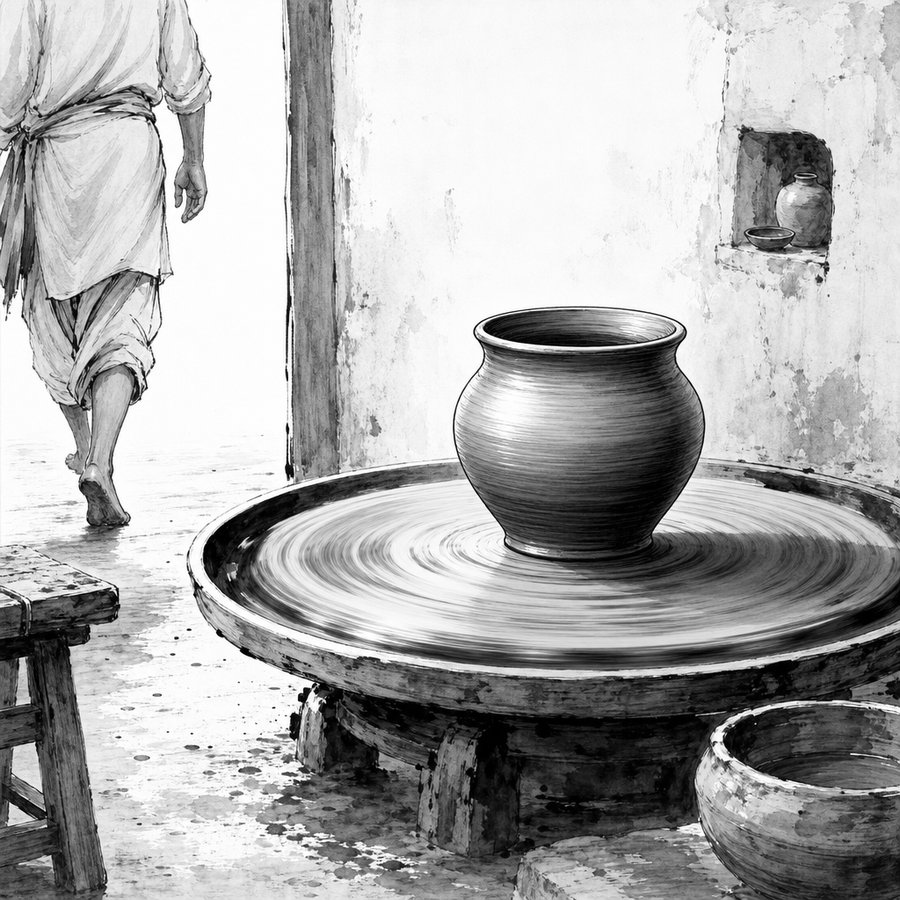
Janaka describes the mind he has now, and the first verse opens on a condition the court has no word for. His mind is empty by its own nature. A thought forms in it only through inadvertence, a slip, the way a sleeper mutters, and when it forms it does not stay. Such a man is as if awake while he sleeps, and the long file of remembered things that a king carries, slights, debts, victories, has worn thin in him. What has worn away is a habit, the one that takes each event back out at night and turns it over. A thing happens and is complete in its happening; nobody is left inside to fetch it again after dark.
Shloka 1
He whose mind is empty by nature, who thinks of things only through inadvertence, and who is as if awake even while asleep, has had his worldly memories worn away.
Then Janaka asks a row of questions, and each one opens on the same word, kva, where. Where are riches, where are friends, where are the sense-objects that robbed him, where is scripture, where is knowledge, now that longing has melted out of him. He names everything a king is measured by, treasury, allies, the pleasures of the senses, and everything a seeker is measured by, scripture and knowledge, in one breath, and asks where any of it is now. A robber needs something in the house that wants to be taken. With the longing gone the objects are still in front of him, and the hand that used to close on them is missing. Where is scripture: the largest claim in the verse, made in a hall full of brahmins who live by it, since the seeker holds the scriptures tightest of all. For Janaka they were the road he walked to reach this hall, and a man who has reached the house does not keep walking.
Shloka 2
Where are riches, where are friends, where are the sense-objects that robbed me? Where is scripture, where is knowledge, now that my desire has melted away?
Now Janaka names the knowing that melted all of this. The witness, the supreme self, the Lord: three names and one recognition, and the recognition has happened. After it the longing for bondage and for liberation went out together, since the two are a pair and the king wants nothing from the pair any longer. So he says it plainly: he has no anxiety about being freed. That anxiety was the question that brought him to Ashtavakra in the first chapter, how will liberation come about, and the question did its work. After the recognition it is one more wave on the water, and the man who asked it is standing on the shore.
Shloka 3
Now that the witness, the supreme self, the Lord, is known, and I am without longing for bondage or liberation, I have no anxiety about being freed.
In the last verse Janaka shows the man from outside, as the court must see him. Within, he is empty of vikalpa, the constructions the mind builds; nothing it has woven is standing there. Without, he moves as he pleases, where he likes and how he likes, and to anyone watching he can look deluded, a man who has wandered off the road. He has no plan and no fixed pattern of conduct, so a courtier cannot say what he is doing or why. The many conditions he passes through, Janaka says, are known only to those like him, tadrisha eva janate. A sage is recognized by a sage. The rest will watch and form their opinions. Janaka describes the condition from inside it, knowing that most of his court will never be able to read it, and on that the fourteenth chapter closes.
Shloka 4
Empty of mental constructs within, moving as he pleases without, like a deluded man: the various states of such a one are known only to those like him.