The Saundarya Lahari
A hundred verses, and a story says that Shiva himself composed the first forty-one. The remaining fifty-nine came from Shankaracharya. This is the heart of the Sri Vidya tradition, the beauty of the Goddess rising wave by wave.
If you remember only one line, let it be this one.
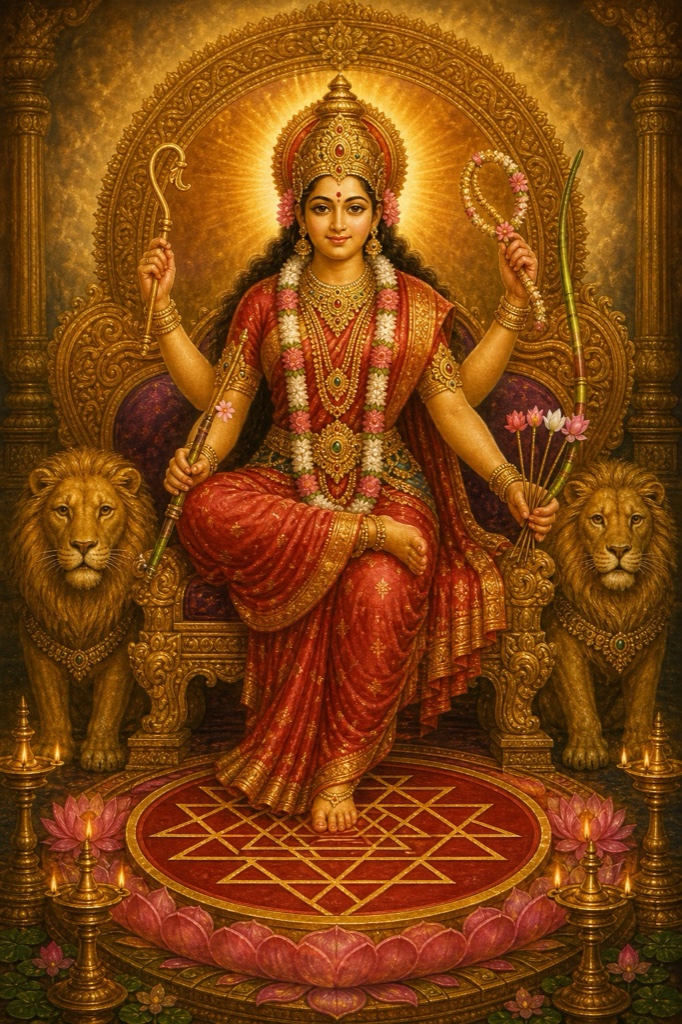
Shiva can create only when he is joined with Shakti. Without her, that same god cannot so much as stir.
Saundarya Lahari, verse 1
First, a word
There is a story, and this story explains the very build of the Saundarya Lahari. They say Adi Shankaracharya went to Mount Kailasa. Shiva gave him a composition, a hymn to the Goddess. As Shankaracharya was leaving, the gatekeeper seized the manuscript, and by the time it was released, only the first forty-one verses remained in Shankaracharya’s hands. Shiva smiled and said, complete the rest yourself. And Shankaracharya did exactly that.
True or not, the story catches one thing precisely: the Saundarya Lahari has two halves, and each has its own temperament.
Ananda Lahari (verses 1-41) is the inner half: kundalini, the chakras, the Sri Chakra, the Goddess as pure Shakti. It is tantric, esoteric. Saundarya Varnan (verses 42-100) is the outer half, the Goddess from crown to feet, the beauty of one limb after another. It is pure poetry, worship from head to toe.
Tradition has always held this to be Shankaracharya’s work, and the Kailasa story is part of that tradition. Modern scholars debate the authorship, especially of the first half. We tell the story as a story, and make no claim about history.
In the tradition, every verse of the Saundarya Lahari carries its own yantra, its own seed-mantra, and a specific fruit, so this is a science of mantra as much as it is something to read. That layer comes from a guru, through initiation.
How to read this
These are a hundred small jewels, each one a complete little poem in itself. Ananda Lahari comes first and holds the map: who the Goddess is, what Shakti is. Then Saundarya Varnan, the celebration that follows the map. Where the first half turns esoteric, the second is pure delight, and the mind feels at home there without effort.
Ananda Lahari · Verses 1-41
The inner waves. The Goddess as pure Shakti, without whom even Shiva cannot stir (verse 1). The rise of kundalini from muladhara to sahasrara, the Sri Chakra, the map of the chakras, and the form of the Goddess that stands above every god.
Pause and read: 1, 8, 9, 10, 21, 35
Saundarya Varnan · Verses 42-100
The outer waves. From crown to feet, one limb at a time: hair, forehead, eyes, smile, voice, throat, and down to the lotus feet. The most lyrical part of the hymn, where the poet’s tongue drowns in the beauty of the Goddess.
Pause and read: 42, 44, 46, 48, 51, 100
One thread that joins the two parts
There are two halves, one tantra, one poetry, and both say the same thing, only in two languages.
Ananda Lahari says: the Goddess is the Shakti without whom nothing so much as moves. Saundarya Varnan says: and that same Shakti is so beautiful that the poet’s tongue tires in the describing. Power and beauty, for the Saundarya Lahari these are two forms of one Goddess.
Where to go after this
In this same collection, the Devi Mahatmya shows the other side of the same Goddess. There she destroys demons, here she is a wave of beauty. Both are two faces of one Shakti.
And hear verse 1 once more: without Shakti, Shiva cannot even stir. The one who knows and the energy that acts, this pairing is the first principle of the Saundarya Lahari.
Read alongside
- Vishnu Sahasranama The same devotion settled name by name, turned toward another god.
- Narada Bhakti Sutra A text that binds devotion into sutras.
- Ashtavakra Gita The knowledge side of the same Advaita tradition.
The same story, over there
- Devi
Character profile: the whole nature of Devi - Devi Mahatmya
Devi Mahatmya (Markandeya Purana): Durga-Chandika’s slaying of the demons - Sri Lalita Sahasranama
Lalita Sahasranama: the Lalita Tripurasundari of Sri Vidya