On this page
The Samhita of the Shukla Yajurveda arrives at its fortieth chapter. The thirty-nine chapters before it are a working book, and the man who works from it is the adhvaryu, the priest who does the physical labor of a sacrifice. He paces out the ground and marks it with a cord and pegs, cuts and lifts the turf, sets the fire in its place, chooses the post, measures the ladles, pours the ghee, handles the pressing stones, and mutters his formula under his breath while his hands are busy, the way a surgeon talks through a procedure. Thirty-nine chapters of that. And then this chapter comes, with no procedure in it, no oblation, no god called down. Its first word passes a hand over the whole world: “ishavasyam idam sarvam yat kincha jagatyam jagat”, all of this, whatever moves in this moving world, is wrapped in the lord. And straight after it, in the same breath, comes the sentence centuries have stopped over, that a man is to enjoy by what has been let go.
Eighteen mantras, and the whole Upanishad is finished. Beside the great Upanishads it looks like a handful, and the density in it runs higher than anywhere in the corpus. There is no story here, no pupil arriving with a question, no king defeating a brahmana. There is one voice that speaks without pausing and turns direction every two mantras. First it holds title over the whole world, then it tells a man to want a hundred years of work, then it describes the being that stands still and outruns the runners, then it warns the people who are enchanted with learning, and at the end it calls on the sun and on fire the way a dying man calls. The way to read this Upanishad is to watch those turns as one journey, taking the mantras together.
The main figures of this Upanishad
The speaker: the Sanskrit never gives him a name. One voice seated in the last chapter of the Samhita, which issues orders and also pleads.
Isha: the lord in whom this whole moving world is wrapped, and whose leavings are what we are given to enjoy.
Atmahan: the self-killers, the harshest word in this Upanishad, which arrives in the third mantra.
The dhiras: the steady forebears from whom the difference of vidya and avidya was heard, and on whose testimony this text rests its case.
Pushan: the sun, called the nourisher, asked to lift the golden lid lying over the face of truth.
Kratu: the resolve seated inside a man, called on at the last moment of the seventeenth mantra to remember, to remember what was done.
Agni: the god of the eighteenth mantra, asked to lead by the straight road, since he knows all our ways.
Ishavasyam: a world worn like a garment (mantra 1)
The first word is the whole Upanishad, and the seventeen mantras after it open that one word out. Ishavasya, covered by the lord, worn over by the lord. The root vas carries the sense of clothing, of putting a garment on, the way cloth is laid over an image or a sheet is drawn across a sleeping child. Laid on from above, covering, and by the covering setting a boundary around what lies inside. This Upanishad calls the world no falsehood. It says a sheet has been laid over the world, and the sheet belongs to the lord.
Consider what it meant to dress a thing in that world. Cloth was expensive and slow. It came off a hand loom after weeks, and a household counted its garments and knew every one of them. When an image in a shrine was clothed at the start of the day, the cloth said whose the image was and who was keeping it. When a bride was given a garment, when a guest was given one, when a dead man was covered, the cloth was the mark of a relation. The word this Upanishad chose for the world carries all of that in it. Something has been put over the world by somebody, deliberately, and the covering is an act of ownership and of care at once.
The next part is finer still: yat kincha jagatyam jagat, whatever moves in this moving world. The word jagat comes twice, and its root meaning is going. Whatever stirs, whatever changes, whatever was one thing yesterday and will be another tomorrow, all of it has come inside. The market, the house, the body, the mind, relationships, time. The Upanishad leaves nothing outside this sheet, and from here both its whole difficulty and its whole relief begin.
Then comes the sentence this Upanishad is known by. “Tena tyaktena bhunjithah”, enjoy by what has been let go. Nowhere is enjoyment forbidden. What is being said is, enjoy the thing that has been released. Renunciation and enjoyment stand together in a single sentence with no quarrel set between them. A thing that belongs to somebody else can be taken in the hand, used, tasted; the one thing you cannot do is get your name written on it.
Understanding this needs no philosophy, one very ordinary picture is enough. People live for years in a rented house, hang pictures on the wall, plant tulsi in the courtyard, mark the children’s height on the door frame. Everything gets enjoyed. One thing stays in place inside: this house belongs to somebody else. With that one thing standing, a life is lived in full, and on the day they have to leave it hurts them without breaking them. This Upanishad asks a man to handle the whole earth on those terms.
And then the warning: “ma gridhah kasya svid dhanam”, do not be greedy, whose is wealth after all. Half a mantra with a question hidden inside it that nobody can answer. Follow anything, a field, gold, a name, and ask whose it is. Wealth in the world this was spoken into was land and cattle and metal kept in the house, and it moved by inheritance, by marriage, by drought, by a raid on the herds at night, by a king’s decision. A family worked one stretch of ground for three or four generations and then the ground carried another family’s name and nobody could say precisely when the change had happened. What is in your hands now was in somebody else’s, and before that in somebody else’s. The root gridh carries the swoop of a vulture in it, the dropping onto a thing. The mantra stops that swoop and leaves the thing alone.
In short: The first mantra draws the lord’s sheet over the whole moving world and in the same breath gives permission to enjoy, on the condition that what is enjoyed has been let go. Then it lays a hand on greed and asks a question nobody answers: whose is wealth after all.
A hundred years, doing the work (mantras 2 and 3)
The second mantra turns toward the reader who heard the first one and dusted off his hands. If everything belongs to the lord and nothing is mine, what is there to do. The answer is very direct: “kurvann eveha karmani jijivishech chhatam samah”, right here, in this very place, doing works, a man should wish to live a hundred years. Notice the word iha, here, in this world. And eva as well, doing works and nothing else. No second door is pointed out.
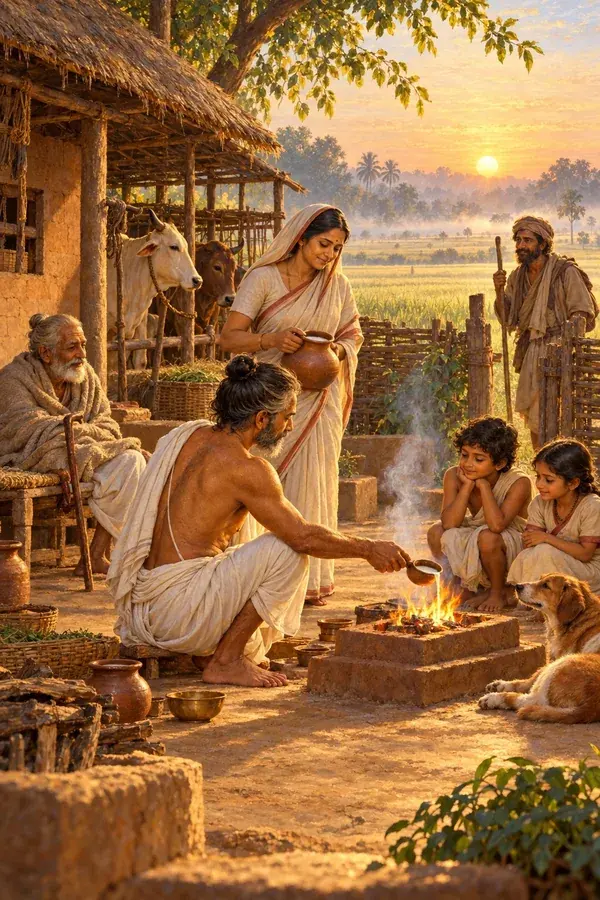
The works being spoken of are specific, and a listener of that time heard them as his own day. A householder keeps a fire, and keeping it is labor. He rises before light, and milk is poured into the flame at the joint of night and day, and again when the light goes. The seasons bring their own offerings, the full moon and the new moon have their own. Around all of that sits the rest of it, the field, the herd, the children, the guests who arrive without warning and must be fed before the family eats, the parents who have to be carried into old age. Nothing about this life is light, and this mantra tells a man to want a hundred years of it.
That sets the Upanishad apart from a great many texts. The wish to live a hundred years is called no fault here. A hundred autumns was the full human span as these people reckoned it, the round number a man was blessed with at his wedding and at the birth of his son, and asking for the whole of it was asking for everything on offer. This text says, wish for a hundred years, and work through those hundred years. The sheet drawn in the first mantra was never drawn to tie a man’s hands. It was drawn to open them, since work on which no ownership is claimed gets done with far lighter hands.
The second half of the mantra gives the reason: in a man who lives this way, works leave no coating. The root lip means to cling, to smear. When there is oil on a hand, whatever it touches sticks to it, and the same object is picked up and set down again by a dry hand. The work happens with both hands; one of them carries a smear and the other carries none. The whole teaching of this Upanishad aims at the smear, and leaves the work alone. And it is said as well that for you there exists no other way than this.
The third mantra goes dark all at once, and the darkness is brought in deliberately. Those worlds named asurya are covered over with darkness, it says, and after death the people who are atmahan go there. Asurya means the place the sun fails to reach, where nothing at all comes into sight. Dark in that world is a real condition and no figure of speech. The sun sets and a house has one small clay lamp with a cotton wick standing in a bowl of oil, and outside the door there is nothing, no road, no edge of a field, no one coming toward you until he is close enough to touch. That is the dark these people are naming, spread out to the size of a world. And atmahan, the killer of his own self, is the heaviest word in this entire Upanishad.
Killing oneself means no leaving of the body here. The self that the first mantra placed under the sheet, living with it covered, living having forgotten it, never once raising an eye toward it, is what this word calls killing. A man can live a hundred years, do a great deal of work, pile up a great deal of wealth, and stay dead in this sense the whole time. This Upanishad takes no interest in threatening anybody with a hell; it says only that a man who lives shut in goes out shut in as well, and the name of that shut place is asurya.
Set the two mantras side by side and a whole life stands up. A hundred years, full of work, empty of claim. And right next to it that other life, which looks just as busy, in which nobody ever glances inside himself. From the outside the two are hard to tell apart. The difference sits inside, and this Upanishad keeps its finger on the inside.
In short: Nowhere is a man let off from work; he is told instead to wish for a hundred years of it right here, since work done in this spirit leaves no coating on him. And beside it the third mantra sets the asurya worlds, where those go who spend a whole life forgetting the self seated inside them.
Unmoving, and faster than the mind (mantras 4 and 5)
Now the voice changes and the description begins of the being whose sheet was drawn in the first mantra. The opening line turns a reader’s head: “anejad ekam manaso javiyah”, it does not stir, it is one, and it is faster than the mind. How can a thing that never moves be fast. The contradiction stings on a first reading and opens on a second.
Measure the speed of the mind. You are sitting here, and in one instant the mind reaches the lane you played in as a child, and the next instant some other city. Nothing is held to be faster than the mind. In a world where the fastest thing a man had ever seen was a horse at full stretch on open ground, and where a message went as far as a runner could carry it in a day, the mind was the one thing that arrived before it left. Yet wherever the mind arrives, this is standing there already. That is why the mind never catches it, and that is why it is called faster than the mind. Whatever stands everywhere ahead of you has no distance to cover.
The mantra carries the point forward: the gods could not reach it, it had gone on ahead of them. The word deva is read here for the senses as well, since the eye, the ear and the mind are the messengers we send out. Wherever they run, they find this standing there before them. And then the loveliest line: standing still, it leaves the runners behind. Beating somebody in a race can be done without running at all, so long as you are seated at the finish already. At the end of the mantra it is said that in it Matarishvan holds the waters, so that whatever flows and moves rests on this unmoving being. Matarishvan is the wind, the thing that carries weather across a country and turns a still afternoon into a storm by evening, and even the wind does its work inside something that has never moved.
The fifth mantra binds the same thing into four pairs. “Tad ejati tan naijati tad dure tad v antike”, it moves and it does not move, it is far and the same is near. And then, it is inside all of this and the same is outside all of this. Each pair shuts one door. Whatever we try to settle about it by thinking, the next half opens back up.
Taking these contradictions as riddles goes wrong. They are measures. Far and near are our measures, moving and staying are the measures on our clock, inside and outside are measures made out of our own skin. The mantra picks up each measure and lays it against him, so that it shows how no measure sits on him properly. The one who does the measuring, how is he to come inside his own tape.
The effect of these two mantras is very practical. If the thing we run after all our lives comes by no running, the manner of reaching it has to change. Running is called useless nowhere here; it is said only that he stands already at the place you want to arrive at. That is why the mantras ahead speak of seeing, and leave off speaking of getting.
In short: The fourth and fifth mantras put that being outside every measure: it does not stir and it is faster than the mind, it stands still and outruns the runners, it is far and it is near, inside everything and outside everything. Wherever the senses arrive, he is there before them, and so he stays out of their grip.
Seeing oneself in all beings (mantras 6 to 8)
The sixth mantra is the largest turn in this Upanishad, because here for the first time we are told what to do with that being. “Yas tu sarvani bhutany atmany evanupashyati”, he who sees all beings in his own self, and his own self in all beings, turns away from nobody after that. Look at the verb, anupashyati, to see along after, to see again and again, to keep on seeing. What the word asks for is the practice of seeing, kept up over years, well past any single vision.
And the fruit named for it is startling. It withholds powers, it withholds the winning of a world. It says he does not vijugupsate, he feels disgust at nobody, he turns his face away from nobody. The root gup carries hiding and protecting in it, and in this form the hiding of one’s face in revulsion. The whole fruit of the inner life has come down into a social fact: nobody is left whom you have to get past.
This is no small matter, and it lands hardest in the world this was spoken into. That was a society organized around who could eat with whom, who could draw water at which step of the tank, whose shadow crossing a cooking pot spoiled the food, which house a man could enter and which door he had to stop outside. Distance between people was a daily practice with rules, kept by everyone, enforced without argument. Into that arrangement this mantra drops one sentence about seeing the same self everywhere, and names its only fruit as the end of turning your face away. Our disgust always rests on a distance. The person we find repellent is first set apart from us, then given a name, and then turned away from. This mantra puts its hand on the first step. When the same self shows in him that is in oneself, the place where the setting apart happens is gone, and the whole building above it comes down with no foundation under it.
The seventh mantra takes this one stair higher. For the knower in whom all beings have become the self itself, “tatra ko mohah kah shoka ekatvam anupashyatah”, for him who keeps seeing oneness, where is delusion there, where is grief. Putting moha and shoka together is exact, because both grow from one root. Delusion comes when a thing feels like one’s own and feels separate at the same time, and grief comes when that separate thing slips out of the hand. Where separateness has gone, the root under both has been cut.
The eighth mantra is a long description of that being, and the words chosen for it are all taken from the language of the body. He is shukra, bright. Akaya, with no body. Avrana, with no wound. Asnavira, with no sinew. Pure, and unpierced by evil. These are the words of people who worked with their hands and with animals, who knew what a wound looks like on the fourth day, who had cut the sinew out of a slaughtered beast and twisted it into a bowstring, who had lifted a man off a field and seen the life leave him through an opening. All our suffering comes to us through the body, through a wound, through a sinew pulled, through tiredness. The mantra denies them one by one, the way a man reads out the list of our pains and strikes a line through every entry.
And then four names arrive: kavi, manishi, paribhu and svayambhu. Kavi, the one who sees, in whose sight everything comes. Manishi, the master of the mind. Paribhu, the one who surrounds everything on every side. Svayambhu, the one who is from himself, whom nobody made. At the end the mantra says he apportioned the objects yathatathyatah, exactly as their own true form requires, for everlasting years. The order of the world is no blind accident; every thing has been set precisely in its place, and the setting is very old.
In short: The sixth mantra speaks of seeing oneself in all beings and all beings in oneself, kept up without a break, and names the fruit as the lifting of disgust. The seventh says the root of delusion and grief is gone for the man who sees oneness. The eighth calls that being bodiless, woundless, sinewless and self-existent, and says he gave every thing its own true form and set it down.
Vidya and avidya, both together (mantras 9 to 11)
Now comes the passage that has been argued over most and misread most. “Andham tamah pravishanti ye’vidyam upasate”, into blind darkness go those who worship avidya. So far everything sounds right. Then the mantra says that into a darkness greater than that go those who take their pleasure in vidya. On a first reading it seems something has been printed the wrong way round.
Nothing is the wrong way round. Avidya here means all the knowledge of this moving world, of work, of name and form, of ordinary dealing. Vidya means the knowledge of that unmoving being. And the weight of the mantra falls on the words that come in both places, upasate and ratah. Upasate is built out of sitting near. It is the word for a man who takes his seat beside a thing every day and keeps that seat for years, the way a pupil sits down in front of his teacher before dawn and is still sitting there when the sun is high. To be occupied with one thing alone, to settle down there, and to let the seat become the whole of your position. The man who stayed sunk in worldly affairs went into darkness. The man who took his pleasure in the higher matter alone, and flinched from touching the world, went into a deeper darkness. Bhuya iva, something further still.
The reason is easy to see. A man sunk in worldly affairs knows what he is doing, and can turn around one day after a fall. The man who caught hold of the name of vidya and sat down inside it has acquired an armor that no fall breaks. He calls his distance sadhana, his indifference vairagya, his disgust discrimination. The vijugupsa whose lifting the sixth mantra spoke of settles in this man thicker than anywhere else.
The tenth mantra lays the ground for the point: they say that something else comes of vidya and something else of avidya, so we heard from those steady ones who explained it to us. Hear the word shushruma, we have heard, and know what hearing meant. There were no books to consult. A teaching existed inside living men and reached the next generation through the ear, in a house, in the early morning, with the pupil repeating each line until he had it. So the speaker rests his case on no strength of his own; he leans on the line of people who walked ahead and whose voices he has in his ear. This is the same modesty found in several Upanishads, and it carries a second meaning: this distinction is nobody’s private discovery, it is a tested one.
And then the eleventh mantra gives the sentence for whose sake this whole passage was written. He who knows these two together, vidya and avidya, “avidyaya mrityum tirtva vidyaya’mritam ashnute”, crosses death by avidya and reaches the deathless by vidya. Both have been given work to do. The verb is the one used for getting across water, and the picture under it is a river in a country with few bridges, where a man waits at a ford for a boatman he knows and gets carried over. Avidya is used as the boat that carries a man off this bank. Vidya is used for the far side.
This is the largest thing in this Upanishad, and it stands in a straight line from the first mantra. There enjoyment and renunciation were put in one sentence; here the knowledge of the world and the knowledge of brahman are put in one sentence. Picking both up with the same hand is what gets repeated every time. A man who puts full effort into his office and sits down in the evening with that same mind is living this mantra. He was spared having to cut himself in two.
In short: Darkness is named for those who stay sunk in avidya alone, and a deeper darkness for those who take their pleasure in vidya alone, since no fall breaks their armor. The road is to know both together, to cross death by avidya and reach the deathless by vidya. As with enjoyment and renunciation, both are held in one hand here.
Sambhuti and vinasha: the same warning under other names (mantras 12 to 14)
The next three mantras repeat the frame of the previous three letter for letter, with the words changed. First darkness is named for those who worship asambhuti, “andham tamah pravishanti ye’sambhutim upasate”, and a deeper darkness for those who take their pleasure in sambhuti. Then the same testimony, that we heard this from the steady ones. And then the same remedy, that the man who knows both together crosses death and reaches the deathless.
Sambhuti means what has come to be, what has taken a form, what stands manifest. Asambhuti means what has yet to come to be, what is unmanifest, whose form has come out nowhere. Behind these two words lies a long tradition of readings. Shankara reads asambhuti as unevolved prakriti and sambhuti as Hiranyagarbha, and that is the reading of the commentary, and no word of the mantra itself. In its own words the mantra holds only this much: the man who stuck in the unmanifest alone went into darkness, and the man who took his pleasure in the manifest alone went into a deeper one.
In the fourteenth mantra one thing changes, and it should be left visible. There the pair is sambhuti and vinasha, destruction, standing where sambhuti and asambhuti stood: “vinashena mrityum tirtva sambhutya’mritam ashnute”, death is crossed by vinasha and the deathless is reached by sambhuti. The words of the twelfth and the fourteenth mantras fail to meet each other completely. This is also the stretch where the transmitted texts pull apart. The Shukla Yajurveda came down through more than one school, and their copies of this chapter differ in places, in the order of the verses and in the wording, so the readings a modern edition prints here are a choice among what the schools handed on. The honest course is to keep the Sanskrit as it stands, with both pairs, and leave off painting them a single color.
What keeps returning through this whole passage shows in the frame itself. First people stuck on one side, then people stuck on the other, and a harder word for the second group. Then the testimony of the forebears. Then the order to hold both together. The frame runs three times, with vidya and avidya, then with sambhuti and asambhuti, and at the end with sambhuti and vinasha. A thing cast three times in one mold should be taken as the largest thing in the text. Casting was how these people made a thing that had to be the same every time: one mold, and the metal poured into it again and again.
And that thing lays a finger on the commonest illness of our lives. We pick up half and take it for the whole. One man catches hold of the visible world alone, its accounting, its measuring, its running, and finishes there. Another speaks of the unseen alone, wrinkles his nose at every solid thing, and dries up inside. The Upanishad asks for both hands, and that demand is what makes it so hard, because cutting one hand off has always been the easy course.
In short: The twelfth to the fourteenth mantras repeat the same mold, with sambhuti, asambhuti and vinasha standing where vidya and avidya stood. Darkness for the man stuck in the unmanifest alone, a deeper darkness for the man settled in the manifest alone, and the deathless for the man who knows both together. In the fourteenth mantra the pair changes, and that is the text’s own tangle, which should be left as it is.
The face behind the golden lid (mantras 15 and 16)
Now the voice changes completely. The one who had been giving orders until this point stands with his hands folded. “Hiranmayena patrena satyasyapihitam mukham”, the face of truth is covered over by a golden vessel. And then the request: Pushan, take it away, so that the one whose law is truth may have the sight of it.
The scene under these words is one a listener stood inside every morning. A man goes down to the water before the light, stands in it to the waist while it is still cold, faces east, and waits. When the disc comes up over the far bank he lifts water in both hands and lets it fall, and speaks his verse into that light. He does this at dawn and again at dusk, every day of his life, from the year he is given the thread until the year he dies. So this request is made by a man standing in a river with his eyes on the sun, and the vessel he is talking about is hanging in front of him.
What stings in this picture is that the lid is gold. If a stone lay in front of truth, or mud, the matter would be simple and the hand would move without hesitating. A hand shakes at lifting a lid of gold, because the lid is beautiful in itself, it is costly, and the eye of the one looking settles on it and stays. The things that keep us from reaching truth are usually fine things. They are our earnings, our name, our learning, all of what we built with effort.
The words set into the request are worth looking at as well: satyadharmaya drishtaye, for the one whose law is truth, for the seeing. The one asking states his own fitness as he asks, and what he asks for is to see. No boon, no world, no power. Only that the screen lift and the thing come into view.
The sixteenth mantra calls that same sun by five names: Pushan, Ekarshi, Yama, Surya and Prajapatya. Pushan, the nourisher, who feeds everybody. Ekarshi, the one who travels alone. Yama, the one who restrains, who keeps everything inside its bounds. Prajapatya, the one who belongs to Prajapati. Calling one disc by five names shows from how many sides the caller wants to come at him. It is how a person addresses someone whose help he needs and whose full character he cannot state in one word, so he says all of it and hopes the right part is listening.
Then comes the request that is very dear: spread out your rays, gather in your blaze. The sun cannot be looked at straight; the eye scorches. Anyone who has worked a field through the dry months before the rains knows the other half of this, that the same light which ripens the grain cracks the ground and empties the tank and drives everything living into whatever shade it can find. The asker wants the light kept as it is, and asks for that glare to be gathered in which keeps a man from seeing at all. And then: the form of yours that is most blessed, that I see. And at the end the sentence on which everything comes to rest: that purusha who is over there, that I am.

The force of that last line opens only when it is set beside the earlier mantras. The sixth spoke of seeing oneself in all beings, the seventh of oneness. Here the same thing is said standing in front of the sun, with the eye raised, in the first person. The one inside the disc and the one inside this body are one. The sentence came out after the screen lifted.
In short: The face of truth is covered by a golden lid, and its being gold is the whole difficulty, since the lid looks beautiful on its own account. The only request made to Pushan is that the screen lift and the sight come. Then the sun is called by five names and his most blessed form is seen, and the mantra comes to rest on this sentence: that purusha who is over there, that I am.
Ash and memory, and the last request to Agni (mantras 17 and 18)
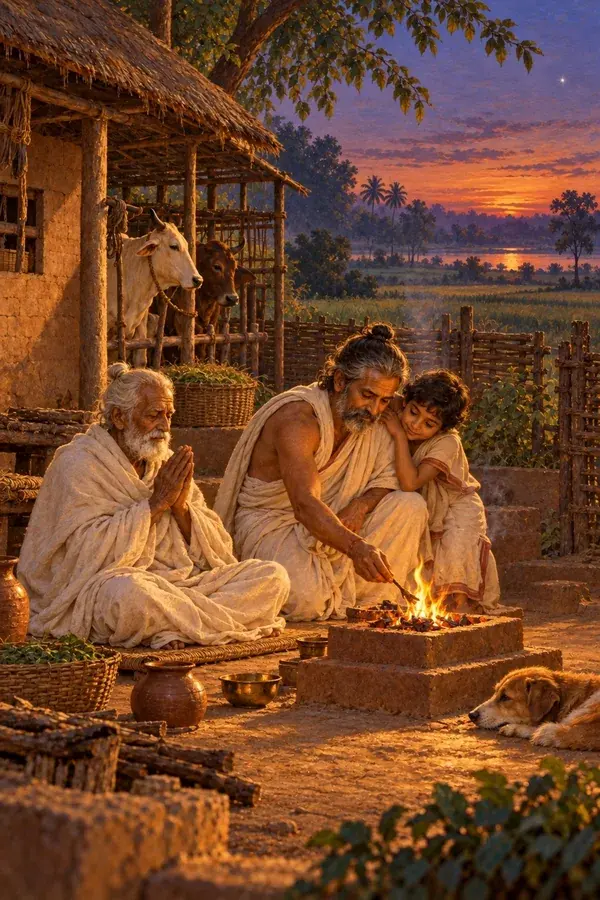
The seventeenth mantra is very short and very heavy. Let this breath go now into anila, into that deathless wind, it says, and this body ends in ash. “Vayur anilam amritam athedam bhasmantam shariram”. In that one word, bhasmantam, the whole story of the body is finished. The words put a scene in front of anybody who has stood at a burning ground at the edge of a river in the evening: the stacked wood, the body laid on it and covered, the fire carried out from the house and put to it by a son, the smoke going up straight in still air, and in the morning a patch of warm gray on the sand with the river running past it a few steps away. Nowhere in this Upanishad is the body treated with contempt; the second mantra went so far as to wish a hundred years of it. Here its end is being stated, with no complaint in the statement, the way a man names the last halt on a journey.
And in that same moment a call goes up: “krato smara kritam smara”, kratu, remember, remember what was done. The whole line is spoken twice. Kratu means resolve, the will by which a sacrifice is performed and by which every act of a life is performed. At the last moment this Upanishad recalls no wealth, no name, no people. It recalls its own resolve, and what that resolve did.
There is something very deep in this call. All our lives we gather things outside, and what goes along at the end is the thing done inside. The mantra is telling nobody to be afraid. It has its own resolve by the shoulder and is shaking it, saying, do not forget at this hour. And it is said twice because this is the hour when everything is sliding, and whatever stays in mind at this hour is the thing that was actually learned.
The eighteenth mantra is the last, and it turns toward Agni. “Agne naya supatha raye asman”, Agni, lead us to prosperity by a good road. Of all the gods this is the one who has been closest at hand. He was in the house every day, on the hearth and on the altar, fed with wood and ghee by name, carried by the family when the family moved, kindled at a wedding and walked around, and at the end of it he is the one who takes the body. A man asks the road of one whom he takes to know the road, and the reason is given at once: you know all the vayunas, all our roads, all our ways of going are inside your knowledge.
Then comes the request that opens up the whole account of this text: turn the crooked sin away from us. The word juhurana carries crookedness in it, the bent road. Sin is seen here as a crookedness in the gait, and no list of offenses is drawn up anywhere. A man who walks bent arrives badly wherever he arrives. And at the end the line in which all the modesty of this Upanishad is seated: we speak to you the word of salutation, again and again. The fullest salutation, and that is all there is left to give.
This ending is worth pausing on. The Upanishad that laid a sheet over the whole earth in its first mantra, that cut the root of delusion and grief in the middle, asks the sun at the end to lift a screen and asks fire for a straight road. After the highest thing has been said, the folding of hands still remains to be done. And with that this Upanishad is finished, returning to the same peace-verse of fullness, in which the full taken out of the full leaves the full standing.
In short: The seventeenth mantra hands the breath over to the deathless wind and the body to ash, and in the same breath calls twice on the resolve seated inside: remember, remember what was done. The eighteenth asks Agni for a straight road and for the crooked sin to be turned away, and this Upanishad finishes by giving the fullest salutation.
And in the end, toward yourself
Eighteen mantras, and the sentence in the first of them is enough for a whole day. On waking, to see once that whatever comes into the hands today is a thing worn over, arrived from under somebody else’s sheet. After that the day runs exactly as it did, the same work, the same people, the same quarrels. The pressure of the grip stays a little lighter. And when something slips out of the hand in the evening, it leaves a shallower cut, because no name was written on it in the morning.
The second thing worth keeping is the vidya and avidya matter, since that is where we slip most. One man sinks so far into his work that he lifts his head years later and recognizes nothing around him. Another takes up the name of the spiritual life and grows distant from the people in his own house, and takes that distance for height. This Upanishad lays a hand on both alike and asks for both hands: full work, full sight, together, in one life. That is why it called the wish for a hundred working years bad nowhere.
And at the end that golden lid, which each man has his own version of. For one it is his earnings, for another his position, for another his scholarship, for another the image that has formed in the eyes of other people. Each one is beautiful on its own account, and each one lies exactly where the looking was to happen. This Upanishad asked for no breaking of it. It asked a man to plead for its lifting, and the man who pleaded said this much about himself and no more, that truth is his law. The call to kratu is useful at the end of a day as well: remember what was done. The day you can remember without shame is the day that was lived correctly.
Source: Isha Upanishad, mantras 1 to 18; read against the Sanskrit, with Shankara’s reading noted where readings differ.