Devi Mahatmya · Durga Saptashati · Chandi Path
From the Markandeya Purana, 13 chapters, 700 shlokas
The Devi Mahatmya, the first shastra of the entire Devi tradition. Chapters 81 to 93 of the Markandeya Purana, seven hundred shlokas, hence the name Saptashati. Three caritas, three acts: Madhu-Kaitabha, Mahishasura, and Shumbha-Nishumbha. Between the battles, two hymns that live in every throat, “या देवी सर्व-भूतेषु” and “नारायणि नमो ऽस्तु ते।” And every sharad Navratri, home after home still recites it.
All thirteen chapters below now read in full English, every shloka in Devanagari with its meaning opened beside it, from the first question in the forest to the final boon.
About the text
The Devi Mahatmya, also called the Durga Saptashati and the Chandi Path, is the principal shastra of Devi worship. The rishi Markandeya is telling his disciple Kraushtaki how Savarni Manu came to be, and inside that story another one opens. King Suratha, stripped of his kingdom, and the vaishya Samadhi, thrown out of his home by his own kin, arrive at the forest ashram of the rishi Medha carrying the same question: we understand it all, so why does the mind stay tied in this attachment? The rishi’s answer is a single word, Mahamaya. Then he unfolds that Mahamaya through three caritas.
The three caritas are these:
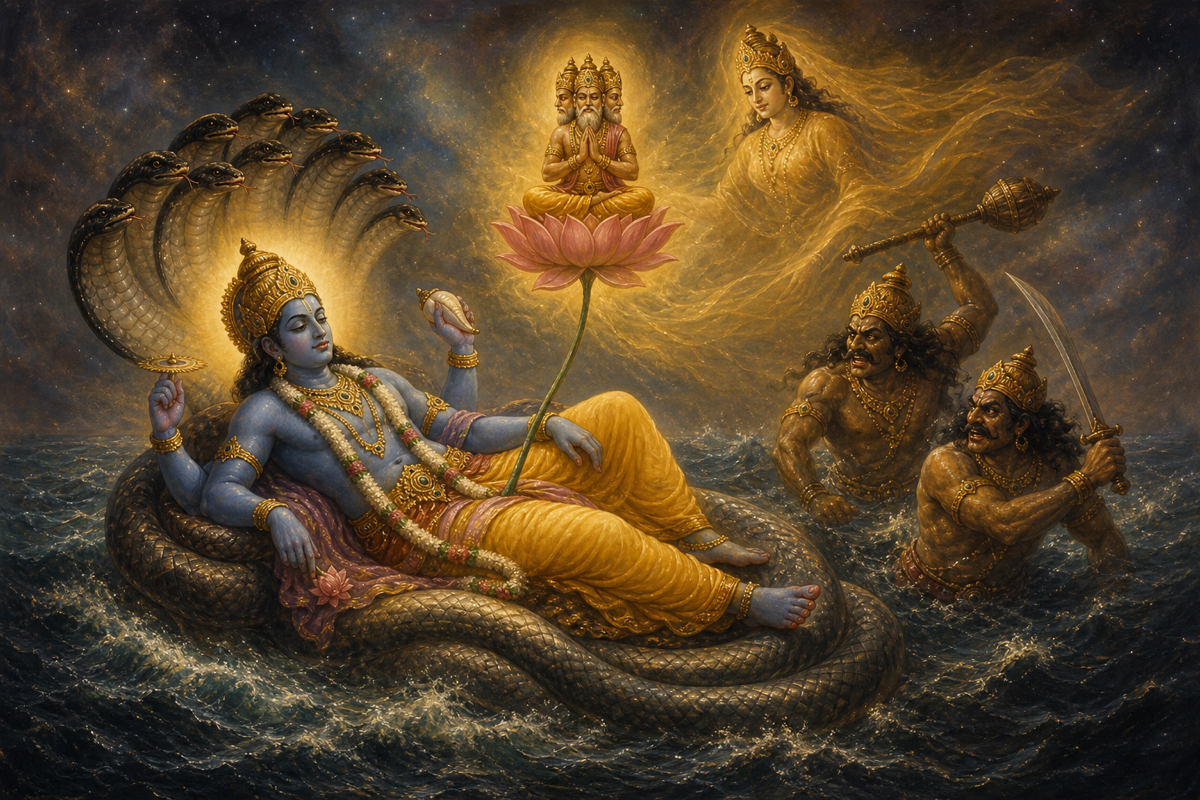
- First Carita (chapter 1): the slaying of Madhu and Kaitabha. The Devi called forth out of Vishnu’s yoga-nidra, and the end of both daityas.
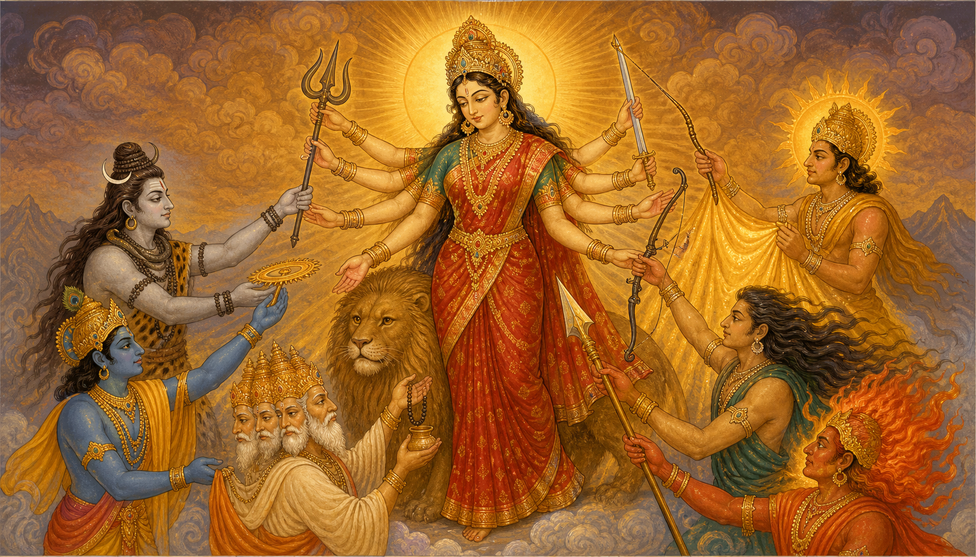
- Middle Carita (chapters 2 to 4): the slaying of Mahishasura. The Devi rising from the gathered radiance of all the gods.
- Final Carita (chapters 5 to 13): the slaying of Shumbha and Nishumbha. Kaushiki stepping out of Parvati’s own sheath, the seven Matrikas, Brahmani, Maheshvari, Kaumari, Vaishnavi, Varahi, Narasimhi, and Aindri, the slaying of Raktabija, the birth of Chamunda, and the two famous hymns, the “Ya Devi” and the “Narayani.”
The order of recitation
The recitation goes in order, because each chapter stands on the one before it. One chapter per sitting is enough, and the whole text completes in thirteen days. If the recitation is taken up as a sankalpa in the sharad Navratri, the bright fortnight of Ashvin, chapters one through nine carry the first nine days, the tenth falls on Dashami, and the remaining eleven through thirteen fill the next three.
The shlokas most often taken up in daily recitation: 1.1 to 1.3 (Markandeya’s words); 4.17 (“दुर्गे स्मृता हरसि भीतिम्”); 5.12 to 5.37 (the “Ya Devi”, twenty-five shlokas); 11.7 to 11.22 (“नारायणि नमो ऽस्तु ते”, sixteen shlokas); and 11.51 (“इत्थं यदा यदा बाधा”).
The Devi Mahatmya, 13 chapters
Chapter 1 · The slaying of Madhu and Kaitabha
Shlokas 1 to 78 · First Carita
King Suratha and the vaishya Samadhi meet in the forest. Both are in sorrow, yet their affection still clings to the very people who betrayed them. The rishi Medha names the force behind it, Mahamaya. Then comes the most ancient story of all: Vishnu deep in yoga-nidra at the kalpa’s end, Madhu and Kaitabha born from the wax of his ears, Brahma’s hymn to the Devi, Vishnu waking, and both daityas slain.
Chapter 2 · The birth of the Devi, and the rout of the army
Shlokas 1 to 70 · Middle Carita (1)
Mahishasura has seized Indra’s throne. The gods take refuge with Vishnu and Shiva, and then the astonishing thing happens: the radiance of every god pours into a single mass and takes the Devi’s form, and one by one each god places his own weapon in her hands. Then the great battle opens, and the generals fall, Chikshura, Chamara, Udagra, Karala, and the rest.
Chapter 3 · The slaying of Mahishasura
Shlokas 1 to 44 · Middle Carita (2)
Now Mahishasura himself stands before her in buffalo form. Form after form he shifts, a lion, then a man, then an elephant, then the buffalo again. The Devi pins his neck beneath her foot, drives the trident through him, and takes his head with the sword. From this moment she is called Mahishasura-Mardini.
Chapter 4 · The hymn of Indra and the gods, and the boon
Shlokas 1 to 38 · Middle Carita (3)
After the victory, the gods’ long hymn, “दुर्गे स्मृता हरसि भीतिम्।” Pleased, the Devi told them to ask for a boon. They asked for one promise only: whenever they remember her, she must appear. The Devi said, so be it, and vanished.
Chapter 5 · The “Ya Devi” hymn, and Shumbha’s envoy
Shlokas 1 to 79 · Final Carita (1)
Shumbha and Nishumbha have taken Indra’s throne. The gods climb to the Himalayas and praise the Devi with the hymn the whole tradition carries by heart, “या देवी सर्व-भूतेषु”, twenty-five times, each time naming one of her forms: Vishnu-maya, consciousness, intellect, sleep, hunger, shadow, power, thirst, forbearance, birth, modesty, peace, faith, radiance, Lakshmi, steadiness, livelihood, memory, compassion, contentment, mother, delusion, and at the end, awareness. Then Kaushiki emerges as Parvati bathes, the dark-hued Kalika appears, and Shumbha’s envoy arrives.
Chapter 6 · The slaying of Dhumralochana
Shlokas 1 to 19 · Final Carita (2)
Shumbha sends Dhumralochana with an army of sixty thousand. The Devi burns him to ash with a single roar. Then her lion takes the whole army apart.
Chapter 7 · The slaying of Chanda and Munda, the birth of Chamunda
Shlokas 1 to 26 · Final Carita (3)
Chanda and Munda arrive with a full four-limbed army. The Devi darkens with anger, and from her brow springs Kali of the dreadful face. Kali swallows the entire army and delivers the severed heads of Chanda and Munda into the Devi’s hands. The Devi gives her a new name, Chamunda.
Chapter 8 · The slaying of Raktabija, the seven Matrikas
Shlokas 1 to 63 · Final Carita (4)
Shumbha raises the entire asura host. From the bodies of the gods their shaktis step forth, Brahmani, Maheshvari, Kaumari, Vaishnavi, Varahi, Narasimhi, Aindri, and Shiva-duti. Then comes Raktabija, from whose every fallen drop of blood a new asura stands up. Kali drinks his blood before it can touch the ground, and so he is slain.
Chapter 9 · The slaying of Nishumbha
Shlokas 1 to 40 · Final Carita (5)
Now Nishumbha himself takes the field, striking with ten thousand arms. Weapon after weapon of his shatters. The Devi drives the trident deep into his heart, and then another Nishumbha begins to climb out of him. She severs that head too.
Chapter 10 · The slaying of Shumbha
Shlokas 1 to 30 · Final Carita (6)
Shumbha throws his taunt: the Devi is fighting on the strength of others. She draws every mother-power back into her own body and says, I am alone. Then a duel beyond anything before it, a fist-fight rising into the open sky. In the end the trident splits Shumbha’s chest and he falls.
Chapter 11 · The Narayani hymn
Shlokas 1 to 55 · Final Carita (7)
The gods pour out a hymn that reaches the heart, every shloka coming to rest on “नारायणि नमो ऽस्तु ते”, sixteen times. Then the Devi’s promise: whenever obstruction comes, she will appear. And a glimpse of avatars still ahead, Yogamaya (in the house of Nanda the cowherd), Raktadantika, Shakambhari, Bhima, and Bhramari.
Chapter 12 · The fruits of recitation
Shlokas 1 to 41 · Final Carita (8)
The Devi herself declares what fruit comes to the one who reads and hears this Mahatmya. Fire, water, weapons, storms at sea, lions, a king’s wrath, captivity: protection in every one of these dangers. And the greatness of the yearly sharad worship.
Chapter 13 · The boons to Suratha and the vaishya
Shlokas 1 to 17 · Conclusion
King Suratha and the vaishya Samadhi practice tapas for three years. The Devi appears before them in person and grants each his boon. Suratha will rise as Savarni Manu in the next manvantara, and the vaishya receives the very knowledge he had longed for.
For the reader
The Devi Mahatmya has by tradition been the heart of Durga worship. In this edition every shloka stands in Devanagari exactly as the standard Markandeya Purana text gives it, with roman transliteration and the meaning and sense in plain language. Both famous hymns arrive complete, the “Ya Devi” of chapter 5 (twenty-five shlokas) and the “Narayani” of chapter 11 (sixteen shlokas), every shloka given its own space.
Those who want a purely Sanskrit commentary may turn to Swami Jagadishwarananda’s “Devi Mahatmya” (Advaita Ashrama) or Swami Chinmayananda’s edition.