On this page
The same Gita, returned in a quieter voice
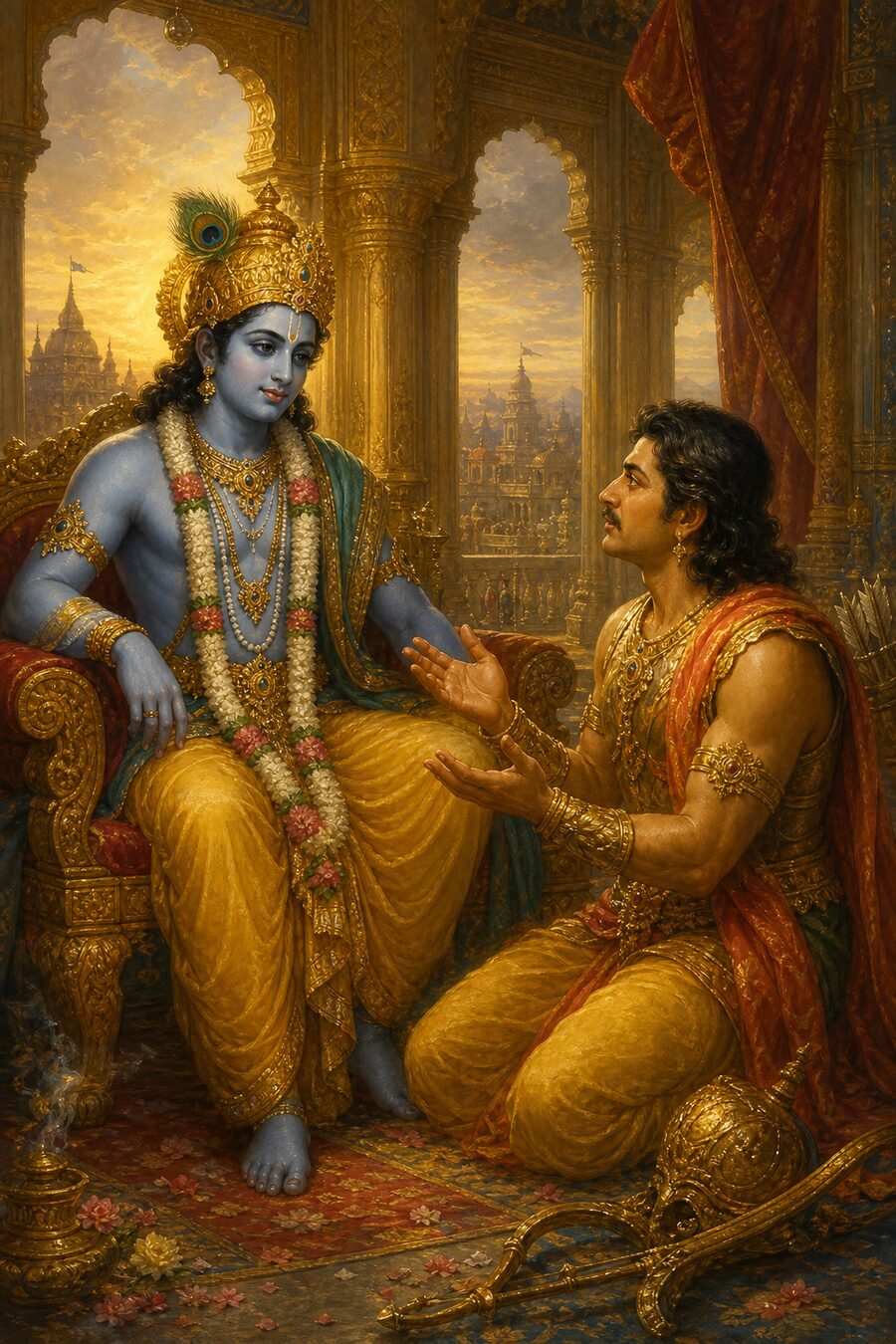
The great war was over. Those who had fought for the victory had indeed won it, and they were learning, too, the emptiness that arrives alongside a victory. In the middle of it came a quiet day, in that same assembly hall of Indraprastha where once so much had shattered, and there Krishna and Arjuna sat together, two friends. The chariots and the battlefield were behind them now. What remained between them was a long weariness and a deep love.
Somewhere in the talk, Arjuna spoke the words a student hesitates to say to his teacher. Keshava, he said softly, at the very edge of battle, when I looked upon my own people arrayed before me and collapsed, you gave me a supreme teaching. It has gone out of my mind now. I want to know it again.
A faint flicker of irritation crossed Krishna’s face, and behind it, a smile. That yoga, Arjuna, I spoke to you in a heightened hour, he said, when my whole being was gathered into a single point. To hand you that same speech back word for word is no longer possible, because it belonged to that moment. But do not lose heart. With the help of an old story, I will give you the same gist once more. And so began the teaching they call the Anugita, an echo of the Gita, in a calm and unhurried voice.
The karma that never dies
Krishna began the old story in his own courtyard. Arjuna, he said, a Brahmana once came to us out of the regions of heaven, a man of irresistible energy who had come down from the realm of the Grandsire himself. We received him with every honor that was due. And when we asked him about the dharma of release, asking out of compassion for all creatures and for no gain of our own, he answered in the manner of heaven. Listen to what he said, and let no scruple of any kind stand in your way.
That Brahmana told us this. Slayer of Madhu, he said, there was once a Brahmana named Kashyapa, rich in austerities and foremost among those who understand their duties, and he went to see another Brahmana who had come to know every mystery of religion. This second man had mastered all that the scriptures teach about the departure of beings and their return. He possessed the direct knowledge that yoga gives. He knew the truth about pleasure and pain, the truth about birth and death, and the distinction between merit and its opposite. He could see the ends that embodied creatures reach, high and low, in consequence of their acts. He lived like one already set free from the world. Crowned with ascetic success, perfectly tranquil in soul, he had every sense under his command, and he seemed to blaze with the light of Brahman. He could go wherever he wished and could vanish at will from before the eyes of all. He kept the company of invisible Siddhas and celestial musicians, and he would sit and talk with them on some spot withdrawn from the bustle of people. He was as unattached to all things as the wind. Kashyapa heard a true account of him and longed to see him. Intelligent as he was, he found the sage, and when he had seen all those wonderful attributes with his own eyes he fell at the sage’s feet with a rapt heart, moved by the desire to earn merit. Filled with wonder, Kashyapa then began to wait upon that foremost of Brahmanas with the dutiful reverence of a disciple serving his preceptor, and by his devotion and his obedience he won the sage over.
One day, gratified, the sage spoke to him cheerfully, with an eye to the highest success. By diverse acts, my son, he said, and by the help of merit, mortal creatures reach diverse ends here and residence in heaven. Nowhere is the highest happiness, and nowhere can residence be eternal. There are repeated falls from the highest regions, regions won with such sorrow. Because I indulged in sin, I myself reached many miserable and inauspicious ends, filled as I was with lust and wrath and deluded by greed. Again and again I have undergone death and rebirth. I have eaten diverse kinds of food, I have sucked at diverse breasts. I have seen diverse mothers, and diverse fathers unlike one another. Diverse kinds of happiness have been mine, and diverse kinds of misery. Over and over I have been parted from what was dear and joined to what was hateful. I have earned wealth with great toil and then had to bear its loss. I have taken insults and excessive misery from kings and from kinsmen. Mental pain and bodily pain of great severity have been mine, and humiliation, and death, and imprisonment under harsh conditions. I have fallen into hell and suffered great tortures in the domains of Yama. Decrepitude and disease have assailed me repeatedly, and calamities as frequent and as copious. In this world I have undergone, again and again, every affliction that flows from the perception of the pairs of opposites. Then one day, overwhelmed with sorrow, a blank despair came upon me. I took refuge in the Formless. Afflicted with great distress, I gave up the world with all its joys and sorrows. Understanding this path, I practiced it here in this world, and afterward, through tranquility of soul, I reached the success you now see. I shall never have to come back to this world. Until I am absorbed into eternal Brahman, until the final dissolution of the universe itself, I shall look on the happy ends that will be mine and on the beings that make up this universe. Let no doubt remain in you about this. I know the purpose for which you have sought me. I shall soon depart from this world, and that is why I have given you this hint. I am well pleased with you. Your intelligence is great, and I applaud it, for it was with that intelligence that you were able to recognize me. Question me now, and I shall tell you what is beneficial to you, according to your desire.
Kashyapa touched his feet and asked the questions that are hardest of all to answer. How does the body dissolve away, and how is another body acquired? How does a person become free after passing through a repeated round of painful rebirths? Having enjoyed Prakriti for a time, how does the jiva cast off the particular body that Prakriti gives? Freed from the body, how does the jiva attain what is different from the body? How does a human being enjoy and endure the fruits of the good and bad acts he has done? And where do the acts of one who no longer has a body exist?
The emancipated sage answered those questions one after another. When the acts capable of prolonging life and bringing fame, the acts done in a particular body, are exhausted, the embodied jiva, its span now shortened, begins to do things hostile to life and health. As destruction approaches, its understanding turns away from the proper course. A man of uncleansed soul, even after a correct knowledge of his own constitution and strength and of the seasons of his life and of the year, begins to eat at irregular hours and to eat food that is hostile to him. He eats too much at one time and goes without at another. He takes bad food, bad meat, bad drink, or dishes whose ingredients quarrel with one another. He eats what is heavy beyond measure, or eats again before the last meal is digested. He overdoes exercise and the pleasures of the bed, or out of greed for work suppresses the urgings of his own body even when they have become loud. He eats very juicy food, or sleeps in the daytime. Food that is not properly digested excites the faults of the body when the time comes, and from that excitement comes disease, and the end of disease is death. Sometimes a person even turns to perverse and unnatural acts, like hanging himself. Through such causes the living body dissolves. Hear how it happens. Driven by the wind, which grows violent, the heat in the body becomes excited and, reaching every part one after another, restrains all the movements of the vital breaths. Grown very strong, that heat pierces every vital part where life may be said to dwell, and the jiva, in great pain, quickly takes its leave of its mortal casing. The pain a person feels in casting off the body is like the pain of first entering the womb and of coming out of it. The wind within the body, excited by cold, dissolves the compound called the body into its five elements, and the wind that lives in the breaths called prana and apana rushes upward out of its distress, leaving the creature behind. Then there is breathlessness. The man is left without heat, without breath, without beauty, without consciousness, and people say that he is dead.
Yet the jiva does not go alone when it leaves the body. It goes surrounded by its acts, equipped on every side with all its merit and all its sins. Brahmanas of knowledge, who hold the settled conclusions of the scriptures, can tell from the signs whether it carries merit or the reverse. As people with eyes watch a firefly appear and vanish in the dark, so people with the eye of knowledge, crowned with the success of austerities, watch with spiritual vision the jiva as it leaves the body, as it is reborn, and as it enters the womb. Three regions are assigned to the jiva eternally. This world where creatures dwell is called the field of action; here, performing acts good and bad, all embodied creatures reap their fruits, and acquire even here superior or inferior enjoyments. Those who do evil go down to hell, where creatures are cooked with their heads downward, a condition of great misery from which rescue is exceedingly hard, and from which one should strive with all one’s strength to save oneself. And above are the regions where creatures of righteous deeds go when they ascend from this world: the stellar worlds that shine in the firmament, the disc of the moon, and the disc of the sun that shines by its own light. From those regions, when their merit is spent, they fall away again and again. And even in heaven there is a difference of inferior and superior and middling felicity, and even in heaven there is discontent at the sight of a prosperity brighter than one’s own.
Then the sage came to the truth that is the first breath of this whole teaching, the one that every person runs into sooner or later. The acts a jiva does, good and bad, are not subject to destruction. As it takes body after body, those acts produce fruits corresponding to themselves. As a fruit tree, when its season of bearing comes, yields a great quantity of fruit, so merit achieved with a pure heart yields a great crop of happiness, and sin done with a sinful heart yields a great crop of misery. Placing the mind ahead of itself, the jiva addresses itself to action; and equipped with all its acts, overwhelmed with lust and wrath, it enters the womb. The vital seed, mixed with blood, enters the womb of the female and becomes the jiva’s field, good or bad, born of its own acts. Because of its subtlety and its unmanifest condition the jiva becomes attached to nothing even after it has taken a body, and so it is called eternal Brahman; it is the seed of all creatures, and it is because of it that living creatures live. As molten iron poured into a mold takes the shape of the mold, such is the entrance of the jiva into the fetus. As fire entering a mass of iron heats it through, such is the manifestation of the jiva in the fetus. As a lamp burning in a room discovers everything inside it, so the mind discovers the several limbs of the body. Whatever acts the jiva did in a former body, good or bad, it must certainly enjoy or endure. By such enjoyment and endurance the former acts are exhausted, and other acts gather in their place, until the jiva comes to know those duties of contemplation that lead to release. So the skill lies in understanding action and performing it without attachment; running from it changes nothing. And the sage told him how a jiva, while it still courses through the round of rebirths, may be happy: by gifts, by austerities, by continence, by bearing Brahman as the ordinances lay down, by self-restraint, tranquility, compassion for all creatures, restraint of the passions, abstention from cruelty and from taking what belongs to others, refusal to do even in thought any act that is false or injurious to living creatures, reverent service of mother and father, honor to deities and guests, worship of preceptors, pity, purity, constant restraint of all the organs, and the causing of all good acts. This is the conduct of the good, and from such conduct arises the righteousness that protects all creatures eternally. The sage went on to the oldest question of all, by what the jiva’s first acceptance of a body was determined. Brahma, the Grandsire of all the worlds, first formed a body of his own and then created the three worlds entire, with their mobile and immobile creatures; having first taken a body himself, he created Pradhana, the material cause of all embodied creatures, by which all this is covered. What is seen is called the destructible; the other is the immortal and indestructible. The person who looks upon pleasure and pain as inconstant, who regards the body as an unholy conglomeration and destruction as ordained in action, and who remembers that what little pleasure there is turns out in the end to be all pain, crosses this terrible ocean of worldly migration, which is so hard to cross.
Then he described the one who is free. The friend of all, who endures everything, who loves tranquility, who has conquered all his senses, who is rid of fear and wrath, and whose soul is restrained, succeeds in emancipating himself. He who behaves toward all creatures as toward himself, who is restrained and pure, free from vanity and emptied of egoism, is regarded as emancipated from everything. So is he who looks with an equal eye on life and death, pleasure and pain, gain and loss, the agreeable and the disagreeable; who covets nothing that belongs to others, who never disregards anybody, and who has passed beyond the pairs of opposites. He who has no enemy, no kinsman, and no child, who has cast off religion and wealth and pleasure alike, who acquires neither merit nor demerit and sheds those gathered in former births, who looks upon the universe as an unenduring thing, like an ashvattha tree ever subject to birth and death and decay, and whose eyes are always turned toward his own faults, soon frees himself from the bonds that bind him. Abandoning with the help of the understanding every purpose relating to body and mind, he gradually attains the cessation of separate existence, like a fire unfed with fuel. And after this the sage declared the science of yoga, than which nothing is higher, and the doors by which one directs the soul within the body and sees that which is without beginning and end. Withdrawing the senses from their objects, one should fix the mind on the soul; having first undergone the severest austerities, one should practice that concentration which leads to release. Restraining all the senses in a forest that is free from noise and empty of people, one should meditate on the All, outside and inside the body, on the teeth and the palate, the tongue, the throat, the neck, the heart and the ligatures of the heart. As a person who has seen some unknown stranger in a dream recognizes him on waking and says, this is he, so the good man who has seen the Supreme Soul in the deep contemplation of samadhi recognizes it on waking from samadhi. As one draws out the fibrous pith from a blade of munja grass and looks at it, so the yogin draws the soul out of the body and sees it; the body is the munja blade, and the pith stands for the soul. When the bearer of a body has adequately seen the soul in yoga, he has no master over him any longer, for he has become the lord of the three worlds. No fear springs up in him even at the sight of all creatures falling to destruction before his eyes. Weapons never pierce him; death does not exist for him; nowhere in the world can anyone be seen who is happier than he. Yoga comes to the one who devotes himself to its constant practice for six months.
That disciple asked one more question, hard to answer. How does the food that is eaten from time to time become digested in the stomach? How is it transformed into juice, and then into blood? How does it nourish the flesh, the marrow, the sinews, the bones? How do all these limbs of embodied creatures grow, and how does strength grow in the growing man? How does one breathe in and breathe out again? Staying upon what particular part does the soul dwell in the body? And here the visiting Brahmana opened his secret before Krishna. Madhava, he said, that is what my disciple asked me, and I answered him as I myself had heard. As one who has put some precious object in his storeroom keeps his mind upon it, so, placing the mind within one’s own body and restraining all the senses, one should seek after the soul and avoid every heedlessness. It cannot be seized by the eye, nor by all the senses together. Only by the lamp of the mind can that great soul be seen, the one who has hands and feet on all sides and ears on all sides, who dwells pervading all things in the world. The jiva then sees the soul drawn out of the body as the stalk is drawn from the munja blade, and casting off Brahman as invested with form, he sees Brahman freed from all attributes, and seeing the soul with his mind he smiles. With that I asked leave of my disciple and told him to go wherever he pleased, and that Brahmana of rigid vows and austere penances went away according to his pleasure. Kashyapa was my disciple, and the sage of this story was myself.
Having said so much, Arjuna, that best of Brahmanas vanished then and there, Krishna said. Partha, have you heard this with your mind set wholly upon it? This is the very thing you heard that day on the chariot. It is hard to grasp for one whose understanding is confused, or who has acquired no wisdom by study, or who eats food that is at war with his body, or whose soul is not purified. This is a great mystery among the gods, never before heard by anyone in this world, and no other man than you deserves to hear it. The gods, who hold to the religion of action, do not love the ceasing of the mortal form. The highest goal is the one made of eternal Brahman, where one casts off the body and attains immortality and is happy forever. The mortal who, endowed with intelligence and faith and vigor, renounces as unsubstantial what the world counts substantial, obtains the Supreme within a short time by these means. There is nothing higher than this. Here the Anugita opened its wings.
The altar within
Then Krishna told an old story, a conversation between a husband and wife. The husband had laid every rite aside and sat apart, and the wife asked him where that left her: a wife reaches the worlds her husband wins, and he had given up all acts, so what end would she come to? The answer the husband gave is the key to this whole teaching. The greatest yajna burns within us, he said, in our own bodies. No outer fire pit holds it. Our senses are the altars, our breaths are the offerings, and every alert moment of ours is the oblation in which the ego slowly burns away. Whoever masters this inner rite no longer depends on outward observances.
Through this small story Krishna said something large. The real ground of practice is our own body and mind, closer than any distant temple or forest. And if we choose, we can make every breath into an offering.
The mind, the senses, and the five breaths
The husband and wife went on talking, and two quarrels came into the telling, both of them fought inside the body itself. The husband spoke first of seven sacrificing priests who serve at the inner rite: the nose, the eye, the tongue, the skin, the ear, the mind, and the understanding. They share one dwelling and yet never perceive one another, because each knows only its own portion of the world. Smell belongs to the nose alone, color to the eye alone, touch to the skin, sound to the ear, taste to the tongue; doubt comes to the mind alone, and certainty to the understanding alone. Out of this division arose an old dispute between the mind and the senses.
The mind opened the case. Without me, it said, the nose does not smell, the tongue does not taste, the eye seizes no color, the skin feels no touch, the ear catches no sound. Among all the elements I am the eternal one and the foremost. Robbed of me, the senses sit dark, like houses emptied of their people or fires whose flames have gone out. Let them strain as they will, without me no creature grasps a single quality or object, just as a heap of wood, wet and dry together, kindles no fire.
The senses heard the whole speech and made their answer. What you think would be true, they told the mind, if you could enjoy one pleasure without us and without our objects. Let us go dark, and let there still be satisfaction, the upholding of life, and the continuance of your enjoyments; or let us be withdrawn while the objects remain in front of you, and take your delight by wish alone as fully as you take it with our help; then we will grant your claim. And if your dominion over our objects is as complete as you believe, then seize color with the nose and taste with the eye, catch smell with the ear and touch with the tongue, and hear sound through the skin. Those who hold real power are bound by no rule; rules exist for the weak. You are like a disciple who goes to a teacher for the Vedas and, having received them, lives on their meaning: the objects you call your own are the ones we show you, past or to come, in sleep or in waking. When a creature of little wit lets its mind wander and sink, its life is still upheld because our objects keep doing their work. A creature may form a thousand purposes and lose itself in dreams, yet the moment desire presses it, it runs straight to the objects of sense. And whoever sets out to enjoy on mental purpose alone, cut off from any real object, dies when the breaths run out, like a lit fire when the fuel is gone. It is true that each of us is bound to its own attribute and knows nothing of the others. Yet without us you have no perception, and without us no happiness can ever reach you. The dispute was left there, with no judge to settle it.
Then the husband turned to five sacrificing priests, and named the five breaths: prana, apana, udana, samana, and vyana. The wife stopped him. Until now, she said, I held that there were seven; explain to me how the number comes to be five. So he told her the old story. The wind nursed by prana takes birth in apana; nursed in apana it grows into vyana; nursed by vyana it becomes udana; and nursed in udana it is born as samana. Long ago these five went to Brahma, the first-born Grandsire, with a question. Tell us which of us is foremost, they said, and that one will be our chief. Brahma answered with a test. The one at whose going out every breath goes out of the bodies of living creatures, and at whose moving they all move again, that one is foremost among you. Go where you like and try it.
Prana claimed the place first. When I go out, all the breaths go out; when I move, they move; see, I go into extinction. Prana went out and moved once more, and at once samana and udana spoke. You do not dwell here pervading the whole body as we do; you are not the foremost; only apana is under your sway. Then apana made the same claim and gave the same proof, and vyana and udana told him that only prana was his to command. Vyana claimed, went out, returned, and the other four told him that samana alone was his. Samana claimed and tested. Udana claimed and tested, and when he came back the others said to him too that only vyana was under his sway. Each breath had shown that it could stop the body, and one after another they heard that their rule reached no further than a single companion.
Then the five stood together before the Lord of creatures, and Brahma gave his judgment. None of you is superior to the others. Each of you carries its own attribute, each is foremost in its own sphere, and each holds the power that is its own. There is one that is unmoving and one that is moving; by the difference of your attributes you are five breaths, yet my own self is one, and that one gathers itself into many forms. Become friends to one another, gratify one another, and go in peace. Blessings on you all. Uphold one another.
The forest of the world, and the city of nine gates
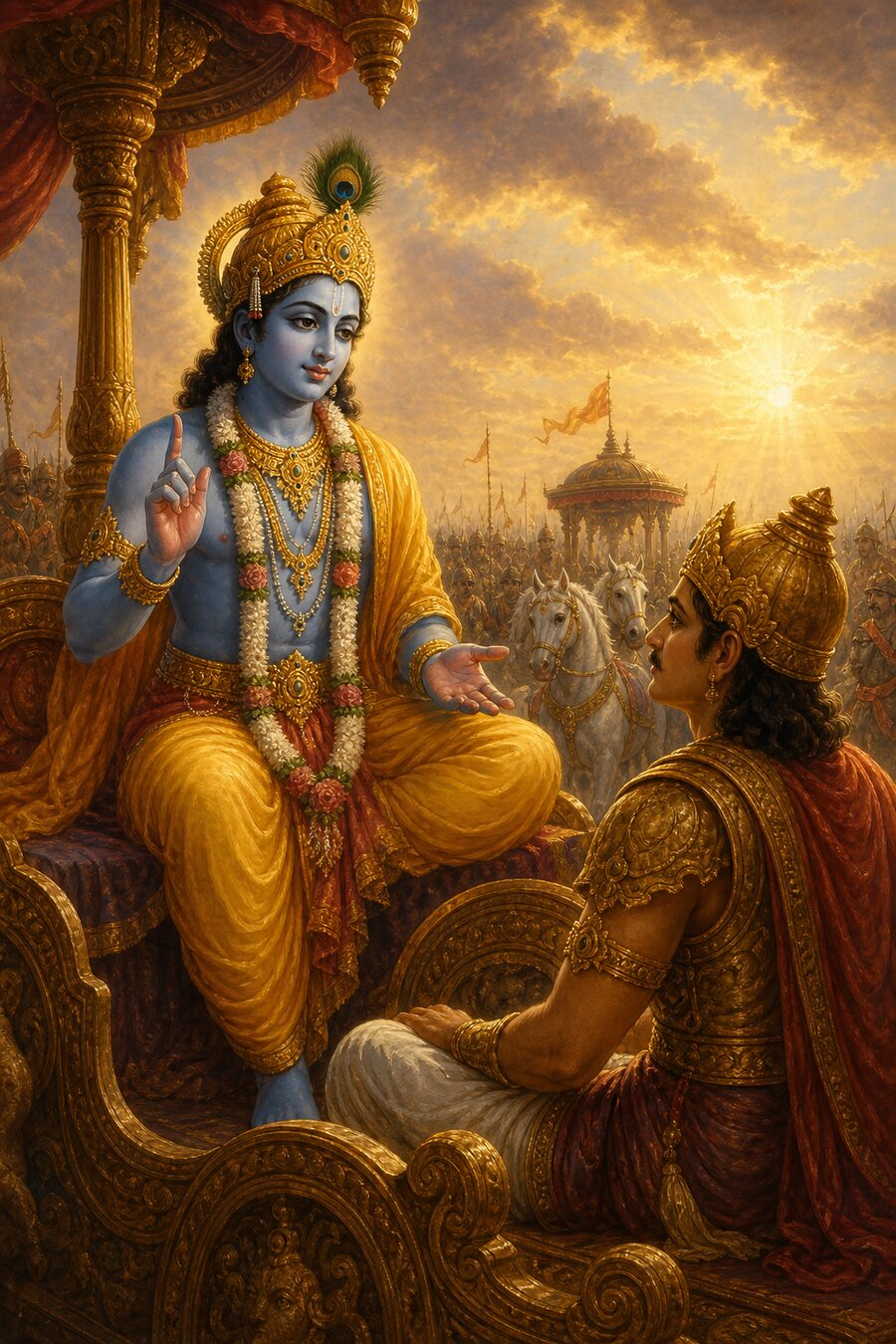
Krishna showed this world as a dense forest, one where the gnats and mosquitoes of willful desire keep up their whine, where the sun and shade of sorrow and joy shift back and forth, where the darkness of delusion hangs low, and where the snakes of greed slither near the feet. To cross this forest is what living means, and whoever turns inward and recognizes his own master crosses it without losing the way.
In the same breath he called this body a city of nine gates, in which that unmanifest, all pervading essence dwells. We think we own this city, yet its true resident is the one who sits behind all these gates of eye and ear, a silent witness. To recognize him is the gist of all knowledge.
Three colors, and one final voice
Then Krishna spoke of the three gunas that stay woven together inside every person, sattva, rajas, and tamas, which are steadiness, restlessness, and inertia. They are hard to hold apart, because they are coupled with one another, rest on one another, take refuge in one another, and follow one another. Whoever learns to recognize these colors and to see past them keeps them from ruling over him.
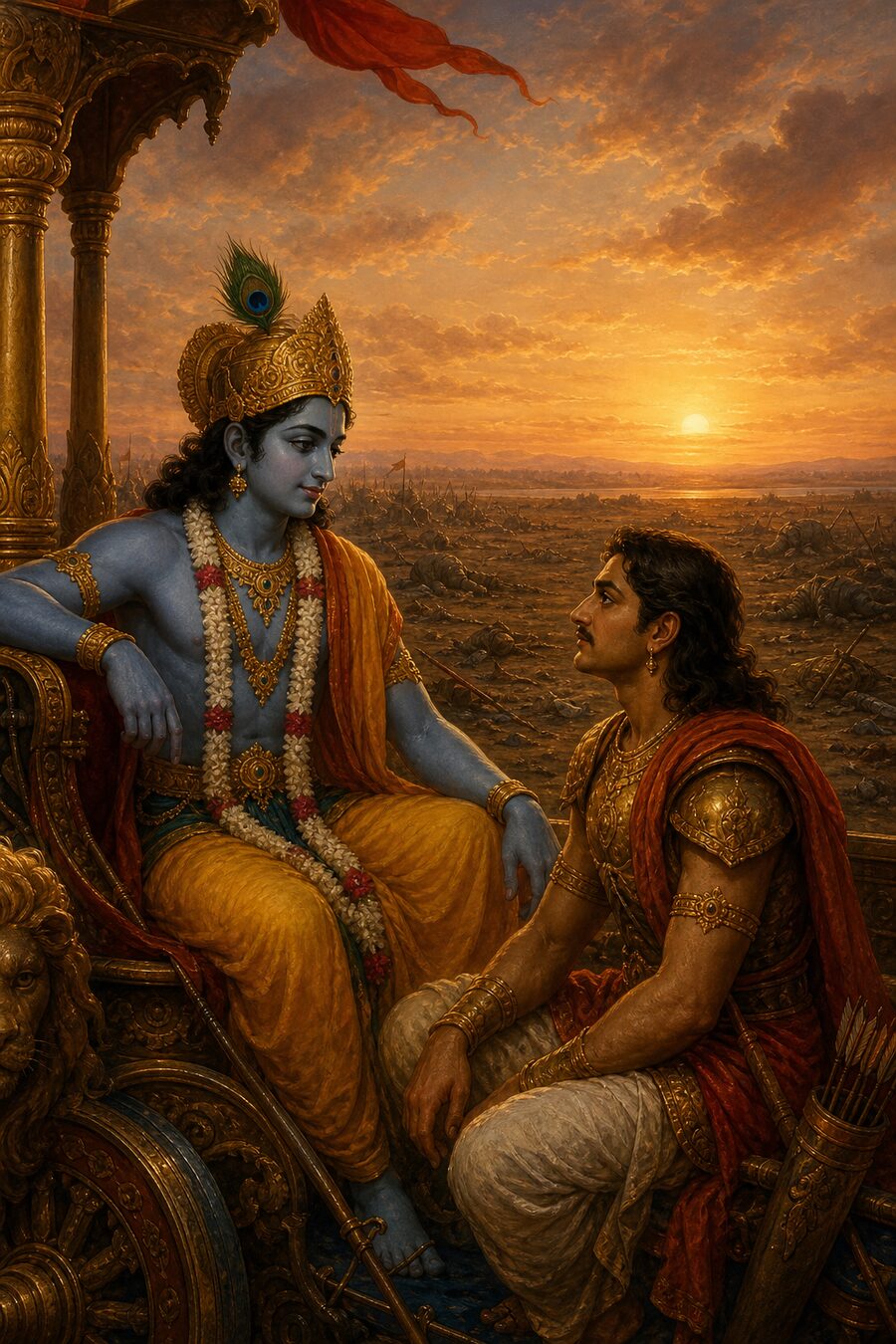
The story did not end there. Arjuna said, through your favor my mind has come to delight in these subtle expositions; now expound Brahman to me, the highest of all objects of knowledge. And Krishna recited one more old history, a conversation between a preceptor and his disciple on the subject of Brahman.
Once, he said, an intelligent disciple questioned a certain Brahmana of rigid vows, his preceptor, as the teacher sat at his ease. What, indeed, is the highest good? Wishing to reach what constitutes the highest good, I throw myself at your feet; bending my head, I ask you to explain to me what I ask. The preceptor answered, I shall explain to you everything about which you have any doubt. Then that disciple, who was devoted to his preceptor and lived so constantly at his side that he had almost become his shadow, who was self-restrained and led the life of a yati and a brahmachari, spoke with joined hands. Where am I? Where do you come from? Explain to me the highest truth. From what source have all creatures sprung, the moving and the unmoving? By what do creatures live, and what is the limit of their life? What is truth, and what is penance? What are the things the good call attributes? What paths are to be called auspicious? What is happiness, and what is sin? Afraid of worldly life, we have grown desirous of release. Who else in this world is capable of answering these questions? You are celebrated in all the worlds as one well skilled in the duties that relate to release, and there is no one but you who can remove all kinds of doubt.
The preceptor, possessed of intelligence and observant of vows, duly answered every one of those questions. All this, he said, was declared in days of old by Brahma himself, the Grandsire of all the worlds; applauded and practiced by the foremost of rishis, and resting on a knowledge of the Vedas, it concerns what the real entity is. We regard knowledge as the highest object, and renunciation as the best penance. He who knows with certainty the true object of knowledge, the soul abiding in all creatures, the one thing circumstances cannot modify, goes wherever he wishes and comes to be regarded as the highest. The learned man who sees the dwelling of all things in one place and their severance as well, who sees unity in diversity, frees himself from misery. He who covets nothing and cherishes no idea of mineness toward anything, though he lives in this world, is held to be one with Brahman. He who knows the truth about the qualities of Pradhana, who understands the creation of all existing objects, who is divested of mineness and without pride, is emancipated beyond doubt. And the preceptor spoke of the great tree that has the unmanifest for its seed, the understanding for its trunk, the high consciousness of self for its branches, the senses for the hollows from which its twigs issue, the five great elements for its flower buds and the gross elements for its smaller boughs; a tree always in leaf, always in flower, on which every existing thing depends, whose seed is Brahman and which is eternal. Cutting through every topic with the sharp sword of knowledge, a person attains immortality and casts off birth and death. I shall declare to you, he said, those conclusions about the past, the present, and the future, about religion and pleasure and wealth, which are well known to the assemblies of Siddhas and belong to remote ages, and are eternal. These constitute what is called the Good, and the wise who understand them in this world attain success.
Then the preceptor told him the scene in which this knowledge was born. In days of old the rishis Brihaspati and Bharadwaja, Gautama and Bhargava, Vasishtha and Kashyapa, Vishvamitra and Atri gathered together to question one another. They had traveled over every path and had grown weary of the acts each of them had done. Placing the sage son of Angiras at their head, those regenerate men went to the region of the Grandsire, and there they saw Brahma, perfectly cleansed of all sin, seated at his ease. Bowing their heads to that high-souled one, the great rishis, full of humility, asked him the grave question of the highest good. How should a good man act? How is one released from sin? What paths are auspicious for us? What is truth, and what is sin? By what action are the two paths, the northern and the southern, obtained? What is destruction, and what is release? What is the birth and what is the death of all existing things?
Brahma said, it is from Truth that all creatures have been born, the moving and the unmoving. They live by penance, which is action. Brahman is truth, penance is truth, Prajapati is truth; it is from truth that all creatures have sprung, and truth is the whole universe of being. The wise say that duty is one, though it has four quarters, and that it has faith for its chief indication. The first step is the mode of life of the brahmachari; the second is domesticity; after this comes residence in the woods; and after that comes the highest step, the one that relates to the inner self, Adhyatma. As long as one has not reached Adhyatma, one sees light and space, the sun and the wind, Indra and Prajapati. The forest life of ascetics living on fruits and roots and air is laid down for the three regenerate orders; the domestic mode is ordained for all. And Brahma counted out the elements that reside in parts in all objects: the great soul, the unmanifest, egoism, the ten organs and the one that is the mind, the five great elements and their five specific characteristics; four and twenty, he said, and one more. The wise man who understands the production and destruction of all these never meets with delusion, and he who understands the elements accurately, with all the qualities and all the deities, cleanses himself of every sin. From there Brahma went on to the city of nine gates and the three qualities.
Yet when all of it had been declared, those learned Brahmanas felt doubts, and they questioned the Grandsire once more. The diverse modes of duty, they said, contradict one another. Some say that something remains after the body is destroyed; others say it does not exist. Some say that everything is doubtful; others have no doubts at all. Some say the eternal principle is not eternal; some that it exists, and some that it exists not; some that it is of one form, some that it is twofold, some that it is mixed. Some wear matted locks and deer skins; others shave their heads and go entirely naked. Some are for abstaining from baths altogether, and some are for bathing. Some are for taking food, while some are devoted to fasts. Some applaud action; others applaud perfect tranquility. Some applaud release; some, enjoyments of every kind. Some want wealth of many sorts, and some want poverty. Some are devoted to a life of harmlessness; others are addicted to destruction. Some say the whole of it is meditation; other learned Brahmanas say it is sacrifice, or gift, or penance, or the study of the scriptures, or knowledge and renunciation; those who ponder the elements say it is Nature. Some extol everything, and some nothing. Each person who is attached to a certain duty applauds that duty as the best, and so our understanding breaks down and our minds are distracted. We wish to know, best of all beings, what is good; and we wish to know the mystery of the connection between the Kshetrajna, the knower of the field, and Nature.
The illustrious creator of the worlds answered them accurately. Learn, he said, what was told by a preceptor to a disciple who came to him, and having heard it all, settle the matter properly. Abstention from harming any creature is regarded as the foremost of all duties; that is the highest seat, free from anxiety, and the mark of holiness. The ancients who saw the certain truth have said that knowledge is the highest happiness, and so one is released from all sins by pure knowledge. Those who are given to destruction and harm go to hell, driven by greed and delusion. Those who perform acts promptly, impelled by expectation, are born again and again in this world and sport in joy; and those who, endowed with learning and wisdom, perform acts with faith and free of expectation, with concentrated minds, are the ones said to see clearly. As for the association and dissociation of the Kshetrajna and Nature, the relation between them is that of subject and object. Purusha is always the subject, and Nature is the object. They exist together after the manner of the gnat and the udumbara fig. Nature, an object of enjoyment, is unintelligent and knows nothing; the one who enjoys it is the one who knows it. The Kshetrajna is the enjoyer and Nature is the enjoyed. Nature is always made up of pairs of opposites and consists of qualities; the Kshetrajna is free of the pairs of opposites, without parts, eternal, and in its essence free of qualities. It dwells in everything alike and walks with knowledge, and it enjoys Nature as a lotus leaf enjoys water: possessed of knowledge, it is never tainted even in contact with all the qualities, unattached like the unsteady drop of water on the lotus leaf. As a person carries a lamp into a dark place, so those who wish for the Supreme proceed by the light of Nature; as long as oil and wick last, the lamp burns, and when they are exhausted the flame goes out. Thus Nature is manifest, and Purusha is said to be unmanifest. Then Brahma gave the rishis a pair of likenesses. A man who sets out on a long road without provisions for the journey proceeds in great discomfort and may perish before he reaches its end, and so it is with the one who lacks the perception of truth; the progress of the intelligent is like that of men who travel the same road in a chariot drawn by fleet horses. The man of learning drives on as long as the chariot path lasts, and when he sees the chariot path end he leaves the chariot and goes on. One who plunges without a boat into the terrible ocean with only his two arms, out of delusion, is wishing for his own destruction; the man of wisdom, who knows distinctions, goes into the water in a boat fitted with oars, crosses the lake without fatigue, and when he has reached the far shore he casts off the boat, freed from the thought of mineness. The one overwhelmed by delusion through attachment clings to it like a fisherman to his boat, and wanders within its narrow range. And Brahma said that with even a thousand explanations a person of bad understanding does not acquire knowledge, while the one endowed with intelligence reaches happiness with a fourth part of them.
At the end Brahma declared the secret on which this whole teaching rests. Since the mind is the ruler of these five elements, in controlling them and in bringing them forth, the mind is the soul of the elements; the mind always presides over the great elements. The mind yokes the senses as a charioteer yokes good horses. The senses are the horses, the mind is the charioteer, the understanding is the eternal reins, and in that great chariot of Brahman the jiva drives about on every side. The learned and wise man who understands the chariot of Brahman in this way is never overwhelmed by delusion in the midst of all beings. This forest of Brahman begins with the unmanifest and ends with gross objects; it holds the moving and the unmoving, takes its light from the radiance of sun and moon, is adorned with planets and constellations and decked on every side with nets of rivers and mountains, and in that forest the Kshetrajna always moves about. Of two syllables is death, and of three syllables the eternal Brahman: mineness is death, and the reverse of mineness is the eternal. One necessarily becomes that on which one’s mind is set; this is an eternal mystery. The one who understands Him that is immortal, immutable, incomprehensible, eternal and indestructible, the restrained Soul that transcends all attachments, does not die. This goal can be reached by one who is alike to all creatures, without attachment and without expectation, who looks equally on all things. I have now declared everything to you, Brahma said; act in this way at once, and you will acquire success.
Thus addressed by Brahma, the preceptor said, those high-souled sages acted accordingly and attained many regions of great felicity. Do you also, pure of soul, act according to the words of Brahma as I have declared them, and you will attain success. And Krishna said, son of Kunti, the pupil, so instructed in the principles of the high religion, did everything accordingly and reached release, and attained the seat where no one has to grieve. Arjuna asked, who was that Brahmana, Janardana, and who was the pupil? And Krishna gave the answer that is the key to the whole story. I am the preceptor, he said, and know that the mind is my pupil. Through my affection for you I have related this mystery. If you have any love for me, then, having heard these instructions about the soul, act by them always, and when this religion has been duly practiced you will be freed from all your sins and attain absolute emancipation. Long ago, when the hour of battle came, this very religion was declared by me to you; set your mind on it. And now it is long since I saw my father. With your leave, I wish to see him again. Arjuna answered that they would go that very day from the town to the city named after the elephant, and that after meeting the virtuous king Yudhishthira there and informing him, Krishna could go on to his own city. Here the Anugita comes to its close.
Arjuna had listened to all of it in silence. At Kurukshetra the teaching had come as thunder, with Krishna revealing his cosmic form. Now the same truth arrived in a low, almost domestic voice, as if the song had been hummed again on a quiet evening, a hand resting on a friend’s shoulder. And perhaps that is why they call it the Anugita, the same supreme word, come down from the height of war and returned to the level of daily life.
This retelling is based on the Anugita of the Mahabharata’s Ashvamedha Parva, told at length in story form, following the sequence and spirit of the original. (The Anugita re-presents the same gist of the Gita in fresh words. It does not repeat the Gita verbatim.)
The same story elsewhere
- Bhagavad Gita
Bhagavad Gita: the teaching given to Arjuna at Kurukshetra (Bhishma Parva) - Uddhava Gita
Uddhava Gita: the teaching given to Uddhava before his departure (Shrimad Bhagavata, Skandha 11) - Chapter 3: Karma Yoga
Bhagavad Gita, Chapter 3: Karma Yoga - Chapter 5: Karma Sannyasa Yoga
Bhagavad Gita, Chapter 5: Karma Sannyasa Yoga - Karma Yoga for decision-makers
Karma Yoga for decision-makers: a reading guide