On this page
jitan kahan na katahun ripu taken
Friend, whoever rides a chariot made of dharma has no enemy anywhere left to conquer.
Introduction
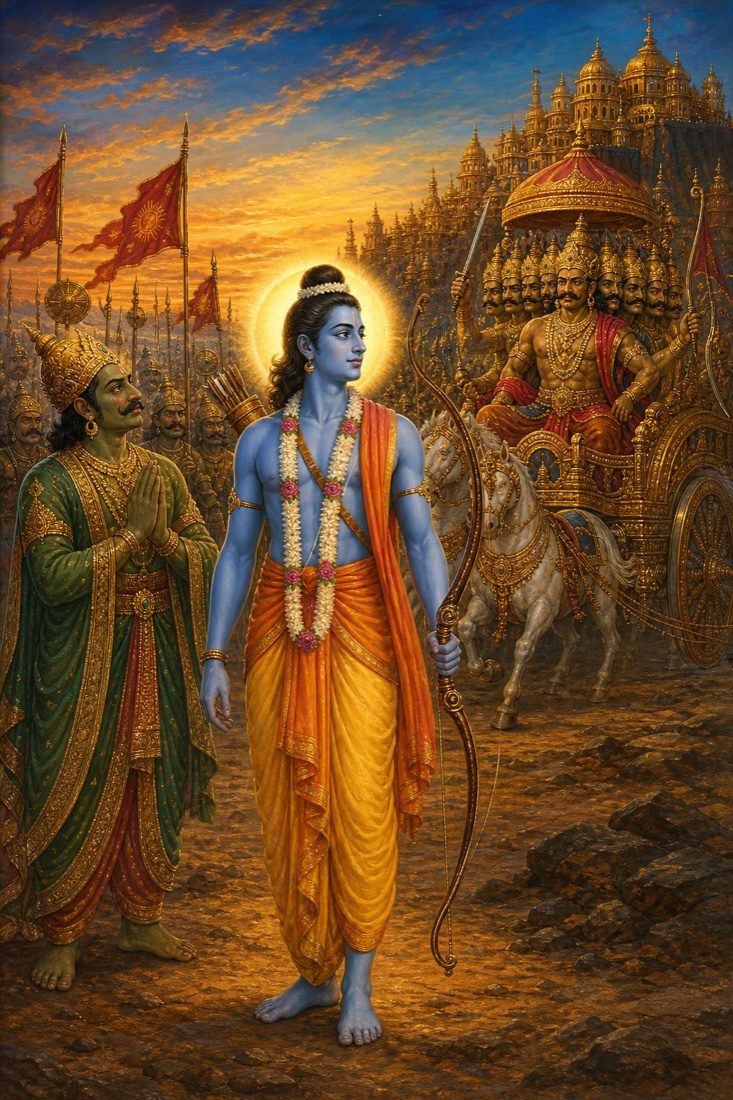
Within Tulsidas’s Ramcharitmanas there is a small episode that came in time to be counted among his most beloved teachings. It is called the “Vibhishana Gita,” though the word “Gita” in the name causes some confusion. In truth it is a brief dialogue from the Lanka Kanda, where Rama explains to Vibhishana the true nature of dharma.
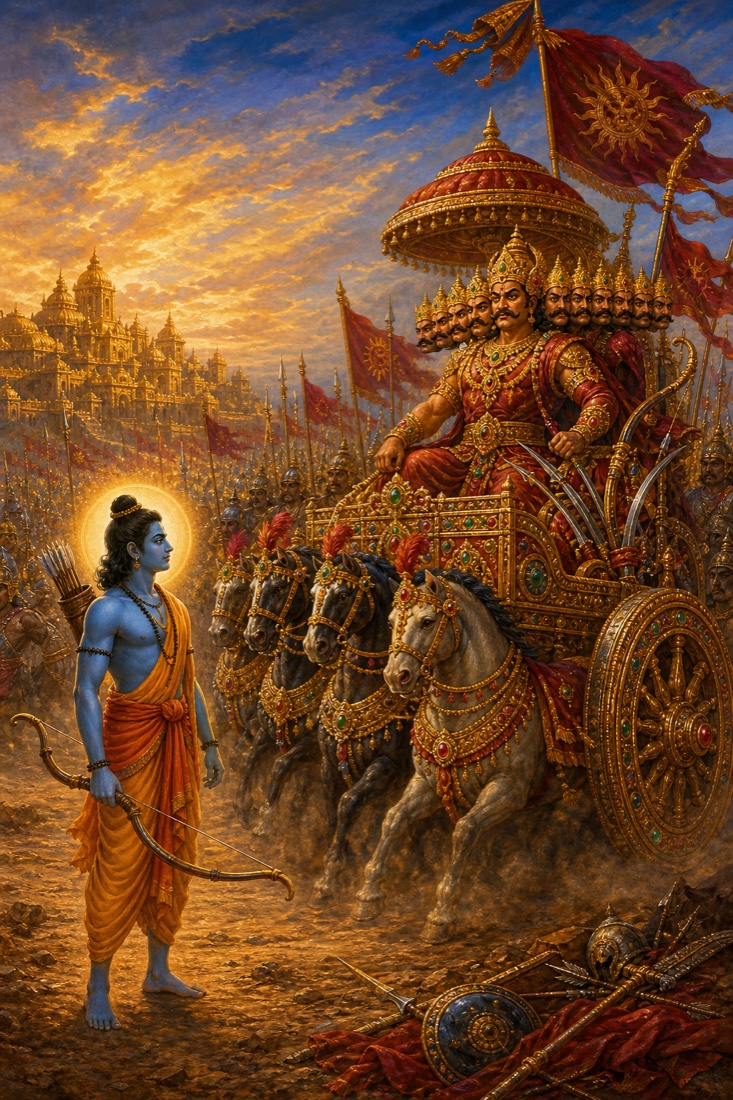
The scene is this. Lanka is Ravana’s kingdom. Vibhishana is Ravana’s younger brother, now on Rama’s side. Both armies have already raised their war cries and closed with each other. Ravana rides his chariot, and with him comes an army of chariots and mounts under banners and flags of many colors. And Rama stands on the bare earth on foot, no chariot, no armor, not even sandals on his feet.
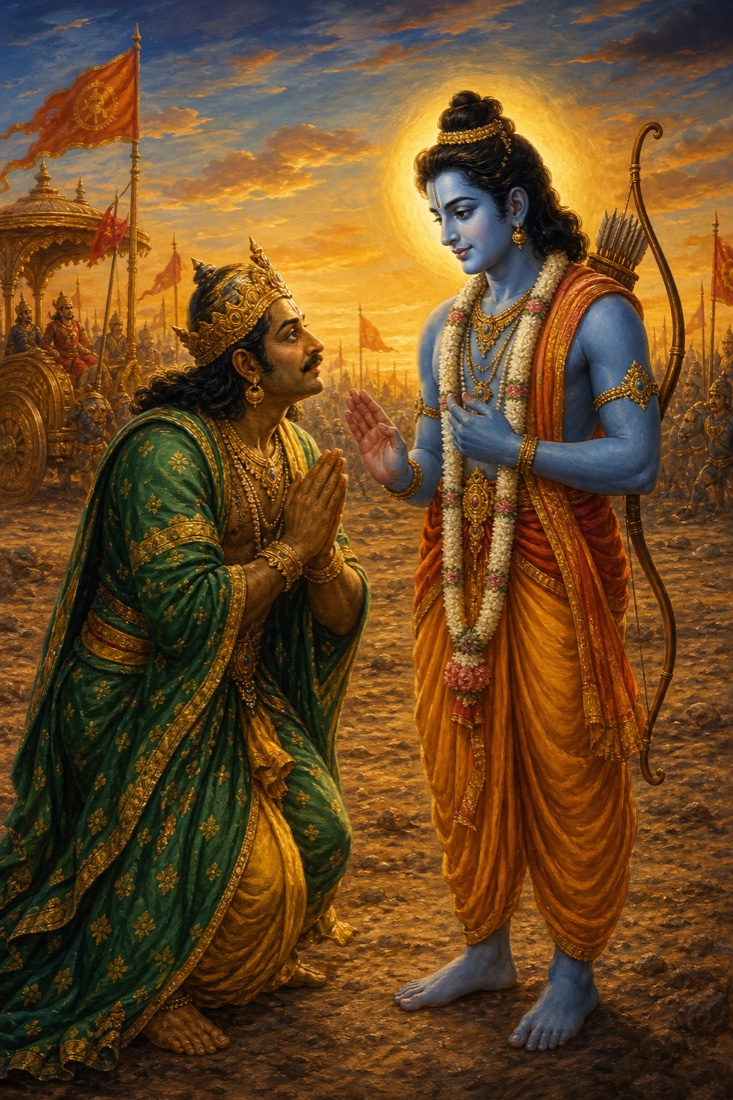
Vibhishana’s mind wavers. Tulsidas names the cause himself: his love is too great, and out of that love the doubt rises. He comes near to Rama and asks with great respect, “Lord, you have no chariot, no armor to guard your body, no shoes on your feet. By what means will you conquer so strong a warrior?”
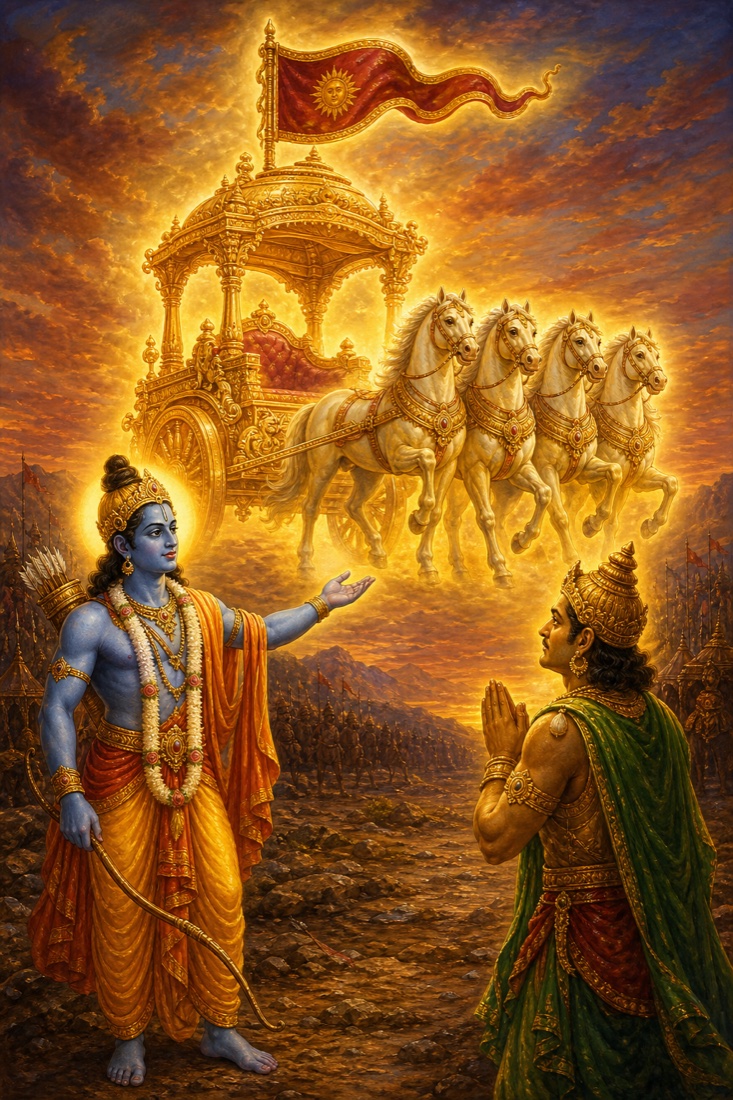
The question is guileless, risen from an innocent heart. Rama, the treasure of compassion, answers without a trace of displeasure. “Listen, friend,” he says, “the chariot that brings victory is of another kind entirely. Its wheels are valor and fortitude, its flag and banner are truth and good conduct, its four horses are strength, discernment, self-control, and care for others.”
This metaphor of the chariot of dharma unfolds across eleven chaupai lines of the Lanka Kanda. Every part of the chariot, every wheel, every weapon stands as the symbol of some virtue. Here dharma comes down to the ground of living, closer to daily life than to the heights of philosophy. Contentment for a sword, charity for an axe, intellect for a lance, higher knowledge for the bow, and calm, restraint and observance for arrows: these are named as the true weapons.
We have divided it into six parts. Each part centers on one theme, and each takes Tulsidas’s Awadhi chaupais one by one, in a plain-English rendering with commentary.
Six Parts
Tulsidas’s chaupais in English, with commentary.
Frequently Asked Questions
Where does the name “Vibhishana Gita” come from?
The title is a later one; Tulsidas gives the passage no name of its own. Vibhishana is the one who receives the teaching, and so it came to be called the “Vibhishana Gita.” But this dialogue is brief, nothing like the long discourse the word Gita suggests.
How long is it?
Eleven chaupai lines and two dohas. In the Lanka Kanda of the Ramcharitmanas, after doha 79, once the war between Rama and Ravana has begun. Five to ten minutes to read in full.
Is it only the metaphor of the “chariot of dharma”?
Mainly yes, though along with the metaphor there is the whole conversation too. Vibhishana’s question, Rama’s answer, and at the end Vibhishana’s feeling. The episode is complete in itself.
Is it only for war, or for everyday life?
For life itself. This “chariot” of Rama is needed in the mind of every person. Every hardship is a “war,” and every person must array their own chariot of dharma themselves.
Is this Vedanta, or bhakti?
Something apart from both. Here dharma is at the center, the ground of conduct, moral strength, and inner firmness. Even so, the ending comes to rest in the feeling of bhakti, because Tulsidas’s vision is always turned toward devotion to Rama.
Read alongside
- The Rama Gita Rama’s Vedanta teaching given to Lakshmana.
- The Bhagavad Gita The teaching of self-knowledge given on the field of battle.
- The Hanuman Chalisa Tulsidas’s hymn of devotion to Rama.
Vibhishana’s story in Valmiki
- Chapter 23 · Vibhishana Takes Refuge
Valmiki Ramayana: Vibhishana takes refuge