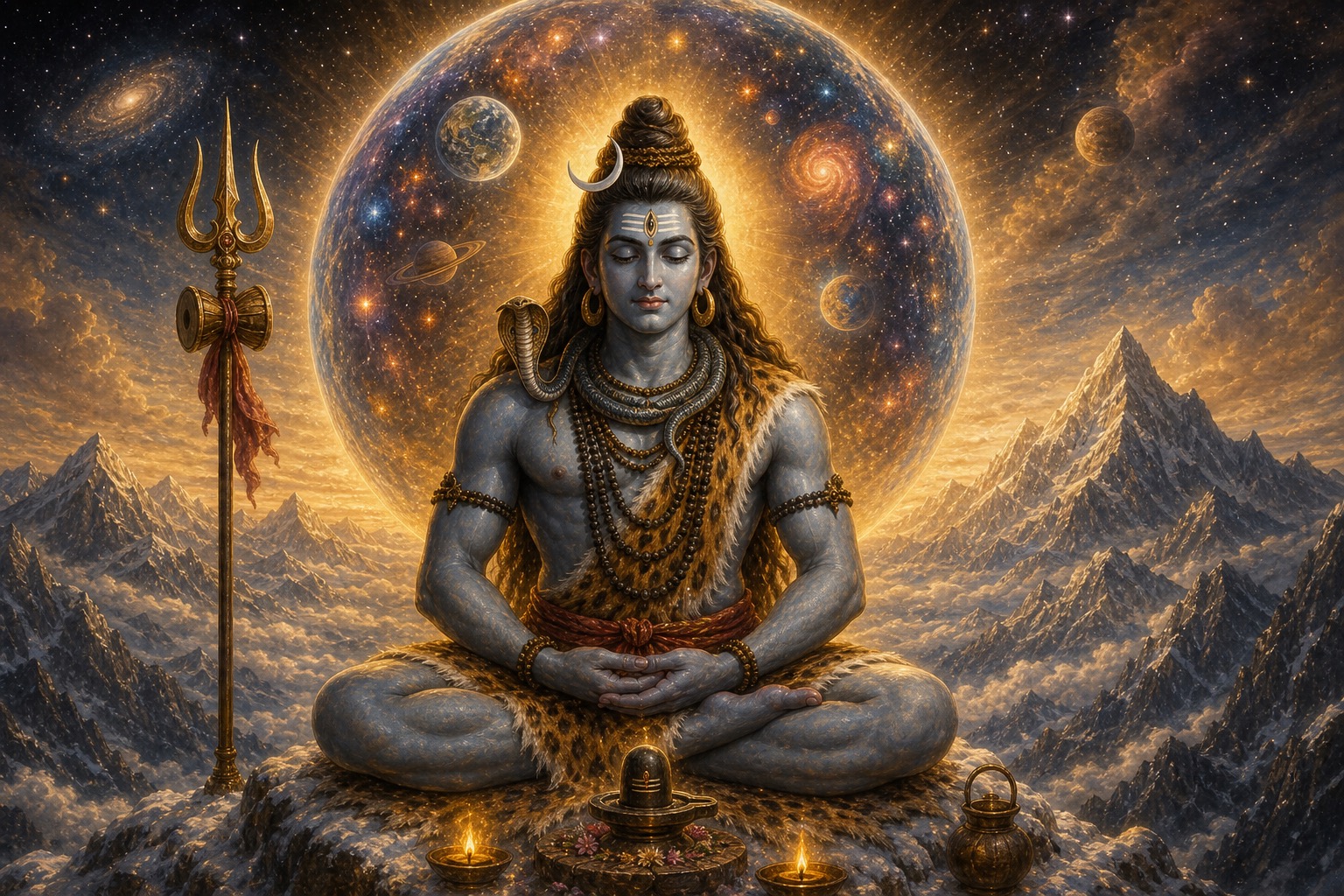
Picture an assembly of sages, where amid smoke, kindling wood, and a deep silence a handful of brahmavadis (thinkers on the trail of Brahman) turn a single question over and over. The question is not a small one. They ask what the root cause of all this vast unfolding finally is, where we arose from, on whose strength we draw breath, at whose signal pleasure and pain arrive at our door, and in whom, at the end, we come to rest. From this very assembly the Shvetashvatara Upanishad opens, and in its first breath it sets us on the threshold beyond which there is only the search.
The temper of this Upanishad
This Upanishad comes from the Krishna Yajurveda and flows through 6 chapters. Many other Upanishads only gesture toward that supreme reality, keeping it formless and past all name and shape. This Upanishad does something more. It gives that one being a face, a heart, and a name, and brings it before us: Rudra, Ishvara, Hara, Maheshvara. Here, for the first time in any Upanishad, the word blossoms that the whole tradition of devotion will later breathe by, and that word is bhakti (devotion). The teaching, it is said, came to the saint Shvetashvatara through the strength of his tapas (austerity) and the grace of God, and he handed it down to his students, and this Upanishad took its name from him.
The very first question: who is the cause?
The very beginning is a question held still, and hearing it the mind pauses for a moment.
किं कारणं ब्रह्म कुतः स्म जाता जीवाम केन क्व च सम्प्रतिष्ठाः।
That is: what is the root cause, from what were we born, by what do we live, and in what do we abide. Here the Upanishad hands over no answer in a hurry. One by one it sets out all the answers that circulated in that age, that perhaps kala (time) alone fashions everything, or svabhava (the inherent nature of things), or niyati (a fixed fate), or yadriccha (mere chance), or the panchabhuta (earth, water, and the other elements) are the root. And one by one it shows that no single one of these stands as the full cause of this conscious world, since behind all of them too something is needed to bind them and drive them. Then those seekers, who had gone down into the depth of meditation, catch a glimpse.
ते ध्यानयोगानुगता अपश्यन् देवात्मशक्तिं स्वगुणैर्निगूढाम्।
Through the yoga of meditation they saw that devatma-shakti, the very power of God that sits hidden behind the veil of his own attributes. This is the Upanishad’s first great pointing: the cause of the world is the power of a conscious being. Bare time will not account for it, nor will bare chance. Inner meditation lays hold of it where outer argument cannot reach.
Two birds on one tree
Now the Upanishad draws an image that settles into the mind the moment you hear it.
द्वा सुपर्णा सयुजा सखाया समानं वृक्षं परिषस्वजाते।
Two birds, close friends, forever together, are perched on a single tree. One bird tastes the fruit of that tree, now sweet, now sour, and keeps sinking and surfacing in their flavor. The other bird eats nothing and only watches, serene. This tree is our own life, the fruit is the experience of pleasure and pain, the bird tasting the fruit is the jiva (the self bound within a body), and the bird watching in silence is that same supreme God, seated within us as the witness. The Upanishad says that so long as the jiva stays tangled in the taste of the fruit, it thinks itself helpless and goes on grieving. The moment its gaze falls on that other bird, on the glory of that God, in that same moment all its grief drops away.
Maya, prakriti, and the magician
Then the Upanishad says something that would become the foundation of all Vedanta to come.
मायां तु प्रकृतिं विद्यान्मायिनं तु महेश्वरम्।
That is: know this prakriti (the root substance of all creation) as maya, and the magician who fashions and works that maya as Maheshvara. As a skilled conjurer is never bound by his own trick, so Maheshvara fashions all this unfolding by his power and stays uncaught within it. And the Upanishad adds that this entire visible world is filled with him in the form of his own parts, with no corner left empty of him. This distinction between prakriti and purusha (the conscious principle), and the one God seated above them both, is the framework of this Upanishad.
The One, hidden in all
This Upanishad calls that one being by the name Rudra, and says plainly that he is alone, that no second stands equal to him, एको हि रुद्रो न द्वितीयाय. He is the one hidden within all living beings.
एको देवः सर्वभूतेषु गूढः सर्वव्यापी सर्वभूतान्तरात्मा।
One God, concealed in all beings, spread through every place, the inner atman (self) of every creature, the witness of all deeds, pure consciousness, and beyond all attributes. He is so subtle that the eye cannot catch him, and so vast that nothing is left outside him. And here comes the most resounding line of this Upanishad, that apart from knowing this supreme purusha there is no other road that crosses beyond death.
तमेव विदित्वातिमृत्युमेति नान्यः पन्था विद्यतेऽयनाय।
Knowing him alone, a person steps across death; toward liberation there is no other path than this.
The method of sitting, of turning inward
But how does that hidden being come within reach? The Upanishad does not stop at lofty talk; it also gives the method of sitting. It says to hold the three upper parts of the body, the chest, the neck, and the head, straight and level, to still the rest of the frame, and with the help of the mind to turn the senses toward the heart. Choose a place to sit that is clean, level, far from gravel and noise, pleasing to the eye, and sheltered from sharp gusts of wind. As the meditation deepens, it is said, certain glimmerings rise within, at times like mist, at times like smoke, at times a flash like the sun, fire, a firefly, lightning, crystal, or the moon. All of these are only the early waystations of that inner journey, and not its destination. The destination is that one alone, and knowing it, all grief and all bondage collapse.
And at the last, bhakti
And here, in the last chapter of this Upanishad, comes the moment for which it is forever remembered. All the search, all the reasoning, all the meditation takes a tender turn, and before us stands bhakti.
यस्य देवे परा भक्तिर्यथा देवे तथा गुरौ। तस्यैते कथिता ह्यर्थाः प्रकाशन्ते महात्मनः॥
The great soul in whose heart there is supreme devotion for God, and the same devotion for his own guru as for God, within that soul all these hidden meanings unfold and shine of their own accord. Notice this: the Upanishad does not hand these mysteries to mere reading and rereading. Where the heart fills with love, knowledge comes down of its own accord as light. In this same spirit the Upanishad, at one place, joins its hands and says that the God who at the dawn of creation shapes the creator and hands him the Veda, into his refuge, carrying the longing for liberation, we surrender ourselves.
So the Shvetashvatara Upanishad does more than tell us who the cause is. It takes us by the hand and leads us all the way to the heart of that cause, and arriving there, reason falls silent, and only love and surrender remain. The day that watching second bird appears within you, and this same supreme devotion wakes toward it, on that day the fear of death is left behind, and the immortal one, who had always been seated within you, opens in his full light.
Source: the Shvetashvatara Upanishad.