Moha-mudgara, the hammer that shatters delusion
Adi Shankaracharya’s dvadasha-manjarika, the lines of fourteen disciples, and Shankara’s closing
First, one thing
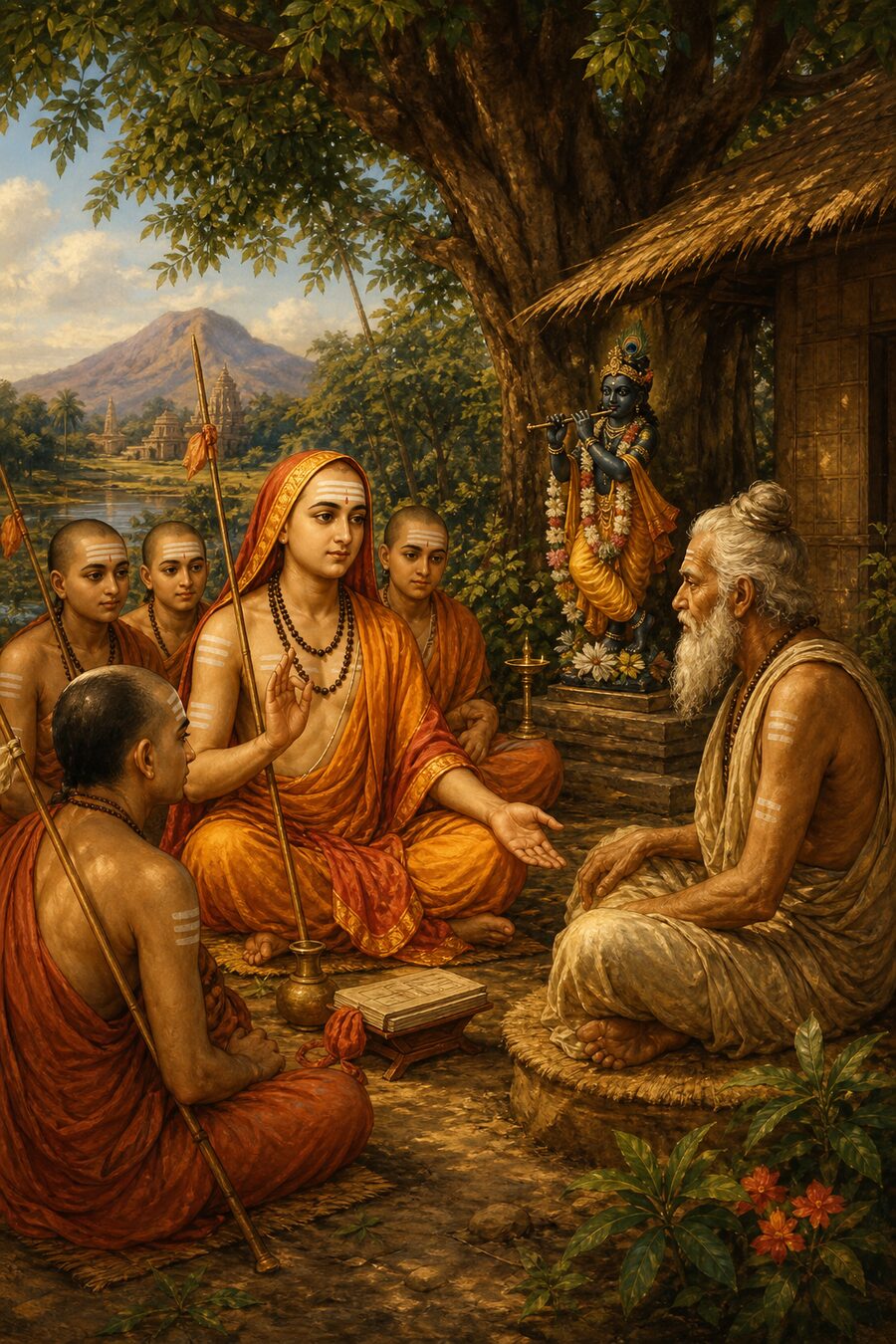
Shankaracharya was walking the lanes of Kashi, the city people come to when they mean to die well. Through some doorway the sound reached him. An eighty-year-old pandit sat in his room repeating “dukrin karane, dukrin karane” (the root kri, in the sense of doing) over and over. It is a root-rule from Panini’s grammar, the kind children drill by rote in their first year of study. Shankara stopped and watched him, an old man with very little time left, still grinding through the rules of grammar as though the grammar would be waiting at the end to meet him. Tradition says that Bhaja Govindam took shape in that very moment. The warning lands in the very first line: when death arrives, your dukrin-rules will save nothing.
At first it reads as harsh. This is a harshness that rises from tenderness, like a guru’s whip, raised by the one person in the room who wants nothing from you. Shankara called it the moha-mudgara, the hammer that shatters delusion, and a hammer is an honest name for it, since nothing here is built to be admired. It is built to break something. The work comes in three parts. The first twelve shlokas (the dvadasha-manjarika) are Shankara’s own, the middle fourteen belong to his disciples, and the last few return to Shankara. Behind every shloka sits a psychological observation: the separate distractions of child, youth, and old man, the pride of wealth and woman and youth, the conditionality of family attachment, and the gap between outer costume and inner dispassion.
How to read this
One way: the whole work in a single sitting, a focused reading of sixty minutes, taking the hammer in one continuous run of blows. A second way: one shloka a day, a vow of thirty-three days, ten or fifteen minutes on each shloka until its secret opens. A third way: the refrain alone, bhaja govindam bhaja govindam govindam bhaja mudhamate, again and again, the way you would a mantra, letting the sound work on you first, and then one day you look at the meaning.
The seed of the whole work sits in the very first line. Sing to Govinda, foolish mind, because when the hour of death draws near, the rules of grammar will not save you. Mudhamate, he calls the listener, foolish mind, and the word is pointed at whoever happens to be reading. This is the signature line that returns in every refrain. After it, Shankara lays a hand directly on an old habit of the mind, the thirst to earn wealth. He asks you to settle your mind in whatever your own work brings, nija-karma, what your own hands have already earned, and to learn contentment as an art, with no call to poverty in it at all.
Shlokas 1-2 · The hammer’s first blow
Now Shankara turns toward the impermanence of the body and of life. Do not drift into infatuation at the sight of a woman’s body; all of it is a modification of flesh and fat; see this in your mind again and again. This is a severe anatomy-meditation addressed to the renunciates of the eighth century, close to the ashubha contemplation of the Buddhist tradition. And then the lotus-leaf image, which belongs to anyone who has ever stood at the edge of a pond in the rain: water falls on the leaf, gathers into a bead, rolls once, and is gone, and the leaf it sat on is dry. Life is that unsteady, and the whole world is gripped by disease, pride, and grief.
Shlokas 3-4 · Body and the flicker of life
Here Shankara opens the truth of family attachment, laying blame on no one, only observing. As long as you are busy earning wealth, the people of the house stay bound to you; later, when only an aged body is left, no one so much as asks after you. And the next shloka is the last stage of this same movement: as long as breath remains in the body, they inquire after your health; the moment the breath departs, that very body, precious a moment ago and fussed over and held, becomes a corpse, and even the wife who lay beside it begins to fear it. One breath is the entire distance. This is a merciless record of the transactional reality of relationships.
Shlokas 5-6 · The terms of kinship
Now a plain picture, each age with its own distraction, and the pattern only shows itself when the three are set side by side. The child is lost in play, the young man in a young woman, the old man in worry. A whole life passes that way, absorbed the entire time, and no one rests in the supreme Brahman. Right after this he sets down the five root questions that begin every true seeker: who is your wife, who your son, how strange this world is, whose are you, who are you, from where have you come. Bhratah, he says, brother, and after all that hammering the address arrives gently. Reflect on these very principles.
Shlokas 7-8 · The tangle of every age
Now the most famous shloka of the work, in which Shankara binds the whole of practice into a single ladder. From good company comes non-attachment, from non-attachment comes freedom from delusion, from freedom from delusion comes the stillness of truth, and from that stillness comes liberation while still alive. Each rung is cut from the one beneath it, and the entire Advaita program stands there in eleven or twelve words. Alongside it come four parallel questions: once youth has passed, what desire remains; once the water has dried, what pond; once wealth has dwindled, what family; once truth is known, what world. Every dependence rests on a condition, and after the knowledge of truth no world is left at all.
Shlokas 9-10 · The ladder to liberation
The dvadasha-manjarika closes on pride and on time. Take no pride in wealth, in people, in youth; time carries everything off in a single moment; this whole spread is made of maya; know it and let it go, and enter the state of Brahman. And then the beautiful wheel of time: day and night, evening and morning, winter and spring return again and again, each arriving exactly as it arrived last time, while time keeps playing and the lifespan runs down. And still the wind of hope will not loosen its grip. This word asha-vayu is like empty air, nothing you could close a hand around, and it holds us bound all the same. Here Shankara’s own twelve shlokas come to an end.
Shlokas 11-12 · Pride and the wheel of time
Now the disciples’ lines begin. The first is held to be Padmapada’s: why this worry over woman and wealth, madman, have you no ruler over you at all? In all three worlds, the company of the good is the one boat that carries you across the ocean of existence. Then a sharp blow at outer garb, and it lands on every holy costume of the age at once: you may wear matted locks, you may be shaven, you may have your hair plucked out, you may drape yourself in ochre, you may put on many costumes, and still the one who sees yet does not see is a fool, because all this dress is for the belly. Outer show cannot take the place of inner realization.
Shlokas 13-14 · Company and the costume of pretense
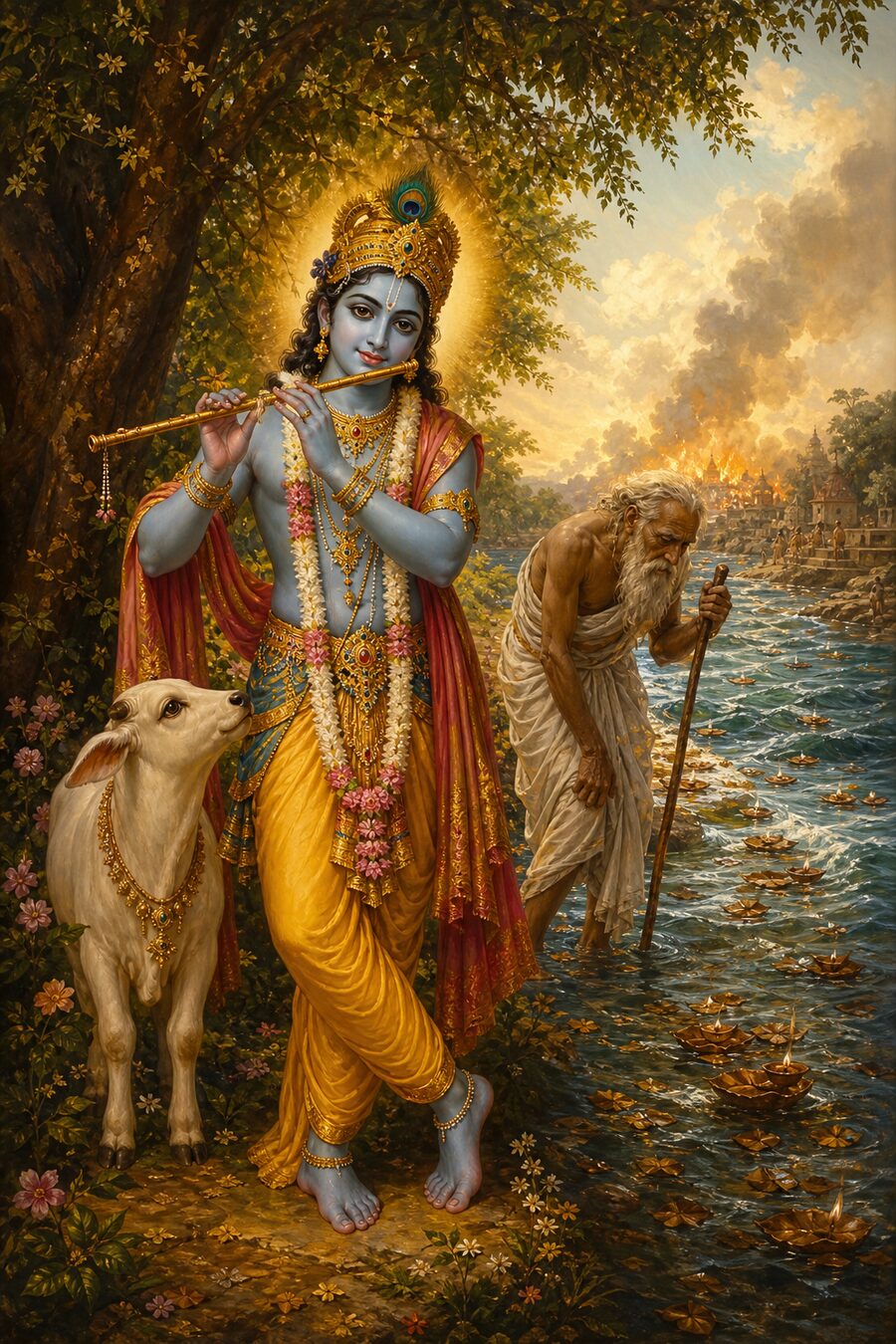
Two shlokas dwell on the aging body and the stubbornness of inner hope. The limbs go slack, the hair turns white, the mouth loses its teeth, the old man walks leaning on a stick, and even so the lump of hope will not let go. Even a renunciate with fire in front of him, the sun at his back, his chin resting on his knees through the night, alms in his palm, his shelter under a tree, cannot loosen the noose of hope. Everything a man can put down, this one has put down, and the noose is still around his neck. Outer renunciation is easy; renouncing inner hope is hard.
Shlokas 15-16 · Hope that will not let go
Now the question of knowledge against ritual. One may make the long pilgrimage to Gangasagar, keep vows, give in charity, and without knowledge, by any doctrine you like, liberation does not come even in a hundred births. Shankara is immovable on this point: pilgrimage and charity are good, and they are not enough, and a hundred births is how long he is willing to wait for you to notice. And on the opposite side, the pleasant face of dispassion: a dwelling in a god’s temple or at the root of a tree, the ground for a bed, a deerskin for clothing, the giving up of all possession and enjoyment, whom does such dispassion fail to make happy. True renunciation is a joy, and no torment at all.
Shlokas 17-18 · Knowledge and true dispassion
Now the most inclusive note in the work. Absorbed in yoga or in enjoyment, in company or alone, the one whose mind delights in Brahman is glad, is glad, is glad indeed. The verse says it three times, nandati nandati nandatyeva, and the repetition is the argument. Outer form does not matter; when the inner turn is toward Brahman, joy arrives on its own. And with this, the glory of the Gita and the Ganga: whoever has read even a little of the Bhagavad Gita, drunk even a drop of Ganga water, offered even a single worship to Murari, has no dispute with Yama. After all the hammering, this is a tone of encouragement. Even a little is enough.
Shlokas 19-20 · The inner turn, a touch of the Gita
Now Shankara’s devotional side opens, the side so often forgotten by those who quote him. Birth again, death again, again a sleeping in the mother’s womb; in this world so terribly hard to cross, save me by your boundless grace, Murari. The man who has been swinging the hammer for twenty shlokas is now asking to be carried. This cry belongs to a devotee, with none of the dry Advaitin in it. Along with it comes the image of the avadhuta: dressed in a patched cloak stitched from scraps of cloth picked up off the road, on a path beyond merit and sin, the yogi whose mind is set on yoga delights like a child or a blissful madman.
Shlokas 21-22 · The cry and the avadhuta
The same root question returns, in slightly new words. Who are you, who am I, from where did I come, who is my mother, who my father; reflect on these in depth; this whole universe is without substance, a dream-like notion; let it go. This repetition is deliberate; without being raised again and again, these questions do not hold in the mind, and a question you answer once is a question you have not really asked. Then Advaita is brought down out of the heights and into the room where people quarrel: in you, in me, everywhere there is one and the same Vishnu; do not rage at me in vain, do not be intolerant, stay even-minded everywhere if you want Vishnu-hood soon. Anger at others is anger at your own true nature.
Shlokas 23-24 · Who am I, and the one Vishnu
That same current of Advaita brings down the walls between relationships still further, and it takes the peacemaking down with the quarreling. With enemy, friend, son, or kinsman, make no effort at quarrel or at truce; see the atman in all of them; from every side let go of the ignorance of division. Then a pointing toward the inner enemies, the four that do the real damage: giving up desire, anger, greed, and delusion, reflect on the atman, who am I. Those without knowledge of the self, the fools, go on cooking in the deep pit of hell.
Shlokas 25-26 · Letting go of division, the inner enemies
Now four solid acts, worth doing every day, and after so much dismantling it is a relief to be handed something to do. Sing the Bhagavad Gita and the Vishnu Sahasranama, meditate without pause on the form of Shripati Vishnu, carry the mind into the company of the good, and give wealth to those in need. After this the same old cycle opens again: pleasure is enjoyed, then disease enters the body, and though in this world death is the final refuge, still a person will not give up sinful conduct. Behind the repeating and repeating lies this one worry, that the lesson does not settle in the mind.
Shlokas 27-28 · Acts worth doing, and the same old cycle
A deep critique of wealth and a practical blueprint of practice arrive side by side. See wealth always as a source of ruin; from it not even a fraction of true happiness comes; the wealthy man carries a fear even of his own son, watching the one person who should be safest in the house; this is the fixed custom everywhere. Then the tools of practice: pranayama, pratyahara, the discernment of the eternal from the fleeting, the discipline of samadhi together with japa; do all of this with great care, with full attention. Here Shankara’s Advaita and Patanjali’s yoga come into a single frame.
Shlokas 29-30 · The fear in wealth, the tools of practice
Now the work moves toward its close. Become a whole-hearted devotee at the lotus feet of the guru, be freed from the world soon, and through the restraint of the senses and the mind alone, see the deity seated in your own heart. Here the three threads bind together: devotion to the guru, restraint of the senses, and the deity within the heart. Then a meta-shloka that folds the work’s own birth-story back into it, closing the circle on that room in Kashi: that foolish grammarian who had been drowning in the study of dukrin, once the disciples of the revered Shankara Bhagavatpada explained things to him, had his senses made pure. The hammer found its mark after all.
Shlokas 31-32 · The guru’s feet and the work’s own story
And at the end the same first line returns, unchanged, though the reader who reaches it now is no longer the reader who met it in Kashi. Sing to Govinda, foolish mind, because apart from the remembrance of the name we see no other means of crossing the world. After all the philosophical intricacy, all the anatomy and the arithmetic of hope, Shankara comes to rest on this one simplicity: a single solution, a single refuge.
Shloka 33 · The same call, one last time
Read alongside
- The Bhagavad Gita which this very work tells you to sing
- The Vishnu Sahasranama whose chanting of the names is suggested here
- The Yoga Sutras of Patanjali the original source of pranayama and samadhi
- The Ashtavakra Gita the thread of the koham, the who-am-I question
- The Ganesha Atharvashirsha a companion text in the hymn tradition