The Brihadaranyaka Upanishad

बृहदारण्यक उपनिषद्
Shukla Yajurveda · Upanishad
A vast text composed in the forest, and the encounters inside it where, for the first time, a voice said, “I am Brahman.”

Picture northern India some twenty-five or thirty centuries ago. In those days the deepest questions of life and death were not settled in books. They were settled in open assemblies and in forest huts. Kings staged contests of knowledge in their courts, the great scholars sat facing one another and took each other’s measure, and whoever left everyone with nothing to say walked off with the prize. The hero of such contests was Yajnavalkya, one of the most fearless minds of his age, a man who could silence a full assembly single-handed.

The name of the text tells you its temperament. Brihat means vast, aranyaka means a text of the forest, so the whole is a vast text composed in the wilderness, drawn from the closing portion of the old Shatapatha Brahmana. It falls into three kandas. This Upanishad does not ask how the world was made. It asks what is left when everything is taken away, who it is that is seeing, hearing, thinking. In that search, here, for the first time, the sentence was spoken that the whole later Vedanta tradition would keep repeating, अहं ब्रह्मास्मि, I am Brahman. And with it the method too, नेति, नेति, not this, not this.

The main figures of this Upanishad

Yajnavalkya: the towering rishi of that age, King Janaka’s court philosopher, and the founder of the Shukla Yajurveda tradition. He loses no debate.

Janaka: king of Mithila (Videha), who ran a kingdom and was also besotted with the knowledge of Brahman, and who convened assemblies on exactly these questions.

Maitreyi: Yajnavalkya’s wife and a brahmavadini, a woman given over to the search for Brahman. His other wife, Katyayani, was an ordinary householder, at home in the world of house and family.

Gargi Vachaknavi: the one woman scholar in Janaka’s assembly, whose questions the greatest learned men preferred to sidestep.

Uddalaka Aruni and Shakalya: two more formidable teachers in the assembly, who closed in on Yajnavalkya.

Prajapati: the creator, who taught gods, humans, and asuras, all three, from a single syllable.

Madhu Kanda · Chapters One and Two

Before creation, and the first word, “I am”

In the whole Brihadaranyaka, the fourth section of the first chapter is, in Swami Krishnananda’s reading, the very heart of that chapter. It is called the Purushavidha Brahmana, the account of creation in the form of a Purusha, and here the Upanishad tells the entire story of creation, from the supreme truth at the top down to the smallest and humblest creature below. Swami ji says this story reaches past any outside world and becomes the story of all of us, because “you,” “we,” and every living being are folded into this same creation.

So the question stands: in the beginning, when nothing at all existed, what was there? There was no world then, no person, no stir of movement. Even so, Swami Krishnananda says, “something” was there. That “something” was the atman, the original nature of everyone, pure being alone, sat, existence and nothing more. That alone was, and beyond it not even the idea of anything else was possible. This is the truth the Upanishad will later call सत्यस्य सत्यम्, the truth of truth itself.

But Swami ji points to a delicate thing. This pure “being” is so formless that the moment you sit down to think of it, it seems like “nothing at all.” To grasp the cause of creation the mind needs some handhold, and so the Upanishad calls it “Purushavidha,” meaning the supreme cause is taken to be like a “person.” We think of God as the supreme Purusha, the highest person, Swami Krishnananda says, for one reason only: the human mind has no living handhold higher than humanity itself. So the deepest form of our own mind, extended to infinity, is taken as the shape of that cause.

The primordial cosmic Purusha awakening alone in a luminous void before creation, a radiant golden anthropomorphic figure with eyes just opening, the first word 'I AM' glowing around him, classical Indian temple-mural style.

Now that supreme Purusha woke to himself. But awareness of whom? Only of himself, since outside him there was nothing at all. Swami ji says he was neither man nor woman, and he knew of no one but himself, because there was no “anyone else” to be found. And the instant he woke, the first thing he knew was, “I am,” अहम् अस्मि. This was the first consciousness, not “you are,” not “he is,” not “this is.” It was that primordial “I,” Swami Krishnananda explains, the pure, all-pervading “I,” free of the small ego-“I” that clings to a body. And this eternal “I” would later shine inside every tiny creature as its own “I.”

This is why, Swami ji says, even today when someone knocks at a door and the person inside asks “Who is it?”, the answer comes back, “It is I.” The name comes afterward; first there is only “I.” The way each person grasps himself as “I” is an echo of that original “I.” And notice, we love this “I” more than anyone or anything else; everything else too seems dear only because it guards this “I,” only for its sake. The day this “I” departs, everything departs with it. For this reason अहम्, “I,” is the true name of God, Swami Krishnananda says, because God is nothing other than pure self-consciousness. This “I am” becomes the root of अहं ब्रह्मास्मि, I am Brahman.

Now why was he called “Purusha”? Swami ji opens the marrow of the word. A Purusha is one who has burned up the sin of externality, the sin of there being any “other” outside. The one evil spoken of here is the only real evil there is, and that is externality. When there is no “other” outside at all, there is no fear and no evil; all fear and all pull are children of this externality. Whoever takes that “other” to be real, in him a craving for contact awakens, and in that craving his power keeps leaking away. But that supreme Purusha was whole and complete in himself alone, so nothing remained outside for his power to flow toward. Swami Krishnananda gives the assurance that “one who knows thus,” य एवं वेद, can become just like this. No one can stand against such a Purusha, no one can contend with him; he becomes unconquerable, power itself in form, because his power never drains away in outward contact.

The gist: before creation there was only pure “being,” and the moment it woke it knew one thing, “I am.” What you seize every day as “I” is a glimpse of that primordial “I.” All fear and all craving come from the “other” we have invented outside ourselves. Whoever returns inward to his own fullness can be contended with by no one, and his power never runs dry.

The contest of the senses, and the cry of “असतो मा”

Having told the full story of creation, the Brihadaranyaka Upanishad now uses a story to open a deeper truth. Two kinds of children of Prajapati, the creator, are locked in conflict, the gods on one side and the asuras on the other. Acharya Shankara, the towering Vedanta commentator, explains that the gods are always fewer in number and the asuras more, meaning that those who chase their raw instincts are many and those who rein them in are few. The gods decided that to defeat the asuras they would take the support of the Udgitha, a chant-mantra of the Samaveda, and that by the power of this chant alone they would win.

Here Swami Krishnananda makes a fine point. These gods and asuras are not creatures somewhere outside; they are two tendencies inside us. The power that joins everything into one is the god, and the power that breaks and scatters is the asura. And the gods of the senses are seated separately in our body: the sun is the god of the eye, the Ashvini Kumaras of the nose, the directions of the ear, Varuna of the tongue, Vayu of the skin, the moon of the mind. Swami ji says the Udgitha chant is no rote muttering of the mouth. It is the joining of one’s own inner sense-power into a single note with the vast power outside. Without that union the mantra simply does not work.

The gods first said to speech, “Sing the Udgitha for us.” Speech rose and began to sing. But the asuras saw through it and struck speech with sin, with corruption. Ever since, speech says good and bad both, words that help and words that wound. According to Swami Krishnananda, speech’s very power to say something evil is the scar of that wound from the asuras. Then in turn the eye sang, and the asuras pierced it too, which is why that same eye sees rightly and wrongly, sees one and the same thing both truly and in distorted form. The ear came, and corruption reached it as well, which is why the ear is an open door through which good and bad alike pour in. The tongue, the nose, and at last even the mind, each rose to sing and each was pierced by the asuras. The gods came to the brink of defeat.

The dark asuras hurling themselves against the serene central life-breath (Mukhya Prana) personified as a steady glowing figure, shattering like a dry clay clod smashing on hard rock and scattering to dust in all directions.

At last the gods spoke to the one joining power within, to the chief breath, the central breath, the life-energy spread through the whole body, “You sing.” The breath began to sing. The asuras rushed at it too, but this time something else happened. The Upanishad says that just as a dry clod of earth strikes a hard rock and is itself smashed to dust while nothing happens to the rock, so the asuras struck the breath, scattered, and flew off in all directions. The gods returned to their true stations. Swami ji explains that the breath belongs to no single sense; it is that one power flowing through the whole system, without which the eye cannot see nor the ear hear. Every sense runs toward its own object, so every sense is a scatterer, and that is why the asuras seize it. The breath runs toward no object; it joins, and so corruption cannot even touch it.

Swami Krishnananda deepens this very point. This breath is really the sutratman, the thread on which all creation is strung like beads, which is also called Hiranyagarbha, the first collective consciousness of the whole creation, and it is the direct form of the self-power seated within us. Our body is made of countless separate cells and organs, and yet we feel one unbroken wholeness inside. Swami ji says this sense of unity is the gift of this breath, and in the end the gift of the atman. The root of our feeling weak inside is this: driven by ego, we have said “my breath, my mind, my senses,” and cut ourselves off from that all-pervading vast breath, as though we had raised a wall. The moment that wall falls, the same energy that flows everywhere begins to flow in us too.

A seeker rising from shadow toward radiant dawn light, hands joined in prayer, the senses-deities (sun for eye, moon for mind) reconnecting to a single cosmic light overhead, illuminated-manuscript devotional style.

So what is the cure? Swami ji says: stop the senses from running toward their objects and turn them back toward their own source. Join the eye back to the sun, see each deity as one limb of the vast whole, the way a small bulb’s wire is joined to a distant power station and the light comes on by itself. And its highest reach is this vision: what appears in front of you is really no “object” at all, because from its own standpoint it too is a subject, a thing that knows itself. In every particle, down to the subtlest particle, this sense of its own being is seated, so in truth there is no alien object anywhere; on every side there is only one consciousness. At this very turn the world-famous prayer of this Brahmana rises, असतो मा सद्गमय, तमसो मा ज्योतिर्गमय, मृत्योर्मा अमृतं गमय, lead me from the unreal to the real, from darkness to light, from death to immortality. It is the cry of that same journey, from scatter to unity, from the contest of the senses toward that center no corruption can touch.

The gist: the senses lose because each one runs toward its object and scatters us, and corruption grips only what is scattered. The inner center that joins all, the breath, stays untouched. The practice is simply to turn the running senses back toward their source, and then “असतो मा सद्गमय” stops being a rote chant and becomes the natural cry of that homecoming.

Madhu-vidya: everything is the sweetness of everything else

There is a strange story behind this teaching, and Swami Krishnananda begins right here. The Madhu-vidya, the secret knowledge that every thing is the sweetness of every other, was so guarded that Indra, king of the gods, wanted it kept to himself and reaching no one else. He had told his guru Dadhichi, that is, the rishi Dadhyan Atharvana, an ascetic teacher of the Atharvaveda line, “If you teach this to anyone else, we will cut off your head.” Such a strange pupil he was, and the guru held his peace.

The twin Ashvini-Kumara physicians fitting a white horse's head onto the seated sage Dadhyan (Dadhichi) while his true human head rests safely aside, the horse-mouth about to speak the secret Madhu-vidya, jewel-toned classical painting.

Then the Ashvini Kumaras, the twin physician-gods of heaven, came longing for this knowledge and said, “Teach us the Madhu-vidya.” The rishi said, “Do you know the danger in it? Indra has threatened that the moment I teach it my head is gone.” The Ashvini Kumaras devised a clever plan. “Do not worry. First we will lift off your real head and keep it safe, and fix a horse’s head in its place. Speak the knowledge through that horse’s mouth. The head Indra cuts off in his fury will be the horse’s. Afterward we will set your own head back on.” And that is exactly what happened. The Madhu-vidya came out of the horse’s mouth, Indra cut off that horse-head, and the Ashvini Kumaras returned the rishi his own head and made him whole again.

Whatever the tale, Swami Krishnananda says, its gist is a grand declaration: everything is organically joined to everything else. This joining is living and organic, woven together like the organs of a body, with nothing artificial about it. When we touch one thing, in that instant we touch all. One who touches a table is touching the sun as well. To know one is to know all. It was over this secret that Indra was so enchanted that he wanted to hold it to himself alone.

The Upanishad’s first sentence here is, “This earth is the madhu, the honey, of all beings, and all beings are the honey of the earth.” Swami ji opens it this way: as we suck honey, lick it, enjoy it, and take it into ourselves, so beings soak the earth into themselves, and the earth too takes every being into itself. This is a two-way drinking of sweetness. “Earth” here means far more than this ball of clay; it means the whole physical creation. In the same way water, fire, air, sun, and moon, all the mahabhutas, the five basic elements, hold their own counterparts inside us. The solidity of our body is that same earth, that same sun sees in our eye, our breath is that same cosmic air.

But the real point lies further on. Between these two ends, the vast outside and the person inside, sits a third and higher element: the tejomaya amritamaya Purusha, the luminous, immortal consciousness that gives life to every body. The immortal Purusha seated in the sun and the immortal Purusha seated in the eye, Swami Krishnananda says, are one and the same. A single consciousness joins them both. And then the Upanishad says, अयम् एव स यो’यम् आत्मा, इदं ब्रह्म, इदं सर्वम्, this very one is the atman, this is Brahman, this is all. This atman belongs to no one person; it is the atman of every being. Swami ji sharpens it further: this is the atman that is itself every being. The vast lives on this person and the person on the vast, feeding each other exactly like a mother and child.

Swami ji gives the image of a wheel: as all the spokes meet in the hub, the nabhi, of a wheel, so all beings, all gods, all worlds, all breaths rest in this one atman. And then comes the verse Swami Krishnananda holds to be deeply important, रूपं रूपं प्रतिरूपो बभूव, in every form he appeared as the very likeness of that form. Cast in the mold of a bird, he shows as a bird; cast in the mold of a man, as a man. But why fashion such strangeness? The Upanishad’s answer is, तद् अस्य रूपं प्रतिचक्षणाय, this form is for recognizing him. Swami ji stresses that God did not fashion this world for nothing; every form is a sign of his presence, so that we may recognize the one within every limited shape. Our whole difficulty is this: we see one form and cannot join it to the rest, and it is this separation that drops us into sorrow. To one who sees through his eyes, no contradiction appears and no knot, only one unbroken interconnection.

The gist: everything is the honey of everything else, drinking it and becoming its honey in turn, because inside and out there sits one and the same luminous, immortal Purusha. All this variety of forms serves a single purpose: that the one may be recognized in every form. The day touching one touches all, no contradiction remains, and no loneliness.

Where we vanish to in deep sleep

The scene is the royal court of Kashi. Driptabalaki Gargya, born in the line of Garga, a towering scholar so taken with his own learning that “Dripta,” the proud one, has fixed itself to his name, comes before Ajatashatru, king of Kashi, and announces with great pride, “We will teach you Brahman, the supreme truth behind everything.” The king is delighted by his good will, “How kind of you! Come, let us give you a thousand cows, the way King Janaka does.” But under this courtesy something lies hidden that Gargya does not yet know, that the man now posing as the teacher is the one who has really come to become the pupil.

Gargya offers his definitions of Brahman one by one. “We worship the Purusha who dwells in the sun as Brahman.” Ajatashatru stops him, “Do not speak to me like this.” Then the moon, lightning, space, air, fire, water, the reflection seen in a mirror, and the sound of footsteps coming up from behind, each time Gargya lays his finger on some single form, and each time the king turns it back. Swami Krishnananda calls this whole sequence “the progressive definition of Brahman,” and gives its marrow: Gargya keeps seizing some particular form, a limited, molded shape, while Ajatashatru points to the general being behind each particular, the being that makes the form possible. Do not worship the mirror; worship the “power to reflect” that comes before any reflection. Reach past the shape of the sun to the radiance that is the source of every shine. In Swami ji’s words, “Always go to the one behind, toward the cause rather than the effect.”

Beaten nine times, Gargya falls silent and says, “Now I come to you as your pupil.” Ajatashatru hesitates, because tradition is being turned on its head, a brahmana coming to learn from a kshatriya. Then he takes Gargya by the hand and leads him to a man sunk in deep sleep. The king calls the sleeping man by the very names Gargya had been worshipping, “O white-robed one, O king Soma, rise.” The man does not wake. Then the king shakes him by the hand, and at once he wakes.

Now Ajatashatru puts the real question, “Gargya, this vijnanamaya Purusha, the knowing person made of intellect, which is a human being’s highest wealth, where was it while it slept? And when it woke, from where did it come back?” Gargya has no answer. So the king tells him himself: in sleep this consciousness draws its power back from all the outer doors, from breath, speech, eye, ear, and mind, and returns to rest in that space within the heart, the antarhridaya akasha, the open room of consciousness set in the heart. From outside it looks as if life itself has left. In truth it is lost nowhere; it has drawn back into its own home.

Swami Krishnananda opens the gist of the whole episode at this point. In his reading, when we are awake our consciousness is scattered like a thousand sparks; our “I” spreads into whatever object we know, so in the waking state our true nature is hard to grasp. But in deep sushupti, dreamless deep sleep, the mind returns to the heart-center called Puritat, draws its cord back from the seventy-two thousand hita-nadis, and then king or beggar, child or towering scholar, everyone’s sleep becomes one and the same. Swami ji says this proves the atman is one; in sleep we all return to a single ocean of consciousness, and on waking become our own separate waves again. This is why Ajatashatru chose a sleeping man rather than a waking one to teach.

But there is a catch, on which Swami ji lays special weight. In sushupti we do return to our source, yet we are not conscious there; so we “go like fools and come back like fools,” as though nothing had happened. If we could stay awake even in sleep, at a single stroke we would know that universal being which is the nature of all. In the end Ajatashatru gives the example of the spider and the sparks: as a spider draws its web out of itself and sparks leap from fire, so all breaths, all worlds, all gods come forth from that one atman. That is the “truth of truth,” सत्यस्य सत्यम्, the being behind everything, beside which every being of the world looks borrowed.

The gist: every definition seizes some form, yet Brahman is the being behind every form, the being that makes the form possible. Deep sleep is its living proof. Consciousness does not perish there; it simply returns to its source, to the space within the heart, and in the morning comes out again through the same door. To stay awake and recognize the very home we return to every night without knowing it, that is knowledge.

The conversation with Maitreyi: what use is a thing that cannot make me immortal

Yajnavalkya has reached the turn of life where he must leave the household and take the road to the forest. Tradition calls this sannyasa, walking out and leaving everything behind. Before he goes, as custom requires, he means to divide his savings between his two wives. The elder wife, Katyayani, is an ordinary householder whose heart is set on home and world. The other, Maitreyi, is a brahmavadini, a woman whose mind stays fixed on the search for Brahman, far from wealth and household.

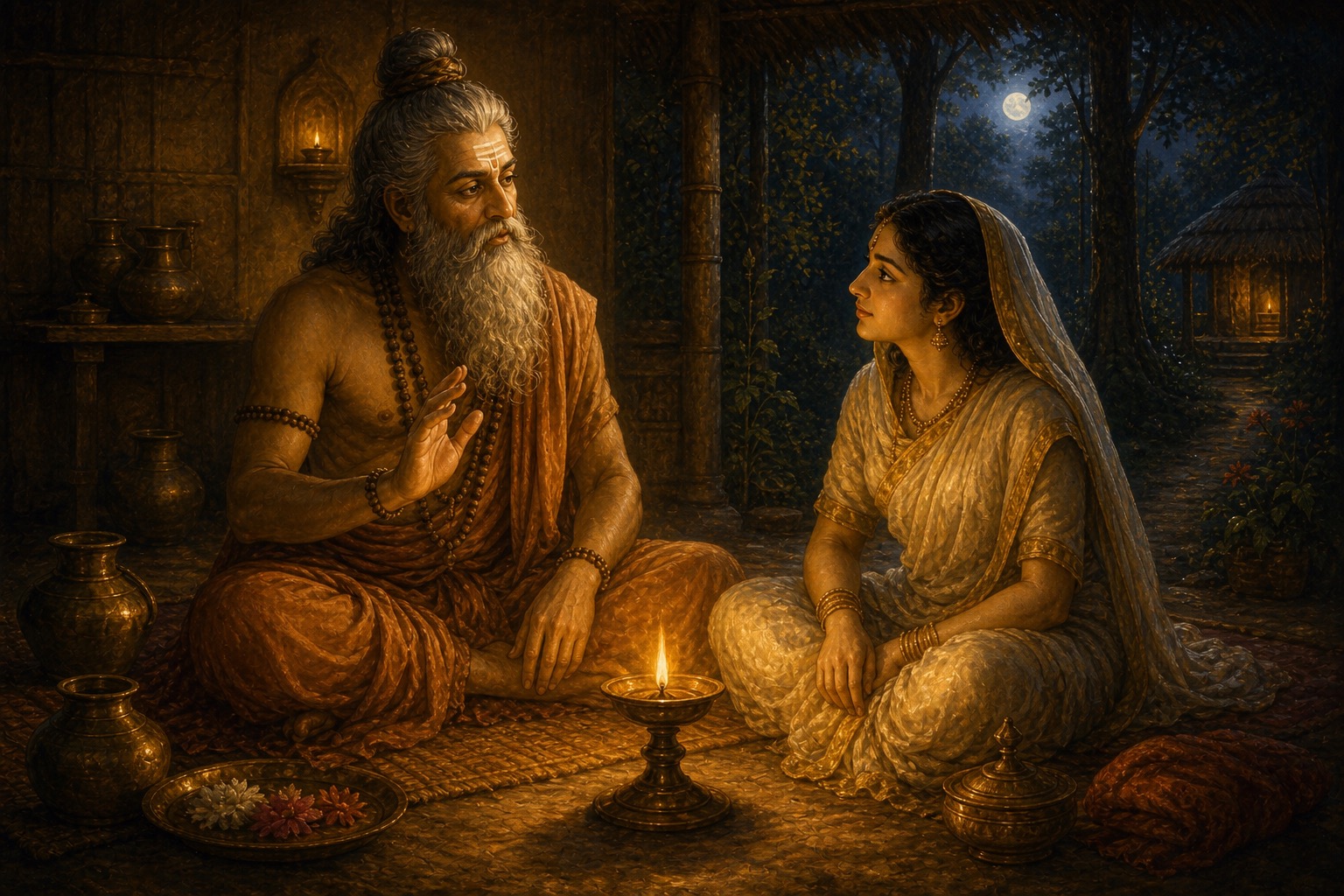
Maitreyi, seated before the renouncing sage Yajnavalkya amid divided heaps of wealth, refusing the riches and earnestly asking for the knowledge of immortality, a quiet hermitage-courtyard scene in warm classical-Indian palette.

Hearing of the division, Maitreyi pauses and puts a plain question, “If this whole earth were to fill with wealth and become entirely mine, would it make me immortal?” Yajnavalkya’s answer is blunt, “No. You might win the comfortable life of the well-provided, but from wealth there is no hope of immortality.” Maitreyi’s reply is the first spark of this whole Upanishad, “What shall I do with a thing that cannot make me immortal? Tell me only what you yourself know.”

Swami Krishnananda takes this conversation to be about the bond between the mortal and the eternal, between what perishes and what never perishes. In his reading “wealth” means far more than money; it means everything that seems to give us something, comfort, honor, status, relationships. All of these lie within the circle of time, and whatever lies within the circle of time one day slips away.

Then he opens a deeper truth. What we appear to love, we truly love for the fullness it seems to promise. This whole world is packed with countless incompletenesses, and each incomplete thing is pulled toward another piece like itself, so that for a while it may feel full. That very pull we name love. But this feeling of fullness is borrowed, and a borrowed thing must one day be returned. Yajnavalkya’s formula is this: whatever you grasp as separate from yourself, as some “other,” will one day leave you, and in leaving will hand you sorrow, because it was never truly yours.

So what, then, is immortal? That which is not separate from you, which no relationship or bargain has fastened on from outside, the atman. Yajnavalkya’s famous saying runs, “The husband is dear for the sake of the atman; the wife, the children, wealth, the gods, all are dear for the sake of the atman that peers out from within them all.” And he gives a full method for reaching it: first hear of the atman (shravana), then dwell on it again and again (manana), then stay drowned in it (nididhyasana). “Know the atman and you have known all,” because it is seated inside everyone.

In the end Maitreyi raises a tangle, “You say this atman is pure consciousness, an ocean of knowing. And then you say that in that state it knows nothing. How can both be so?” Yajnavalkya explains that the tangle sits in her idea of “knowing.” Every knowing of ours is a game of two, a knower and a thing to be known. But in the atman there is no second at all, so no separate act called “knowing” is left there, only the knower remains. For this reason only this much can be said of it, नेति, नेति, not this, not this. Whatever you point your finger at will be a “thing,” and the atman is no thing. It is the seer himself, whom you can never see, because all seeing begins from him.

The gist: what we call love is really a hunger for fullness, which we keep hunting in things. Things give a borrowed fullness, and one day carry it back. The fullness that is not borrowed is you yourself, that very seer whom you can never see, because all seeing begins from him.

Muni Kanda · Chapters Three and Four

Janaka’s assembly, and Artabhaga’s question about death

Now the Brihadaranyaka brings us into the palace of Videha, into King Janaka’s assembly. Swami Krishnananda clears one thing up in advance: “Janaka” is not one man’s name, it is a title, the way “Collector” is an office and no one’s name. According to the Puranas there were sixty-four such Janakas, and each one was a knower of the atman. One of them would later become Sita’s father. The Janaka spoken of here wants to know who in his kingdom knows Brahman, the one supreme truth from which all things come, most deeply of all. Thousands of scholars arrive, but how is the true one to be found?

King Janaka's grand assembly with a thousand fat cows whose horns are tied with ten gold coins each, the sage Yajnavalkya calmly directing his pupil to drive the herd home as stunned scholars look on, opulent durbar painting.

Janaka devises a scheme. He holds a great yajna with lavish gifts, a rite of oblation and giving, where donations are handed out with open hands. Then he sends for a thousand cows, fat and strong and heavy with milk, and has ten gold coins tied to each cow’s pair of horns. In the middle of the assembly the announcement goes out, “Whichever of you scholars knows Brahman most deeply, let him rise and drive these cows away.” Now who will stand up and say, “I am the best”? It was a delicate moment, and everyone kept silent.

Just then the great teacher Yajnavalkya, seated in the assembly, made no claim at all. He called his brahmachari pupil Samashrava and said, “Son, drive these cows to our house.” The assembly was stunned. The brahmanas flared up, “Who is this man to count himself the best of us all? He has insulted us before the whole assembly.” Janaka’s chief hota, the principal priest who recites the Rigveda mantras, was Ashvala, and he took up the fight and challenged him, “Yajnavalkya, so you are the deepest knower of Brahman among us all?” Yajnavalkya answered with humility, “To whoever is truly the greater knower, our salutation. We are only a seeker of cows, a gokama, one who longs for cattle, and so we drove them off.” And with that Ashvala’s volley of questions began.

Ashvala’s first question fell on death itself, “When all this is in the grip of death, how does the one who performs the yajna cross beyond that death?” Swami Krishnananda holds this answer to be very deep. In his reading the marrow of Yajnavalkya’s reply is this: as long as a man thinks himself a separate, cut-off individual, he cannot slip free of death. Swami ji says death is really a hard austerity laid down by the law of truth. We are all stubborn, we assert our separate existence, we push our “I” forward in everything; the name of the punishment for this discord is birth and death. And so, in his reading, wood and ghee for the fire alone will not do; alongside the yajna an inner meditation must run too, in which the hota unites himself with fire, the adhvaryu, the priest who carries out the rite with the Yajurveda mantras, unites himself with the sun, and every priest joins himself to the cosmic deity he serves. Only then does the separation break and the grip of death loosen.

When Ashvala tired, the rishi Artabhaga, a descendant of Jaratkaru, rose up, “Yajnavalkya, we too have a question, since you drove off our cows.” He asks: how many grahas are there, and how many atigrahas? Swami Krishnananda explains, graha, the seizer, means the senses, and atigraha, the one that seizes even the seizer, means their objects. The eye seizes form, and form seizes the eye in return; the two grip each other like a pair of wrestlers, and in that very grinding they one day kill each other. Then Artabhaga asks: everything is food for death, but of what is death the food? Yajnavalkya answers: as fire devours everything and water puts out fire, so the only thing that swallows death is the supreme being, the ultimate reality called Brahman. Without leaning on it there is no release from birth and death.

Now comes Artabhaga’s real, stinging question, “When a man dies, all his parts return to their sources, speech into fire, breath into air, eye into the sun, mind into the moon, body into the earth; then where does the man remain, and out of what does he take birth again?” Here Yajnavalkya stops. He takes Artabhaga by the hand, leads him to a corner, and says, “This is not for the full assembly; let this be known to the two of us alone.” Swami Krishnananda says he kept it hidden because ordinary people would misread its marrow. What the two of them distilled between them was karma. What does not fall away at death is a man’s name and his karma. Swami ji stresses that “karma” here does not mean every little action; its real meaning is the deep, settled tendency of the whole personality that lies inside like a seed. And on that the next birth is decided, “by good karma a man becomes good, by bad karma bad.” Hearing this much, Artabhaga grew quiet.

The gist: death washes everything away, body, senses, and breath all return to their own homes. What stays behind is name and karma, and karma is no ordinary action; it is the deep tendency of our whole mind. So the next birth is molded from it, good out of good, bad out of bad. And the real release from this whole grip comes only when we let go of our separate, cut-off “I” and join that one supreme being, which alone swallows even death.

The ruler seated within: the antaryamin

The round of questions in Janaka’s assembly had barely paused. Gargi Vachaknavi, a woman scholar of sharp mind, had asked her questions and taken her seat. Just then Uddalaka Aruni, son of Aruna and a towering teacher of his age, rose from his seat and picked up the thread with Yajnavalkya, the supreme teacher of King Janaka’s assembly. He told a strange tale. He said, we were staying in the land of Madra, in the house of Patanchala Kapya, for the study and performance of yajna. There a gandharva, a being of a subtle world, had come down upon the wife of the master of the house, and out of her mouth some strange things were spilling.

A vast cosmic thread (sutratman) strung with all worlds, beings, gods and stars like luminous beads on a single string, an unseen inner ruler at its center; sages gaze upward in wonder, mandala-like classical Indian cosmology art.

We asked that gandharva, who are you? He said, we are Kabandha Atharvana. Then, with no one asking, he set a question before the master of the house and all of us: do you know that sutra, the thread, on which this world, the world beyond, and all beings are strung like beads? Patanchala joined his hands, we do not know this thread. The gandharva pressed on, and do you know that antaryamin, the being that sits within and drives everything, who dwells inside and holds all these worlds and beings together, and whose very presence not one of them is aware of? That we did not know either. Then the gandharva said, whoever knows this thread and this antaryamin is truly the knower of Brahman, the knower of the worlds, of the gods, of the Vedas, of all beings, and of the atman of all. Saying this, Uddalaka turned toward Yajnavalkya, we learned both of these from that gandharva. Now you tell us. And if you drove off these cows without knowing them, your head will fall.

Yajnavalkya stayed calm, and said, Gautama, we know this sutra, and the antaryamin as well. Uddalaka broke in at once, anyone can say “I know, I know.” Tell it as you know it, and then we will believe. This very answer of Yajnavalkya’s is the famous Antaryamin Brahmana. First he opened the matter of the thread: this sutra is nothing other than the air, the prana-power, of the whole world, that subtle life-energy in whose mold every body is cast. Swami Krishnananda explains it this way: from outside this same energy looks like the world, and from inside like separate living beings. It is this that holds everyone together, and so long as it stays, the body seems whole and steady.

Swami ji gives a moving example. Why, at the moment of death, do the body’s limbs go slack and hang? Because the prana-power that bound the limbs into one rhythm has withdrawn. In his reading what we call life is simply this all-pervading energy flowing through one particular body. The instant that flow stops, the bricks scatter, and we call it death. Uddalaka bowed his head, this answer is right. Now tell us what the antaryamin is.

Yajnavalkya opened the layers one by one. It dwells within the earth, the earth does not know it, the earth is its body, and from within it drives the earth, this is your atman, the antaryamin, the immortal. Then the same was said of water, fire, space, sun, moon, and the directions, and of the inner powers, prana, speech, eye, ear, mind, intellect, with each and every one. Swami Krishnananda draws the gist of this rhythm out like this: there is no separate band of gods, no world outside this, no person apart from this. This one being, seen from above, looks like the gods; seen from outside, like the world; seen from within, like the individual soul.

Swami ji clears up a confusion. “Within” here does not mean within in space, as though we sat inside some room. It is a state of consciousness, called inner precisely because it cannot be seen like an object. In his words, it is not seen because it is the very cause of seeing. Without it nothing can be seen, heard, or thought. This is what the Upanishad calls अदृष्टो द्रष्टा, the one who is not seen yet sees all, अश्रुतः श्रोता, the one who is not heard yet hears all. Swami Krishnananda adds, so when anyone sees, it is really that one who sees; when anyone thinks, it is that one who thinks. This is the atman, this is consciousness, and beside it there is no other seer at all. Hearing this, Uddalaka Aruni fell silent and sat down. There was nothing left to say.

Swami Krishnananda gives a beautiful image, the pin at the center of a wheel. The wheel turns, the pin does not. Everything turns around this unmoving pin. When all is in motion, this is still; when all changes, this stays as it was; when all is racing toward some destination, this is itself the destination of all. This is the thread that is never seen, yet keeps everything strung together.

The gist: one and the same inner being sits like a thread in every creature, holding all together while seen by none. That by which you see, hear, and think can never itself be seen, heard, or thought, because that is you yourself, the antaryamin, the immortal atman.

Gargi’s two arrows, and the imperishable

King Janaka’s assembly is full, and one scholar after another has fallen silent, beaten by Yajnavalkya. In this same assembly sits one woman, Gargi Vachaknavi, daughter of the rishi Vachaknu and herself a brahmavadini, a knower of Brahman. She rises and puts a plain question, “This whole world is woven upon water, joined together upon it; then upon what is water woven?” Swami Krishnananda explains that Gargi is asking after the joining ground itself, the support without which even clay would stay a scattered powder and no building could rise.

Yajnavalkya names one rung after another. Water rests on air, air on the mid-region, the antariksha, then the world of the gandharvas, the world of the sun, the world of the moon, the world of the stars, the world of the gods, the world of Indra, then the world of Prajapati, Virat, the collective power of all the worlds, and at last the world of Brahman, that is, Hiranyagarbha. In Swami ji’s reading this is that same sutra-atman, the thread, on which all creation is strung like beads. But Gargi does not stop, “And upon what is this world of Brahman woven? The cause of all causes, what is its cause?”

Here Yajnavalkya stops her, “Gargi, do not ask so far, or your head may fall.” Swami Krishnananda calls this an ati-prashna, a question past the limit. To ask for a support even for the supreme being on which everything rests lies outside reason, because that is the final ground. In Swami ji’s reading it is a being that lets no question run on past itself. Gargi, startled, falls silent.

The woman-sage Gargi Vachaknavi standing boldly in Janaka's court like an archer with a strung bow and two sharp arrows poised, challenging the seated Yajnavalkya before the silent assembly, dramatic classical-Indian court painting.

But her mind is not satisfied. After a while she rises again, this time with far sharper questions. She says to the assembly, “I loose two questions upon this rishi, as though a skilled archer of Kashi or Videha had strung his bow, taken two keen arrows in hand, and come to stand before him. Yajnavalkya, brace yourself.” The first arrow, “That which is above the sky, that which is below the earth, that which is between the two, and that which stays one and the same in past, present, and future, upon what is it woven?” Yajnavalkya says, upon that unmanifest space, the avyakrita akasha, the unformed, undivided subtle ground, which is no visible sky that the eye can see.

Gargi bows and looses the second arrow, “And upon what is that unmanifest space woven?” Now Yajnavalkya reaches the final place, “Gargi, the knowers call it the akshara, that which never perishes.” Then he tells it only by denial: it is neither gross nor fine, neither short nor long, it has no color and no shadow, it has no eye yet sees all, no ear yet hears all, no mind yet thinks all. It eats no one, and no one eats it.

Then comes the point on which Swami Krishnananda lays weight. “Under the rule of this very akshara, Gargi, the sun and the moon are each held in place, earth and sky stand fixed, the moments, the hours, day and night, the months and the seasons are held, the rivers flow each in its own direction.” Swami ji says this rule is nothing like a master’s spoken order or a wave of the hand. Its command is simply its being. It only is, and by its being alone it holds everything together. This is no craftsman standing outside, who makes a table and walks away; this is the antaryamin seated within, the regulator that drives all from inside, dissolved into the very make of every thing. And it is the seer, so it cannot be seen, the way the eye cannot see itself. There is one way alone to reach it, to become it oneself.

The gist: every question has a final ground, and to ask for a support beneath that is meaningless, because it is the ground of all. That supreme being holds everything, from sun and moon down to our own breath, by no issued command, by its being alone. And it is the seer within us, so it can never be held out at arm’s length and seen the way the eye is seen.

Shakalya’s question: how many gods are there, in the end

King Janaka’s assembly is arrayed and the wrestling-match of scholars is under way. One teacher after another rises, questions Yajnavalkya, the supreme knower-rishi of Janaka’s assembly, and sits down satisfied. There were eight questioners. Now the last, the eighth, rises. His name is Vidagdha Shakalya, a pandit steeped in the recitation of the Vedas. The rest had understood where to stop, but Shakalya had something to prove. Swami Krishnananda says this was the very man who should never have asked at all, and this is the very man who, in that same assembly, in that same place, falls because he asked far too much to no purpose.

Shakalya’s question sounds very simple, “O Yajnavalkya, how many gods are there?” Yajnavalkya first leans on a Vedic verse called the Nivid, a mantra that recounts the Vishvedevas, all the gods, and answers, “Three hundred and three, and three thousand and three.” This did not satisfy Shakalya. “Is that the whole of your answer? No other?” Then Yajnavalkya brings the count down. “Thirty-three.” Asked again, “Six.” Then “Three.” Then “Two.” Then a strange answer, “One and a half.” And when Shakalya still would not relent, at last, “There is one god.” Swami Krishnananda points out that Yajnavalkya is bringing this whole count down with a light smile, and yet behind every number a deep meaning is hidden.

Then Shakalya asked, “These thousands you have named, who are they really?” Yajnavalkya’s answer is the backbone of the whole passage, “These are not really gods at all. They are only the glories of those thirty-three, their powers, their splendor, their strength.” Swami Krishnananda opens it this way: a god means the power that sits within some form and drives it. The god of the eye is not that sun millions of miles away; its real god is the being that steers the eye from within the eye. The hand does not lift until some power within lifts it, the eyelid does not blink until some force within blinks it. The gods do not sit somewhere up in heaven; they pervade us from within.

Then Yajnavalkya names the thirty-three and brings them home: eight Vasus, eleven Rudras, twelve Adityas, and with these thirty-one, Indra and Prajapati. In Swami Krishnananda’s reading the Vasus, in whom everything dwells, such as fire, earth, air, sun, moon, and stars, are the subtle elements out of which even our body is made; no object is really solid, all of it is the thickening of power. The Rudras, those that make one weep, are our inner ten senses and the mind, eleven in all, which at the hour of leaving make us and our loved ones weep. The Adityas, those that carry away, are the twelve months of the year, that is, time, which with every sunrise carries off so much of life. Indra is the strength seated within us that gives us the faith that nothing is impossible, and Prajapati is the yajna, the self-surrender, whose call is made by the antaryamin within us, the one who drives all from inside.

As the count comes down, it halts at the most concentrated answer. “Which two gods?” Yajnavalkya says, “Food and breath.” Swami Krishnananda calls these, in today’s language, matter and energy, matter seen from outside, power seen from within, and beside these two there is nothing at all in the whole of creation. This is the place where the many gods gather up and become the powers of a single being. Thousands of names, and behind them one Brahman alone, seated within every form and driving it. “Enough, be satisfied, Shakalya,” says Yajnavalkya.

But Shakalya had come to win. His questions carried a stubborn will to defeat, with no real hunger to understand. The story says he presses on and asks more, a thing whose answer he did not have himself, and when Yajnavalkya’s counter-stroke returns upon him he cannot bear it; his head falls. Swami Krishnananda does not take this event to be mere legend. In his reading it is the result of one who goes on asking without understanding, to no purpose, only to parade his own learning and to bring another low. Whoever’s question rises from ego rather than a hunger for knowledge, in the end falls under the weight of his own question.

The gist: thousands of gods can be counted, yet behind them stands one being alone, seated within every eye, every hand, every breath, driving it; the gods are not off in some far heaven, they are within us. And whoever asks only to win, with no wish to know, in the end falls under the weight of his own ego.

What is a man’s light: from the sun to his own atman

The scene is the palace of Videha. King Janaka, emperor of Videha and a great seeker after truth, welcomes his teacher. The teacher is Yajnavalkya, the towering brahmavetta of that age, the rishi who knows Brahman. Once, pleased with Janaka’s understanding, Yajnavalkya had granted him a boon called the kama-prashna, the freedom to ask whatever he wished whenever he wished. On the strength of that freedom Janaka today puts a small question that reaches deep within, “किं-ज्योतिः अयम् पुरुषः?”, what is this man’s light, meaning by what light does this man move, work, and find his way?

Yajnavalkya first gives a plain answer, “The light of the sun.” All day a man rises and sits and gets his work done by that aditya-jyoti, the light of the sun. Janaka at once asks further, “And when the sun sets?” The teacher says, “Then the moon becomes his light.” “And when there is no moon either?” “Then fire.” “And when the fire too goes out?” “Then sound itself is the light. In thick darkness, when the hand cannot be seen and someone calls out that here we are, by that sound you know who is where, and you set off.” Janaka digs again, “And when all of them go out, sun, moon, fire, and even sound falls quiet, then?” Then Yajnavalkya says the thing on which the whole section rests, “आत्मा एव अस्य ज्योतिः”, the atman alone is its light, your own atman is your light.

Swami Krishnananda opens the marrow of this ladder like this. Sun, moon, fire, sound, these are all borrowed lights, props taken from outside. Within us is an inner light, like a sixth sense, and it stays covered as long as the outer supports are present. In Swami ji’s reading we have nursed the habit of dependence since childhood, now on parents, now on wealth, now on rank and companions, and this very dependence has made us forget that we are ourselves a mine of power. When every outer prop is taken away, only then does that inner strength and self-worth come forward that was ours all along. His question is a moving one: must the sun, the moon, and the fire all go down before we learn that we carry a light of our own within?

Then Janaka asks, “What is this atman?” To explain it Yajnavalkya opens a man’s three daily states. The first is jagriti, the waking state. Swami ji says the atman here only peers through the flicker of the intellect, it is not seen directly, because it is the very one that sees, and so it cannot be seen. And the outer things we chase all day this Upanishad calls mrityu-rupa, forms of death, because they suck away the strength of our senses and in the end nothing comes to hand.

The second state is svapna, dream. Swami ji calls it the threshold between waking and dissolving. Here the mind takes no instrument from outside; out of its own substance it fashions a whole world, chariots, horses, roads, rivers, ponds, friends and foes, it shapes all of it from within itself and becomes their maker as well. Swami ji’s fine point is this: in dream there is no outer sun, and yet the shine that appears is the mind’s own shine, that is, “स्वयं-ज्योतिः”, self-luminous, its own light. And that light too is really borrowed from the atman. Right here he gives a warning: when the pleasure and pain of a dream can be made by our own mind with no outer object at all, who is to say that in waking too our pleasures and pains are not shaped the same way from within, while we blame outer things for nothing?

The third and deepest state is sushupti, deep, dreamless sleep. Swami ji draws its picture very tenderly. All day the creature wanders the desert of the world chasing mirages, and worn out, at evening it returns to its mother’s lap, which is the very atman that knows, and says, there was nothing out there, we have come back, and that supreme source folds the returning child to its breast. In his reading this is no dull unconsciousness; it is the touch of the root of being. There no desire is left at all, which this Upanishad calls अ-कामम्, desireless, and by this it becomes that state beyond supreme bliss and beyond sorrow. Swami ji adds that this state is very near liberation, only a thin sheet of desires lies between, by which we fail to recognize that bliss, and yet the freshness and fullness we feel on rising each morning is the grace of that supreme being’s touch, which we go and touch every day.

The gist: keep lifting away the borrowed lights one by one, sun, moon, fire, sound, and what remains will be your own atman. The glimpse of that supreme bliss is nowhere far off; in deep sleep you touch it every single day, only you fail to recognize it through the sheet of desires.

After death: the caterpillar, the goldsmith, and desire

Yajnavalkya, the same towering rishi of the Brihadaranyaka who has beaten every rival one by one in King Janaka’s assembly, now pauses at the far end that every human must finally reach: death. This is the place where the whole Brihadaranyaka tells, in a cool, fine voice, what really happens when the body is left behind. Yajnavalkya draws no frightening scene; he simply spreads open the map of the journey through which every creature passes.

Swami Krishnananda unfolds this Brahmana with great patience. In his reading, at the time of dying all the body’s powers slowly draw in and begin to gather in the heart. The brain stops thinking, the breath grows faint. The keen power of sight seated in the eye returns toward its center, the sun, as though an envoy, his work done, had gone back to the one who sent him. This is why, even with the eyes open, a dying man cannot recognize anyone; someone standing near may ask, do you know me, and no answer comes, because the power that sees has already returned to its source. One by one, smelling, tasting, speaking, hearing, touching, all the senses dissolve into their origin.

Then in one corner of the heart, Swami ji says, a tiny light flickers, like the faint flame of a lamp. This is the sole consciousness of that hour, with no sense of the body, none of the people around. By that light the atman comes out of the body, sometimes by the road of the head, sometimes of the eye, sometimes by some other door. The prana, the life-force, follows behind it, and behind the prana all the rest of the sense-powers. Then he raises a moving question: when we leave this world, what do we carry with us? So much property, so many ties, so much learning. In Swami Krishnananda’s reading the Upanishad’s answer is plain: only the knowledge that has become part of your life goes with you, vidya, and not the knowledge stored in books; and only that karma goes with you which you did from the heart, of your own will, with some meaning in it, karma. Along with these go the old impressions set in the mind, vasana, the grooves of desires seated within, and samskara, the old marks of deeds; this mental bundle takes leave of the body. Whatever never sank into you stays behind here like outer baggage.

A green caterpillar at the very tip of a leaf, stretching its front body to grip the next blade before releasing the old, a glowing soul-light leaving one body for another beside it, delicate nature-symbolic classical illustration.

Now comes the lovely image on which this section rests. Swami ji explains that the atman’s leaving one body and taking another is exactly like a caterpillar, the trinajalayuka, the worm that crawls along a leaf, reaching the tip of one leaf. It stretches its front part forward and fixes its grip on a new place, and until that hold is firm it does not raise the back part. In the same way, Swami Krishnananda says, the old body is not let go until the arrangement ahead is ready. As we settle the place of arrival before setting out on a journey, so, even without our conscious planning, the powers of nature bind for us the ground of the next body. This is no physical foot, but a subtle feeler that joins us to the world ahead. In his words, it shows that everything is bound together; we are not flung into some blind gust, all the powers of nature keep watch over us.

Then the second image: the goldsmith, the peshaskari, the craftsman who fashions ornaments. As a goldsmith melts old gold in the furnace and shapes a new and lovely form, so the atman drops this body and shapes a new, pleasing body. Swami Krishnananda stresses that the goldsmith makes no new gold, he gives that same gold a new shape. In the same way earth, water, fire, air, and space, these five elements are the stuff of every body. This body too was made from them, and the next will be made from them. The difference is only of shape, as a carpenter makes from the same wood now a chair, now a table, now a chest. Whether the atman goes to the world of the ancestors, or takes the form of a gandharva or some god, or reaches Hiranyagarbha, the original subtle Purusha of creation, the stuff stays the same; in its gross form it looks like a body such as ours, in its subtle form it turns clear and shining like glass, yet it is the same element.

And now the marrow of this whole section, the sentence the Upanishad shapes here. Swami Krishnananda opens it thus: a man is really made of his desire, his deep longing, kammaya. Some desire or other is always alive in the mind; this is the very mark of the living being. As the desire, so the resolve, sankalpa, the mind’s firm intent; as the resolve, so the karma; and as the karma, so the course. Whatever a man does, however he conducts himself, that is what he becomes: the doer of good becomes good, the doer of bad becomes bad. Swami ji calls this the Upanishad’s doctrine of conduct, that whichever way our inner feeling leans, that same experience waits for us in the next body. So death is only a leap toward the next body decided by desire and karma, that same caterpillar’s step that grips the far end before loosening its hold on the near one.

The gist: death is the caterpillar’s leap, which releases the old twig only after it has gripped the next. The atman, like a goldsmith, shapes a new form from those same old elements, and the writing of that form is set by our deepest desire. As we desire, so we think; as we think, so we do; and as we do, so we become. So whatever is to come is already seeded in today’s desire.

Khila Kanda · Chapters Five and Six

“द, द, द”: Prajapati’s teaching in three syllables

Creator Prajapati on his seat uttering the single syllable 'DA' to three rows of students (radiant gods, humans, dark asuras) who each hear a different teaching, storm clouds thundering 'da-da-da' overhead, vivid classical-Indian narrative panel.

The matter goes back to the dawn of creation. Three kinds of children of Prajapati, the creator, the father of all beings, stood before him, having completed the vow of brahmacharya, that is, having finished their study while living in the guru’s house. First the gods came, then the humans, and last the asuras, beings whose nature leans toward tormenting others. All three folded their hands and said, “Give us some teaching.” Each time Prajapati spoke a single syllable, “द”. And each time he asked, “Did you understand?”

To the gods he said “द”. The gods said, “We have understood, you are saying दाम्यत, master yourself, hold the senses in check.” Prajapati said, “Yes, you understood rightly.” Then to the humans he said the same “द”. The humans said, “You are saying दत्त, give, share.” Prajapati said, “Yes, that is it.” Then to the asuras he said the same “द”. The asuras said, “You are saying दयध्वम्, be merciful, be cruel to no one.” Prajapati nodded again, “Yes, that is it.” One syllable, and three separate commands. This Upanishad says that even today, when the clouds rumble in the sky, that same divine voice is heard repeating “द, द, द”, master yourself, give, be merciful.

The wonder here is that the teacher never gave three separate teachings. The word was one. The difference lay inside the listener. Each pupil filled that half-said syllable from his own deepest need. Whoever lacked a certain thing heard exactly that.

Swami Krishnananda opens this story in his own way. In his reading this is not at all a matter of the outer castes of gods, humans, and asuras; it is a matter of three kinds of inner weakness, and all three weaknesses sit inside every single person. On the spiritual road these are the three great obstacles. The first obstacle is the nature of the mind, which every moment runs toward outer objects and cannot hold still without them; this is the “god” weakness, the race toward pleasure and enjoyment. Its medicine is दाम्यत, master yourself.

In Swami ji’s reading the second weakness is greed, the hunger to scoop up everything and keep it for oneself. He says its root is really an excessive love of one’s own “I”; when trouble comes a man saves himself first and everything else after. This same self-love takes the outer shape of greed for wealth, property, and hoarding, and the more one gets the more the hunger grows. This is the “human” weakness, and its medicine is दत्त, give, open your fist.

Swami ji calls the third weakness the heaviest of all: taking pleasure in the pain of others, causing suffering, the lean toward revenge and violence. This is the “asura” nature, and its medicine is दयध्वम्, mercy. The gist of his point is this: one guru, one syllable, and yet each pupil received exactly the medicine his own disease required. The teaching was the same; the mirror was of the listener’s own lack. And since all three diseases are, somewhere, within us all, that three-way “द, द, द” calls out to none other than us.

The gist: true teaching holds up a mirror rather than pouring in new knowledge. All three heard the one “द” according to each one’s own deepest lack, because we hear only what we most need. In the rumble of the clouds that same call still sounds, master yourself, give, and be merciful; and these three medicines are for none other than our own three inner diseases.

And in the end, toward yourself

“नेति, नेति.” Whenever we say, “This is what I am,” this body, this name, this rank, this savings, the Upanishad answers from behind, not this, not this. This does not empty you out. It lifts the finger off every handhold and points toward the one who is watching all of it.

And the shanti-mantra with which this Upanishad opens and closes reminds us of just this, “That is full, this too is full. Take the full out of the full, and the full still remains.” We are already that same fullness, with no road to travel from some incompleteness toward it. The Brihadaranyaka’s invitation is only this: put Maitreyi’s question to yourself once, of all these things I am chasing, which will truly make me immortal? And then, if only for a moment, turn toward the one who is asking that question.

This commentary rests chiefly on Swami Krishnananda’s (Divine Life Society) commentary on the Brihadaranyaka Upanishad.

हिन्दी