On this page
The Night the Blind King Could Not Sleep
Sanjaya had returned. The envoy sent to the Pandavas and to Krishna, carrying the last message of peace, had come back empty-handed and heavy of heart, and the moment he arrived he had taken Dhritarashtra to task in the king’s own chamber. Tomorrow morning that same Sanjaya would deliver Yudhishthira’s words in front of everyone, and turning over what those words might hold, the blind king’s mind trembled like a dry leaf.
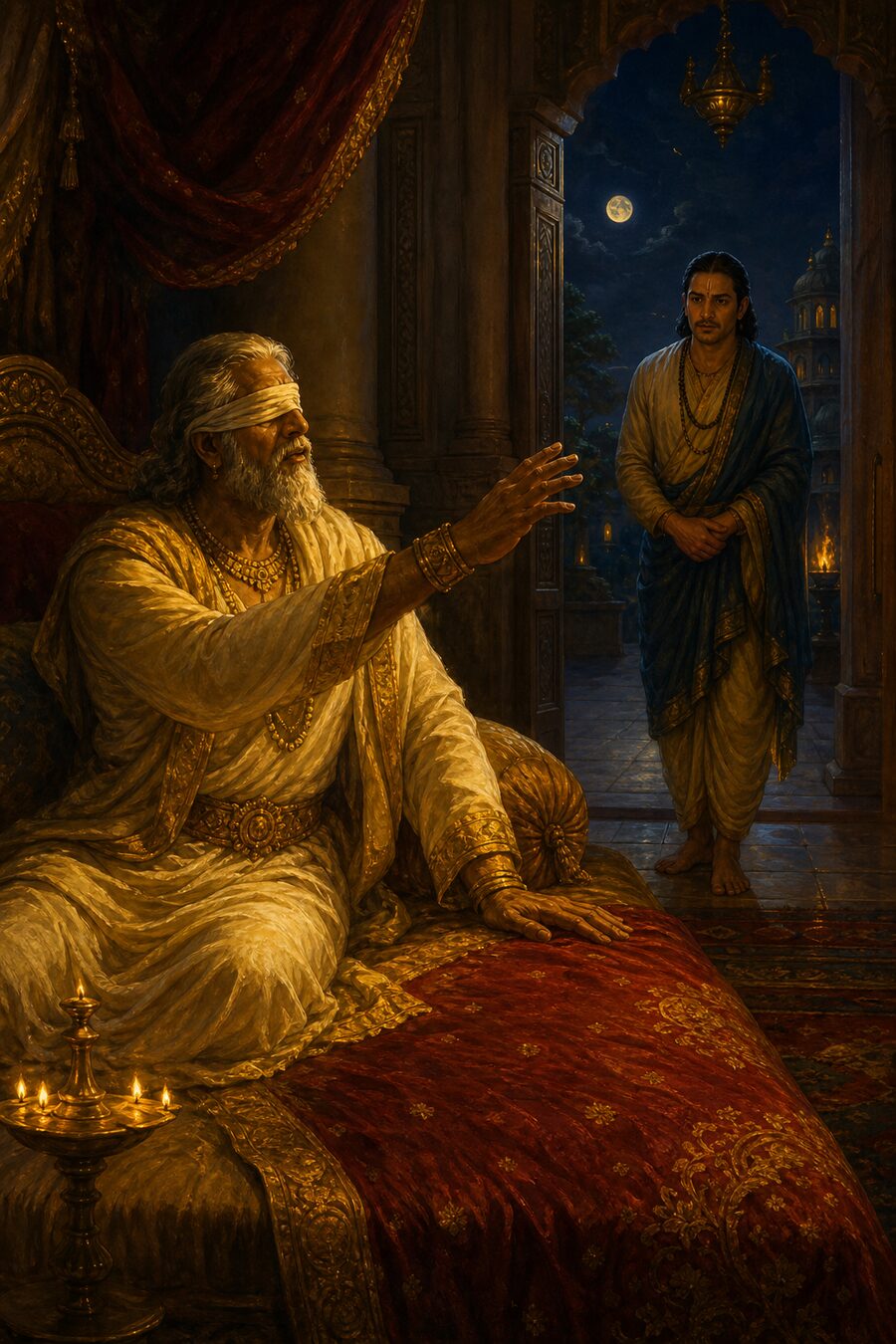
The night had grown deep, yet there was no trace of sleep in Dhritarashtra’s eyes. He turned on the bed again and again, and inside him burned a fire that would not go out. At last, worn down, he sent the doorkeeper: bring Vidura, now. That same Vidura who was his younger brother, whose intellect had no equal among all the Kurus, and whose one distinguishing mark was this: he told the king exactly what was true, however bitter it might be.
Vidura came, stood with folded hands, and said, My king, you have called for me in the dead of night; give your command, what service do you need. Dhritarashtra poured out the sickness of his sleepless nights. What Sanjaya said before he left has scorched me to the core, he said. Sleep is miles away and my body is on fire. You know both dharma and artha, the moral law and worldly gain; tell me the words that might bring this feverish mind some peace.
First, a simple question
Vidura began his answer plainly, with an observation, the kind of thing a man notices about the world before he draws any moral from it. Let me tell you, my king, whose eyes sleep flees at night, he said. The man weak before a stronger enemy who has marched against him. The man stripped of everything he owned. The man burning with longing for another. And the thief, trembling in fear of being caught.
Then, very softly, he spoke the words that were the true question of this whole night. Has one of these afflictions touched you, my king? Could it be that you burn like this because you covet wealth that belongs to another? There was no harshness in the question, yet its point rested directly on the wound the king hid most carefully: his son’s craving to seize the Pandavas’ kingdom, a craving the king could not restrain.
Dhritarashtra flinched from the sting. Speak to me the words that are full of dharma and lead toward good, he said. And then Vidura opened the flow that would run on through the rest of the night.
Who is wise, and who is a fool
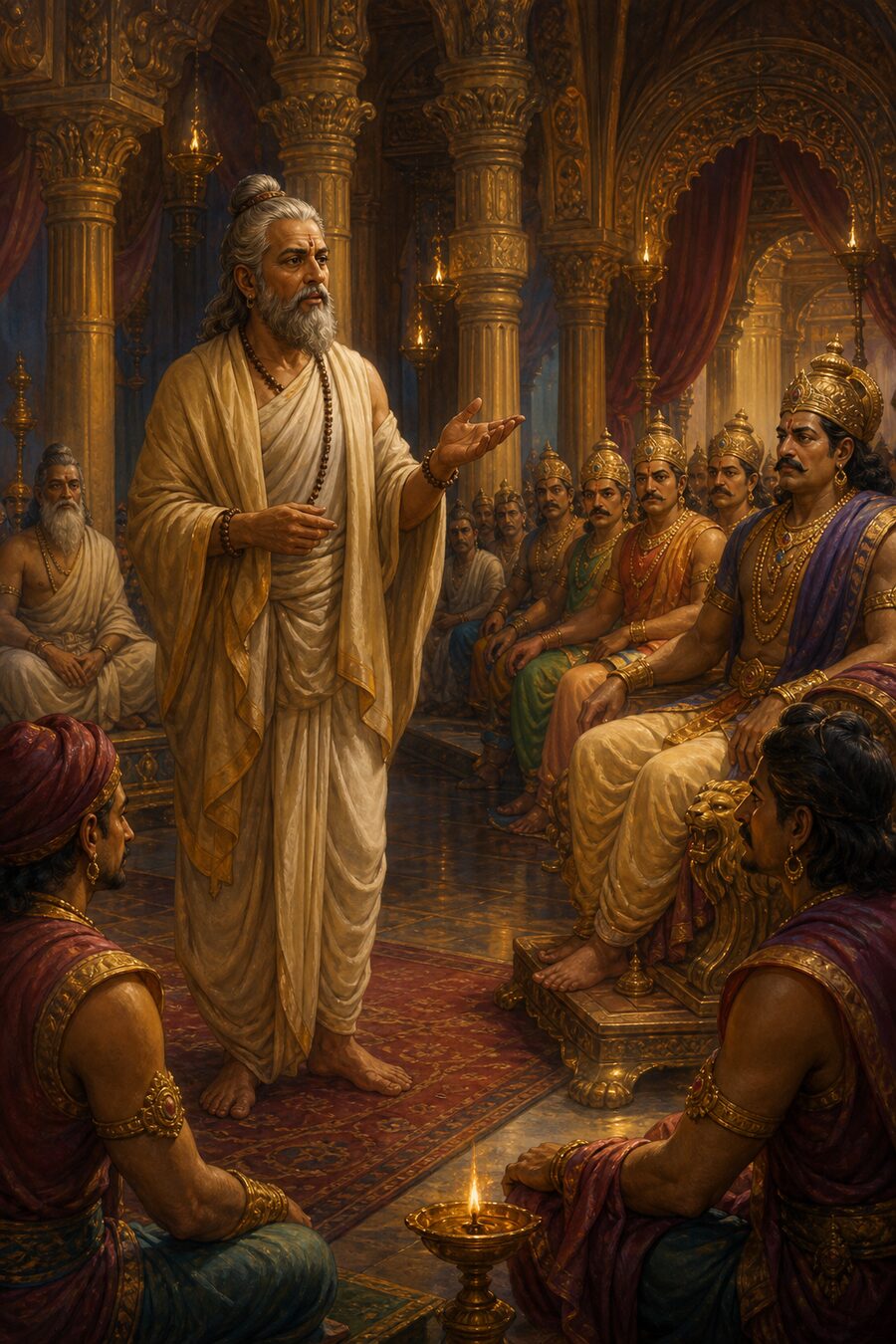
Vidura told him first how a truly wise man is known, because a great many people only look wise. The wise man, he said, takes up only the task worth taking up, and no one learns his plan before it is done. Cold, heat, fear, and infatuation never break his work; he knows his own strength and carries a load neither greater than it nor smaller; and whatever comes to him, in that he finds contentment. Such a man grows tall even on little.
Then he drew the opposite portrait, the fool, and every line of it seemed to point toward one decision or another taken in Hastinapura. The fool is the man who talks on and on without being asked; who places his trust in those who do not deserve it; who lays the blame for his own mistake on the heads of others; and who rages in a place where he has no power to back that rage. Such a man, Vidura said, drowns his own house with his own hands.
Dhritarashtra kept listening, kept nodding, because every sentence was true. But hearing the truth is one thing. Living by it is another.
Victories that force cannot win
Vidura’s voice went deeper now. There are victories a weapon can never win, he said; they are won by character alone. Conquer anger with calm, evil with goodness, the miser with a gift, and the liar with truth. The man who can forgive is the strongest of all, because forgiveness is the choice of the strong, a thing only the powerful can decide to give.
He said too that certain people and certain things are not worth keeping in a house, and he counted them off: the teacher who cannot teach, the priest who has never studied, the king who cannot protect, the wife whose words are always bitter. And in among these came the sharp remark aimed straight at the king’s son, that one man alone commits a sin and many taste its fruit; yet those who taste it go free, and the guilt climbs onto the one who acted alone. For Dhritarashtra, Duryodhana’s face showed plainly in that sentence.
A story in which a father spoke the truth against his own son
To press the point deeper, Vidura opened an old story. A maiden named Kesini had two suitors, Sudhanvan and Virochana. One was a brahmana, aligned with the gods; the other was the son of Prahlada, king of the Asuras. Kesini put a question to them: who is greater, the brahmana or the Daitya? On that very question the two locked horns. Virochana declared with pride, we are the greater; Sudhanvan challenged him. Before long the matter swelled so far that each staked his own life on it, and they agreed that the answer would be given by one known everywhere for his truth.
And who was to be the judge? Prahlada himself, Virochana’s own father. Here lay the thorn of the story, because the one standing in the dock was Prahlada’s own son, and on one side stood truth while on the other stood his own blood. Prahlada asked Sudhanvan, tell me first what the punishment for lying is, so that I may speak knowing it. Sudhanvan’s answer was enough to make a man shudder. A lie told about an animal casts five generations of ancestors down from heaven; a lie about a cow, ten; a lie about a horse, a hundred; a lie about a man, a thousand; but a lie told about land drowns everything. Therefore, he said, never speak falsely about land.
Now Prahlada had no road left. He spoke the truth against his own son, that Sudhanvan is the greater. And then something rare happened. Sudhanvan, who had become the master of Virochana’s life, gave that life back to him gladly, only because Prahlada had refused to lie even for his own son. Here Vidura pulled the thread straight toward the king. This is the whole of it, my king, he said. Do not lean on falsehood in your greed for land, and do not move toward your own ruin, dragging your sons and your ministers down with you.
Whose labor is wasted, and who deserves honor
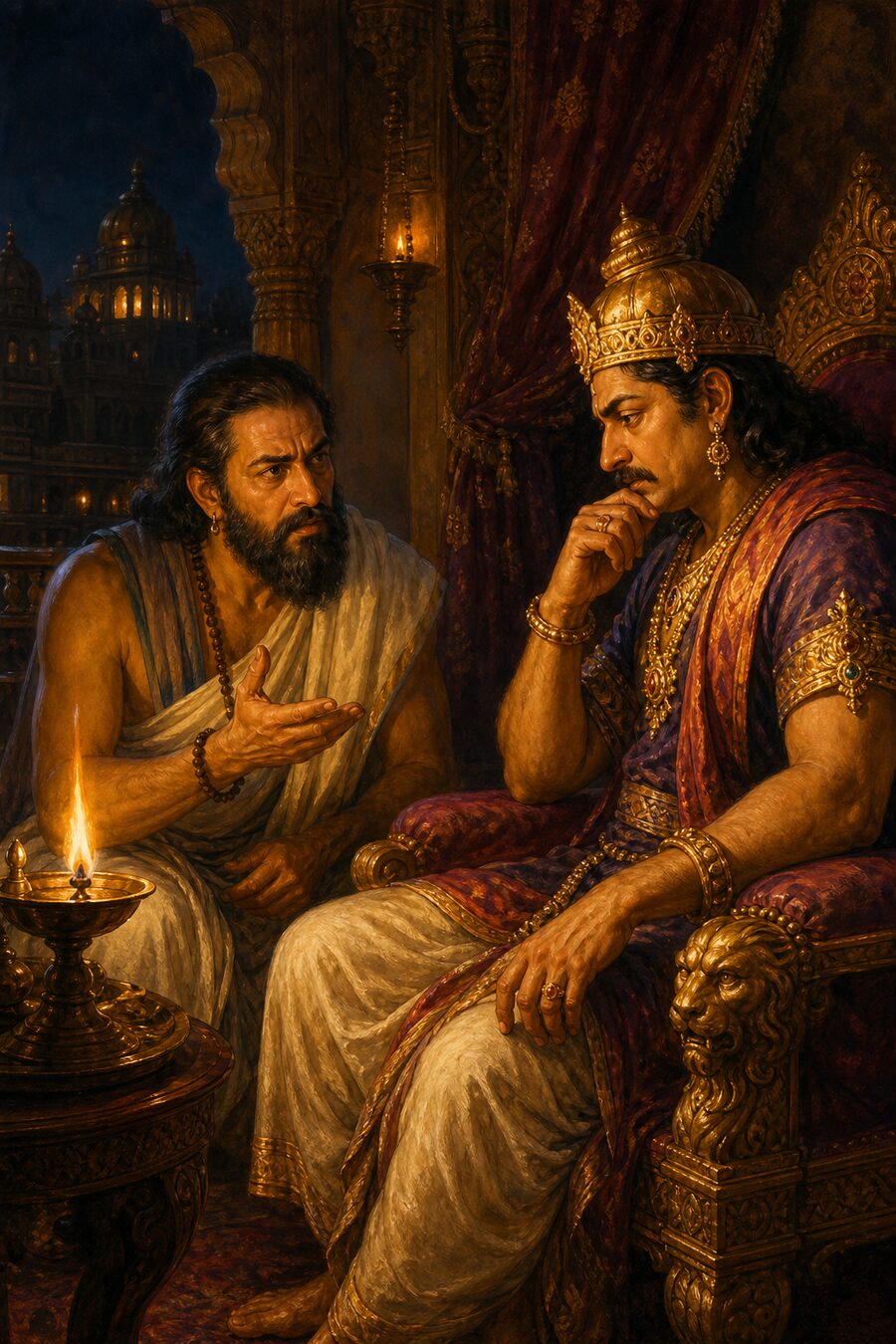
The night wore on, and Vidura’s speech flowed on with it. He recited the list Manu had counted out, the seventeen kinds of people who seem to beat the sky with their fists and try to press oil from sand, whose every labor runs to waste: the one who tries to master a man no one can master, the one content with small gains, and the one who, being weak, keeps up a feud with the strong.
Then the talk turned to honor and propriety. When an elder or a guest comes before a young man, Vidura said, the young man’s life-breaths seem to rise upward, and only by standing to greet them do they settle back into their place. Honoring the guru, the guest, and one’s elders is itself a way of holding steady the fire within you, and it reaches well past mere courtesy. And in among these came the lovely comparisons too: not even the Vedas can rescue a man who lives by deceit; just as birds abandon the nest once their wings have grown, so his own merits abandon him.
And before morning came, a confession
When the greater part of the night had passed and Vidura had said a great deal, Dhritarashtra spoke the words that gathered into themselves the pain of this whole night, and perhaps of his whole life. You speak rightly, he said softly. Whatever you say, every word of it is true, and while I listen my own mind agrees that this is the right course.
But there is one thing, he went on, and here his voice began to break. The moment Duryodhana comes before me, this same mind turns over again. The resolve my reason builds all night long scatters the instant I see my son’s face. What fate has written down, perhaps no man can step across.
Here was a king with the statecraft of the whole world laid before him, who took every word of it as true and still could not walk by it, because a father’s attachment weighed more than all his wisdom. Vidura had held up a light through the whole night, and the eye that refused to see was blind for more reasons than birth alone.
This story is based on the Prajagara Parva (Vidura Niti) within the Udyoga Parva of the Mahabharata, told at length in story form, following the original sequence of events and its spirit.
The same story, elsewhere
- Chapter 18 · The peace effort, Vidura Niti, Sanatsujata
Mahabharata (Udyoga Parva): Vidura Niti amid the peace effort