On this page
The course is finished. The student came to this house as a boy, small enough that his father had to hand him over at the door, and he has lived here ever since, sleeping on the floor of the same room he swept, bringing in firewood before light, taking the cattle out and bringing them back, walking the village at midday with a bowl to ask for the food that fed the household, and sitting down twice a day in front of one man to take the Veda into his memory a line at a time. Nothing was ever written down for him. The whole of it went in through the ear, was given back through the mouth, and was corrected on the spot. Today he is being sent home. The acharya seats him in front of him the way he has seated him ten thousand mornings, and what he says carries no rounded blessing in it, only straight sentences. “Satyam vada”, speak the truth. “Dharmam chara”, walk in dharma. Let no slackness come into your study, take your leave after bringing your teacher the wealth he holds dear, and let the thread of your line stay unbroken. Then come the four sentences this country has never once let out of its hands, “matri-devo bhava”, hold your mother as a deity, and in the same way your father, your teacher, and the guest who has come to your door. Even now, when that line sounds out at some convocation, it is the echo of that same classroom.
Everything the boy is about to walk into is waiting on the other side of that doorway. He will go back to a village that has forgotten his face. He will marry, he will light his own fires and keep them alive for the rest of his life, he will have a field and cattle and debts, and strangers will arrive at his gate at dusk expecting to be fed before anybody in the house eats. He will teach his own students one day, in his own courtyard, out of nothing except what is in his head right now. There is no book he can go back and consult. The sentences he is hearing this morning are the entire baggage. That is why the address is short, and that is why not one word in it is decorative.
The Taittiriya Upanishad comes from the Taittiriya branch of the Krishna Yajur Veda and moves in three vallis. The first is the Shikshavalli, where the talk begins with pitch and pronunciation and travels as far as that parting address. The second is the Brahmanandavalli, where a man’s body is opened out as five sheaths set one inside another, food into prana, prana into mind, mind into understanding, and understanding into bliss, and then an unusual piece of arithmetic arrives for the measuring of bliss. The third is the Bhriguvalli, where a son asks his father for the address of brahman and comes back five times with an answer, each one larger than the last. This Upanishad is in a hurry nowhere, and that is the largest thing about it.
The main figures of this Upanishad
The acharya and the antevasin: the teacher and the student who lives in his house to study; the whole frame of the Shikshavalli stands between these two, and the closing address is spoken between them as well.
Mahachamasya: the teacher who knew a fourth vyahriti, mahas, alongside bhuh, bhuvah and suvah, and who passed it on.
Prachinayogya: the student who is addressed by his own name and told to meditate in this way on the space inside the heart.
Satyavacha Rathitara, Taponitya Paurushishti and Naka Maudgalya: three teachers, whose three separate opinions are set down on one page with no quarrel between them.
Trishanku: the seer whose recitation of the Veda arrives as a short declaration, that he is the shaker of the tree and that he stands watered with the deathless.
Bhrigu Varuni: the son of Varuna, who comes asking for the address of brahman and who performs tapas and returns every time.
Varuna: Bhrigu’s father and teacher, who keeps the full answer behind his teeth and hands over a test instead, letting his son reach it on his own feet.
The threshold of the Shikshavalli: peace, pitch, and the knowledge of joints
The first voice of this Upanishad belongs to a prayer, and it is spoken out loud, by both men together, before a single line of the lesson is touched. May Mitra do us good, may Varuna do us good, may Aryaman do us good, may Indra and Brihaspati do us good, and may Vishnu of the wide stride do us good. Then salutation to brahman, and salutation to Vayu, and Vayu is addressed to his face, “tvam eva pratyaksham brahmasi”, you alone are brahman made visible, and you alone I shall call brahman made visible. Vayu gets that greeting for a reason a reciter feels in his own chest. Sound rides on moving air, and the Veda exists only while somebody is breathing it out. After this come two promises that fix the pitch of the whole book, I shall speak ritam and I shall speak satyam. And at the end a request, that it protect me and protect the one who is speaking these words as well. The one studying and the one teaching are taken under a single umbrella, because if either of them goes wrong the chain breaks in the same place.
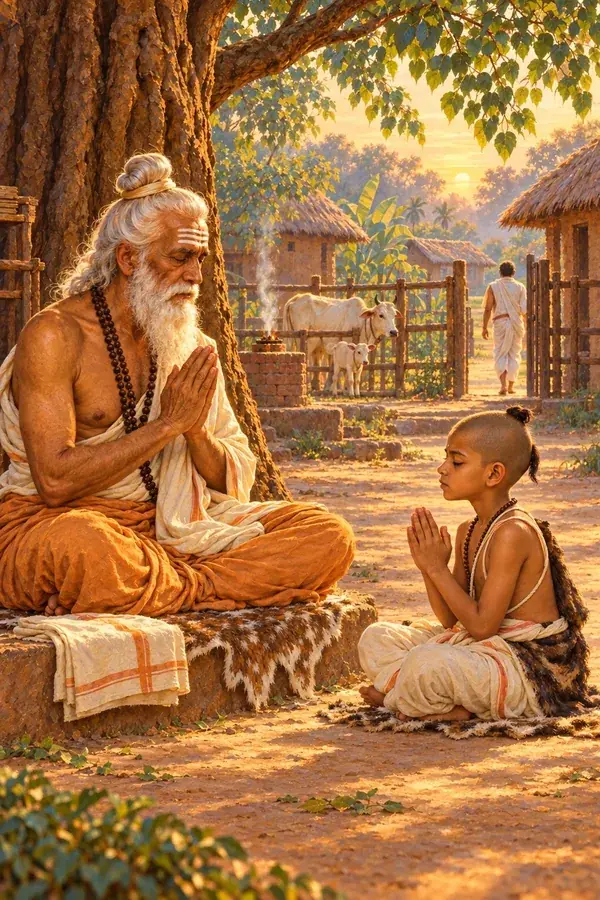
The lesson that starts immediately afterward is a lesson in sound. Shiksha, the science of pronunciation, is explained in six words. Varna, the letter. Svara, its rise and fall. Matra, its length. Bala, the effort spent in speaking it. Sama, evenness of delivery. And santana, the running of words into one another without a break. To a reader who learned everything he knows off a page this can look like a strange place to open a book about the highest matter. Consider what these men were holding. The entire Veda lived in human throats and nowhere else, moving from one generation to the next the way a flame is carried between lamps, and a syllable spoken on the wrong tone becomes a different word with a different meaning inside a sentence that is supposed to be exact. A slip is a loss with no backup copy anywhere on earth. So this Upanishad hands its opening chapter to the throat and the tongue, and it does that with a straight face.
Now another step. When two words come close, the place where they meet is called samhita, and this Upanishad keeps an upanishad of its own about that meeting. Anybody who has recited knows why the meeting place matters, since that is exactly where two words melt into each other and a careless reciter loses the seam. It opens the joint in five fields and counts four limbs in every joint: purvarupa, the first end, uttararupa, the second end, sandhi, the place where the two meet, and sandhana, the thing that holds them joined. Among the worlds the earth is the first end, the sky the second, space their sandhi, and air the thing that joins them. Among the lights fire and the sun are the two ends, water their sandhi, and lightning their join.
The third field is the loveliest. In learning, “acharyah purva-rupam”, the teacher is the first end, and the antevasin is the second, vidya is the sandhi between them, and pravachana, the work of teaching, is the cord that holds them joined. Teacher and student stop being two separate persons. They become two words of one sentence with knowledge running between them. That picture is a description of the room these two are sitting in. The man on this side has the whole Veda in him and no way to move it except by speaking, and the boy on that side has an empty memory and no way to fill it except by listening, and the thing that passes across the gap belongs to neither of them alone. In the fourth field the mother is the first end, the father the second, offspring their sandhi, and the begetting of offspring their join. And the fifth field lies inside one’s own body, the lower jaw and the upper jaw the two ends, speech their sandhi, and the tongue the thing that joins the two.
These five this Upanishad calls the mahasamhitas, and it counts out the fruit for whoever knows them this way, that he is joined to offspring, to cattle, to the luster of brahman, to plenty of food and drink, and to the world above. Read that list of rewards with the life of the man in mind. Offspring, cattle, grain, standing among those who know, and a good place after death. This is the whole ambition of a householder set down in one line, and the Upanishad has no embarrassment about it. What is worth noticing is that the joint is built the same way everywhere. Two separate things, an empty place between them, and something flowing through that empty place which keeps them from staying two. The world is held up in this fashion, and further on this same point will return in the language of layers and sheaths.
After this comes the prayer for medha, and it is an intimate one. May that omkara, the bull among the meters, of every form, which rose above the meters out of the deathless, fill me with wisdom in the shape of Indra. May my body be fit for going about, may my tongue be sweet, may my ears bring me much to hear, and then the line a man with a head full of unwritten text would say every day of his life, “shrutam me gopaya”, guard for me what I have heard. Then comes the teacher’s own asking, that fortune come to my house, that clothes and cattle come, that food and water be there always, and above all, that students come to me, come from every side, come carrying restraint and quiet. That prayer is a household account. A teacher who took boys in fed them, clothed them and housed them, and he was paid in nothing except the fee a departing student could carry and the standing his teaching earned him. Any teacher who has once looked at an empty room will recognize this prayer at once.
In short: the Shikshavalli opens with a peace chant and teaches pronunciation before anything else, since in a heard tradition the pitch is the keeper of the meaning. Then it shows in five places that everything rests on some joint, and the most alive of those joints is the one between teacher and student, which teaching holds together.
Four vyahritis, the space inside the heart, and the syllable everything begins with
Bhuh, bhuvah and suvah, these three vyahritis every brahmana knew from childhood. They were the first Sanskrit a child heard with meaning attached, spoken at the fire at dawn and again at dusk, three syllables covering this world, the space above it and the world beyond that, said so often that they wore smooth. This Upanishad holds a fourth, and the credit for it is given by name, that Mahachamasya knew it and made it known, mahas. Naming the man matters. In a tradition carried by mouth, a piece of knowledge has an owner and a chain of hands, and the chain is stated so that a listener can tell whether the thing in front of him has a pedigree. And it is said at once that this is brahman, this is the atman, and the remaining deities are its limbs. After this the set of four is laid down four times over, on a new level each time. Among the worlds bhuh is this earth, bhuvah is the middle space, suvah is that world above, and mahas is the sun, since it is by the sun that all the worlds are made great.
The second time it falls among the lights, where bhuh is fire, bhuvah is air, suvah is the sun, and mahas is the moon, since it is by the moon that all the lights are made great. The third time among the Vedas, where bhuh is the ric verses, bhuvah the samans, suvah the yajus, and mahas brahman, since it is by brahman that all the Vedas are made great. And the fourth time inside one’s own breathing, where bhuh is prana, bhuvah apana, suvah vyana, and mahas food, since it is by food that all the pranas are made great. Four vyahritis go fourfold and become sixteen, and whoever knows them, this Upanishad says, knows brahman, and all the gods bring him their offerings. The method here is the method of the whole text. One small set is laid over the sky, then over fire, then over the books, then over the breath in a man’s own chest, until the four levels stop feeling like four places.
After this the scene turns inward all at once. Inside the heart there is a space, and in that space is the purusha made of mind, who dies never, who is golden. Then a road is described with great precision: that piece which hangs like a nipple between the two palates is the doorway to Indra, and past it, at the place where the hair of the head parts, the road comes out by separating the two halves of the skull. Put a finger to the roof of your own mouth and you will find the landmark the text is using. These men were describing a route through a body they knew from the inside, with the same care they used for a route through a forest, and the landmarks they chose are the ones a person can locate on himself while sitting still. Walking this road a seeker says bhuh and settles in fire, says bhuvah and settles in air, says suvah and settles in the sun, and says mahas and settles in brahman.
Arriving there he gets his own kingdom, he gets the lord of the mind, and he becomes lord of speech, lord of the eye, lord of the ear and lord of understanding. And then he himself becomes what this Upanishad has described in four short pieces, whose body is space, whose nature is truth, who takes his pleasure among the pranas, whose mind is in bliss, who is full of peace, who is deathless. And at the end a name arrives, Prachinayogya, meditate in this way. Somebody sitting in that room had a name, and the text kept it. In the whole Upanishad this is the only place where a meditation is handed over to one named person, and with it the text turns all at once into a lesson in a classroom, with a boy in it who is being spoken to directly and who presumably went home afterward and tried it.
The next anuvaka plays a game of counting. On the outward side there are fives: earth, middle space, sky, the directions and the intermediate directions. Fire, air, sun, moon and the stars. Water, herbs, forest trees, space and the atman. And on the inward side there are fives as well: prana, vyana, apana, udana and samana. Eye, ear, mind, speech and skin. Hide, flesh, sinew, bone and marrow. Having set all this down, the seer said that all of this is made of fives, and that it is by the fivefold that the fivefold is completed. The inside and the outside are cut to one measure, and so passing from one to the other is possible.
This part of the Shikshavalli comes to rest on the syllable that every recitation starts with. Om is brahman, om is all of this, and om is the assent by which every act moves forward. The saman chants begin with om, the shastras are recited with om, the adhvaryu answers by saying om, the priest called brahma gives his permission with om, the agnihotra is allowed with om, and a brahmana sitting down to teach says om and holds in his mind that he may reach brahman, and he reaches brahman. Picture the sacrificial ground while that is going on. Several priests with separate offices are working the same rite in parallel, each waiting on the other, and the single syllable is how one of them tells another that the thing may now proceed. One small yes, by which every large thing is given its road.
In short: a fourth vyahriti, mahas, joins the three, and the four are laid again and again over the worlds, the lights, the Vedas and the breath. Then the matter comes to the space inside the heart, where the deathless purusha made of mind lives, and at the end to om, by whose single assent every sacrifice and every recitation runs.
Study and teaching are themselves the tapas
Now an anuvaka arrives that reads like a list and works as an insistence. Ritam is to be done, and study and teaching as well. Truth, and study and teaching as well. Tapas, and study and teaching as well. Restraint as well, calm as well, the tending of the fires as well, the agnihotra as well, hospitality to a guest as well, one’s duty toward other people as well, offspring as well, the begetting of offspring as well, and the carrying on of the line as well. With every single item the same two words come back, svadhyaya and pravachana, reading for oneself and teaching others. Twelve times over the pair is repeated, and the repetition is its argument. Read the list aloud and the effect is the one the text wants. Every other duty gets named once and walks past. These two stay in the room.
After this three teachers are called by name. Satyavacha Rathitara says that truth is the whole of it. Taponitya Paurushishti says that tapas is the whole of it. And Naka Maudgalya says that study and teaching are the whole of it, for that is tapas, that is tapas. The three opinions are set down on one page with no tug of war between them, and nobody is declared wrong. Three men who disagreed are quoted by name with their disagreement intact, which is how this literature usually settles a dispute. The repetition in the last sentence, though, makes its own case.
To feel the size of what Naka Maudgalya is claiming, it helps to know what tapas normally bought a man. Tapas meant heat, and the heat was literal. A man sat between four fires through the hot months with the sun overhead for the fifth, he fasted, he stood through the night in cold water, he held a posture past the point where the body complained. Those were the recognized ways of building up the reserve that a serious undertaking required. Naka Maudgalya is putting the daily recitation into that same account, and it is worth remembering what the daily recitation was. Hours of it, at dawn and again later, the same corpus rolled through the mouth until the memory of it was load bearing, with no page to glance at and nobody to prompt. Then handing it on to boys who get it wrong, evening after evening. The man who does that has been in the fire.
This point is of even more use today. We usually go looking for tapas inside some extraordinary hardship, some fast, some solitude. This Upanishad sets it down on the everyday table. The man who comes back to his subject every day, who repeats it, and who then hands it over to somebody else, is wearing himself down, and the shine comes off that wearing. Reading alone stays incomplete, since what has been learned becomes a tradition only after it reaches another person’s ear, and teaching alone stays incomplete too, since a man who does no reading of his own has stale goods to hand over.
In this same run comes a short declaration, the recitation of Trishanku. “Aham vrikshasya reriva”, he says, I am the shaker of the tree, and his fame stands high like the ridge of a mountain, and he is pure from above, and as the deathless is in the sun so is he that same clean deathless, he is shining wealth, he is of good understanding, he is watered with the deathless. To an ear trained on modesty it sounds like self praise and it does the opposite work. Whoever has touched the element inside himself that dies never says exactly this, and he is speaking about that element, with himself left out of the account.
In short: through a list of twelve duties one pair comes back every time, study and teaching. Three teachers’ three opinions are set side by side, and the last of them is said twice over, that reading and teaching are themselves tapas. After it comes the cry of Trishanku, in which the recognition of the deathless inside a man is doing the speaking.
The convocation address: satyam vada, dharmam chara
Having taught the Veda through, the acharya instructs his antevasin. Hold the moment in view before the sentences start, because everything in them depends on it. The teaching is over. There is nothing left to learn in this house. The boy who arrived years ago is a grown man this morning, his memory is full, the fee has been brought and set down, and in an hour he will pick up his water pot and walk out of a courtyard he has swept every day of his adult life, into a world where nobody will check his work again. This is the last time anyone with authority over him will tell him anything. A commencement address has exactly one listener here, and he is leaving.
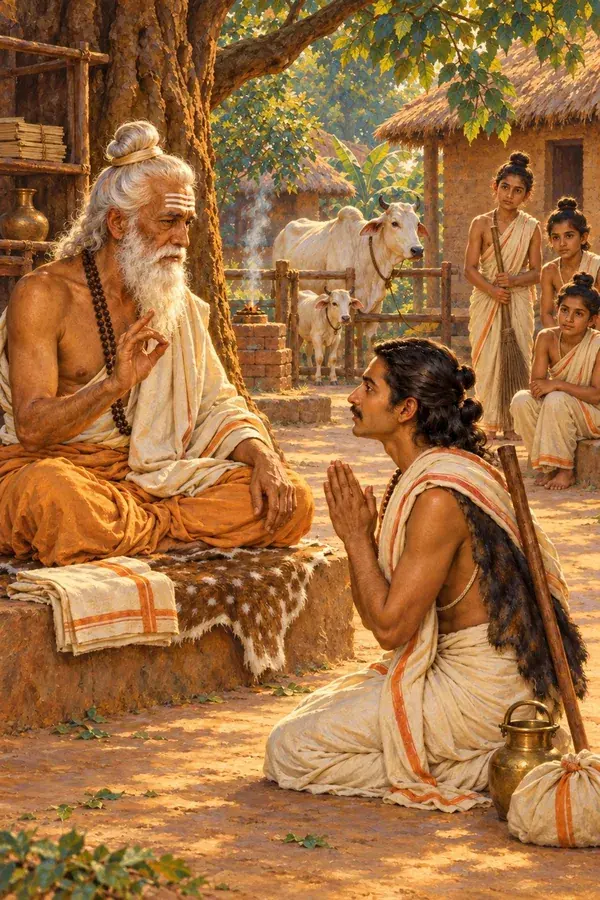
The first sentence is the one by which this address is known across the world, “satyam vada”, speak the truth, and right behind it “dharmam chara”, walk in dharma. Then, “svadhyayan ma pramadah”, let no carelessness come into your study. Bring your teacher the wealth he holds dear and take your leave, and let the thread of your line stay whole. A whole household is bound up inside these few words. Truth is the vow of speech, dharma the vow of work, study the vow of the mind, the teacher’s fee the vow of gratitude, and offspring the vow of responsibility toward time. Notice how much of it points forward at the life ahead. The man is being sent to marry, to work land, to keep fires, to raise sons who will carry the same lines in the same order, and the instruction assumes every bit of that without spending a word on it.
Then the same thing is said in another fashion, this time by forbidding. There is to be no carelessness about truth. No carelessness about dharma. No carelessness about kushala, one’s own welfare. No carelessness about bhuti, one’s own prospering. No carelessness about study and teaching. And no carelessness about the offices owed to the gods and to the fathers. This Upanishad asks nobody to run away from the world. It keeps a man’s own welfare and a man’s own prospering in the same list that holds truth and dharma, and six times over it repeats one word, let it slip nowhere. The offices owed to the fathers are the ones a man performs for the three generations of his dead, on fixed days, with his own hands, and the line is a reminder that he is now the only person who will do it.
Now come the four sentences that turned into household speech in this country. “Matri-devo bhava”, let your mother be a deity to you. Let your father be a deity, let your teacher be a deity, let your guest be a deity. All four run in one order, beginning with whoever is nearest and going out to the one who has just arrived at the door. And notice that no temple is named here. Those who gave the body, those who gave the learning, and the one who came without an invitation, these four are the deities whose worship this Upanishad has prescribed. The fourth is the surprising one until you know what a guest was. A traveler on foot reached a village at dusk with no inn waiting and no way to buy a meal, and the household that took him in was the only arrangement standing between him and the night. Putting that stranger in the same sentence as a man’s own mother is a piece of social engineering with the weight of scripture behind it.
After this comes the sentence that makes the whole address honest. “Yany anavadyani karmani tani sevitavyani”, those acts that stand beyond reproach, practice those, and no others. And then the acharya speaks about himself, that whatever conduct of ours is good conduct, take up that, and nothing else. Consider who is saying it and to whom. A man who has had total authority over another human being for a decade, in a house where his word decided the day, is telling that person on the way out to keep from copying him wholesale, to sort him, to leave behind whatever in him will not stand the test. A sentence this clean is rare in any tradition, and it is what keeps this tradition from tightening into a grip.
Then the manners of giving are taught, because the man walking out is about to become the one people come to. Let those brahmanas who stand above us be given a seat so that their tiredness may go. “Shraddhaya deyam”, give with shraddha, give nothing without shraddha. Give according to your means, give with modesty, give with fear, and give with understanding. Those four words hold the whole state of mind of giving. Modesty, that the giver shrink from advertising his giving. Fear, that it may go wrong in the doing. And samvid, that the giving be shaped to the condition of the one receiving. The manner of a gift is dearer to this Upanishad than its size, and the seat offered to a tired man arriving on foot is named before anything that changes hands.
At the end comes a piece of advice that makes this address very modern. If ever a doubt rises in your mind about some act or about somebody’s conduct, then whichever brahmanas there are thoughtful, engaged in their own work, free of harshness and in love with dharma, conduct yourself as they would conduct themselves in that situation. And where a man stands accused, the same measure applies. Look at the qualifications being demanded. Thoughtful, meaning the man weighs a case. Engaged in his own work, meaning he has something at stake and is no idle judge of others. Free of harshness, which rules out the severe man who enjoys a verdict. In love with dharma, meaning he wants the right outcome more than he wants to be right. Rules cannot be made for every situation, and so in the place of a rule a finger is pointed here at a living person. This is the instruction, this is the teaching, this is the secret of the Veda, this is the discipline, this is the way to live.
In short: in the parting address truth, dharma, study, gratitude and the line of the family are handed over in one breath, and four deities are counted out, mother, father, teacher and guest. The largest thing in it is the release the teacher gives away himself, that only what is good in us should be taken up, and that in a doubt one should settle the matter by watching some thoughtful and unharsh person.
The Brahmanandavalli: truth, knowledge and the endless, and the first sheath made of food
The second valli opens with that shared prayer of teacher and student which is repeated in every classroom to this day, that it protect us both, that it nourish us both, that we find strength together, that what we study be full of light, and that we bear no ill will toward each other. That last clause is the practical one. Two men sitting knee to knee for years, one correcting the other daily, have every opportunity to grow tired of each other, and the prayer says so out loud before the work begins. Straight after it falls the first sentence, “brahmavid apnoti param”, the knower of brahman reaches the highest. And then comes the introduction that stands as the most tightly packed line in this Upanishad, “satyam jnanam anantam brahma”, brahman is truth, is knowledge, is endless. Whoever knows it as set down in the cave of the heart, in the highest space, enjoys every desire at once along with that brahman who knows all.
Three words close three doors. Calling it truth takes it out of the class of things that keep changing. Calling it knowledge keeps it from being inert; it is awareness. And calling it endless leaves it no boundary at all, of place, of time, or of any other thing. After this the order of creation is said in one breath. From that atman space came to be, from space air, from air fire, from fire water, from water earth, from earth the herbs, from the herbs food, from food seed, and from seed the purusha. Creation comes down from above and at the very end becomes a man, made of the essence of food. Follow the last three steps and they describe a field, a harvest, a meal and a child, in that order, which is a sequence every listener had watched happen.
Now this Upanishad opens that man out like the altar of a sacrifice, and it will repeat one map five times over. Every sheath has a head, a right wing, a left wing, a middle trunk, and a tail that keeps it standing. That shape came from the ground these men worked on. The great fire altar was built out of baked bricks in the outline of a bird in flight, a head, two spread wings, a body between them and a tail behind, laid course by course over days by men who counted every brick. Anyone in the audience had either helped build one or watched one go up. So when the text says head, right wing, left wing, trunk and tail, the listener is already seeing a shape on the ground, and the body he is sitting in gets laid out in the same five pieces. The first sheath is annarasamaya, the body made of the food a man has eaten. This is its head, this its right side, this its left, this its middle, and this the standing ground below.
After this comes the verse in praise of food, which this Upanishad will pick up again in the third valli. From food alone all creatures are born, all that live supported on the earth. By food alone they live, and into food they go in at the end. Food came first among beings, and so it is called the essence of all herbs. Those who worship food as brahman obtain all food. And the reason for the word anna is counted out as well, that it is eaten and it also eats creatures, and so its name is anna.
This one line is the key to the whole Upanishad. Whatever we are eating is eating us, slowly, every day. To a people who buried or burned their dead in the ground they farmed, the circle was visible. Grain feeds the man, the man goes into the earth, the earth carries the next season’s grain. The body is made of food and will go back at the end as food. This Upanishad sets that truth down as a fact, with no sadness laid over it, and out of the same fact it builds the next step. A thing that can be eaten has no claim to be the last thing, and so the next line comes, that inside this one made of the essence of food is another atman, made of prana, and by it this body is filled.
In short: the Brahmanandavalli catches brahman in three words, truth, knowledge and the endless, and places it in the cave of the heart. Then, having set out the order of creation from space down to a man, it opens the first sheath, the body made of food, which eats and is eaten.
Prana, mind, understanding and bliss: four sheaths going inward
Before the second sheath opens, take the first one at its word and find it on yourself. The sheath made of food is the thing your hands are. It has a weight you can read off a scale, it came out of meals you can remember, and it will be gone in a few decades. Press a thumb into a forearm and that is the whole of annarasamaya. Now stop breathing and count. Somewhere before a minute is out, something that has nothing to do with weight will overrule every plan you have. That is where the second sheath begins.
The second sheath is pranamaya. The gods breathe along behind prana, and so do men and animals. Prana is the life span of creatures, and so it is called the life of all. Those who worship prana as brahman reach their full span. The map of this sheath is drawn the same way: prana is its head, vyana the right wing, apana the left wing, space the middle trunk, and the earth its tail, its standing ground. And at the end the same sentence comes back, that this second one is the atman of the body that was the first, and that inside this one there is another. Notice the shape of the claim. The breath has no edges you can point to and it fills the body exactly, and the body is described as a thing the breath is wearing.
The third sheath is manomaya, and here a turn comes into the map. The head of this sheath is the Yajur Veda, the right wing the Rig Veda, the left wing the Sama Veda, the middle trunk adesha, the prescription of the Brahmana texts, and the tail the Atharvangirasas. Building the sheath of the mind out of the Vedas says something deep. Whatever words our mind is filled with become its shape. Sit still for one minute and watch what runs through, and almost none of it will be yours by invention. Snatches of what was said to you, lines you learned, a tune, an argument you had. The inner man of anybody is made of whatever he has heard and repeated all his life, and that is why the first valli stayed so long on svadhyaya. For the boy in that courtyard, the material being loaded into that sheath every morning was chosen on purpose.
The fourth sheath is vijnanamaya, the one that knows and decides. It is the part that stands up and commits while the mind is still turning options over. Its head is shraddha, its right wing ritam, its left wing satyam, its middle trunk yoga, and its tail mahas. Placing shraddha at the head is a very large thing. The whole building of knowing stands first of all on a trust, that there is something worth knowing and that I can come to know it. The boy who sat down at eight years old to take in a corpus he could not evaluate was running on that alone. Vijnana spreads the sacrifice and spreads the acts, and all the gods worship that eldest brahman. A man who knows vijnana as brahman and lets no carelessness come near it leaves behind the wrongs lodged in the body and obtains every desire.
And the fifth sheath is anandamaya. Its head is priya, the first lift that rises the moment a wanted thing appears, before you have it, the half second when the door opens and it is the person you were hoping for. Its right wing is moda, the pleasure of getting it. Its left wing is pramoda, the spreading out of that pleasure, the hour afterward when everything else also seems fine. Its middle trunk is ananda itself. And its tail, the thing this whole sheath stands on, is “brahma puchchham pratishtha”, brahman as the tail, the standing ground. Here this Upanishad breaks its own map, since every earlier sheath had some other thing for a tail and this time the tail is brahman. Shankara puts his weight on this very word, that anandamaya is a sheath like the others and that brahman is what even this sheath is standing on.
Look at the five sheaths together and one plain thing comes out. Each time this Upanishad repeats the same frame and each time says that inside it there is another, which is to say that the thing we had taken for our everything turns out to be draped over something else. The body is draped over prana, prana over mind, mind over understanding, understanding over bliss, and bliss over brahman. Anyone can walk the ladder inward in a quiet minute. Feel the weight of the body. Feel the breath moving in it, which the body cannot supply for itself. Watch the traffic of the mind, which keeps running while the breath goes on without instruction. Catch the one that decides which of those thoughts to act on. And notice that behind all of it sits the plain preference for going on being alive, which nobody argued you into. And the line placed at the edge of the fourth sheath is the most famous line in the whole book, “yato vacho nivartante aprapya manasa saha”, from which speech turns back, along with the mind, having failed to reach it.
In short: prana inside food, mind inside prana, understanding inside mind, and bliss inside understanding. The same map of a bird is repeated for every sheath, and the same sentence returns every time, that inside this one there is another. By putting brahman at the tail of the anandamaya, this Upanishad signals that the counting ends here.
Making by tapas, entering the making, and the reckoning of bliss
Now a hard sentence arrives. Whoever takes it that brahman has no existence becomes himself unreal. And whoever knows that brahman exists is held by good men to be real. Straight after it the questions rising in the student’s mind are set down, which this Upanishad calls anuprashnas. Does the one who has no knowledge also reach that world after dying, or is it the one who knows who reaches it and gains it. The question is left hanging in the air, and in the place of an answer a story walks in, which is the way of this Upanishad.
He desired. May I become many, may I be born. He performed tapas. Having performed tapas he made all of this, whatever is here. And having made it he entered into it. Having entered, he became the manifest and the one that never comes forward, the defined and the undefined, the one with a support and the one without, knowledge and unknowing, truth and untruth. And whatever is here became truth, and so it is called truth. The maker stayed outside nothing once he had made. He went into the very thing he had made, and that is why he will be found inside everything. The desire comes first and the heat comes out of the desire, which is the sequence any craftsman knows from his own bench. A man wants a thing to exist, and the wanting is what keeps him at the work past the hour when the body would have stopped.
The next anuvaka says the same thing from the other side. In the beginning all this was as though unreal, and out of it the real was born, and it made itself by itself, and so it is called sukrita, the self made. And then comes the sentence that is the heart of this Upanishad, “raso vai sah”, he is rasa itself. Rasa is the word for the juice of a fruit, the sap of a plant, the thing that is left when everything inessential has been pressed away, and the same word does duty for the taste a thing has and for the pleasure of tasting it. It is on getting this rasa that a creature becomes full of bliss. If this bliss were absent from the space inside the heart, who would breathe and who would live. It is he who makes everyone blissful.
After this the root of fear is named, and it is very direct. When a creature finds its own standing in that unseen, bodiless, unnamed and unsupported reality, it becomes free of fear. And the moment it makes the smallest crack in that, sets up the smallest interval, in that same moment fear comes to it. Fear arrives from no outside thing. Fear is born the moment I and that become two. And this Upanishad adds that this fear belongs to the very learned man who holds the doctrine and does no reflecting on it, which is a warning aimed straight at the people most likely to be reading.
A vast picture of this same fear stands in the first sentence of the next anuvaka. “Bhisha’smad vatah pavate”, out of fear of him the wind blows, out of fear of him the sun rises, out of fear of him fire and Indra do their work, and the fifth, death, runs out of fear of him. Fear here carries the sense of order. There is a power on account of which the air moves at its hour and the sun comes up at its hour, and that same power is the law that keeps everything inside its own limit. Even death is on a schedule and answers to somebody.
And now comes the arithmetic that gave this valli the name Brahmananda. Suppose there is a young man, a good young man, well read, the swiftest, the firmest, the strongest, and suppose this whole earth full of wealth were his. Hold that picture for a second, because it was built to be the best thing the listeners could imagine. A man at the top of his strength, trained, admired, and owning the ground from one horizon to the other. That is one human bliss, and it is the bottom rung. A hundred of those human blisses make one bliss of the human gandharvas, and the same bliss belongs to the shrotriya who is unhurt by desire. Then a hundred blisses of the human gandharvas make one bliss of the divine gandharvas, then the bliss of a father who dwells long in his world, then the bliss of the gods born into their station, then of those who became gods by their acts, then of the gods, then of Indra, then of Brihaspati, then of Prajapati, and at the end the bliss of brahman.
One sentence keeps coming back all the way up this staircase, and it is the real matter. At every tread it is said that this same bliss belongs to the shrotriya whose desire leaves him unwounded. A shrotriya is a man who has heard the text and holds it, which describes a great many people in that room. The second qualification is the one that thins the crowd. Akamahata, unstruck by desire, meaning the wanting arrives and passes through him without leaving a mark. Which is to say that the height the gods climb by hundredfold steps is where a quiet man is already standing, seated where he is. And at the end this Upanishad makes the joining it has been moving toward from the start, that the one who is in this person and the one who is in the sun are one. Whoever knows this, on going from this world, passes the annamaya, the pranamaya, the manomaya, the vijnanamaya and the anandamaya atman one after another.
The last page of the valli returns to the line we met in the middle, that the man who knows the bliss of that brahman from which speech turns back with the mind, having failed to reach it, is afraid of nothing. And then a very human thing, that he goes unburned by the regret of why did I do no good act and why did I do the wrong one. Whoever knows this gathers both of them into his own atman. The questions that rise at night while a man is looking at the ceiling, this Upanishad counts out by name and then shows a place above them.
In short: he wished, performed tapas, made, and entered his own making, and so he is met from inside everything. He is the rasa that gives living its taste, and fear is born the moment the smallest interval is set up inside that one. On the hundredfold staircase of bliss, level with every tread, stands the shrotriya whom desire leaves unwounded.
Bhrigu returns five times
The third valli starts with a son. Bhrigu was the son of Varuna, and he went to his father with a request that has a fixed form, “adhihi bhagavo brahma”, sir, teach me brahman. The form matters, because a son asking his father for a blanket or a field asks in the ordinary way of a household, and this is not that. He has come as a student comes, using the word a student uses, and the moment he speaks it the relationship in the room changes. The man in front of him stops being his father for the purpose of this conversation. Varuna first counted out a few things, food, prana, the eye, the ear, the mind and speech, the doors through which any search at all might start. And then he gave the test that will drive this whole valli, “yato va imani bhutani jayante”, that from which these beings are born, by which, being born, they live, and toward which they go and into which they enter, seek to know that, for that is brahman.
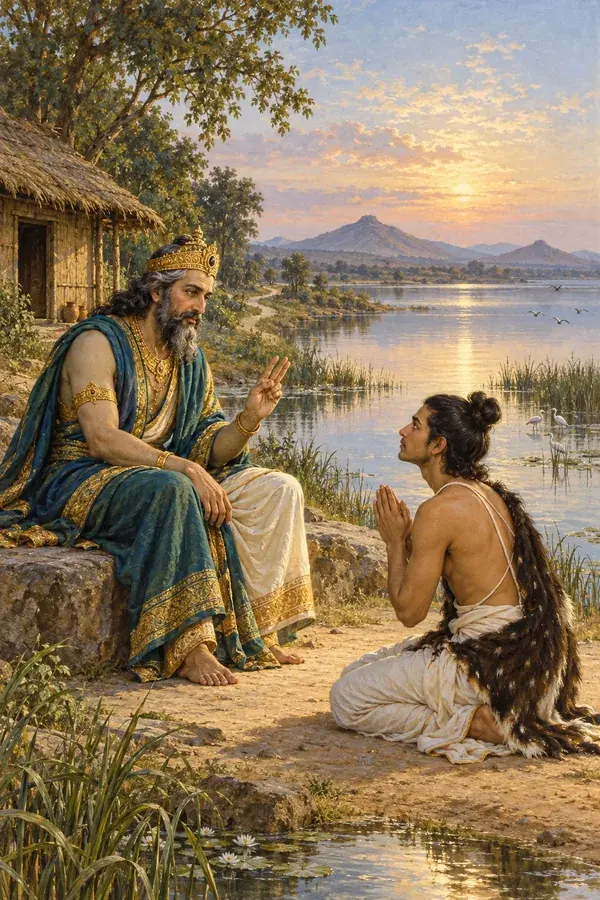
Notice that the father gave no answer. He handed over a balance with three pans, that from which everything is born, by which everything lives, and into which everything returns. Now the son has to set one thing after another on that balance and look. And Varuna had said one more thing, that you should seek to know through tapas, tapas is brahman. In this valli tapas is the name for keeping a thought fixed in one place, the stubbornness that refuses to be satisfied early by any answer. What that meant in practice was walking out to a solitary place and staying there, alone, without conversation, for as long as it took.
Bhrigu performed tapas and got his first answer, “annam brahma”, food is brahman. On the balance it sat correctly, because from food all these beings are born, by food they live, and into food they go in at the end. This was no raw answer. A man who knows hunger knows that the body is made of soil and grain and will go back into it, and in a world where one failed monsoon emptied a village, food was the visible governor of whether anybody was alive at all. He had every reason to stop there. And still Bhrigu sat down with that answer nowhere. He went to his father again and spoke the same sentence, sir, teach me brahman.
And Varuna said the same thing over again, “tapasa brahma vijijnasasva”, seek to know brahman through tapas, tapas is brahman. The father reviewed nothing. He said neither that you were wrong nor that you were right. He simply handed the same tool back. This is the most controlled part of the whole story. A teacher who knows the right answer and still keeps it behind his teeth, because he knows that a borrowed answer will do his son no work. Anybody who has watched somebody they love struggle with a thing they could solve in one sentence knows the size of that restraint.
Doing tapas a second time Bhrigu knew that prana is brahman. And he knew rightly, because from prana all these beings are born, by prana they live, and into prana they enter. The leap from food to prana is a long one. The first time he had looked at the thing that can be set on a balance, and now he looked at the thing that stays out of sight and is felt only as a movement. A corpse has a full stomach and no breath. That difference is the whole of what he found in the second round, and it is a real finding. And still he came back, and his father said the same one sentence again.
The third time, through tapas, he knew that mind is brahman, because from mind all these beings are born, by mind they live, and into mind they enter. Watch the ground shift again. Breath a sleeping man has, and animals have, and the mind is what separates one creature’s world from another’s, since everything anyone has ever known has arrived through it. That is larger than the answer before it. And he came back again, with the same six words, and his father gave him the same six words in return.
The fourth time he knew that vijnana is brahman, the understanding that decides and without which no work gets made, because from it all these are born, by it they live, and into it they enter. This is further in again. The mind supplies the material and vijnana is what chooses, commits and builds, and nothing a man has raised in the world, no altar, no house, no sacrifice, exists without it. Four answers now, each one true, each one larger than the last, and four walks back to the same doorway. The same door every time, the same request, the same reply. Five rounds were written into this story for a purpose other than tiring a reader. They were written to say that depth keeps no short road, and that each new floor is reached by standing on the one before it.
And what happened the fifth time is the largest silence in this Upanishad. Through tapas Bhrigu knew, “anando brahma”, bliss is brahman, because from bliss all these beings take birth, by bliss they live, and going toward bliss they enter into it. This time he stayed where he was. No walk back. No sentence. The story stops there, and a name comes in its place, “saisha bhargavi varuni vidya”, this is the Bhargavi Varuni vidya, established in the highest space. The father’s name was written onto the son’s finding, because the man who gave no road was the one who had built it.
And then the fruit that is counted out comes down to the ground. Whoever knows this becomes established, becomes possessed of food and an eater of food, becomes great through offspring, through cattle and through the luster of brahman, and great in fame. The outcome of knowing bliss as brahman is no farewell to the world. The outcome is that a man now has a great deal to give, and it is here that this valli takes its last turn.
In short: Varuna gives no answer, he gives a test, that from which all is born, by which all lives, and into which all returns. Bhrigu sets food, prana, mind and understanding on that test and comes back every time. The fifth time, when bliss opens as brahman, he stays where he is, and that staying is the proof of the answer.
The vow of food, and at the end that song
Having arrived at bliss, this Upanishad comes back to the kitchen, and that is its finest gesture. Four vows are counted out, and all four concern food. The first, “annam na nindyat”, speak no ill of food, this is the vow. Say it in a house where the meal is small and the year has been thin, and it lands as a rule of conduct with teeth. Nobody at that fire is to push a bowl away with a comment. And its reason is given as well, that prana is food and the body is the eater of it, that the body is set in prana and prana is set in the body, and so this food is set in food. Whoever knows this becomes established, becomes possessed of food and an eater of food, great through offspring, through cattle, through the luster of brahman and great in fame.
The second vow, “annam na parichakshita”, slight no food. Here water is food and light is the eater, since light is set in water and water is set in light. The third vow, “annam bahu kurvita”, grow food in plenty. That one is an instruction to work, addressed to men with land, and the Upanishad puts it in the same series as the highest knowledge it has. Here the earth is food and space is the eater, since space is set in the earth and the earth is set in space. Every time the same sentence returns, that food is set in food, which is to say that the eater and the eaten are two ends of one circle, and that no end stands higher.
The fourth vow is the most human of them, “na kanchana vasatau pratyachakshita”, turn nobody away from your dwelling, this is the vow. And the reasoning behind it is a startlingly plain thing, that for this reason a man should come by plenty of food in whatever way he can. Read the order of that argument again, since it reverses what a reader expects. The cause for laying in food here is the stranger at the door, with one’s own hunger out of the account. People say of such a house that food is ready for him, and this Upanishad adds that food served first, with honor, comes back to the giver first, what is served in the middle comes back in the middle, and what is served last comes back last. The manner of the giving becomes the manner of the return.
After this come some equations that lie inside a man. In speech there is kshema, the keeping of what one has. In prana and apana there is yogakshema, the getting of what one lacks and the keeping of what one has. In the hands there is work, in the feet there is going, and in the organ of excretion there is release. These are the human namings. Then the divine namings come, in rain there is satisfaction, in lightning there is strength, in cattle there is fame, in the stars there is light, in the generative organ there is offspring and the deathless and bliss, and in space there is everything. Every item on that list is something a farming household counted its year by. This matching of inside and outside the Upanishad had shown in the first valli as well, and here it turns it into a meditation.
Now six steps of meditation arrive. Meditate on it as pratishtha, a standing ground, and a man becomes one who stands firm. Meditate on it as mahas, and he becomes great. Meditate on it as manas, and he becomes one who is honored. Meditate on it as namas, and desires bow down before him. Meditate on it as brahman, and he becomes possessed of brahman. And meditate on it as the parimara of brahman, and all around him those who hate him are destroyed. And then the same sentence returns that had already come in the second valli, that the one who is in this person and the one who is in the sun are one.
And now the last scene. Whoever has come to know this passes, on going from this world, the annamaya atman, passes the pranamaya, the manomaya, the vijnanamaya and the anandamaya. Then he moves about through these worlds getting the food he wants and taking the form he wants, and he sits and sings a saman. First a long call three times over, the sound held out the way a chanter holds it at the close of a rite, and then the words with which this Upanishad is finished, “aham annam aham annam aham annam”, I am food, I am food, I am food. And right after it, I am the eater of food, three times. I am the maker of the verse, three times. I am the first born of ritam, I am in the middle of the deathless ahead of the gods, whoever gives me saves me, I eat the eater of food, I have overcome the whole world, I am shining like gold.
This song is the knot of the whole book. What began with food says food again at the end, and now there is no shrinking in it. Earlier the word food meant the thing that is eaten and used up. Now the word food means the thing that gives, that is shared out, and that grows no smaller for being shared. For the man who has seen himself as the eater and the eaten together, the accounting of loss comes to an end, and the song comes out of that filled mind. It is worth noticing where the book leaves him. He is singing, and what he is singing about is a meal.
In short: after the highest thing has been known, this Upanishad hands over four vows, and all four are about bread: speak no ill of food, slight it never, grow it in plenty, and turn nobody away from your door. At the end the man calls himself food and the eater of food together, and on that song the book is finished.
And in the end, toward yourself
The first thing this Upanishad puts into a reader’s hand is Bhrigu’s returning. A true answer came to him every time, and every answer was good enough to stop at. Food was true, prana was true, mind was true, understanding was true. And still he got up and walked to the same door. In our own lives the answers come the same way, some work, some relationship, some identity, which for a while looks like the whole world. There is no call to declare it false. There is only a need to remember that something lies inside it as well, and that remembering is what keeps a man walking.
The second thing concerns that fear. This Upanishad says fear is born when we make the smallest interval inside that one, a little distance, a little separation. Hold a day’s worth of anxieties up against that measure and nearly every time the same thing shows, something or other we have taken to be apart from us and set against us. The moment that distance shrinks a little, the fear shrinks in the same proportion. And the real message of that whole staircase of bliss was this as well, that the man whose desire leaves him unwounded stands level with the gods, seated where he is.
And the third thing comes from the classroom where all of this started. Picture that courtyard one last time, the fee set down, the water pot packed, a young man about to walk out into a life nobody will supervise. The acharya told him to take up only what is good in us, and that when it stays unclear what should be done, to settle it by watching some thoughtful, unharsh, dharma loving person. No tradition has given its heir more honest counsel. And at the end that same Upanishad handed over a vow as well, turn nobody away from your door. Having given the highest knowledge it laid a hand on the lowest step, and its whole case is in that.
Source: Taittiriya Upanishad, all three vallis; Shikshavalli anuvakas 1 to 12, Brahmanandavalli anuvakas 1 to 9, Bhriguvalli anuvakas 1 to 10; read against the Sanskrit, with Shankara’s reading noted where readings differ.