Shri Lalita Sahasranama
One thousand names, the heart-text of the Srividya tradition.
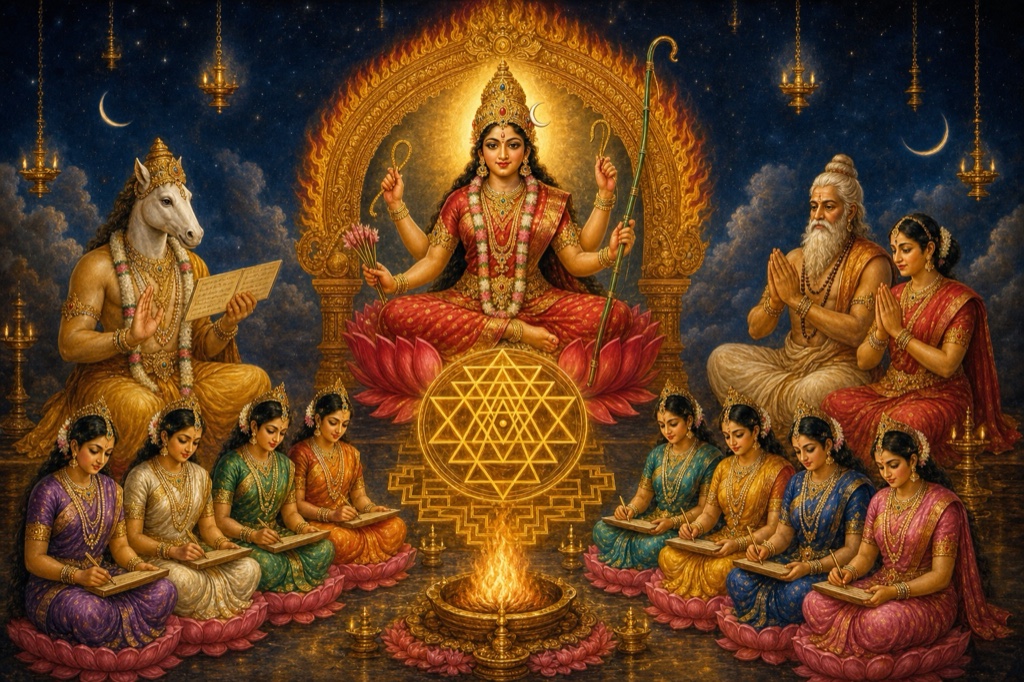
The structure of the thousand names
In the tradition of worshiping the Goddess, the sahasranama recitation is an ancient form, one that threads a deity’s thousand names through a tight weave of meter. The Lalita Sahasranama has its origin in the Lalitopakhyana, which appears in the Uttara Khanda of the Brahmanda Purana, where Vishnu in his Hayagriva form gives this text to his student, the sage Agastya. Dating it in the traditional way is hard, yet from the language and style of the text most scholars place it near the eighth or ninth century.
Here is the setting of the story. The sage Agastya and his wife Lopamudra were great devotees of the Goddess, and one question stood before them: what is the most complete form of Srividya worship? Agastya asked Hayagriva, and in answer Hayagriva gave this sahasranama. Tradition holds that these names were composed by eight speech-goddesses at Lalita’s own command. The style of the text is a namavali, which means each name is repeated as a meditation by placing “Om” before it and “namah” (salutation) after it. There is also the sahasranama-stotra style, in which these same thousand names are bound into anushtup verses.
The order of the names is no accident. The first eighty-four move through the Goddess’s purpose in taking form, her body from head to feet, her city of Shrinagara, and the war with Bhandasura. The names that follow pass through her mantra-body and the rising kundalini, her stainless majesty and the states of waking, dream, and sleep, and on into Srividya, the tattvas, and Vedanta. The last few hundred are the technical vocabulary of Vedic philosophy: Sacchidananda-rupini (whose form is being, consciousness, and bliss), Mithyajagadadhishthana (the ground of the unreal world), Sarvopanishadudghushta (whose praise all the Upanishads proclaim).
The Srividya tradition
To understand Lalita, a short introduction to the Srividya tradition is needed. It is a Dakshinachara, or right-hand, branch of Tantra, which means it keeps in step with Vedic rites and stands apart from the practices of the left-hand path. The Srichakra, an interlocking yantra built from nine triangles, is the central symbol of this tradition. The four triangles that point upward belong to Shiva, the principle of spirit; the five that point downward belong to Shakti, the principle of nature. The point at the center is Lalita’s place.
The hidden center of the tradition is the Panchadashakshari mantra, a small formula of fifteen syllables. The initiating guru gives this mantra to the student, and later it is completed with the sixteenth syllable, the Shodashi. Thousands of pages of commentary have been written on this small mantra, the most famous of them Bhaskararaya’s “Varivasya Rahasya,” from the middle of the eighteenth century.
The Bhandasura story at the center
According to the Lalitopakhyana of the Brahmanda Purana, Lalita took form for one specific purpose: to slay the demon named Bhandasura. Here is the story of how Bhanda came to be. When Shiva burned Kamadeva to ash with his third eye, a terrible demon rose from that ash, and he was given the name Bhanda because the creator, watching what he did, cried out “Bhanda, bhanda!” Shiva, pleased with him, granted him a boon: half the strength of any opponent would flow into his own, and his arrows would make the enemy’s weapons useless.
Bhandasura conquered all three worlds. The gods called on Lalita, and she appeared from the fire-pit of consciousness, carrying the radiance of a thousand suns, four-armed, arrayed with noose, goad, bow, and arrow. With her Mantrini, the power of mantra, and her Varahi, the power of the rod, she killed Bhandasura. Names 64 to 84 of the sahasranama tell this war story in compressed form.
The structure, in ten books
We have divided the thousand names into ten books, each book of about a hundred names. This thematic division follows the sense and coherence found in Bhaskararaya’s “Saubhagya Bhaskara” commentary.
The divine mission and the divine form
Begins with Shri-mata, the auspicious Mother, eighty-four names. These first names describe the Goddess’s purpose in taking form, her appearance from head to feet, her city, and the war with Bhandasura. The section runs from “Deva-karya-samudyata” (intent on the work of the gods) through the description of her features.
The mantra-body and the ascent of kundalini
The Goddess as mantra-body, laid out on the three clusters of the fifteen-syllable mantra, the current of kula, and the kundalini rising from muladhara to sahasrara. Then the first turn toward devotion, peace, and the formless.
Majesty and the three states
Begins with Nishpapa, the sinless. Pairs of negation and gift, the long garland of names that begin with maha, waking, dream, sleep, and turiya, and at the close the Goddess’s five acts.
Cosmic Form, Kamakala, and the Levels of Speech
Begins with Bhairavi, seated at the center of the solar orb. The Goddess’s cosmic form, the syllable hrim, kamakala, the field and its knower, the sense of tat tvam asi, the four levels of speech, the sixteen Nityas, and Ardhanarishvari.
Primal nature and the yoginis of the chakras
Begins with Mulaprakriti and Avyakta, primal nature and the unmanifest. Shivaduti, Gayatri, Kurukulla, and then the yoginis of the chakras: Dakini in the vishuddhi, Rakini in the anahata, Lakini in the manipura.
The form that pervades the cosmos
The rest of the chakra yoginis, from Kakini in the svadhishthana to Yakini in the sahasrara; Svaha, Svadha, Shruti, Smriti; the mother of the world from ether onward; and Shrividya, the Shodashakshari, Trikuta. At the close, Dakshayani, destroyer of Daksha’s sacrifice.
The bond with the seeker and the path of practice
The Goddess’s bond with the seeker. Eyes trembling with compassion, Gurumurti (the guru’s own form), Adishakti, the Yogini and the three powers of will, knowledge, and action, Rajarajeshvari, and at the close Sacchidananda-rupini (being, consciousness, and bliss).
The harmony with Vedanta and the great sayings
The Goddess’s Vedantic form: Deshakalaparicchinna (bounded by no place or time), Sarvaga (present everywhere), Maya, Mithyajagadadhishthana (the ground of the unreal world), Satyajnananandarupa (truth, knowledge, and bliss). This section shows the meeting point of Srividya and Advaita Vedanta.
Beyond the qualities, without attributes
Beyond the qualities, the form without attributes, past maya. The names of the form beyond all division.
The closing and the sealing names
The final hundred names, the names that seal the text. Shri-shiva (the auspicious one), Shiva-shakti-aikya-rupini (the oneness of Shiva and Shakti), Lalitambika (Lalita, the Mother), these last three names are the gist of the whole stotra.
The old method of recitation
By tradition this recitation is special on Fridays, because Friday is Lalita’s day. The method is simple. After the morning bath, sitting before a Sri Yantra or some image of Lalita, you make a simple resolve: “I am reciting this stotra for the love of the goddess Lalita Tripurasundari.” Then the thousand names, without a pause, without an error, with devotion. The whole thing in thirty-five to forty minutes.
New readers can finish it in ten days, at the pace of one book a day. In the traditional panchanga recitation, all five parts come together: the patala, the paddhati, the kavacha, the sahasranama, and the stava. Reciting the sahasranama alone is also considered complete.
Read alongside
- Saundarya Lahari by Shankaracharya, the poetic form of Srividya
- Devi Mahatmya from the Markandeya Purana, the form of Durga
- Lalita Trishati a stotra of three hundred names, sibling of the Sahasranama
- Khadgamala Stotram the ritual of worship for the Srichakra
- Mahavakya the meeting point of Srividya and Advaita Vedanta
The same story, elsewhere
- Devi
Character profile: the Goddess in her complete form - Devi Mahatmya
Devi Mahatmya (Markandeya Purana): Durga-Chandika’s slaying of the demons - Saundarya Lahari
Saundarya Lahari: Shankaracharya’s hymn to Tripurasundari