Textual context
Moksha, liberation, names the eighth chapter. Most schools treat it as a fruit, won at the end of a long practice. Ashtavakra treats it as a present fact that a veil hides, and these four verses describe the veil. Shankara’s Advaita holds the same position, that liberation is already the case and knowledge only removes what covered it; this chapter states it as plainly as any text does.
Martin Heidegger’s word for truth, Unverborgenheit, unconcealment, comes nearest in modern philosophy to what Ashtavakra describes. For both, truth is uncovered; it stood there the whole time, and the work lies in removing what hid it.
Moksha
Liberation · 4 shlokas
Janaka has just spoken for the whole of the seventh chapter, as a man who already sees: the ocean, the waves rising and falling in him while he stays still. Ashtavakra’s reply is four verses long and answers a question the king did not ask: how will he know, on any afternoon, whether he is bound or free?
The eighth chapter holds Ashtavakra’s own definition of moksha. Liberation is a condition of the mind; it has no place, no date and no price. The last part of Badarayana’s Brahma Sutras asks what the fruit of knowledge is and when it comes, and reaches by a long road the answer given here in four lines.
So far
After peace, moksha. Four verses, and in them the whole difference between a bound man and a free one, laid out as movements of the mind.
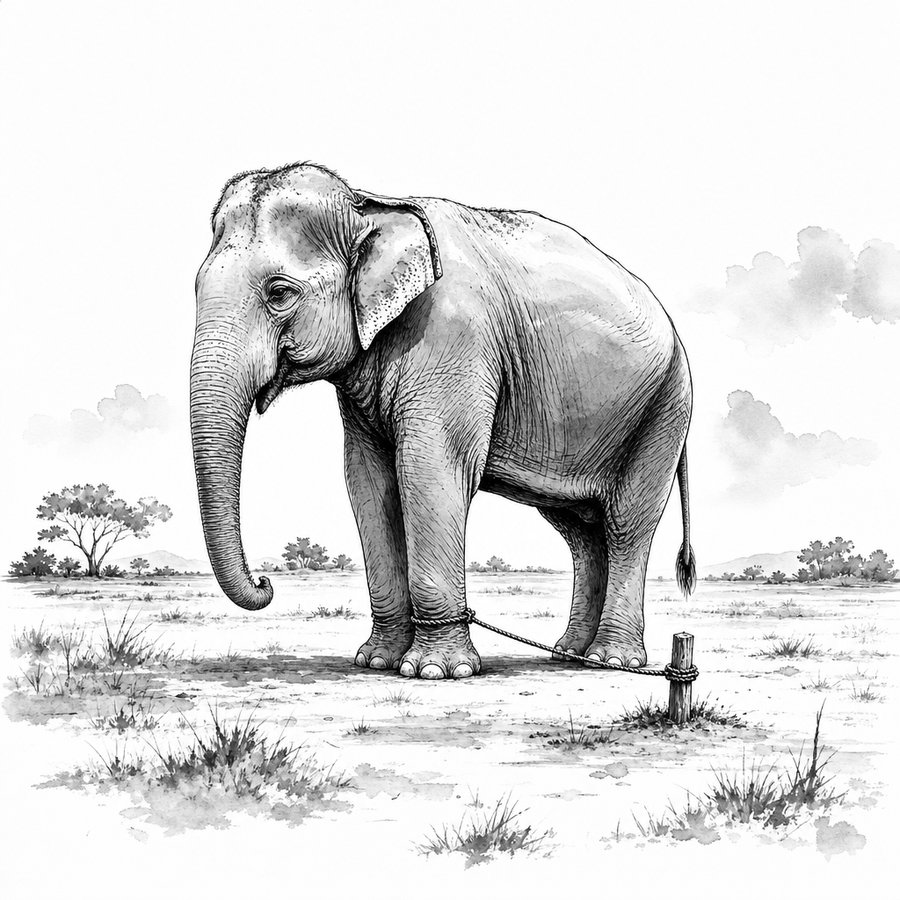
Ashtavakra speaks again, and this time there is no picture, only a plain test. There is bondage, he says, when the mind wants something or grieves over something, lets something go or takes something up, is delighted by something or angered by it. Six movements of the mind, in three pairs: wanting and grieving, letting go and taking up, delight and anger. Each is a leaning toward some object or a pushing of it away. The list is ordinary on purpose. A king wants a province and grieves for a lost one, lets a minister go and takes a general up, is delighted by a victory and angered by an insult, and every one of these is a movement the verse has named. The king who has just said that nothing touches him is handed a way to check, on any afternoon of his reign: whenever the mind leans toward a thing or away from it, that lean is bondage. The second verse is the first turned over, with na set before every verb. The mind that neither wants nor grieves, neither lets go nor takes up, is neither delighted nor angered: that, he says, is liberation. It is the portrait of a mind that has come to rest, drawn with the same six words. Janaka spoke of the still ocean; here is that stillness brought down into an ordinary day.
Shlokas 1 · 2
There is bondage when the mind wants something or grieves over something, lets something go or takes something up, is delighted by something or angered by it.
There is liberation when the mind does not want and does not grieve, does not let go and does not take up, is not delighted and is not angered.
In the third verse Ashtavakra says the same thing through one more word, drishti. A drishti is anything that reaches the senses, a taste, a face, a sound. There is bondage when the mind is attached to any one of them, and liberation when the mind is unattached in all of them. The weight of the verse sits on two words: kasu api, in any, even a single one, and sarva, all. A mind caught in one experience is bound, however free it may be of all the rest, and a mind unattached in all of them is free. A day is a long row of experiences, and in each one a brief grip forms: this tea is good, this room is cold, this man is tiresome. None of these is large, and none of them lasts, and the mind has moved on to the next before the grip has been noticed at all. Ashtavakra points at the grip, small and quick and almost invisible. The tea may stay. The grip is what he calls bondage.
Shloka 3
There is bondage when the mind is attached to any one experience; there is liberation when the mind is unattached to every experience.
At the end Ashtavakra brings the whole matter down to one word, “I”. When there is no “I”, there is liberation; when there is “I”, there is bondage. The verse speaks of presence and absence, and says nothing about degrees, nothing about a smaller “I” or a larger one. Then comes the word that marks the verse as his, helaya, lightly, with ease. Knowing this, he says, lightly, take up nothing and let go of nothing. No strain is asked for, because taking up and letting go are both acts of the very “I” the verse has just named as bondage. A man who grips the “I” to keep it and a man who grips it to throw it away are doing the same thing with the same hand. The whole chapter fits on one line: where the “I” is, bondage; where it is absent, freedom. In the ninth chapter Ashtavakra moves on from here, toward detachment. On that the eighth chapter closes.
Shloka 4
When there is no “I,” there is liberation; when there is “I,” there is bondage. Knowing this, lightly, take up nothing and let go of nothing.