Textual context
Advaya, the word in this chapter’s title, means without a second. It refuses even the number one, since one can only be counted against two, and it is the word Gaudapada leans on in the Mandukya Karika, where he argues that nothing was ever born at all. Ashtavakra does not argue the point here. He takes it as settled and asks what a man who has settled it still reaches for.
In the last century Ramana Maharshi spoke of the Ashtavakra Gita with respect, and its habit of asking a question and leaving it with the listener is the habit of his own teaching.
The Non-dual Self
The Self is non-dual · 14 shlokas
Janaka has barely finished when Ashtavakra puts a sharp question to him. A man who has truly recognized the one imperishable Self, how does his mind still tangle itself in small things? The chapter belongs to that riddle: the old habits that go on living in a man after knowledge has arrived.
Advaya means that which has no second, and Advaita, the name Shankara’s school took for itself, grows from the same root. Ashtavakra uses it as the ground he and the king now stand on together, and from that ground he examines the king.
So far
Janaka has answered the teaching with wonder and said that nothing is his. Ashtavakra heard every word, and now he asks what the king’s habits make of it.
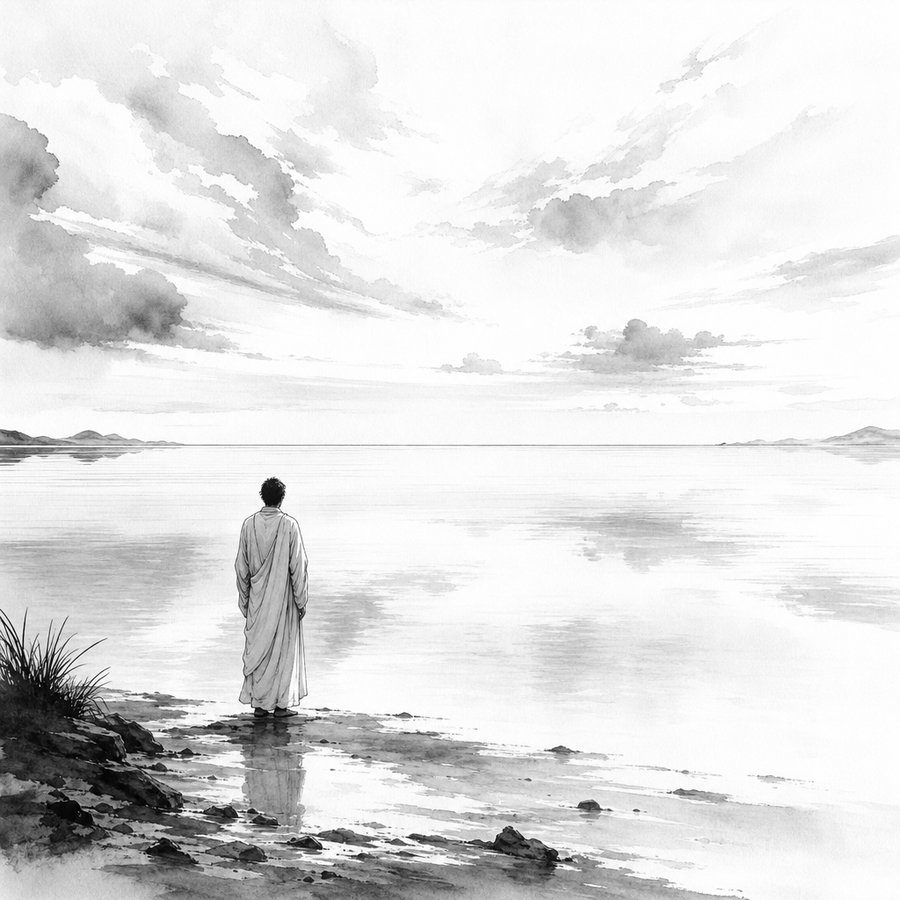
Ashtavakra looks at the king, and what he says has an edge on it. Janaka has just told his court, with his treasurers standing in it, that nothing at all is his. Very well: a man who has truly known the Self as imperishable and one, steady, a knower, how does such a man still take pleasure in gathering wealth? The boy does not wait for an answer. He gives it himself. The pull comes from ignorance of the Self and nowhere else. Out of that unknowing the mind grows fond of the illusory world of the senses, exactly as a man who fails to recognize mother-of-pearl sees silver in it and feels greed. The silver was never there; the greed is real. Ashtavakra is testing whether the recognition that filled the hall a moment ago has reached as far as the king’s hands.
Shlokas 1 · 2
Having truly known the Self as imperishable and one, how can you, steady and a knower of the Self, still take pleasure in gathering wealth?
Oh, it is from ignorance of the Self that fondness arises for the illusory world of the senses, as greed arises for illusory silver when mother-of-pearl goes unrecognized.
Then Ashtavakra gives the king back his own ocean. This whole universe rises in you like waves on the sea, and you have known it; why, then, do you still run about like a poor wretch? A king’s day is running about, petitions, campaigns, the price of grain, and the question lands on all of it. A man who is the ocean has no wave to chase and nothing to lose. Then a warning, and it is a blunt one. A man may hear that the Self is pure consciousness and more beautiful than anything, and if he stays deeply attached to sexual pleasure he turns impure all the same. Hearing is where the knowledge begins; the clinging is where it leaks away.
Shlokas 3 · 4
Having known yourself as that in which this universe rises like waves in the ocean, why do you run about like a poor wretch?
Even after hearing that the Self is pure consciousness and supremely beautiful, a man deeply attached to sexual pleasure falls into impurity.
Now Ashtavakra takes Janaka’s own word and turns it over. The king said Aho, wonder, at what he had found; the boy says ascharyam, a wonder, at what a man who has found it still keeps. A sage who knows the Self in all beings and all beings in the Self, and in whom the feeling of mine runs on: a wonder. A man established in the supreme non-duality, set on moksha, who falls under the sway of lust and comes apart over the lessons of love-play: a wonder. A man who has understood that desire, the moment it rises, is the enemy of knowledge, and who still craves it when he is feeble and his last hour has come: a wonder beyond the others. He says none of this to the king’s face. He says it to the hall, and everyone in the hall knows where it points.
Shlokas 5 · 6 · 7
It is a wonder that a sage who knows the Self in all beings and all beings in the Self should still keep the feeling that things are his.
It is a wonder that a man established in the supreme non-duality and set on liberation should fall under the sway of lust and be unnerved by the practice of love-play.
It is a wonder that a man who has understood desire, once it rises, to be the enemy of knowledge should still crave it when he is very feeble and has come to his final hour.
Ashtavakra names one more wonder, the finest of them. A man detached from this world and the next, who can tell the eternal from the passing and who longs for moksha, and who is afraid of moksha itself. The fear has a shape: whoever lets everything go suspects that he will be let go of too. Then the boy stops counting faults and begins a portrait. The steady one, the dhira, whether he is feasted or tormented, sees the Self alone in either, and is neither pleased by the one nor angered by the other. The king is being handed a likeness and left to hold it up beside himself.
Shlokas 8 · 9
It is a wonder that a man detached from this world and the next, who tells the eternal from the passing and longs for liberation, should be afraid of liberation itself.
But the steady one, whether feasted or tormented, always sees the Self alone, and is neither pleased nor angered.
Such a man watches his own body move and act as if it belonged to someone else. A court runs on praise in the morning and blame behind the pillars, and he is shaken by neither, because the thing being praised or blamed is a body he looks at from outside. And seeing this whole universe as maya, an appearance with no more weight than the silver in the shell, he has stopped being curious about it, so even with death standing near he does not tremble. Death comes to the body he watches, and he has already stepped back from it.
Shlokas 10 · 11
He sees his own body, as it moves and acts, as if it were someone else’s. How could such a great soul be shaken by praise or by blame?
Seeing this universe as mere illusion, his curiosity gone, how could the steady-minded one be afraid even with death at hand?
Then Ashtavakra climbs to where comparison gives out. The great soul whose mind is free of longing even when every hope has failed, who is content in the knowledge of the Self, with whom could he be compared? Disappointment grows out of wanting, and a man who wanted nothing has nothing to be disappointed in. And the steady-minded one who knows by his very nature that this whole visible world is nothing: where would he see one thing to be taken and another to be left? The line between taking and leaving has gone, and with it the daily labor of a king, who does little else all day than take and leave.
Shlokas 12 · 13
With whom can one compare the great soul whose mind is free of longing even in disappointment, and who is content in the knowledge of the Self?
Knowing that this visible world is by its very nature nothing, how would the steady-minded one see that this is to be taken and that to be left?
At the end Ashtavakra sets down one quiet verse. For the man who has dropped every passion from the inside, who stands beyond the pairs of opposites and has no desire left, an enjoyment that arrives unsought brings neither pain nor gratification. He turns nothing away and runs after nothing; what comes of itself he takes, and nothing in him says “I am the one enjoying this.” Ashtavakra has not told the king whether he passes. He has drawn the steady one and left the drawing in the king’s hands, and in the fourth chapter Janaka answers him.
Shloka 14
For one who has inwardly dropped every passion, who is beyond the pairs and free of desire, an enjoyment that comes unsought brings neither pain nor gratification.