The Shiva Mahimna Stotra
A hymn to Shiva composed by the gandharva Pushpadanta · 43 shlokas
One thing first
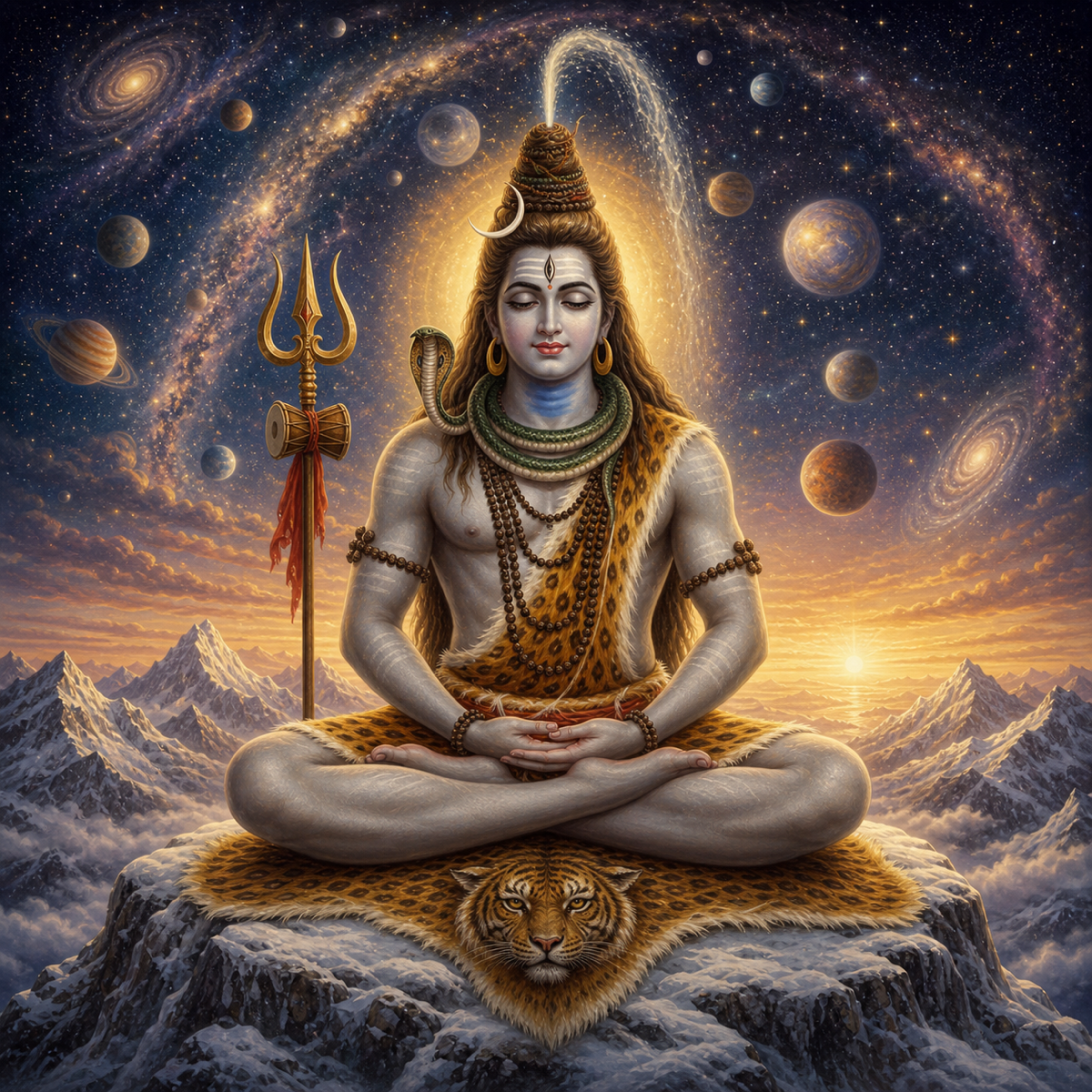
There was a gandharva named Pushpadanta, king of the gandharvas, those celestial singers whose entire occupation is music made in the hearing of the gods. He had one power, the power to vanish at will. And he had one habit: every day, turning invisible, he stole flowers from a certain king’s garden, and every day he carried them to Shiva. The theft was for the worship.
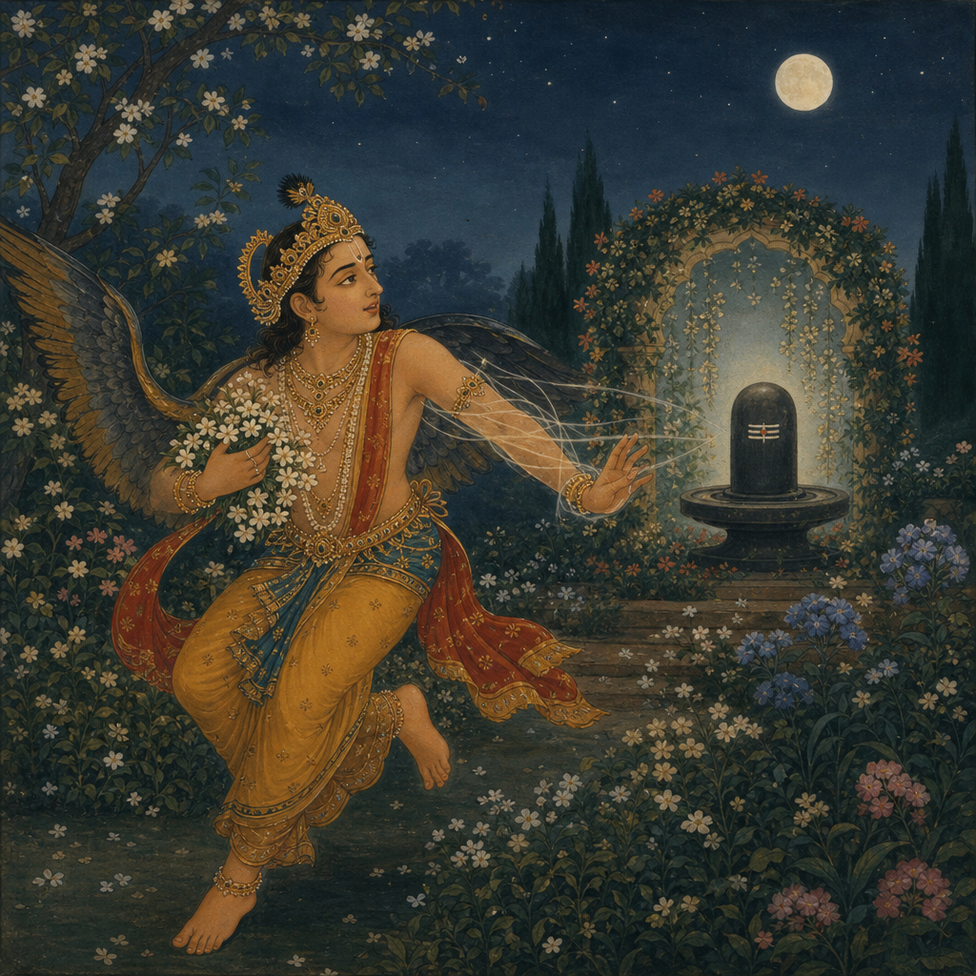
One day the gardener had scattered across the garden the leaves already offered to Shiva. Pushpadanta stepped over them without knowing, and that disrespect stripped him of his power. It happened in the middle of a stride: one moment he was air, and the next he was a man standing in a garden he had no business standing in. He became visible. He was caught. When he understood his lapse, in remorse he composed this stotra. Shiva’s most beloved hymn rose out of a mistake, out of a fall.
The most famous lines of this stotra say this very helplessness in the most beautiful way:
This is shloka 32. On the surface it looks like the defeat of speech, every resource in creation spent down to the last drop and the sentence still nowhere near its end. Underneath it is joy. Pushpadanta delights that some glories never run out. Anything whose end you can reach turns out to be small.
How to read this
One way: the whole thing in a single sitting, pausing as you go, an experience of about 50 minutes. The first 9 shlokas run a little dense; they speak philosophy, and they are doing the work of clearing the ground before any story is allowed to stand on it. Take them slowly.
A second way: a few shlokas each day. Shlokas 10 through 24 hold the Puranic stories (Tripura, Nilakantha, the burning of Kama), and the pace picks up here. Shloka 32 is the heart. From 33 to 43 the stotra speaks about itself, about its own birth and its own fruit.
A third way: recite it aloud from a chanting text, again and again, without looking at the meaning, to catch its mantra quality, letting the meter do its work before the sense arrives. Then one day come back with the meaning.
Pushpadanta opens with an admission, which is a strange way to open a hymn. He says that the praise of even the greatest sage cannot touch the far edge of your glory, that the speech of the likes of Brahma tires and halts before you, so what standing could a caught thief possibly have. And at once he raises a gentle argument, and it is the argument that lets him keep going: everyone sings to the limit of their own understanding, and to sing that much is no fault. Then he goes deeper. Your glory lies past the road of both speech and mind; even the Veda can only say “not this, not this” and point in astonishment. The greatest text in the world stands there and makes do with a hint. Here is the amusing turn: on small subjects everyone’s tongue and mind race ahead in an instant, and nobody stammers. Our understanding is built for small things, not for the boundless. The third shloka turns the matter around. You fashioned the Veda yourself, speech swelling with honey, the highest nectar there is, so what words could astonish you, even the eloquence of Brihaspati, guru of the gods? Pushpadanta has nothing to dazzle Shiva with, and he knows it. So he makes his aim clear: he sings so that the singing will purify his own speech. A prayer works more on the one who prays than on the one who is prayed to.
Shlokas 1 to 3 · the defeat of speech, and a gentle argument
Now the stotra descends into philosophy. One single power does three works: it makes the world, guards it, and gathers it back in, and the Veda shows this same power split into three forms across three qualities. Behind them the reality stays one. Some dull-minded people slander this beautiful truth, but Pushpadanta does not curse them; he only calls them “unfortunate,” people who are missing this rasa, the flavor of it. Then he takes up a particular kind of question: by what desire, with what body, by what means, and on what foundation does the maker fashion the three worlds. These questions wear the look of wisdom. They are a colossal mistake. A potter needs clay, a wheel, and hands to shape a pot, and he needs them because he stands outside the pot, a man at a wheel with wet earth in front of him. The one who is all things has no outside to fetch anything from. Shiva’s sovereignty is “atarkya,” past the grip of reasoning. Seen from the other side the answer grows clearer: worlds whose parts are plainly visible cannot be beginningless, and without some capable power they cannot hold together on their own. Still, some slow minds keep on doubting.
Shlokas 4 to 6 · one power, three works, and the limit of reason
Now comes the most generous shloka of the stotra. Vedic Mimamsa, Samkhya, Yoga, Pashupata, Vaishnava, these are different roads, and each one holds itself to be correct. But people’s tastes differ; one likes the straight road, another the winding one. As the water of every river finally meets the sea, whatever country it crossed and however long it took getting there, so the one destination they all reach is you alone. A path being crooked does not make its water dirty. Then he comes to Shiva’s gear, and he inventories it the way you would count a beggar’s possessions: one old bull, a khatvanga (a skull-topped staff), an axe, a hide, ashes, snakes, and a skull, only this much. And the gods, who hold all the splendor of heaven, receive even their own riches from a single glance of Shiva’s grace. The one who is “svatmarama,” who delights within himself, is not driven here and there by the mirage of sense-objects. And at the end Pushpadanta lives an honest moment. The philosophers do not agree among themselves; one says everything is eternal, another says all of it is fleeting. Singing to you in the middle of all this, he feels shy. But he says it plainly: there is no insolence in this outspokenness. A plea of love does not answer to the rules of debate. A debate demands that you be correct; love asks only that you be sincere.
Shlokas 7 to 9 · all rivers, one sea, and singing while shy
From here the stotra descends into the Puranic stories, and the first katha (story) is the Lingodbhava. An argument broke out between Brahma and Vishnu over who was greater. Just then an endless pillar of fire appeared between them, and the two set out to find its ends, Brahma upward, Vishnu downward, the two greatest powers in existence turned into surveyors. Both wore themselves out; the end never came. Then they gave up measuring and praised him with devotion and faith, and Shiva appeared on his own. The end that measuring could not find, bowing found. The last line gives an assurance: when following the gods bore fruit, ours is certain to bear fruit too. Then Ravana enters, and an unexpected side opens up. Even after conquering all three worlds, an itch for battle still remained in his arms, with nothing left anywhere to fight, and he carried that intensity all the way to cutting off his own lotus-like heads and stacking them at Shiva’s feet, one after another. This was the power of his unshakable bhakti. But in the next story that same Ravana flips. With the very strength he had won by serving Shiva, when he tried to shake Kailasa, Shiva pressed down with one big toe, no more than that, an idle movement, and Ravana was pinned, and he found no resting place even in the netherworld. A power received from its source cannot stand against that same source.
Shlokas 10 to 12 · the end of the pillar, and Ravana’s two faces
The story of Banasura says this same lesson from the other side. He was a supreme devotee of Shiva, and before him even the sovereignty of Indra, the highest wealth the world of the gods has to offer, looked poor; all three worlds became his attendants. What is there to wonder at in this, says Pushpadanta, waving the whole marvel away; whose advancement does a head bowed before you fail to bring. The thing the world calls height grows through bowing. Then comes the most beloved shloka of the stotra, the story of Nilakantha. The churning of the ocean gave up nectar and also poison. The gods flew off with all the nectar, every one of them, and the poison sat there with no takers, while gods and asuras alike stood terrified that the universe would end before its time. Out of compassion for them, Shiva lifted it, drank it, held it in his throat, and that killing poison turned his throat blue and became an ornament. Even a blemish is worth praising in one whose whole passion is to break the fear of the worlds. If you must drink poison, do not let it go down inside you; hold it in your throat, and watch, that same poison becomes your mark of recognition. When the bitterness of life stops at the right place, it makes you deeper.
Shlokas 13 and 14 · rising by bowing, and the ornament of poison
Now it is Kama’s turn. His arrows never failed on anyone, god, asura, or human, and a record like that will convince a man of almost anything. Trusting in it, he drew on the meditating Shiva, as if Shiva too were some ordinary god sitting with his eyes closed. The third eye opened, and Kama was burned to ash and left as mere “smara,” remembrance alone, without a body. For one who is fully composed within himself, a desire moving toward him cannot shake him; it runs out on its own. This comes as the natural outcome of inner steadiness, with nothing forced down. Then the stotra turns toward Shiva’s dance, and catches a paradox. This dance is for the protection of the world, and that same dance of protection sets all three worlds trembling. When his foot comes down, the earth begins to doubt its own footing; when his arms wheel, Vishnu’s realm staggers along with the planets; when his matted locks swing, the edges of the sky start to collide. The ground you are standing on right now is inside that dance. What you take to be steady and solid is only one held pose of it.
Shlokas 15 and 16 · the burning of Kama, the dance of protection
Now the stotra opens the eye of proportion. The Milky Way, spread across the whole sky with its foam of stars, the largest thing a human being can see with the naked eye, looks like a tiny droplet caught on Shiva’s brow, and from that one vast stream the entire world of continents and oceans was made. From this alone, gauge how immense that divine body is. Here the glory reveals itself through proportion. Then comes the scene of the burning of Tripura, and it is magnificent. To burn the three flying cities to ash, the earth became Shiva’s chariot, Brahma the charioteer, Meru the bow, sun and moon the two wheels, and Vishnu who holds the discus became the arrow itself. The whole of creation was taken apart and rebuilt into a single weapon. But Pushpadanta asks with a smile: why so much pomp for a Tripura no sturdier than a straw, why would the one whose will moves everything need a chariot and bow. The answer hides in the last line: the mind of one who is truly capable makes playthings of its instruments. All this arrangement was lila, sheer play. The third story is the summit of bhakti. Vishnu offered a thousand lotuses every day; one day, by the count, a single lotus fell short, and, unwilling to leave the worship unfinished for want of one flower, he reached up and plucked out his own eye and laid it in the gap. That surging devotion became the Sudarshana discus, which guards the world to this day. What is offered with a true heart returns in a changed form, carrying even greater power.
Shlokas 17 to 19 · the Ganga as a droplet, the lila of Tripura, the offered eye
Now the stotra touches an old philosophical knot. A yajna (fire-rite) happens today, its fruit comes years later, and somewhere in between the act itself has vanished, the fire cold, the priests gone home. So where does that fruit come from, and what carried it across the gap. Pushpadanta answers directly: God is the one who grants the fruit, and God stays awake even when the karma itself has gone to sleep. On this conviction people bind their faith to the Veda and perform their fire-rites with easy minds. Between the act and its fruit there is an unseen link, and that link is the wakefulness of God. Then the next shloka shows the reverse side of this, through the story of Daksha’s yajna. Daksha was “kriya-daksha,” a master of ritual, an expert in its inner workings; every rule in his yajna was correct, every measure exact, rishis served as priests, gods sat as the assembly. Nothing on the checklist was missing. One name was: in his arrogance he gave Shiva neither invitation nor reverence, and the whole grand yajna was destroyed. However complete the procedure, once reverence for the root is gone, the affair falls apart and brings ruin in its place.
Shlokas 20 and 21 · the guarantor of the fruit, and a yajna without reverence
Two tender stories come together, one of anger, one of laughter. The first is the source of the deer-constellation in the sky. Prajapati, forgetting all propriety, advanced toward his own daughter who had taken the form of a doe, himself becoming a stag to follow after her. Then Shiva took the form of a hunter and raised his bow, and pierced by the arrow that deer fled trembling into the sky, where it runs to this night, the hunter still fixed at its back, the whole chase nailed up there in stars for anyone who looks. Shiva’s wrath is never arbitrary; it rises only when some boundary of order is broken. Compassion and anger both rise from the same protection of dharma. The second story carries a light laughter. Kama burned like a straw before Shiva, and she watched it happen, and yet if Parvati, on account of his Ardhanarishvara form (half woman, half man), takes Shiva to be under a woman’s control, that is only her innocent love. Whoever keeps count of wins and losses in love is still standing outside love. Where two truly become one, each the other’s half, the question of who controls whom simply falls away.
Shlokas 22 and 23 · the protection of order, and the innocence of love
Now the most startling shloka of the stotra. Everything about Shiva is held to be inauspicious: the cremation ground is his playground, ghosts and spirits his companions, funeral ash on his body, a garland of skulls at his throat. Every item on that list is something a household would perform a rite to keep off its doorstep. Shiva lives among the very things society shrinks away from. And then the shloka turns: this same Shiva is the highest blessing for those who remember him. Shiva is in the cremation ground because he has no fear of death, and only one who has no fear of death can grant true fearlessness. Our division of auspicious and inauspicious sits on the surface; whoever has crossed past it stays a blessing in every condition. And then the stotra steps away from the Puranic stories and descends into the experience of meditation. The yogi turns the mind inward, masters the breath, and takes something like a plunge into a pool full of nectar; then every pore blooms, the eyes fill with bliss, and the body reports what the words cannot. Whatever unspoken thing is found in that depth, Pushpadanta gives it no name. He only says “kimapi,” a certain something, and then he adds: that is you. Shiva is right here, the experience that meets you the moment you dive within.
Shlokas 24 and 25 · a look of ill omen, the highest blessing, and the plunge within
Now the stotra begins to call Shiva everything, but with a beautiful twist. You are the sun, you are the moon, you are the wind, fire, water, sky, earth, and the atman (self) within is also you. Yet listing you in this way is itself a kind of limiting, because a list can be finished, and counting has a boundary built into it. The real point is that there is nothing at all that you are not. You do not need to go searching for God anywhere, because there is no place at all where God is not. Then Om is laid out in the open. Om is the joining of three sounds, A-U-M, and each sound gathers up a triad: three Vedas, three states, three worlds, three gods. So Om is the summary of the entire created world. Yet beyond it there is a fourth, the turiya, which watches all three states and is bound to none of them, and that faint silent hum after Om points toward that very fourth. The next time you say Om, let the sound go all the way out and keep your attention on what is left after the final “m” has stopped; that is the true address.
Shlokas 26 and 27 · nothing that you are not, and the map of Om
Now come the shlokas of salutation, and the tone turns into something like a mantra. First, Shiva’s eight names: Bhava, Sharva, Rudra, Pashupati, Ugra, Mahadeva, Bhima, and Ishana. Tradition pairs them with the Ashtamurti, his eight forms, earth, water, fire, air, sky, sun, moon, and the conscious yajaman, the one who offers. The Veda moves through every one of these names, and to the dear abode they all name, Pushpadanta bows. Each name is the lord of one portion of creation, and each name is a door that opens onto the same room. The names differ, the destination is one. Then Pushpadanta, in a single breath, sets down opposing pairs: salutation to the nearest and also to the farthest, to the most subtle and to the most vast, to the most ancient and to the newest. Each salutation cancels the one before it, and both stand. Logic asks how one thing can be both, and Shiva is both ends of every pair, and everything strung between them as well. This works by holding the opposites together, carrying the mind to a place where the “either this or that” way of thinking loosens on its own. Then the same salutation settles into a clean structure: three works, three gunas, three names, for creation rajas and Bhava, for destruction tamas and Hara, for sustenance sattva and Mrida. But the real point is in the last line, “nistraigunya,” beyond all three gunas. Shiva works with the gunas the way a man works with tools he can set down, and is never bound within them. Somewhere in this, we too are that fourth who watches the three come and go.
Shlokas 28 to 30 · eight names, opposing pairs, beyond the gunas
Now Pushpadanta almost closes the full circle. The theme of the first shloka returns: here is his small mind, swaying under the control of sorrows, and there is your glory that overleaps every limit. Thirty shlokas of singing have not closed that distance by a finger. Seeing the gap, the mind would freeze in fear, and now a discovery has been added: who made him sing this in the first place. The answer, bhakti. Devotion made the mind “amanda,” pulled it out of its dullness and had it lay flowers of words at the feet. Singing comes from the love that lifts us above the very question of worthiness. And right after this comes the heart of the whole stotra, the very lines we heard at the start. Pushpadanta turns the cosmos itself into writing materials: the black mountain melted down for ink, the ocean for an inkpot, the wish-granting tree for a pen, the earth spread flat for paper, and the writer herself the goddess of learning, with no limit of time to hurry her. Even after such boundless means, the answer is the same, the end does not come. But this shloka belongs to joy. Anything whose end can be reached turns out to be small, and the endlessness of glory is its most beautiful quality. This is the answer to the first shloka: speech fell short for this reason, and falling short for this reason is nothing to be ashamed of.
Shlokas 31 and 32 · bhakti made him sing, and the endlessness of glory
From here the stotra begins to speak about itself. First the composer records his own name, but very lightly, and only after a long introduction of Shiva, so that by the time it arrives there is barely room for it, “a gana by the name of Pushpadanta.” The artist stays behind, the work in front. And one thing stands out: he calls Shiva “nirguna,” beyond all qualities, and yet the whole stotra sings those very qualities. On the surface this is a contradiction; in truth it is the nature of bhakti. We know that the one we are singing to is larger than words, and we sing anyway, in order to connect. Then the phalashruti begins, the first shloka that tells the fruit of the recitation, and it speaks of both worlds without embarrassment about either: hereafter a place like Rudra’s in Shiva’s realm, and here in this very life wealth, long years, children, fame. But there is one condition riding on all of it, “shuddha-chitta,” with a clean mind. The fruit comes from purity of mind. And then four short sentences, each one a “highest”: no god greater than Mahesha, no praise beyond the Mahimna, no mantra beyond the Aghora, and the highest principle, the guru. Without the guru a mantra is only sound, a stotra only words. Knowledge moves from one to another, hand to hand, warm, in living form, and that living transmission is the highest.
Shlokas 33 to 35 · the humble signature, the fruit of recitation, and the guru
Now the phalashruti says its most daring thing. Initiation, charity, tapas (austerity), pilgrimage, knowledge, yajna, all these great acts of merit together do not stand equal to even a sixteenth part of a true recitation of this stotra. Charity, pilgrimage, yajna, these are all acts of “doing”; in them a doer keeps standing there through the whole thing, quietly holding the receipt, “I did this.” In a true recitation, where the mind goes under, the doer himself melts, and where the doer has melted, that is where the real thing happened. Then the stotra records its own birth-story, and now the humility of shloka 31 makes sense. Pushpadanta was a king of gandharvas, holder of the power to turn invisible, who each day stole flowers for the worship of Shiva from a certain garden. One day he stepped, without knowing, over the leaves already offered to Shiva, and that disrespect carried off his power; he became visible, he was caught, and in remorse he composed this stotra. The most beloved Shiva-stotra rose out of a mistake, out of a fall. And the third shloka gives an assurance: whoever reads it with folded hands and a focused mind reaches near to Shiva, praised by the Kinnaras along the way. This stotra is “svarga-moksha-eka-hetu,” the single cause of both joy and liberation, and it is “amogha,” it never returns empty.
Shlokas 36 to 38 · greater than all acts, the birth of the stotra, and the unfailing fruit
Now the stotra slowly comes down to the ground, the way a deep conversation settles into quiet. First it announces its own completion with simplicity: this meritorious gandharva-speech is finished here, it is without parallel, it steals the mind, and from start to end it is only a description of God. One phrase draws attention, “sarvam ishvara-varnanam,” meaning Pushpadanta nowhere made his own story or his own sorrow the center, even though the stotra was born from his fall and he had every excuse to. To remove yourself from the work, so that only the subject shines. Then a beautiful thing becomes clear: this is a “vangmayi puja,” a worship made of words. He no longer had even the power to steal flowers, that one small gift was gone with everything else, so he offered flowers of words instead, and worship made of words is just as real. Whoever has no flowers, let him offer his own words; the spirit of offering is what is real, never the cost of what is offered.
Shlokas 39 and 40 · the completion of the stotra, and the worship of words
And at the end, after singing forty shlokas, Pushpadanta says something that gives the whole stotra a new depth: “I do not know your essence.” Even after composing a stotra this long and this beautiful, he does not claim that now he has understood. And right after that, the most beautiful turn: whatever you are, to that very form, salutation again and again. The head goes down anyway. Knowing has stopped being a condition for salutation. Love and respect do not wait for understanding; you come to understand someone slowly, in the very act of loving them. Then a lovely give in the final phalashruti: once, twice, or three times, as much as you can, no rigid rule and no one keeping score. And the last shloka counts three ways: kanthasthita, meaning to commit to memory; pathita, meaning daily practice; and samahita, meaning to sink in with full attention. The first two are means, the third is the destination. First you memorize, then you repeat, and one day, without your deciding it, the repeating stops and only the sinking-in remains. The stotra closes by calling Shiva “bhutapati,” lord of all beings, the master of every creature, one’s own lord seated within everyone. The journey Pushpadanta began by stealing flowers is completed here by offering flowers of words. Falling, recognizing, singing, and then dissolving into the singing.
Shlokas 41 to 43 · not knowing, and saluting still, and three steps
Read alongside
- Hanuman Chalisa · the same surrender of bhakti, in Awadhi
- Vishnu Sahasranama · the parallel tradition of praise through names
- Saundarya Lahari · this same praise-poetry, for the Devi
- Bhaja Govindam · the voice of that same age of Shankara
- Ganapati Atharvashirsha · the darshan of all Brahman in a single deity
- Mahavakya · the four great sayings of Vedanta, toward which the Om of shloka 27 points