Textual context
Nirveda names the ninth chapter: a turning away from the things of the senses that owes nothing to despair. The word is kin to the Buddhist nibbida, and the two feel different in the mouth. Nibbida is revulsion, the turning of a man who has seen too much; Ashtavakra’s nirveda is lighter, a loss of interest that leaves the man at ease.
In the modern era, Albert Camus wrote in The Myth of Sisyphus of an awareness of the absurd that sees through the world’s promises and goes on living anyway. His note is tragic. Ashtavakra’s is calm, and the distance between those two notes is what this chapter measures.
Nirveda
Detachment · 8 shlokas
Ashtavakra has told the king where bondage sits. Now he tells him how a man comes to lose interest in it, and the road he describes asks for no vow and no austerity; seeing is enough. Eight verses, and in them the plain look at the world from which dispassion follows on its own.
So far
After moksha, nirveda. Ashtavakra describes the watcher who has looked at the world long enough to stop wanting it.
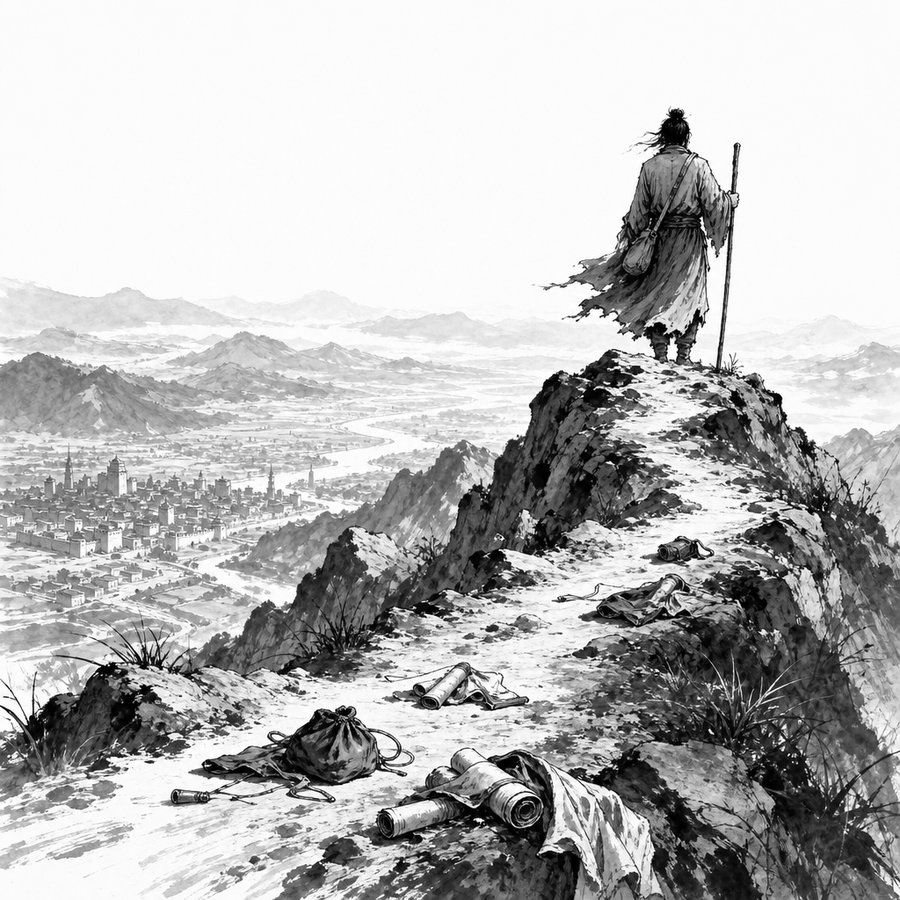
Janaka has heard, in four verses, where bondage sits. Ashtavakra now turns to what a man sees once he knows it, and he opens with a question the court’s scholars could have argued for a week. Done and not done, the pair that drives every day of a king’s life, the decree signed and the one still waiting, the pleasure taken and the one still owed: when has that pair ever come to rest, and for whom? No one in the hall can name the man. From that recognition, Ashtavakra says, a turning away comes on its own, nirveda, and it needs no vow to hold it in place. The ascetics Janaka feeds at his gate took vows and keep them with effort. The man the boy describes has none to keep.
Shloka 1
Things done and things left undone, and the pairs of opposites: when have they ever come to rest, and for whom? Knowing this, through disenchantment be intent on renunciation, and take no vows.
Then the boy’s voice softens, and he calls the king tata, dear one, the word a father uses. What he describes is rare, and he says so: some fortunate man, by nothing more than watching how the world goes about its business, finds three hungers quieted in him, the hunger to go on living, the hunger to enjoy, and the hunger to know. Janaka has watched the world from a throne for years, the petitioners, the merchants, the generals, every one of them running after something. Ashtavakra is telling him that the watching itself can be enough, and that for a few it has been.
Shloka 2
Dear one, for some rare and fortunate man, only watching the ways of the world has brought the wish to live, the wish to enjoy and the wish to know to rest.
The third verse is the inventory such a watcher makes. Everything he sees is impermanent, hollow at the core, and spoiled by the three sufferings the tradition counts: the suffering that rises in one’s own body and mind, adhyatmika, a fever or a grief; the suffering that comes from other beings, adhibhautika, an enemy or a snake; and the suffering sent by forces beyond anyone’s reach, adhidaivika, flood, drought, the turn of the stars. There is no pleasure in the kingdom that one of the three has not touched. A man who has become certain of this grows calm, and the calm is the verse’s last word.
Shloka 3
All this is impermanent, spoiled by the threefold suffering, without substance, condemned, and fit to be cast off. Certain of this, one grows calm.
A listener might hope that the opposites will wear themselves out with time, that old age at least will be quiet. Ashtavakra takes the hope away. What time, what age of life, has ever been free of the pairs? A child has his own, a toy given and a toy taken; a young man his own; an old man his own; and the king on his throne has a fresh set every morning. The verse asks for one thing: overlook them. Upeksha, the overlooking, carries no contempt. It is the act of leaving the pairs alone and living with whatever the day has brought, and the man who manages it, Ashtavakra says, reaches siddhi, fulfillment, with nothing added.
Shloka 4
What time is there, what age of life, in which people are free of the pairs of opposites? Overlooking them and living with whatever comes, one attains fulfillment.
The hall is full of learned men, and the fifth verse is aimed at them. The great seers disagree with one another; so do the saints, so do the yogis; Janaka has heard them argue in this very room for the honor of his patronage. Ashtavakra asks the king to see that disagreement whole, as a fact about every teaching that has ever been offered. A man who has seen it, and felt the disenchantment that follows, has no doctrine left to defend, and such a man grows calm. What person, the verse asks, would not? The question is a real one, and the boy lets it stand.
Shloka 5
Seeing that the views of great seers, saints and yogis all differ, what man, once disenchanted, would not grow calm?
The sixth verse answers a question the court has been asking since the boy walked in: who is this to teach a king? Ashtavakra gives the measure of a guru, and it has nothing to do with age or lineage or the mantras a brahmin can recite. A guru is one who has come to full knowledge of the true nature of consciousness and who carries others across the round of births by three means: nirveda, the disenchantment of the last five verses; samata, the evenness that treats gain and loss alike; and yukti, reasoning, the plain argument the king has been hearing all morning. The description fits the speaker, and everyone present knows it.
Shloka 6
Is he not a guru who, having fully known the true nature of consciousness, carries others across the round of births by disenchantment, equanimity and reasoning?
Now a way of seeing that works at once. Look at the changes the elements go through, the countless shapes that earth, water, fire, air and space take on, and see them as they really are, as elements only. The gold cup in the king’s hand is earth refined; the hall is stone and timber; the body on the throne is the same five elements settled for a while into a shape with a name. Ashtavakra promises that the moment this seeing is clear, the one who sees stands free of bondage and in his own nature. The promise has no stages in it. Tat-kshanat, in that very instant.
Shloka 7
See the changes of the elements as they really are, as nothing but elements, and in that very moment you will be free of bondage and settled in your own nature.
The last verse gives the chapter its axis. Vasanas, the latent desires that wait under the surface and shape what a man reaches for before he knows he is reaching: those, Ashtavakra says, are the world. Give them all up and the world is given up with them, since renouncing the world comes from renouncing desire and from nothing else. The verse ends with the plainest permission in the book. Live now, however things stand. Janaka keeps the throne and the granaries and the army. What he is asked to put down lies inside him, and in the tenth chapter Ashtavakra tells him its name.
Shloka 8
Latent desires alone are the world; so give them all up. Giving up the world comes from giving up desires. Then live now, however things may be.