On this page
A man walks up and stands directly in front of the eldest of all. His name is Ashvalayana, and the one he has come to is Parameshthin, the grandfather, seated at the beginning of the making of things. He asks for no boon, he carries in no calamity, he has lost no argument on the way. With his palms joined he says only this, teach me that knowledge of brahman which stands highest, which good men have always attended upon, which lies hidden, and by which the one who knows it clears away all wrongdoing quickly and reaches that purusha who is beyond the beyond. The Kaivalya Upanishad starts right here, with a request that carries no condition inside it.
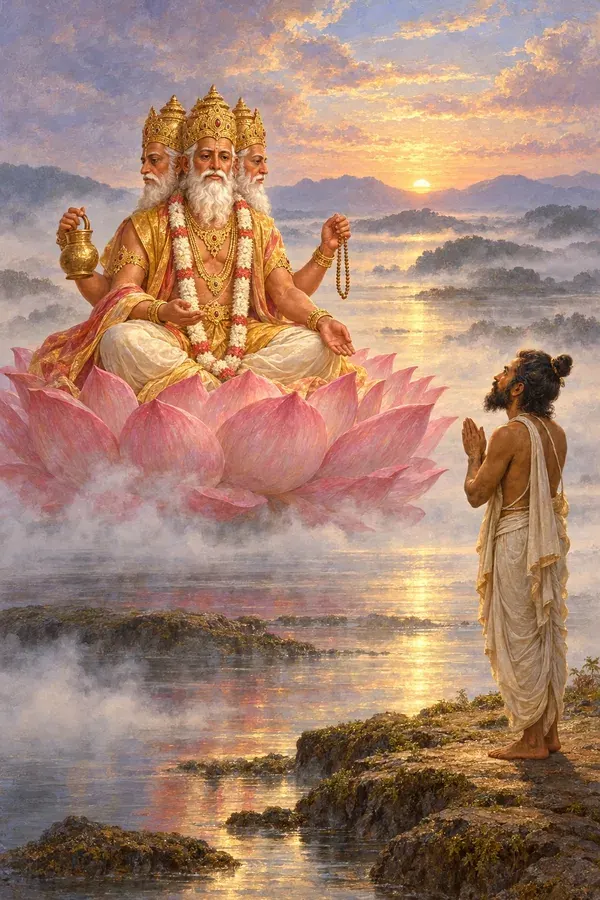
This Upanishad is short, twenty-six verses across two sections, and its frame is perfectly clear. One question, one answer, and the method for putting that answer to use. What makes it worth keeping in mind is that it talks about knowledge and leaves knowledge nowhere alone. The grandfather says shraddha first, then bhakti, and then dhyana. And when the method of dhyana opens out, it turns very concrete: where to sit, how to sit, what to do before doing anything else, and which form to settle the mind on inside. At the end that form and you turn out to be one.
Two things about this text are worth having in hand before the first verse. Shankara commented on the long Upanishads and on a number of short ones, and on this one he wrote nothing whatever, so no reading offered here can be settled by pointing to him. And the editions disagree about which Veda it belongs to. The Muktika list files it with the Krishna Yajur Veda, and the shanti patha this text carries with it, “saha navavatu” (may it protect us both), is the Krishna Yajur Veda one. Then the colophon of this very recension calls it “ity atharvavediya kaivalyopanishat” (thus ends the Kaivalya Upanishad of the Atharva Veda), which hands it to the Atharva Veda. Two pieces of evidence point in opposite directions, and neither one cancels the other.
The main figures of this Upanishad
Ashvalayana: the seeker who walks straight up to the grandfather and asks for the highest and the most hidden knowledge there is.
Parameshthin the grandfather: the one who ties no long preamble around his answer, who hands over three words and builds the whole method on those three.
Svaguru: one’s own teacher, without a bow made to him in devotion the seat itself stays incomplete in this Upanishad.
Hritpundarika: the lotus of the heart, into whose middle the meditation is carried and seated.
Parameshvara with Uma beside him: three-eyed, blue-throated, deeply at rest, the form on which this entire method is centered.
The jiva: that same one, who under the spell of maya takes hold of a body and goes about playing in three cities.
Ashvalayana’s request, and the grandfather’s three words
The first verse disposes of the entire preamble in one sentence. Ashvalayana came and presented himself before the lord Parameshthin and said, “adhihi bhagavan brahmavidyam varishtham sada sadbhih sevyamanam nigudham”, teach me that knowledge of brahman which is the highest, which the good have always attended upon, and which is hidden away. And then he gives the reason for his asking as well, that by it the man of knowledge quickly clears away every wrongdoing and goes to the purusha who is beyond the beyond.
Three things lie folded inside that one sentence. The first, that he is asking for vidya, knowledge, and for no power of any kind. The second, that he knows this knowledge to be old; he says the good have always attended upon it, which is to say he is asking to be let into a lineage. And the third, that he calls it nigudha, hidden, the sort of thing that declines to come to hand on first hearing. The humility is already sitting inside the request, and perhaps that is why the answer arrives so fast.
The second verse is the answer, and it is so small that a first reading slides over it. The grandfather said to him, “shraddha-bhakti-dhyana-yogad avaihi”, know it through the yoking of shraddha, bhakti and dhyana, of trust, of devotion and of steady attention. That is the whole of it. No list, no numbered sequence. Yet the order of those three words is a stairway in itself. Shraddha first, the confidence that the thing being looked for is there. Then bhakti, the leaning of the heart toward that thing. And then dhyana, the settling of the mind in that one place. Pull any one of the three out and the other two start to wobble.
One more thing lies hidden in that answer. In the Sanskrit the three are never counted off separately; they are bound inside a single compound, and one word stands after them, yoga. Which is to say they are three oxen yoked to one beam, walking together. Without shraddha, bhakti stays a mood. Without bhakti, dhyana becomes an exercise. Without dhyana, shraddha remains an opinion. The grandfather asks for the three of them to be driven together, and everything the text does afterward is an unfolding of that yoking.
The third verse sets the other pan on the scale, “na karmana na prajaya dhanena tyagenaike amritatvam anashuh”, by action, by offspring, by wealth, deathlessness has come to nobody; some have reached it by renunciation. And that which shines beyond heaven, placed in the cave, is what the ascetics enter. The line is plain and it is hard. Sacrifice, lineage and property were the three highest aims of that society. This Upanishad calls none of them bad. It declines to accept them as the key to this particular door.
The fourth verse gives a picture of the people who arrive there. Those whose sense of the matter has been settled well by the knowledge of vedanta, who are ascetics through the yoga of renunciation, whose sattva is pure, all of them at the final hour become the supreme deathless and are completely released. The word shuddhasattva draws the eye here. A clearing of the understanding and a clearing of the mind are one thing in this Upanishad.
In short: Ashvalayana asks for the highest and the most hidden knowledge, and the grandfather answers in three words, shraddha, bhakti, dhyana. And it is made clear in the same breath that this thing comes to nobody down the road of action, offspring or wealth.
How to sit: the place, the body, and the bow to the guru
The fifth verse is where this Upanishad puts doctrine down and takes hold of your hand. “Vivikta-deshe cha sukhasanasthah shuchih sama-griva-shirah sharirah”, in a solitary place, settled in a posture that can be held in comfort, clean, keeping neck, head and body even and in one line. Every word there is an instruction. Vivikta desha means a place with no traffic of people through it, where nobody knocks at the door every five minutes. Sukhasana means the seat that can be held for a long while without the legs going numb, which puts the difficulty of the posture outside the aim here.
Make that concrete for tonight. A room with a door that shuts. The hour counts as much as the room, so pick one when nobody is going to want anything from you, early before the house is awake or late after it has gone quiet. Put the phone in another room and face down, because a phone within reach is traffic even while it stays silent. Sit on the floor with a folded blanket under you so the hips ride a little higher than the knees, or sit on a hard chair with both feet flat on the ground. Either one obeys the verse. The test is plain: could you still be in this position twenty minutes from now without wanting to shift. If the answer is no, change it now, because a leg that falls asleep at minute twelve will take the whole sitting down with it.
Shuchi means bathed, in clean clothes, in the condition where the body draws no attention toward itself. And samagrivashirah sharirah means holding the neck and the head so that the line of the spine stays unbroken, the chin neither sunk into the chest nor lifted up. That small matter makes a large difference. With a bent neck the mind slides toward sleep, and with a stiffened neck it slides toward restlessness.
Find that line without forcing it. Sit up and let the crown of the head be the highest point of you, as though a thread ran from it straight upward. Let the shoulders fall away from the ears. Draw the chin back a quarter of an inch until the back of the neck lengthens and the throat is neither shut nor stretched. The spine wants to feel stacked, each part resting on the one below it, so that staying upright costs almost nothing and the body can be forgotten. Then take two or three slow breaths and let them go without managing them. What the verse calls shuchi gets settled in the same practical way, by washing beforehand and wearing something loose and clean, so that no itch, no waistband and no smell of the day still has a claim on your attention.
The second half of that same verse gives two more pieces of work, “sakalendriyani nirudhya bhaktya svagurum pranamya”, having held back all the senses, and having bowed in devotion to one’s own guru. The holding back of the senses is described here with no violence in it. Let the eyes close, let the ear allow whatever arrives to arrive and refrain from running after it, let the tongue go quiet, let hands and feet stop shifting. And immediately after that, the bow to the guru, and made in devotion. That bow before meditation is the moment where the stiffness comes off, and until the stiffness comes off nothing inside opens. There is one more word in the verse, atyashramastha, standing in that condition past the stages of life, which the tradition reads as ground lying above even renunciation.
Work through the senses one at a time, because they let go at different speeds. The eyes close, and behind the closed lids a kind of looking is often still going on, a scanning for shapes in the dark. Let that stop and let the eyeballs rest heavy in their sockets. The ears stay open, since ears have no lids, so the instruction concerns what you do with whatever arrives: a car goes by outside, a floorboard settles, and the hearing registers the sound and declines to follow it anywhere. The tongue comes to rest on the floor of the mouth and the jaw unclenches, which in most people is the last thing in the body to give way. The hands settle wherever they are and stop adjusting themselves. What is being asked for is a withdrawal of the reaching, the way a hand opens and lets go of a fistful of sand.
The order inside the verse deserves attention too. Place first, then the seat, then cleanliness, then the alignment of the body, then the gathering in of the senses, and last of all the bow to the guru. Which means the bow happens after the man has already sat down, already come to a stop, and already left the whole commotion of the outside behind him. A bow made in that condition is addressed to oneself as much as to anyone else, saying that whatever comes will be no earning of mine. The method of meditation in this Upanishad opens from this point, and before it not one word has been said about the inside.
In short: a solitary place, a seat that can be held in comfort, a clean body, and neck, head and body in one line. Then the senses gathered inward, and a bow in devotion to one’s own guru. The method begins here, and it begins by bending.
In the middle of the lotus of the heart, which form to contemplate
Now the sixth verse says what is to be done once you are seated. “Hrit-pundarikam virajam vishuddham vichintya madhye vishadam vishokam”, contemplate that lotus of the heart which is free of dust and altogether pure, and in its exact middle contemplate the one who is clear and past all grief. Notice that the space is made first and the form is placed into it afterward. The lotus of the heart first, free of dust, clean. And then, in the middle of that lotus, the one to be contemplated.
Take the making of that picture slowly, since this is the place where a first attempt usually grabs at too much. Bring attention to the middle of the chest, a hand below the collarbones, where the movement of the breath can be felt under the breastbone. Stay there a little while and do nothing else at all. Then let that place have a small opening in it, clean, with nothing floating in it, which is what viraja and vishuddha are asking for, the dust gone and the water clear. No botanical accuracy is wanted here and no counting of petals. What the word lotus carries is a thing that comes up out of muddy water unstained, and that is the quality the space in the chest is being asked to take on.
Then comes a string of descriptions, and each description lifts the mind from one place and carries it to another. He is achintya, past catching by thought. Avyakta, unmanifest to the senses. Anantarupa, of endless form, so that no single shape of his can be counted out. “Achintyam avyaktam ananta-rupam shivam prashantam amritam brahma-yonim”, past thought, unmanifest, of endless form, shiva, deeply at rest, deathless, the womb of brahman. In the seventh verse the string runs on: without beginning, middle or end, one, all-pervading, consciousness and bliss, formless, astonishing.
And then, at exactly this place, this Upanishad takes the turn that gives it its own face. “Uma-sahayam parameshvaram prabhum trilochanam nilakantham prashantam”, the one whose companion is Uma, Parameshvara, the master, the three-eyed one, the blue-throated one, deeply at rest. The descriptions that had been stripping every shape away suddenly come and settle on one shape. This Upanishad finds no conflict in that. Meditation on the one who has no form stays unsteady until the heart is given something to hold, and here the thing to hold is the peaceful form of Shiva.
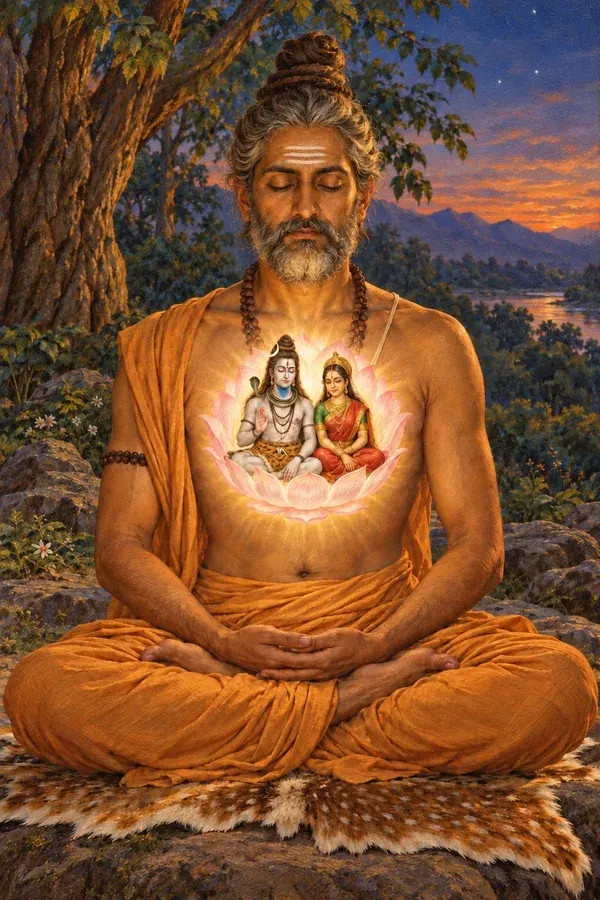
Then set the form in the middle of that opening and let it be small and steady. He is seated, and he is at rest in the way a person is at rest who has nothing further to settle. The throat is blue. There is a third eye in the forehead, closed. Uma is beside him. Hold the picture about as firmly as you would hold the memory of a face, which is to say let it be present without being stared at, since staring at an inner image makes it flicker and go out. When attention slips off toward the grocery list or toward a conversation from Tuesday, notice that it has gone, come back to the middle of the chest, and set the form there again. Coming back is the whole of the practice, and in one sitting it will be done many times over.
The end of that same verse says what this meditation does. “Dhyatva munir gachchhati bhuta-yonim samasta-sakshim tamasah parastat”, meditating so, the muni reaches the womb of all beings, the witness of everything, who stands out beyond the darkness. Which is to say a meditation settled on a form finishes somewhere past the form. It carries the meditator onward from there. This is worth a great deal to anyone who suspects that meditation with a shape in it is the lower article. Here that very shape opens as a door.
The eighth verse folds that one into every name, “sa brahma sa shivah sendrah so’ksharah paramah svarat”, he is Brahma, he is Shiva, he is Indra with the gods, he is the imperishable, supreme, self-luminous. And onward: he is Vishnu, he is prana, he is time and fire, he is the moon. In the ninth verse he is everything that has been and everything that will be, eternal, and knowing him a man crosses over death, since for release no other road exists at all.
The tenth verse gives the meditation one more movement. “Sarva-bhuta-stham atmanam sarva-bhutani chatmani”, the self standing in all beings, and all beings standing in the self. Seeing the two together, a man goes to the supreme brahman, and by no other means. That seeing runs in two directions, from inside outward and from outside inward, and both are practiced in one sitting. The eleventh verse sets down the same picture of the fire sticks that appears in the Shvetashvatara, “atmanam aranim kritva pranavam chottararanim”, make the self the lower fire stick and pranava the upper one. Then, by the practice of churning with knowledge, the learned man burns his wrongdoing away.
In short: the lotus of the heart is cleaned first, and then the form is seated in its middle, a form that is past thought and also the blue-throated one with Uma beside him. The meditation settles on the form and the form carries you past itself. And at the end the self is the lower fire stick, pranava the upper one, and practice is the friction that draws the fire out.
The same one at play in three cities
From the twelfth verse the pitch of the Upanishad changes. Now it goes after that one who lies hidden inside our own round-the-clock coming and going. He, under the spell of maya, takes the support of a body and does everything. Awake, he arrives at satisfaction through woman, food, drink and a hundred assorted enjoyments. Notice that this Upanishad calls the waking state one condition of that same one.
The thirteenth verse counts out two more conditions. In dream that same jiva consumes pleasure and pain, in a world of the living that his own maya has put together. And at the hour of deep sleep, when everything has dissolved, overcome by darkness he comes to rest in the shape of happiness. This is the same map of three states that other Upanishads draw, though its work here is different. Here it stands in order to show that whatever changes across the three is the scenery, and whatever stays unchanged is the thing worth looking for.
The fourteenth verse is the densest of them. Once again, through the yoking of deeds from other births, that same jiva sleeps and wakes. The jiva who plays in three cities is the one out of whom all this variegated spreading was born. And he is the support, he is bliss, he is unbroken awareness, and into him those three cities dissolve. The three cities are the three states, waking, dream and deep sleep, and the word play belongs to this Upanishad’s own hand. The player goes into all three and is caught in none.
The fifteenth verse brings the whole making out of him. From this are born prana, mind, all the senses, space, air, fire, water, and the earth that carries everything. The sixteenth verse is this Upanishad’s hinge sentence. That which is the supreme brahman, the self of all, the great dwelling place of the world, finer than the finest, eternal, “tat tvam eva tvam eva tat”, that is you, and you are that. It is said from both directions, so no room to slip out has been left anywhere.
The order of the count in the fifteenth verse speaks too. Prana first, then mind, then all the senses, and only after that space, air, fire, water and earth. The inner first, the outer afterward, and the most solid thing of all at the very end. The earth we take to be real before anything else is the lowest rung on this ladder. That order overturns a reader’s habit, and it is on that overturning that the next verse lays down its largest statement.
In short: waking, dream and deep sleep, the same one plays in all three cities, and all three dissolve into him. Prana, mind, the senses and the five elements come out of him. And then arrives the sentence that ties the knot from both ends, that is you, and you are that.
I am Sadashiva: the declaration of identity
From the seventeenth verse the voice changes. Until now it was being said that he is like this and he is like that. Now the speaker begins to say it out of his own mouth. That which lights up this entire spectacle of waking, dream and deep sleep, “tad brahmaham iti jnatva sarva-bandhaih pramuchyate”, knowing I am that brahman, a man is loosed from every bond. The sentence is set down in the manner of a recognition, the way a person groping a long time in the dark finally recognizes his own hand.
The eighteenth verse sharpens that recognition. In the three abodes, whatever is the thing enjoyed, whoever is the enjoyer and whatever the enjoying may be, distinct from all of these, the witness, “chinmatro’ham sadashivah”, I am consciousness alone, I am Sadashiva. This is where the Upanishad earns its name. Kaivalya means becoming kevala, standing alone, in the sense that everything joined on has come away and what remains is complete in itself. And here that remainder is recognized by the name Shiva.
The nineteenth verse spreads the same thing wide. “Mayy eva sakalam jatam mayi sarvam pratishthitam”, in me alone everything was born, in me alone everything stands. Into me alone everything dissolves, and I am that brahman without a second. The twentieth verse plays with measurements. I am finer than the atom and in the same way I am the great, I am this world, I am this whole variegated spreading. I am ancient, I am purusha, I am the lord, I am made of gold, I am the form of shiva. The count keeps rising and at every step one more boundary goes down.
The twenty-first verse brings back a very old note. I am without hands and feet, my power is past thought, “pashyamy achakshuh sa shrinomy akarnah”, I see without an eye, I hear without an ear. I know, my form stands apart from all, and there is nobody who knows me, since I am consciousness always. The twenty-second verse says that whatever is worth knowing through the many Vedas, I am that; I am the maker of vedanta and I am the knower of the Veda.
The twenty-third verse clears everything away. “Na punya-pape mama nasti nasho na janma dehendriya-buddhir asti”, for me there is no merit and no wrongdoing, no destruction, no birth, no body, no sense, no intellect. I have no earth, no water, no fire, no air, no space. And the twenty-fourth verse closes the first section. Having known in this way that form of the supreme self, which lies asleep in the cave, which is without parts, without a second, witness to all, and past both being and non-being, a man goes to that pure form of the supreme self.
In short: here the Upanishad comes down from the third person into the first. Standing apart from enjoyer, enjoying and the thing enjoyed, that witness recognizes himself as consciousness alone and as Sadashiva. Merit, wrongdoing, birth, body and the five elements are cleared away one by one, and what remains is kaivalya.
Shatarudriya, avimukta, and the state of kaivalya
The second section holds two verses only and it speaks in a manner entirely unlike the first. There is no meter here, there is prose, and its subject is the recitation of the Shatarudriya. The one who recites the Shatarudriya becomes purified by fire, becomes purified by wind, becomes purified by the self. Then comes a listing of the things that society held heaviest of all, and it is said that he becomes clean of every one of them as well.
This passage reads hard and it wants reading properly. Nobody is being handed a license to commit anything here. It is spoken in that old Vedic manner in which the capacity of a recitation is conveyed by naming the heaviest load available, to show that even that load can be made light. And the Shatarudriya is that chapter of the Yajur Veda in which Rudra is called by hundreds of names, in every direction, in every trade, in every thing.
The end of that same verse says that he therefore comes to be one who has taken shelter in the avimukta, and that a man in an ashrama should recite it always, or at the least once. The word avimukta has been read in two ways. One line of tradition takes it as the name of Kashi, which Shiva never left. Another reads it as the spot within the body between the brows, which the practitioner never leaves. Both readings say one thing, that there is a place a person is to keep from moving away from.
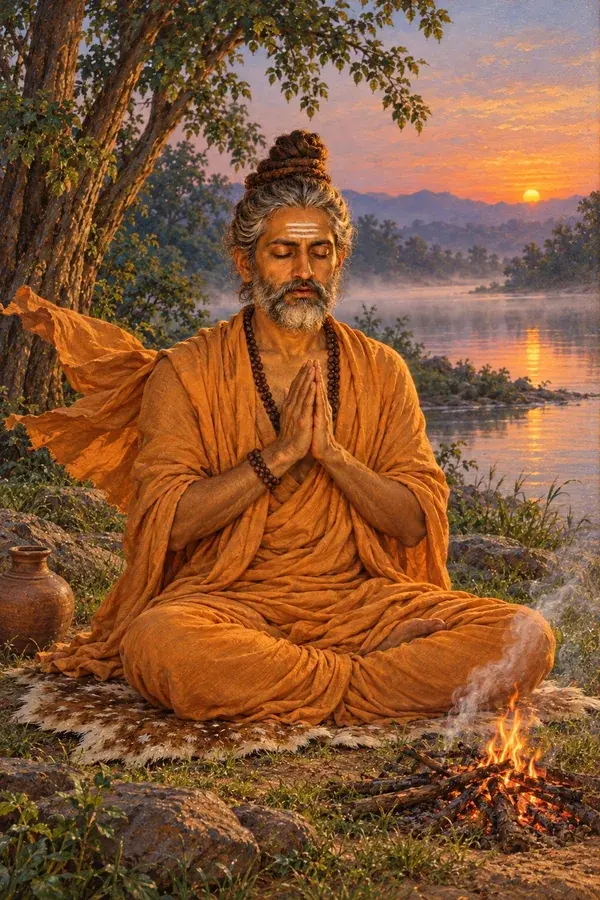
It is worth noticing as well that the whole first section speaks of meditation and recognition, and the second section starts talking about recitation all at once. There is no reversal in it. Sitting down to meditate is beyond reach at many hours, and this Upanishad sends away empty-handed nobody who lacks that hour. For such a person there is a recitation, which can be done always, and failing that, once. The large method and the small one have both been set down in one text.
The twenty-sixth verse gathers everything up. Through this comes the knowledge that dries up the very ocean of samsara. Therefore, knowing this in this way, a man attains the state of kaivalya. And the Upanishad closes by repeating its last words, “kaivalyam padam ashnute”, he attains the state of kaivalya. That repetition is no accident. A repeated ending in the Upanishads announces that the text is complete here and that nothing further is to be added.
In short: the second section states the capacity of the Shatarudriya recitation and describes the practitioner as one settled in the avimukta, whether you read that as Kashi or as the spot between the brows. At the end it repeats the very word on which the name of the whole text stands, the state of kaivalya.
And in the end, toward yourself
The best thing about this Upanishad is that it can be tried this evening. A room where nobody will come in for half an hour. A seat you can hold without your legs going numb. Bathed, in clean clothes. Neck, head and spine in one line, the chin neither sunk nor lifted. Eyes closed, hands still, the ears letting what they hear go by without running after it. And the moment you are seated, before starting anything at all, a bow in the mind to your own teacher. That order comes from this Upanishad, and not one step in it is there for decoration.
Then inward. Look at the lotus of the heart first, clean of dust, clear. No picture has to be constructed; simply seat the mind in that place in the middle of the chest where the movement of the breath is felt. And in the middle of that lotus place the one who is at rest, whose throat is blue, who has three eyes, who has Uma beside him. When the mind wanders, back to that middle again. This Upanishad makes no promise that something will flash on the first attempt. It says only that the muni who meditates in this way reaches the one who is witness to all.
Set a length before you begin and hold to it. Ten minutes on the first night, the same ten minutes tomorrow, and let a clock decide when to stop so the mind has nothing to negotiate about. When the time is up, sit a moment before standing, and let the eyes open onto the room slowly, because those last few seconds decide whether the sitting carries into the day or gets left behind at the door. Nothing in that whole sequence asks anybody to believe anything. The verse asks for a place, a seat, a straight line from the base of the spine to the crown, the senses let go of, a bow, and a form held in the middle of the chest. Every one of those is a thing a body can do this evening.
And the third thing belongs to the sentence that is the root of this whole text. Several times a day we fasten ourselves to some condition, this mood, this tiredness, this insult, this happiness. The Kaivalya Upanishad teaches one small habit, which is to stop in the middle of that condition and see that the one consuming and the thing being consumed are both changing, and that the one watching the two of them is exactly where he was. See that often enough and one day the sentence stops being a thing read and becomes a thing recognized, that this is you, and you are this.
Source: Kaivalya Upanishad, verses 1 to 26, sections 1 and 2; read against the Sanskrit. Shankara wrote no commentary on this Upanishad, so no commentarial reading is cited here. The editions do not agree about its Veda: the Muktika list places it with the Krishna Yajur Veda, and the shanti patha this text carries is the Krishna Yajur Veda one, “saha navavatu” (may it protect us both), while the colophon of this very recension calls it “ity atharvavediya kaivalyopanishat” (thus ends the Kaivalya Upanishad of the Atharva Veda) and so attaches it to the Atharva Veda.